
Before you can even think about filing for divorce in Texas, you have to answer two simple questions: How long have you lived in Texas, and how long have you lived in your current county? The state requires you or your spouse to have been a resident for at least six months, and you must have lived in the specific county where you plan to file—like Harris or Montgomery County—for the last 90 days.
Once you clear that hurdle, the process officially kicks off when one spouse files a document called an Original Petition for Divorce with the local district court. This is the first official step in a legal journey that can feel overwhelming, but we're here to guide you through it. At The Law Office of Bryan Fagan, we provide our Kingwood neighbors with practical, step-by-step support.
Your First Steps in the Texas Divorce Process
Thinking about divorce in the Kingwood area can be daunting. The maze of legal documents and court procedures feels overwhelming, but the first part of the process is actually pretty straightforward. It’s all about confirming you're eligible to file and then preparing one single, but very important, document.
Getting this foundation right from the start ensures your case begins on solid legal ground. For folks here in Kingwood, Humble, and the surrounding parts of Northeast Houston, it all boils down to meeting two non-negotiable requirements. These rules exist to make sure a Texas court has the proper authority, or what lawyers call "jurisdiction," to handle your case.
Meeting Texas Residency Requirements
First things first: you have to meet the state's residency rules. Texas law is black and white on this, and there’s no getting around it.
- State Residency: You or your spouse must have lived somewhere in Texas for at least the last six months.
- County Residency: On top of that, one of you needs to have been a resident of the specific county where you're filing for at least the last 90 days.
So, if you live in Kingwood, you’ll likely file in either Harris County or Montgomery County, depending on which side of the line your home is on. As long as you’ve been living in that county for the past three months and in Texas for six, you’re good to go.
This infographic breaks down that initial process into three basic actions you'll take.
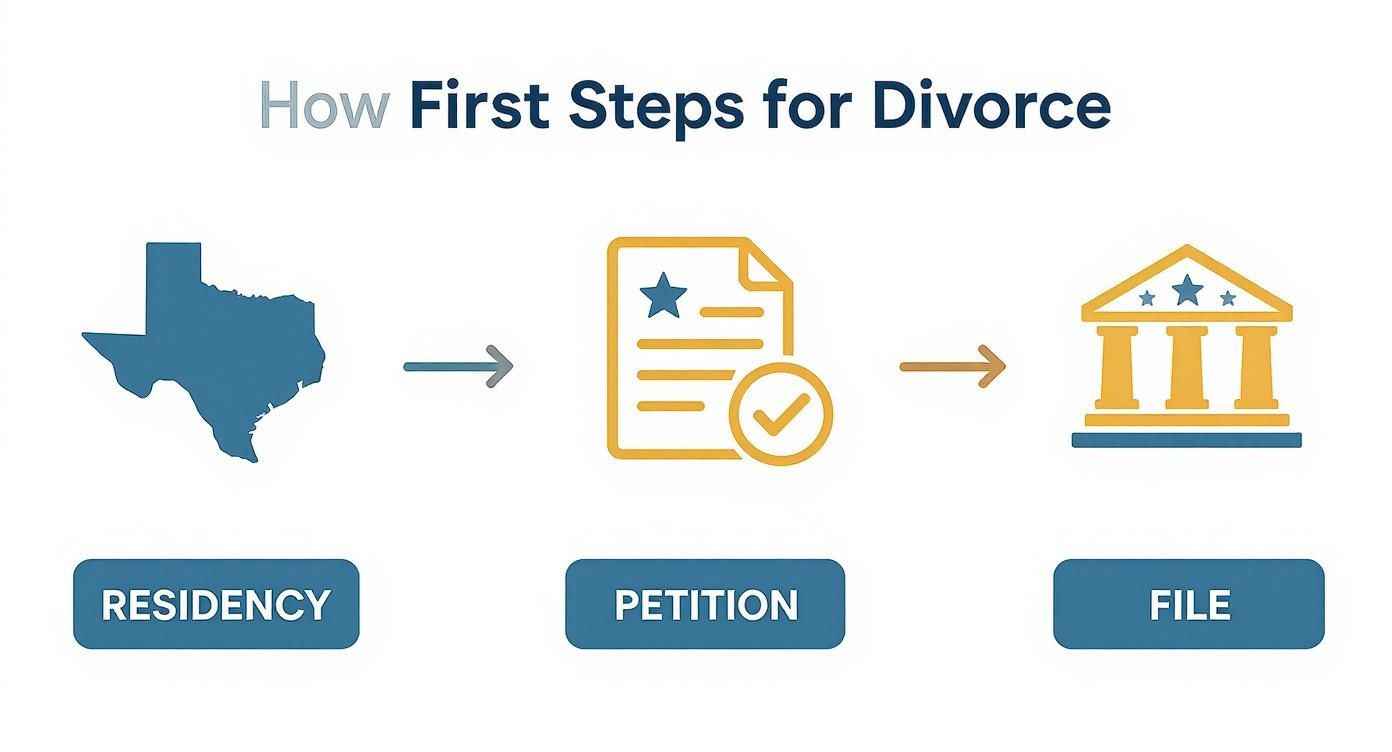
It’s a simple visual, but it really helps clarify the path forward: check residency, prepare the petition, and file it at the courthouse. It makes the whole thing feel a lot more manageable.
The Original Petition for Divorce
After confirming you meet the residency requirements, your next move is to prepare the Original Petition for Divorce. This is the formal document that officially opens your divorce case with the court. It’s not a place to list every grievance or tell your side of the story; instead, it’s a factual document that gives the court the basic, essential information it needs.
The petition will typically include:
- The names and addresses for you, your spouse, and any children.
- The date you were married and the date you separated.
- A statement confirming you meet the residency requirements.
- The legal grounds for the divorce. Most divorces in our Kingwood community are filed on "no-fault" grounds, simply stating the marriage is no longer supportable.
Filing this petition correctly is absolutely critical. Our Kingwood legal team has seen simple mistakes cause major delays, forcing people to amend their paperwork and essentially start over. This document sets the tone for the entire case.
Getting the details right is paramount. This is the document that tells the court and your spouse what you're asking for, whether it's about how to divide property or handle custody arrangements. While the fine details get hammered out later, the petition establishes the initial framework. Understanding the nuances of Texas divorce proceedings right from the beginning can save you from costly errors and a lot of unnecessary stress down the road.
Getting these first steps right is key. Below is a quick checklist to help you organize your thoughts and actions as you begin.
Texas Divorce Filing Checklist: Key First Steps
This table summarizes the essential first actions you need to take to get your Texas divorce case started on the right foot.
| Requirement | What It Means for You | Where to Start |
|---|---|---|
| State Residency | You or your spouse must have lived in Texas for the past 6 months continuously. | Gather documents like a driver's license, utility bills, or lease agreements to prove your Texas residency. |
| County Residency | You or your spouse must have lived in the county of filing (e.g., Harris, Montgomery) for the past 90 days. | Pinpoint the correct county based on where you or your spouse has lived for the last three months. |
| Grounds for Divorce | Decide on the legal reason for the divorce. Most cases use "insupportability" (no-fault). | Determine if you will file on no-fault grounds or if there are fault grounds like adultery or cruelty to consider. |
| Drafting the Petition | Prepare the Original Petition for Divorce, which formally starts the case and outlines what you are requesting from the court. | You can find state-approved forms online, but consulting with our Kingwood office ensures it's filled out correctly. |
Taking the time to verify these details before filing will make the entire process smoother and help avoid frustrating and costly delays.
Diving Into the Divorce Paperwork and Court Filing
Once you've confirmed you meet the Texas residency rules, it's time to tackle the paperwork. We know this part can feel technical and a bit overwhelming, but thinking of it as a series of manageable steps makes it far less intimidating. For our neighbors here in Kingwood, Humble, and Porter, just knowing which forms you need and how the filing process works is half the battle.

This is where precision really matters. The documents you're about to prepare will form the legal bedrock of your entire divorce case. Even a seemingly small mistake can lead to frustrating delays down the road. Our goal is to demystify this process so you can get it right the first time.
Pinpointing the Must-Have Divorce Forms
While the Original Petition for Divorce is what officially starts the clock, it's rarely the only form you'll need. The court requires a few other key documents to get a complete picture of your situation right from the beginning.
Here are the main forms you’ll need to get your case started:
- Original Petition for Divorce: As mentioned, this is the foundational document. It formally identifies you and your spouse, confirms you meet the residency requirements, states the grounds for the divorce, and lays out what you are initially asking the court for regarding property, debts, and children.
- Civil Case Information Sheet: Think of this as the cover sheet for your lawsuit. It’s a standard administrative form the court clerk uses to categorize your case. It provides a quick, high-level summary of who is involved and what kind of case it is.
- Information on Suit Affecting the Parent-Child Relationship: If you and your spouse share minor children, this form is absolutely mandatory. It provides the court with crucial details about each child, where they live, and whether any other custody or support orders are already in place.
For those of us in the Kingwood area, you can typically find these forms on the websites for the Harris County District Clerk or the Montgomery County District Clerk. The trick, however, isn't just finding them—it's ensuring you have the most current version and that every single line is filled out correctly.
How to File Your Documents at the Courthouse
With your paperwork prepared and triple-checked for accuracy, the next move is to file it with the district clerk's office in the correct county. For most people living in our Northeast Houston area, this means a trip down to the courthouse in Houston for Harris County or over to Conroe for Montgomery County.
When you file, you are officially opening a case with the court. The clerk will stamp your documents, assign a unique case number, and your divorce is legally underway. You'll also need to pay a filing fee, which usually falls somewhere between $250 and $350, depending on the county and whether your case involves children.
We often see clients get stressed about the upfront cost of filing. If that fee is a genuine hardship, you can file a document called a "Statement of Inability to Afford Payment of Court Costs." If the judge signs off on it, your filing fees could be waived completely.
It’s a practical measure that ensures everyone has access to the legal system, no matter their financial circumstances.
Practical Tips for Avoiding Common Filing Mistakes
From our experience serving the Kingwood community, we can tell you that countless cases get delayed by simple, avoidable errors on the initial paperwork. A small mistake can cause the clerk to reject your filing, forcing you to go back, fix everything, and start the process all over again.
Here are a few tips to help our Porter and Humble neighbors sidestep these common pitfalls:
- Double-Check Every Name and Date: Make sure every name is spelled correctly and all dates (like your date of marriage and separation) are accurate. Consistency across all your forms is critical.
- Verify the County: Be absolutely certain you are filing in the correct county based on that 90-day residency rule. Filing in the wrong county is a surefire way to get your case dismissed.
- Include All Required Forms: Don't forget that Civil Case Information Sheet or the child-related form if it applies to you. A single missing document will bring the entire process to a halt.
- Make Copies, Then Make More: Always bring at least two copies of every document you plan to file. You'll need one for the court, one for your own records, and one to have formally served on your spouse.
Taking just a few extra minutes to review everything can save you weeks of headaches. At The Law Office of Bryan Fagan, we walk our Kingwood clients through every single form and filing requirement. If you're feeling the least bit unsure about this process, schedule a free consultation with us. We're right here in your community, ready to help you get started on the right foot.
Serving Papers and Getting a Response
Once you’ve filed your divorce petition with the court, you hit a step you absolutely cannot skip: officially notifying your spouse. In legal terms, this is called service of process. This isn't just about being polite; it's a constitutional right that guarantees your spouse a fair chance to respond to the lawsuit. For many folks here in Kingwood, this part can feel a little awkward or confrontational, but it's a formal, non-negotiable part of the Texas divorce process.
Proper service is what officially pulls your spouse into the case and starts the clock on their deadlines. If you get this wrong, your entire divorce can grind to a halt before it even begins. That’s why it’s so critical to understand your options and handle this step correctly.
How to Officially Serve Divorce Papers
Texas law is very specific when it comes to how service needs to happen. You can't just hand the papers to your spouse yourself or stick them in the mail. It has to be done by a neutral third party so there’s no question it was handled correctly.
Here are the standard methods used in our local Harris and Montgomery County courts:
- Personal Service by a Sheriff or Constable: This is a common approach. You can arrange for a local law enforcement officer to deliver the citation and petition directly to your spouse. It's official, reliable, and hard to dispute.
- Personal Service by a Private Process Server: These are certified professionals who serve legal documents for a living. In our experience, they can be more flexible and resourceful than law enforcement, especially if a spouse is difficult to locate in the Northeast Houston area.
- Substituted Service: What happens if your spouse is actively dodging the process server? If you can prove to the court that you've made several genuine but failed attempts, you can ask a judge for "substituted service." This might mean leaving the papers with anyone over 16 at their home or even posting them on the courthouse door—whatever the judge believes will reasonably notify them.
Whoever serves the papers must complete a Return of Service. This is a sworn document they file with the court confirming exactly when, where, and how your spouse received the paperwork. It’s the official proof the court needs to proceed.
The Amicable Alternative: A Waiver of Service
For many couples, especially in nearby communities like Humble and Porter, the idea of having a stranger show up with legal papers just adds unnecessary drama to an already stressful situation. If you and your spouse are on decent terms, there’s a much smoother way.
If your spouse agrees with the divorce and is willing to cooperate, they can simply sign a Waiver of Service. This is a straightforward legal document where your spouse confirms they've received a copy of the petition and agree to waive their right to be formally served.
By signing a waiver, your spouse isn't giving up their rights in the divorce. They are just agreeing that the formal song and dance of being served isn't necessary. It saves time, money, and a whole lot of potential awkwardness.
Once the waiver is signed in front of a notary and filed with the court, the service requirement is officially met. This is an incredibly common and effective tool in uncontested or collaborative divorces, which we handle frequently for Kingwood families.
What Happens After Your Spouse Is Served?
Once your spouse is officially served (or files that waiver), a legal clock starts ticking. They now have a specific deadline to file their own formal response with the court, which is usually a document called an Answer.
The deadline is a bit quirky, but it’s firm: by 10:00 a.m. on the first Monday after 20 days have passed from the date of service. Filing an Answer is a simple but crucial step for your spouse. It officially notifies the court that they plan on participating in the case and prevents you from obtaining a default judgment against them.
Understanding this sequence—from service to the formal response—is key to knowing what comes next. Whether your path involves a simple waiver or requires a more formal service process, The Law Office of Bryan Fagan is right here in Kingwood to help you navigate it. If you have questions about serving papers or what to expect next, schedule a free, no-obligation consultation with our local team.
Navigating the 60-Day Waiting Period in Your Texas Divorce
Once your divorce petition is filed and your spouse has been officially served, the clock starts on a legally mandated 60-day waiting period in Texas. It's a common misconception that this is just a time to sit and wait. In reality, life in Kingwood doesn't just stop, and this two-month window is one of the most critical phases of your entire case.

This period is not a pause button. Think of it as the time to build the foundation for your post-divorce life. Important decisions about finances, property, and parenting need to be made now, not later. How you use these 60 days can significantly impact the stability of your family and the final outcome of your divorce.
Bringing Order to Chaos with Temporary Orders
So, the petition has been filed. What happens next? Who's going to pay the mortgage this month? Where are the kids staying this weekend? These urgent, real-life questions can’t be left hanging for two months. This is exactly why we have Temporary Orders.
Temporary Orders are court-issued directives that act as the rulebook for you and your spouse while the divorce is ongoing. They are absolutely essential for creating stability when everything else feels chaotic. For a family in Humble or Northeast Houston, these orders can mean the difference between maintaining a household and facing total financial upheaval.
A judge can issue Temporary Orders to address nearly any immediate concern, including:
- Child Custody & Visitation: A clear schedule outlining where the children will live and when they will see each parent.
- Financial Support: This establishes temporary child support and, if applicable, spousal support to ensure financial needs are met.
- Property Use: The court can decide who stays in the family home and who has exclusive use of certain vehicles.
- Paying the Bills: Orders can specify who is responsible for paying the mortgage, car notes, credit cards, and other joint debts.
These orders aren't the final word, but they provide much-needed predictability. A judge will hold a hearing, listen to both sides, and create a fair, temporary arrangement to get everyone through the divorce process.
The Power of a Detailed Property Inventory
While Temporary Orders handle the day-to-day, the 60-day waiting period is the ideal time to tackle a crucial long-term task: your Inventory and Appraisement. This isn't just a simple list of your stuff; it's a sworn, detailed document outlining every single asset and debt you and your spouse have.
You'll be required to categorize everything, carefully distinguishing between community property (what you acquired during the marriage) and separate property (anything you owned before marriage or received as a gift or inheritance).
In our experience with local Kingwood clients, a meticulously prepared inventory is one of the most powerful tools in a divorce case. It ensures nothing gets hidden or forgotten and lays the groundwork for a fair and equitable division of property.
A complete inventory also has benefits beyond the divorce itself. Understanding your complete financial picture is a vital first step in updating your estate plan. It helps you prepare for things like creating a new will or understanding what is a power of attorney and how it can be used to protect your interests moving forward.
Make This Time Work for You
This waiting period can feel like you're stuck in limbo, but we encourage clients to see it as an opportunity. Use this time proactively. Gather all your financial documents—bank statements, tax returns, retirement account info. Start building a budget for your new, single-income life.
This is also a time to focus on your well-being and help your children adjust. Establishing a consistent routine based on the new temporary orders can provide a sense of normalcy for everyone. Here at The Law Office of Bryan Fagan, our Kingwood attorneys specialize in helping clients navigate this critical interim period. We'll work to secure strong Temporary Orders that protect you and your family from day one.
Finalizing Your Divorce: The Final Decree
Once you've filed the initial petition and cleared the 60-day waiting period, the finish line starts to come into view. The ultimate goal of this entire process is to obtain a Final Decree of Divorce. This isn't just a formality; it's the comprehensive, legally binding court order that officially dissolves your marriage. Think of it as the detailed blueprint for your new, separate life, dictating everything from who gets the family home in Kingwood to the exact terms of your parenting plan.

Essentially, you have two ways to get there: you and your spouse can work out an agreement, or you'll need to have a judge decide for you. For any family in Northeast Houston navigating this change, understanding the difference between these paths is absolutely critical.
Reaching a Settlement Through Agreement
The good news is that most divorces in Texas don't end in a dramatic courtroom battle. The vast majority are finalized through a settlement, where you and your spouse—usually with your lawyers' guidance—negotiate and agree on every single issue. For many couples we work with in Humble and Porter, this is by far the preferred outcome.
Why? An agreed-upon divorce is almost always:
- Faster: You sidestep the long and uncertain court calendar.
- Less Expensive: Trial preparation is a huge driver of legal fees. Settling saves a significant amount of money.
- More Private: Your family's financial and personal details stay out of the public record.
- Less Contentious: Working toward a common goal can significantly reduce conflict, which is invaluable if you have to co-parent moving forward.
From years of experience helping Kingwood families, we can tell you that mediation is one of the most powerful tools for reaching a fair settlement. A skilled, neutral mediator can cut through the emotion and guide productive conversations, helping couples craft a custom agreement that truly fits their family's needs.
When an Agreement Isn't Possible: The Path to Trial
But what happens when you and your spouse are at a complete impasse on major issues like who keeps the house or how you'll share time with the kids? If you truly can't find common ground, your case is considered "contested," and you're headed for a trial.
This is where each side will present their case, with evidence and testimony, to a judge. The judge then listens to both arguments and makes the final, binding decisions on all the unresolved matters. It's an adversarial process that can be incredibly stressful, but sometimes it's the only way to ensure your rights and interests are protected when a fair settlement just isn't on the table.
Deciding whether to settle or prepare for trial is a major strategic decision. To help clarify the differences, here’s a look at how the two paths compare for families in the Kingwood area.
Contested vs Uncontested Divorce Paths in Texas
| Feature | Uncontested Divorce | Contested Divorce |
|---|---|---|
| Decision-Making | You and your spouse decide the terms together. | A judge makes the final decisions for you. |
| Typical Timeline | Can be finalized shortly after the 60-day waiting period. | Can take many months, or even over a year, to resolve. |
| Overall Cost | Significantly lower due to fewer legal fees and court costs. | Substantially higher due to trial preparation, discovery, and litigation. |
| Privacy | Your personal and financial details remain largely private. | Your case becomes part of the public court record. |
| Emotional Impact | Generally less stressful and allows for a more amicable split. | Often highly adversarial, emotionally draining, and stressful. |
| Control Over Outcome | You have complete control over the final agreement. | The final outcome is entirely in the hands of the judge. |
Ultimately, while an uncontested divorce offers clear advantages in cost and control, it requires cooperation that isn't always possible. A contested divorce becomes necessary when protecting your fundamental rights is the top priority.
What Your Final Decree Must Contain
No matter which path you take, the Final Decree of Divorce is the crucial document that emerges. It has to be drafted with precision to be enforceable down the road.
A well-drafted decree will explicitly cover:
- The official date your marriage is legally dissolved.
- A detailed inventory and division of all community property, from the house and cars to bank accounts and retirement funds.
- Confirmation of what is considered each spouse's separate property.
- A clear assignment of who is responsible for paying which debts.
- If you have children, a comprehensive parenting plan is essential. This outlines conservatorship (legal custody), a possession schedule (visitation), and the specific child support obligations. You can find a deeper dive on how Texas handles these matters in our guide to child custody arrangements.
The Last Step: Proving Up Your Divorce
Once the Final Decree is written and signed by both parties and their attorneys (in a settlement), there's one last, quick court appearance called a "prove-up."
This is a brief, informal hearing where you go before the judge, state your name for the record, confirm you meet the residency requirements, and testify that you signed the agreement freely and believe it’s a fair resolution. The judge will ask a few simple questions, sign the decree, and just like that, it becomes an official order. Your divorce is final.
Whether you're working toward a collaborative settlement or bracing for a necessary fight in court, the team at The Law Office of Bryan Fagan is here to see you through to the end. As your local Kingwood attorneys, we have the experience to guide you across the finish line. Call us today to schedule your free consultation.
Common Questions About Filing for Divorce in Texas
Even with a detailed guide in hand, it's natural to have lingering questions. After all, every situation is different. Over the years, we've sat down with countless people from Kingwood, Humble, and Porter, and we’ve found that many of them share the same core concerns.
Let’s walk through some of the most common questions we hear every day in our Kingwood office, answered in plain English.
How Long Does a Texas Divorce Take?
This is almost always the first thing people want to know. The short answer is that Texas has a mandatory 60-day waiting period that starts the day after your divorce petition is filed. So, in a perfect world, the absolute fastest a divorce can be wrapped up is 61 days.
But let's be realistic. Most divorces take longer.
- For uncontested cases, where you and your spouse are on the same page about everything, you can often get it finalized shortly after that 60-day mark. Think somewhere in the 3 to 4-month range.
- For contested divorces, where you disagree on property, kids, or both, the timeline can really stretch out. These cases can take anywhere from 6 months to well over a year, depending on the level of conflict and whether you need to go to trial.
What's the Average Cost of a Divorce?
There’s no single price tag for a divorce, because the cost is almost entirely driven by one thing: conflict.
The more you and your spouse can work together and agree on, the less you'll spend. If you’ve ironed out all the details and just need an attorney to draft the Final Decree of Divorce correctly, you’ll be on the most affordable path. This is a common scenario for many of our Humble and Porter clients.
On the other hand, a case with major disagreements that requires formal discovery (exchanging financial documents), temporary orders hearings, and a potential trial will be significantly more expensive. Every contested issue adds hours of legal work. The surest way to keep costs down is to find common ground wherever you can.
What if My Spouse Lives in Another State?
This is a very common situation, and it usually isn't a major roadblock. As long as you meet the Texas residency requirements, you can file right here in your local county (Harris or Montgomery). You just need to have lived in Texas for the last six months and in your specific county for the past 90 days.
The main difference is how you'll serve your spouse with the divorce papers. The process for serving someone out-of-state is a bit more involved, but it's a routine procedure. Once they've been served, the Texas court has jurisdiction, and the case can move forward.
A big worry we hear in our Kingwood office is whether an out-of-state spouse can hijack the case and move it to their state. The general rule is no—whoever files first in the correct jurisdiction typically secures it. This is a perfect example of why moving promptly can be a real strategic advantage.
How Does Texas Handle Property Division?
Texas is a community property state. In simple terms, this means pretty much everything you and your spouse acquired during the marriage belongs to both of you. It doesn't matter whose paycheck bought it or whose name is on the title.
When you divorce, the court is tasked with dividing this "community estate" in a way that is "just and right." Notice the language there—it doesn't say "equal." While a 50/50 split is the starting point, a judge can award a larger share to one spouse based on certain factors. These can include fault in the breakup, a big difference in earning power, or who will have custody of the children.
Your separate property, however, is yours to keep. This includes anything you owned before the marriage, or assets you received during the marriage as a gift or inheritance.
Navigating Texas divorce law is about more than just knowing the rules; it’s about having a guide who understands the local courts and your community. At The Law Office of Bryan Fagan – Kingwood TX Lawyers, we're committed to giving our neighbors in Kingwood, Humble, and Porter the clear-headed, compassionate, and skilled legal support they need.
If you have more questions or you're ready to talk about your unique circumstances, please schedule a free, no-obligation consultation with us. Let us help you take the next step with confidence. You can find us at https://kingwoodattorneys.com.