
When you’ve made the difficult decision to end your marriage, the path forward can feel shrouded in fog. The first, most common question we hear from our neighbors in Kingwood is, "Where do I even begin?" The answer, thankfully, is a series of clear, manageable steps. At The Law Office of Bryan Fagan, we're right here in your community, ready to provide the support you need.
Let's walk through the foundational requirements for filing for divorce right here in Harris County. It all starts with making sure you're in the right place, legally speaking.
Your Starting Point for a Kingwood Divorce
Before a single form is filled out, you have to meet the state's residency rules. This isn't just a technicality; it's the key that unlocks the courthouse door. If you don't meet these criteria, a Harris County court simply won't hear your case.
The process officially kicks off when one spouse—the "petitioner"—files a document called an Original Petition for Divorce with the Harris County District Clerk. But getting to that point requires a bit of groundwork.

Are You Eligible to File in Harris County?
To file for divorce in Kingwood, your situation must align with the rules set out in Texas Family Code Section 6.301. It's a simple, two-part test, and you must meet both conditions at the time you file.
- First, the statewide rule: One of you must have been living in Texas for at least the last six months.
- Second, the county-specific rule: One of you must have been a resident of Harris County for at least the last 90 days.
Think of it this way: if you moved to your home in Kingwood from Louisiana two months ago, you’d have to wait another four months to satisfy the Texas residency requirement. But if you moved to Humble from another Texas county, like Montgomery or Fort Bend, four months ago, you've already met both the state and county requirements and are ready to file.
Here is a quick summary of what you'll need to confirm before you can get started.
Initial Divorce Filing Requirements for Kingwood Residents
| Requirement | Details for Kingwood Residents |
|---|---|
| State Residency | One spouse must have lived anywhere in Texas for at least the past six months. |
| County Residency | One spouse must have lived in Harris County for at least the past 90 days. |
| Initial Document | The Original Petition for Divorce is the first document filed to start the case. |
| Filing Location | All petitions are filed with the Harris County District Clerk's Office. |
Meeting these baseline requirements ensures your case starts on solid legal footing from day one.
Understanding the Local Court Landscape
Filing for divorce in Kingwood means your case will be handled by the Harris County Family Law Center. It’s crucial to understand that our local court system is one of the busiest in the entire country.
Harris County sees approximately 28,500 divorce cases filed every year, giving us a local divorce rate of 3.4 per 1,000 residents—noticeably higher than the Texas average of 2.6.
What does this high volume mean for you as a Kingwood resident? It means the courts are stretched thin. Judges, clerks, and court staff are managing an immense caseload, and there’s little room for error. A simple mistake on your initial paperwork can cause significant delays, getting your petition rejected or lost in the shuffle for weeks.
From our experience helping Kingwood families, the single best thing you can do for a smoother divorce process is to get the initial filing right. In a system as busy as Harris County's, precision and preparation aren't just helpful—they're essential.
This is where having a local guide who knows the terrain becomes so valuable. An experienced Kingwood divorce attorney understands the specific procedures and unwritten rules of the Harris County courts. We know what judges expect to see and how to prepare documents with the accuracy needed to move forward without a hitch. Making the right choices at the very beginning can set a positive tone for your entire case. If you're considering your options, our guide on how to choose a divorce attorney can provide some helpful insights.
Starting this journey with confidence comes from knowing you have a solid plan and a team that has your back. At The Law Office of Bryan Fagan, we're right here in Kingwood, ready to provide that support. Schedule a free consultation with us to talk about your specific situation and see how we can help you take that first, critical step.
Preparing and Filing Your Divorce Petition
Once you’ve confirmed you meet the residency rules, it’s time to officially get the ball rolling by preparing and filing your divorce paperwork. This is where the devil is truly in the details. In a court system as packed as Harris County's, even a small mistake on your Original Petition for Divorce can cause frustrating delays.
Think of the Petition as the document that introduces you and your situation to the court. It clearly states who you are, who your spouse is, and what you’re asking the judge to do. Getting this foundational document right from the very beginning is one of the smartest moves you can make for a smoother divorce process.

Choosing Your Grounds for Divorce
Your Petition has to state the legal reason—or "grounds"—for your divorce. While Texas law offers seven different grounds, one is used in the vast majority of cases for Kingwood and Humble families because it’s the simplest and least contentious option.
- Insupportability: This is what most people think of as a "no-fault" divorce. It simply means the marriage has broken down due to conflict or personality clashes, with no reasonable chance of getting back together.
- Cruelty: This applies when one spouse's behavior makes living together insufferable or unsafe.
- Adultery: When your spouse has been unfaithful during the marriage.
- Felony Conviction: If your spouse was convicted of a felony and has been in prison for at least one year.
- Abandonment: Your spouse left with the intent to abandon you and has been gone for at least one year.
- Living Apart: You and your spouse have lived in separate households without cohabitation for at least three years.
- Confinement in a Mental Hospital: Your spouse has been confined to a mental hospital for at least three years and a relapse is likely.
For most people in our community, choosing insupportability is the most practical path. It avoids the need to air private matters and prove fault in court, which saves an immense amount of time, conflict, and money. While fault-based grounds like adultery might feel emotionally necessary, you have to present evidence to the court, which often makes the divorce far more complicated and expensive.
Where to File Your Documents in Harris County
If you live in Kingwood, Porter, or anywhere else in Northeast Houston, there's only one place to file your divorce petition: the Harris County District Clerk's Office. The office is located downtown in the Harris County Family Law Center at 1115 Congress Street, Houston, TX 77002.
This is where you'll submit your Original Petition for Divorce and any other initial forms. The clerk will stamp everything, assign your case a unique "cause number," and randomly place it in one of the family law courts. That cause number becomes the official identifier for your case from that point forward.
Local Tip: The Harris County Family Law Center is a big, busy place. Our advice for our Kingwood clients? Arrive with every form already filled out and organized in a folder. You'll have to go through security and will likely face a line, so building some extra time into your trip can significantly lower your stress on filing day.
Understanding Filing Fees and Waivers
Filing a lawsuit always has a cost, and divorce is no different. In Harris County, the initial filing fee for a divorce petition typically runs between $300 and $350. This amount can fluctuate, so it’s always a good idea to check the District Clerk's current fee schedule online before you head downtown.
You'll have to pay this fee when you hand in your petition. But what if you can't afford it? Texas law is designed to ensure that money doesn't prevent someone from accessing the courts. If you can't afford the fees, you can file a document called a Statement of Inability to Afford Payment of Court Costs.
To qualify, you generally need to show that you receive government assistance based on your income (like SNAP or Medicaid) or that your household income falls below a certain poverty threshold. If the judge approves your Statement, all your court costs are waived. This is a critical option for many families in our Kingwood community, and it ensures justice is available to everyone.
Taking the time to get your divorce petition right is an investment in a less stressful, more efficient outcome. If you have questions about which grounds to choose or how to navigate the filing process at the Harris County courthouse, our Kingwood office is here to guide you. Contact The Law Office of Bryan Fagan for a free, no-obligation consultation to talk about your specific situation.
Serving Divorce Papers in the Kingwood Area
Once you’ve filed the Original Petition for Divorce, you can't just hand the papers to your spouse and call it a day. Texas law has a formal process for this called service of process, and it’s a crucial step. Essentially, it’s the court's way of ensuring your spouse is officially notified that a lawsuit has been filed and has a fair chance to respond.
For our clients here in Kingwood and the surrounding Humble area, getting this right is non-negotiable. A mistake in service can stall your entire divorce case in the Harris County court system, causing frustrating delays and unnecessary costs. Let's break down how it works.
The Formal Route: Constable vs. Private Process Server
The law requires an impartial third party to deliver the divorce papers. You can’t do it yourself, nor can a friend or family member. In Harris County, this leaves you with two primary options for formal service.
Harris County Constable or Sheriff: You can pay to have a uniformed officer from the local constable's office (Precinct 4 serves most of Kingwood) or the sheriff's department personally hand-deliver the documents. This is a very official method, and there's no mistaking the seriousness of the delivery. The downside? Officers have heavy caseloads, and it might not be their top priority, potentially leading to delays.
Private Process Server: These are state-certified individuals or companies whose entire job is to serve legal documents. We find they often have more flexibility, attempting service at night, on weekends, or at a workplace. They can be incredibly persistent, which is a huge advantage if you think your spouse might try to avoid being served.
The cost for either option in Northeast Houston usually runs between $75 and $150. A private server might charge more, especially for a difficult service, but their speed and tenacity often justify the extra expense.
From our experience, while a constable works just fine in straightforward situations, a private process server is often the better strategic choice. They are experts in finding and serving people who may not want to be found.
The Amicable Path: The Waiver of Service
Now, what if your divorce is starting on cooperative terms? If you and your spouse have already discussed the divorce and they aren't going to fight you on receiving the paperwork, there's a much smoother, less confrontational option: the Waiver of Service.
This is a simple legal form that your spouse signs in front of a notary. By signing it, they are officially telling the court, "I have received a copy of the divorce petition, and I agree to participate in the case without being formally served."
For our clients in the Kingwood area, choosing a Waiver of Service is almost always a win-win:
- It saves money. You avoid the $75 to $150 fee for a constable or process server.
- It avoids conflict. No one has to experience the awkwardness—or potential alarm—of a uniformed officer or stranger showing up at their door.
- It sets a positive tone. Starting the process cooperatively can make negotiating child custody and property division much easier down the road.
What if You Genuinely Can't Find Your Spouse?
Sometimes, a spouse is actively dodging service, or you may have simply lost all contact with them. If you’ve made a genuine, documented effort to find your spouse in the Porter or greater Houston area and have come up empty, you aren't stuck forever.
In these situations, your attorney can ask the judge for permission to use substituted service. This is a last-resort method where the court might allow you to serve them by:
- Leaving the papers with anyone over the age of 16 at their last known address.
- Serving them through social media (in very rare cases).
- Posting a notice on the courthouse door.
To get a judge to approve this, you have to provide proof of your "due diligence"—all the steps you took to try and locate them first.
Navigating the rules of service can be tricky, and the right choice depends entirely on your specific situation. If you're unsure which path to take, The Law Office of Bryan Fagan can help you make the right strategic decision. Contact our Kingwood office for a free consultation to ensure this critical step is handled correctly from the start.
Navigating Property Division and Child Custody
For most Kingwood families we work with, the toughest part of a divorce isn't the paperwork. It’s facing the big, emotional questions about your home, your finances, and most importantly, your children. These are the decisions that will truly shape your family’s future, long after the legal process is over.
It can feel overwhelming to think about splitting up a life you built together. How do you divide a household, bank accounts, and debts? What will life look like for your kids? Let's walk through how Harris County courts approach these critical issues, so you can move forward with a clear head.
How Texas Handles Your Marital Estate
Texas is a community property state. This is a core legal principle that dramatically affects the financial side of your divorce. Put simply, the law views almost everything you and your spouse earned or acquired while married as belonging equally to both of you.
This "community estate" isn't just the house in Kingwood or the family car. It's a much broader category that includes things like:
- Wages and salaries earned by either spouse during the marriage.
- Retirement accounts, 401(k)s, and pensions that grew while you were married.
- Real estate, investments, and businesses purchased or started during the marriage.
- Debts taken on while married, including mortgages, car loans, and credit card balances.
The court’s job is to divide this community estate in a way that is "just and right." While that often looks like a 50/50 split, it’s not a guarantee. A judge has the discretion to award a larger share to one spouse based on certain factors, such as fault in the breakup, a large difference in earning capacity, or the needs of the children.
Identifying Your Separate Property
Of course, not everything gets thrown into the community pot. Separate property is yours and yours alone. This includes anything you owned before you got married, as well as assets you received during the marriage as a direct gift or inheritance meant only for you.
For instance, if you inherited a family property in Porter before your wedding day, that home remains your separate property. If your parents gave you a large cash gift during the marriage with a note saying "this is for you," that money is also yours. The trick is proving it. You’ll need clear and convincing evidence, which is why keeping meticulous financial records is one of the smartest things you can do. You can get more specifics by reading our guide on how to protect assets in a divorce.
Navigating the division of shared assets can be complex, especially when you start making big decisions like selling your marital home during a divorce.
Putting Your Children First in a Kingwood Divorce
When kids are part of the equation, Texas law has one guiding principle that overrides everything else: the best interest of the child. Every court decision about your children will be viewed through this lens. In Texas, we don't really use the word "custody" like you see on TV. Instead, we break it down into three distinct parts.
1. Conservatorship (Decision-Making)
This is about who gets to make major decisions for your children regarding their schooling, medical care, and general upbringing. Most often, judges in Harris County name parents as Joint Managing Conservators. This means you'll share those rights and responsibilities. One parent is usually given the exclusive right to determine the child’s primary residence, often within a specific geographic area (like Harris County and its neighbors).
2. Possession and Access (Visitation)
This is simply the calendar that lays out when the children are with each parent. Texas has a default schedule called the Standard Possession Order (SPO), which is presumed to be in the child's best interest. It’s a detailed plan covering weekends, holidays, and summer vacation. While the SPO is a great starting point, you and your spouse are always free to negotiate a custom schedule that better fits your jobs and your family's unique needs.
3. Child Support
The state uses a specific formula to calculate child support. It’s primarily based on the net monthly income of the parent who doesn't have the primary residence and how many children are involved. The guideline amount for one child is 20% of that parent’s net resources. For two children, it's 25%, and so on.
At The Law Office of Bryan Fagan, we understand these aren’t just legal concepts—they are the building blocks of your family's new beginning. Our goal is to help our Kingwood neighbors find practical, humane solutions that protect your finances and, more importantly, your children’s stability and happiness.
The choices made today about property and children will echo for years. Having a seasoned Kingwood attorney who knows the local Harris County courts can make all the difference. If you’re worried about what divorce means for your assets and your kids, give us a call. We offer a free, confidential consultation to help you understand your rights and chart a path forward.
The Kingwood Divorce Timeline: From Filing to Final Decree
When you’re facing a divorce, one of the biggest sources of stress is the unknown. People in Kingwood and the surrounding areas often ask us, "How long is this really going to take?" Having a clear picture of the process, a roadmap of sorts, can make the entire journey feel much more manageable.
It's not an overnight process. The Texas legal system intentionally builds in time for couples to process the situation, negotiate, and handle all the necessary legal steps. From the moment you file the initial paperwork, you'll hit several key milestones on your way to a final resolution.
Here’s a simplified look at the fundamental stages of any divorce in Texas.
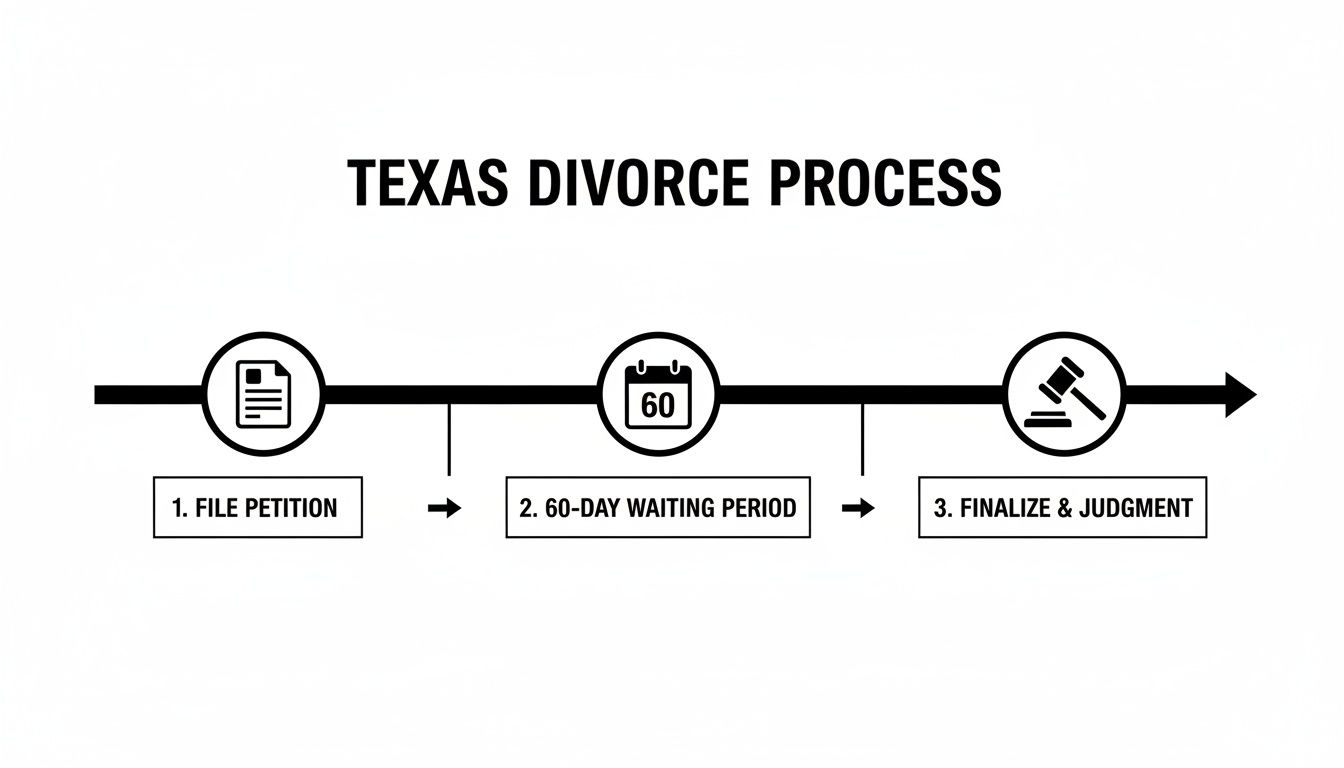
Whether your situation is straightforward or incredibly complex, your case will follow this basic path to become legally final.
The Mandatory 60-Day Waiting Period
Once your Original Petition for Divorce has been filed and your spouse has been officially notified (or has signed a Waiver of Service), a legal clock starts ticking. Texas law requires a mandatory 60-day "cooling-off" period. A judge simply cannot sign your final divorce decree until those 60 days have passed.
The idea behind this waiting period is to give both people a chance to breathe, think things through, and even potentially reconcile. In reality, most of our Kingwood clients use this time productively to start sorting out the important issues.
Keep in mind, this 60-day window is the absolute minimum time for a Texas divorce. It is not a deadline. Only the simplest, most amicable, fully agreed-upon divorces get finalized this quickly. The vast majority take longer.
For a more detailed look at what impacts the length of a case, you can read our guide on how long a divorce typically takes in Texas.
Key Milestones on the Path to Your Final Decree
While that 60-day clock is running, your case isn't just sitting in a file cabinet. This is often the busiest part of the process, especially if you and your spouse haven't agreed on everything.
Temporary Orders Hearing
This is often the first significant court event. A temporary orders hearing is essentially a mini-trial where a judge sets ground rules that will stay in place while the divorce is ongoing. These orders can cover things like:
- Who gets to live in the marital home.
- A temporary possession schedule for the children.
- Who pays child support and spousal support, and how much.
- Rules for managing joint bank accounts and preventing either party from selling off assets.
The Discovery Process
This is the formal legal process for gathering information and evidence from the other side. It’s how we ensure we have a complete and honest picture of all the assets, debts, and facts relevant to your case. Discovery typically includes:
- Interrogatories: Written questions that the other party must answer under oath.
- Requests for Production: Formal requests for documents like bank statements, tax returns, and property deeds.
- Depositions: Out-of-court testimony where we question your spouse or other witnesses under oath with a court reporter present.
This stage is absolutely crucial for achieving a "just and right" division of your community property. In the busy Harris County courts, an attorney who can manage discovery efficiently is a huge asset.
Mediation
Judges in Harris County will almost always order you to attend mediation before they will allow your case to go to a full-blown trial. Mediation is a confidential negotiation session guided by a neutral third-party professional, the mediator. The mediator doesn’t make any decisions for you; their job is to help you and your spouse (along with your lawyers) find common ground and forge a settlement.
It’s an incredibly effective process. In fact, well over 90% of divorce cases in Texas settle, with most of those agreements being reached in mediation. It allows you to maintain control over the outcome and avoid the expense and stress of a trial.
Finalizing Your Divorce
There are two ways a divorce concludes. If you’ve reached a complete agreement on all issues, you’ll finalize the case at a short, informal hearing called a "prove-up." Your attorney will present your signed Final Decree of Divorce, and after some brief testimony, the judge will sign it into law.
If no agreement can be reached, your case is set for a final trial. Both sides will present their evidence and arguments, and the judge will make the final decisions on property, custody, and all other contested matters.
Understanding this timeline can help you prepare for what lies ahead. If you have questions about how these steps might apply to your specific situation, the team at The Law Office of Bryan Fagan's Kingwood office is ready to help you find clarity.
Common Questions We Hear in Our Kingwood Office
Even with a roadmap for the divorce process, you’re bound to have questions. That’s completely normal. The legal world has its own language, and getting straight answers is the first step to feeling more in control. We've compiled a few of the most frequent questions we answer for our Kingwood clients, based on years of helping local families navigate these exact issues.
Think of this as a conversation we might have in our office. Our goal is to demystify the process of how to file for divorce in Kingwood, Texas, and give you the confidence to take the next step.
How Much Does a Divorce Cost in Kingwood?
This is almost always the first question, and the honest truth is that the cost is directly tied to one thing: conflict. How much you and your spouse can agree on will be the single biggest factor in your final bill.
Uncontested Divorce: If you're both on the same page about the big issues—like property, kids, and support—you're looking at a much more affordable path. The costs are generally limited to attorney's fees for preparing the Final Decree of Divorce and the Harris County filing fees, which typically run between $300 and $350.
Contested Divorce: When you can't agree, the costs naturally go up. This is when you start needing hearings, formal information gathering (discovery), and potentially a trial. Expenses for mediation, outside experts like home appraisers, and the extra legal work all add to the total.
Our job is to find the most direct and cost-effective path for you. Starting from a place of cooperation can literally save you thousands of dollars.
The most expensive divorces are driven by emotion, not logic. We always push our Kingwood clients to see it as a business transaction. Finding a practical, business-like solution is almost always the cheapest way to close this chapter.
Do I Actually Have to Go to Court?
Probably not in the dramatic way you see on television. Even if your case starts out as "contested," very few of our clients ever end up in a full-blown trial. Harris County judges push hard for couples to resolve things outside the courtroom, which is why they almost always require mediation.
Mediation is where a neutral professional helps you and your spouse hash out an agreement. It's an incredibly effective process—more than 90% of Texas divorces settle this way, completely avoiding a trial.
If you reach an agreement, your only "day in court" is usually a quick, informal hearing called a "prove-up." This is where you and your attorney present the agreed-upon Final Decree of Divorce to the judge for a signature. It’s usually over in a few minutes and is very low-stress.
Can I Stay in My House During the Divorce?
This is a huge point of stress for families in Kingwood and Humble. Who stays and who goes? The answer really depends on what you two can agree on or, if you can't, what a judge believes is fair for the time being.
If you can't decide together, either of you can request a Temporary Orders Hearing. This is an early, critical hearing where a judge makes temporary rules for the divorce, including who gets exclusive use of the family home until the case is finalized.
When making this call, a judge will look at a few key things:
- Which parent is the children's primary caregiver? Stability for the kids is a top priority.
- Is there any history of family violence?
- Can one spouse more easily afford to find another place to live?
The goal is to keep things as stable as possible, especially for children, while the divorce is underway. This is just a temporary fix until the final division of property is decided.
Having a trusted local attorney in your corner makes answering these questions much simpler. The Law Office of Bryan Fagan – Kingwood TX Lawyers is committed to giving our neighbors in Kingwood, Humble, and Porter the clear, compassionate guidance they need. If you're trying to figure out how to file for divorce in Kingwood, Texas, or just need to explore your options, we invite you to book a free, no-pressure consultation at our Kingwood office. Let us help you find the best path forward for you and your family. Contact us today at https://kingwoodattorneys.com.