Skip to content
When you're putting together a plan for your estate, you might get to the end and wonder, "Okay, so how do I actually make this legal?" For our friends and neighbors in Kingwood, that's where the "execution" of the will comes in. Simply put, executing a will is the formal process of signing it in a way that follows specific Texas laws. This one action is what breathes legal life into your written wishes, turning a stack of papers into a powerful tool that protects your legacy.
Your Guide to Properly Executing a Will in Kingwood
For families here in Kingwood and the surrounding communities like Humble and Porter, getting the will execution right is hands-down the most critical part of the entire process. If a will is signed or witnessed improperly, a court can throw it out entirely. That could leave your family's future up in the air and your final wishes ignored.
This guide will walk you through the process, breaking it down into clear, understandable steps to give you some peace of mind. Think of the signing not just as putting pen to paper, but as a formal ceremony. It’s a deliberate legal act that locks in your intentions and proves to everyone that you signed it freely and with a clear mind.
The Core Steps of Executing a Will
When we work with our clients in Northeast Houston, we boil the process down to three essential actions that make a will legally solid. While there are always nuances depending on the situation, the basic process is refreshingly straightforward.
- It Must Be in Writing: This is where you lay out your final wishes—how your property and assets should be distributed, who you want to be in charge of your estate, and any other specific instructions.
- You Must Sign It: As the creator of the will (legally called the testator), you have to sign the document. Texas law does allow for someone else to sign for you, but they must do it in your physical presence and under your explicit direction.
- It Must Be Witnessed:Two credible witnesses need to physically watch you sign the will (or watch you acknowledge that the signature on it is yours). Then, they have to sign it themselves, right there in your presence. This step is the official validation of the entire signing event.
This visual captures that simple, three-part flow—from drafting your wishes to creating a legally recognized document.
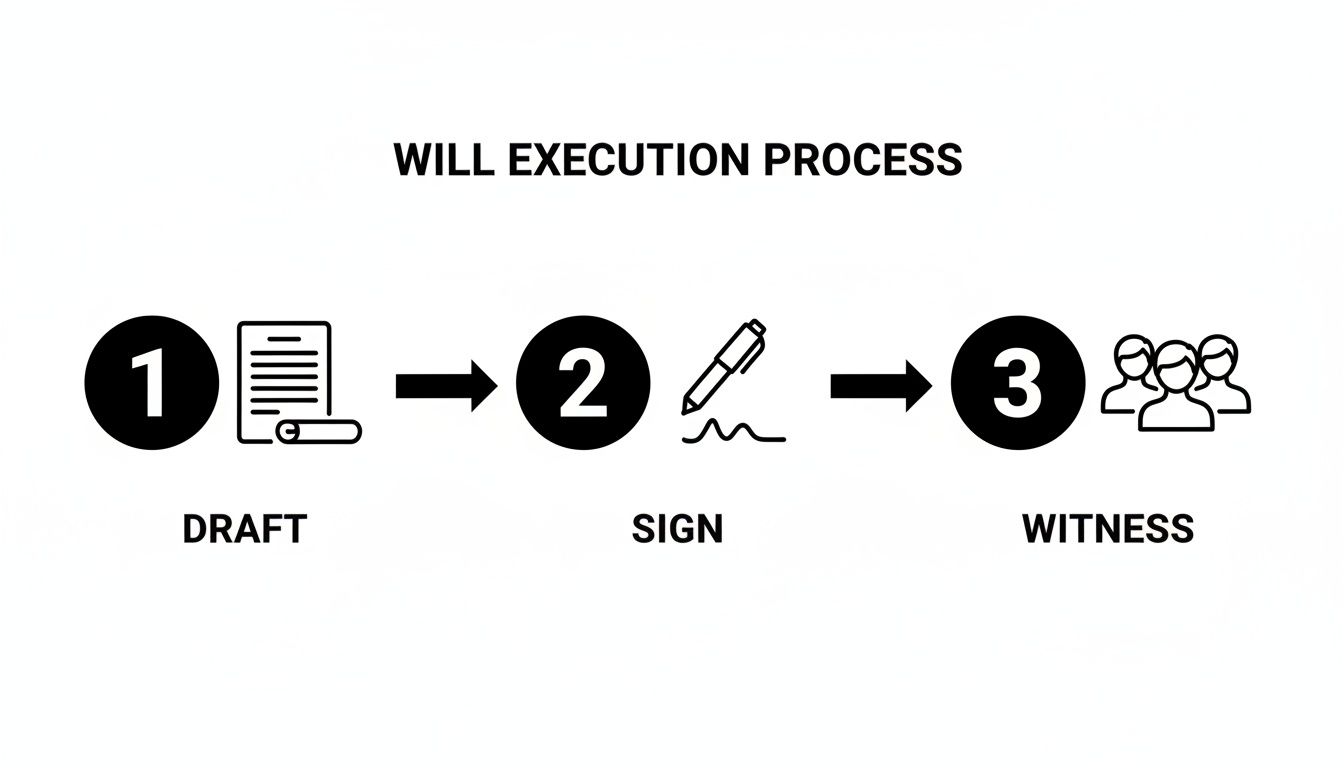
As the infographic shows, each step—drafting, signing, and witnessing—is a vital link in the chain. Miss one, and the whole thing can fall apart.
To give you a clearer picture, here’s a quick breakdown of what Texas law requires for a standard will.
Quick Overview of Texas Will Execution Requirements
| Requirement | What This Means for Kingwood Residents |
|---|---|
| In Writing | Your will cannot be a verbal agreement or a video recording; it must be a physical written document. |
| Signed by Testator | You must sign the will yourself, or direct someone to sign it for you while you are physically present. |
| Two Credible Witnesses | Two people, at least 14 years old, who are not beneficiaries in your will must watch you sign and then sign it themselves in your presence. |
This table outlines the foundational requirements. Getting these right is the absolute minimum for ensuring your will stands up in court.
While some people try drafting their wills on their own, it's easy to miss a small but crucial legal detail. Tools like legal document generation software can help streamline the initial drafting, but they can't replace the value of professional oversight during the actual signing ceremony itself.
At The Law Office of Bryan Fagan, we see proper execution as the final, protective seal on your estate plan. It’s the moment your thoughtful planning becomes legally powerful, safeguarding your family’s future right here in Kingwood.
Understanding these steps is the first move toward true peace of mind. If you have any questions about how to execute your will correctly, our experienced Kingwood team is here to guide you. We offer free consultations to help ensure your final wishes are protected and honored.
The Three Pillars of a Valid Texas Will
When it comes to your last will and testament, Texas law is very specific. To make sure your wishes are legally binding and will hold up in court, your will needs to be built on three foundational pillars. For families here in Kingwood and the surrounding areas, getting these right from the start is what separates a solid estate plan from a document that could cause chaos for your loved ones.
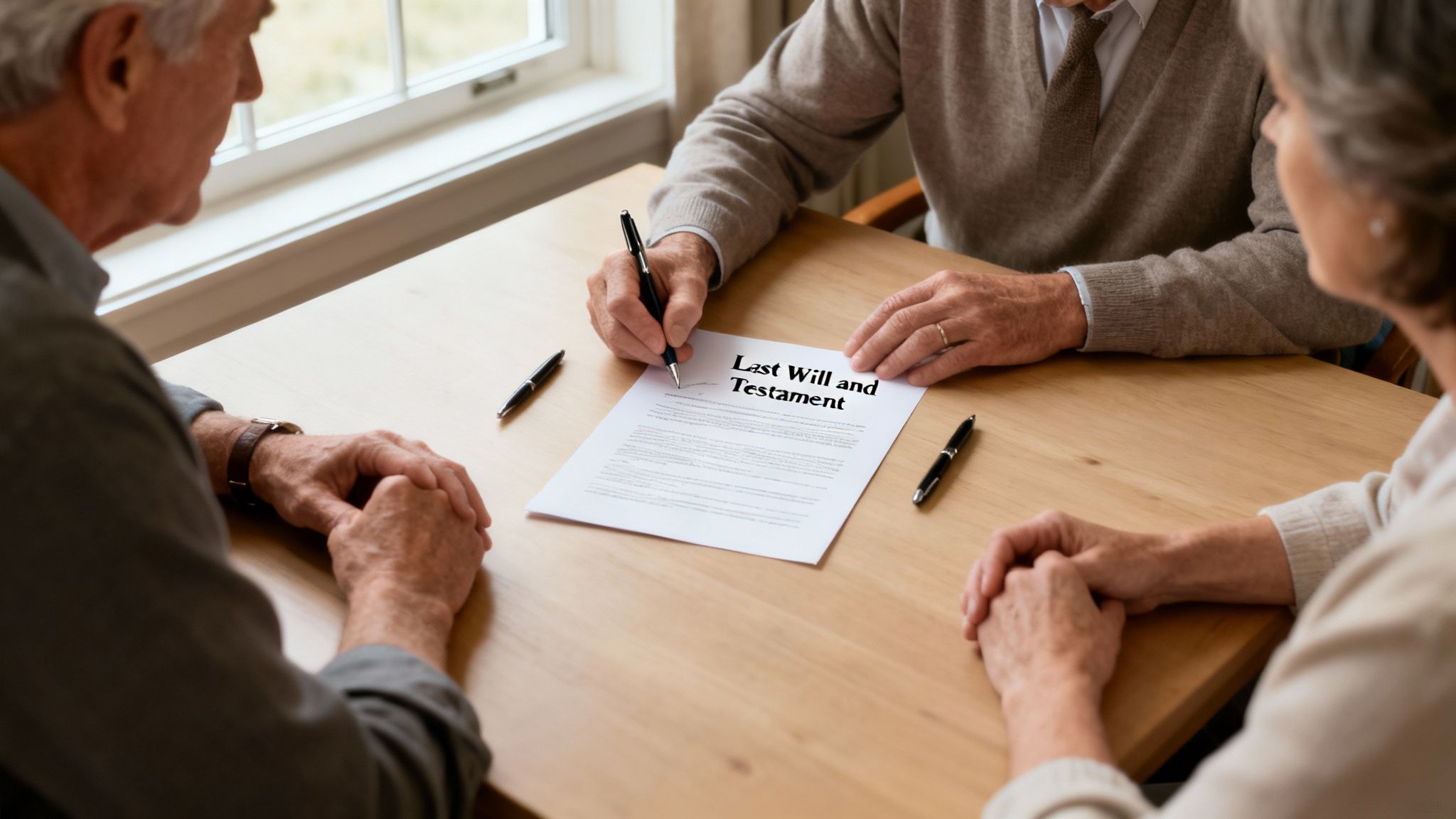
If even one of these pillars is weak or missing, the entire structure can crumble. A court could declare your will invalid, leaving your family’s future up in the air. Let’s walk through exactly what each of these requirements means for you.
Pillar One: Your Will Must Be in Writing
This first rule is as simple as it sounds, but it’s non-negotiable. A standard Texas will must be in writing. A conversation you had with your kids, a heartfelt video message, or a promise made on a handshake simply won't cut it in a Harris or Montgomery County probate court.
Putting your wishes on paper creates a clear, tangible record. It removes all the "he said, she said" and ensures your instructions are preserved exactly as you intended them. For our Kingwood clients, this is the critical first step in properly executing any will.
Pillar Two: The Testator Must Sign the Will
Next, the will needs your official seal of approval—your signature. As the person creating the will (the legal term for you is the testator), you have to sign the document. This signature is your formal declaration that this document truly represents your final wishes.
But what if you're physically unable to sign your name? Texas law has a solution for this. You can have another person sign the will for you, but they must do it in your presence and at your specific direction. This ensures that even those with physical limitations can create a valid will, but it has to be a deliberate, witnessed act.
A quick note on terminology: when lawyers talk about "executing" a will, we're talking about the formal process of signing and witnessing it. It has nothing to do with the other, more grim, definitions of the word. We’ve seen this cause confusion for Kingwood families, so it's important to understand the specific legal context.
Your signature is what turns a simple draft into a legally significant document, which leads us to the final, and arguably most important, pillar.
Pillar Three: Two Credible Witnesses Must Sign It
This last pillar is what truly locks your will into place. Your signature must be attested to by two credible witnesses. This isn't just a bit of ceremony; it's a vital safeguard designed to prevent fraud or someone pressuring you into signing something you don't agree with.
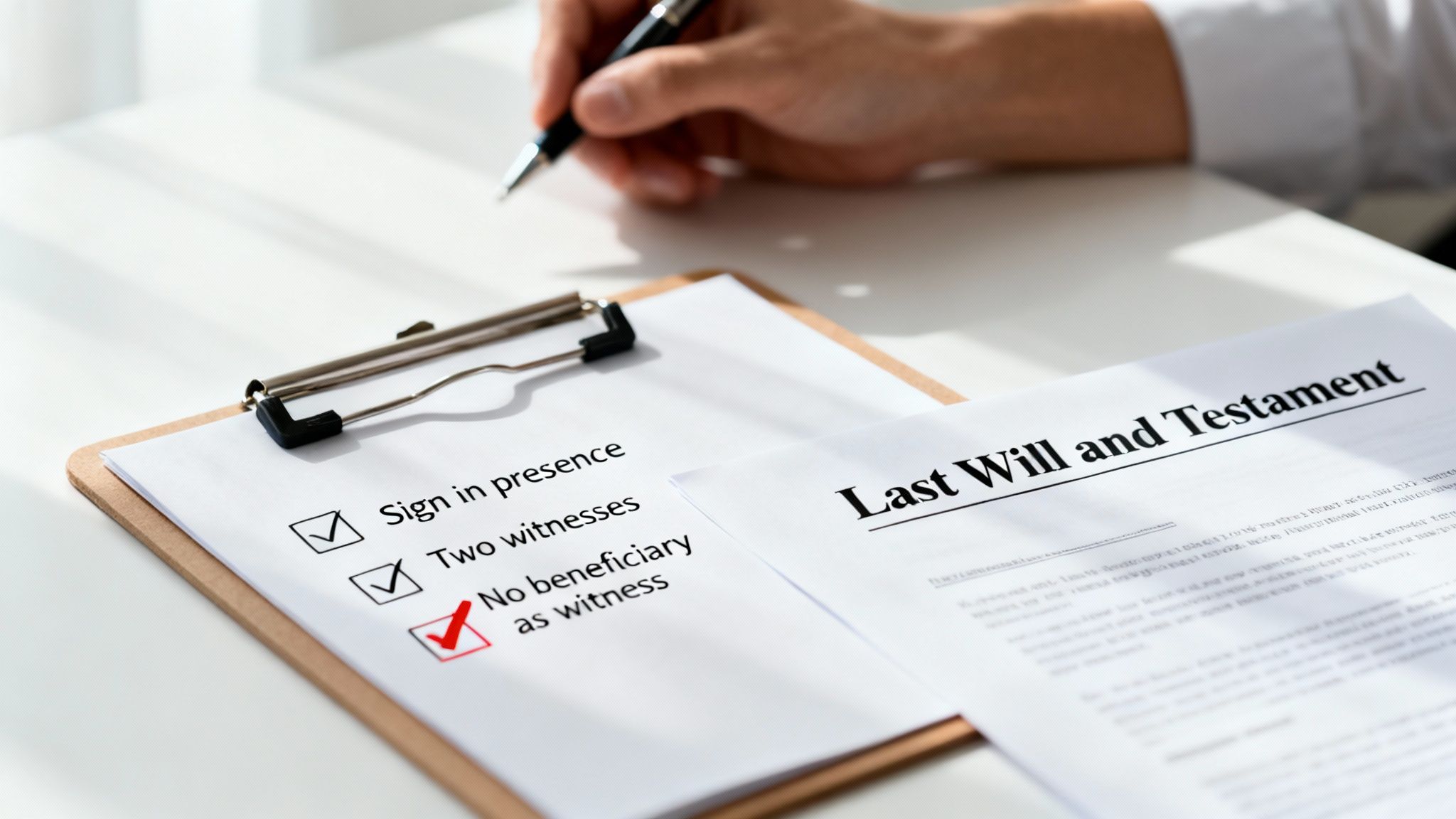
Here’s the practical breakdown of what Texas law demands for witnesses:
- You Need Two of Them: A single witness won't do. It has to be at least two people.
- They Must Be "Credible": This just means they are at least 14 years old and are mentally competent enough to understand what's happening.
- They Have to Sign in Your Presence: This is crucial. The witnesses need to watch you sign (or see you acknowledge your signature on the document) and then sign it themselves while you are all still together.
Think of your witnesses as the official observers of this important legal act. Their signatures are their sworn statement that they saw you sign the will and that you seemed to be of sound mind and doing it of your own free will. They don't have to read the will or know what it says, but their presence and signatures are absolutely required. For families in Porter or anywhere in Northeast Houston, this is the step where things most often go wrong without professional guidance.
While you can create a will on your own, knowing the ins and outs of these requirements is essential. You can learn more in our guide on how to create a will without a lawyer. At The Law Office of Bryan Fagan, we guide our Kingwood clients through this process every day, making sure every pillar of their estate plan is rock-solid.
Making Your Will 'Self-Proved' with a Notary
Imagine giving your family an 'express pass' for the probate court after you’re gone. That's pretty much what a self-proving affidavit does. While it's not strictly required under Texas law, adding this one document is one of the smartest and most compassionate things you can do for your loved ones.
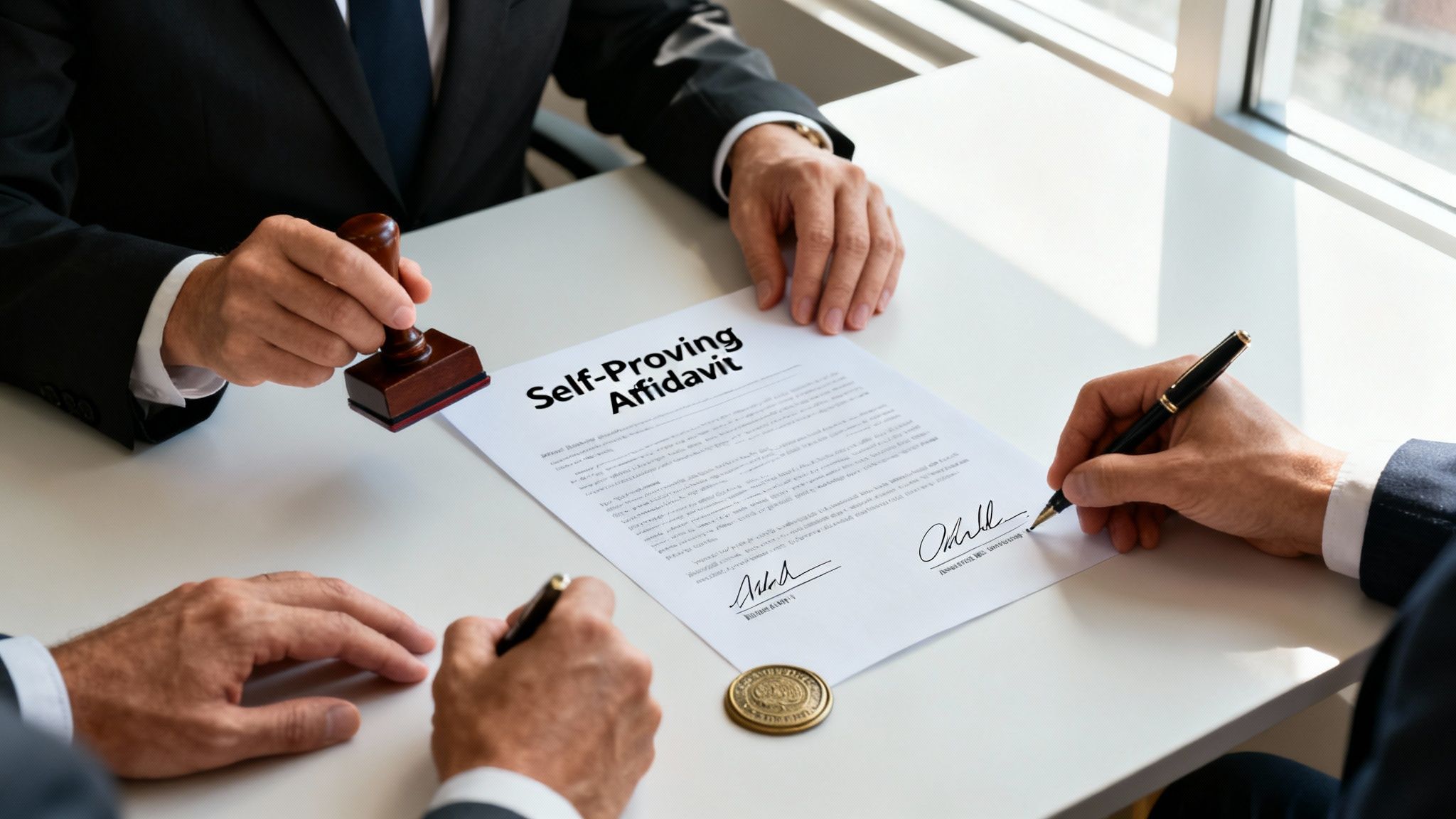
So, what is it? A self-proving affidavit is simply a separate statement that gets attached to your will. In it, you and your witnesses sign in front of a notary public, all swearing under oath that the will was signed correctly, following all the legal rules. Think of it as a notarized confirmation of the signing ceremony itself.
For families here in the Kingwood and Porter areas, the benefit is huge. This one simple step allows the court to accept your will at face value, which saves a massive amount of potential hassle down the road.
Why a Self-Proved Will is So Powerful
Fast forward a few years—or even a few decades—from the day you sign your will. Where are your witnesses? They might have moved across the country, become hard to find, or may have even passed away.
Without that self-proving affidavit, your executor could be stuck with the daunting task of hunting down one of those witnesses and getting them to a Harris or Montgomery County courthouse just to testify that, yes, they saw you sign the document. This can drag out the probate process and rack up legal bills, all for something that could have been handled from the start.
By adding a self-proving affidavit, you completely remove that hurdle.
The affidavit acts as pre-approved testimony for the court. It essentially says, "Everything was done by the book," letting your will sail through the initial probate steps and saving your family from a world of unnecessary stress and expense.
At The Law Office of Bryan Fagan, including a self-proving affidavit isn't just a suggestion; it's a standard part of every will signing we oversee for our Kingwood clients. We see it as a non-negotiable step in truly protecting your family’s future.
How the Notarization Process Works
The process itself is straightforward, but every detail has to be handled perfectly. Here’s a quick look at what happens when we make a will self-proved for our clients in Northeast Houston:
- Drafting the Affidavit: First, we prepare the specific legal wording required by the Texas Estates Code. It’s not a generic form; it has to be precise.
- The Signing Ceremony: You and your two witnesses sign the will itself. Then, we immediately move on to the affidavit.
- Taking the Oath: With a notary public present, you and your witnesses will all formally swear that the facts in the affidavit are true—confirming your identity, that you were of sound mind, and that you signed freely.
- The Notary's Stamp of Approval: The notary signs the document and affixes their official seal, which certifies that everyone properly took the oath.
This final touch solidifies your will's validity and gives it that "express pass" for probate. And while technology is changing how we handle many legal documents, with options like remote notarization services becoming more common, a document as critical as a will really benefits from a professionally supervised, in-person signing. It's the gold standard for a reason.
This small extra step today provides an incredible amount of peace of mind for your family tomorrow. It shows you did everything in your power to make honoring your final wishes as simple as possible. If you want to make sure your will is not just complete, but ironclad, our Kingwood office is here to guide you. Schedule a free, no-obligation consultation with us today.
The Exception to the Rule: What About Handwritten Wills in Texas?
Most of the time, for a will to be ironclad, it has to follow a pretty strict formula of typing, signing, and witnessing. But Texas law carves out a special exception for what's called a holographic will. This is a unique situation where a will written entirely in your own handwriting can be legally valid, even if no one else watches you sign it.
You can probably picture the scenario—someone in a dire emergency, scribbling down their final wishes on a piece of paper. The law was created to account for situations just like that. But for families here in Kingwood and Northeast Houston, relying on a holographic will is a gamble you probably don't want to take.
The Hidden Dangers of a "Simple" Handwritten Will
The main draw of a holographic will is its apparent simplicity. No witnesses, no notary, no formal ceremony. Sounds easy, right? The problem is that this simplicity on the front end almost always creates massive legal headaches for the loved ones you leave behind.
The first major hurdle is proving it's authentic. Someone has to convince a judge that every single word in that document was genuinely written by the deceased. This isn't easy. It often means hiring expensive handwriting experts and tracking down people who can testify about the person's penmanship, which can ignite a courtroom battle before you even get to the will's contents.
Then there's the issue of clarity. When you write a will yourself without legal guidance, the language you use can be surprisingly vague or ambiguous. What felt perfectly clear to you might be interpreted in three different ways by your heirs, creating painful arguments over what you really meant.
Relying on a holographic will is like trying to navigate the complex legal system without a map. It might seem like a straightforward shortcut, but it often leads to confusion, conflict, and costly court proceedings that drain the very estate you wanted to protect.
Why a Formal Will is Always the Safer Bet
A formally executed will—the kind with witnesses and a self-proving affidavit—is specifically designed to prevent these kinds of problems. That structured signing ceremony provides solid, undeniable proof that you signed the document with a clear mind and full intent.
Let’s break down the difference in a side-by-side comparison:
| Feature | Holographic Will (Handwritten) | Formally Executed Will |
|---|---|---|
| Witnesses | None required. This leaves it wide open to challenges of fraud or someone pressuring you. | Two credible witnesses confirm you signed it willingly and were of sound mind. |
| Clarity | Often uses vague, everyday language that can lead to major interpretation disputes. | Drafted with precise legal language to ensure your intentions are crystal clear. |
| Probate Process | Requires the court to validate your handwriting, which causes serious delays and extra costs. | A self-proved will is accepted by the court at face value, making probate much smoother. |
| Family Impact | Carries a high risk of family conflict and legal fights over what the will means. | Provides a clear, indisputable roadmap that minimizes stress and honors your wishes. |
For our clients in the Humble and Porter communities, we always emphasize that the whole point of an estate plan is to create security and peace of mind. A holographic will, while technically legal in Texas, often does the exact opposite. It introduces a huge amount of uncertainty at a time when your family needs clarity more than ever.
The safest, most reliable way to protect your legacy and prevent family arguments is with a professionally drafted and formally executed will. It’s a small investment that protects your family’s future harmony.
If you’re thinking about the best way to document your wishes, don't leave it to chance. The experienced team at The Law Office of Bryan Fagan is right here in Kingwood, ready to help you create a secure and legally sound estate plan. Schedule a free, no-obligation consultation with us today.
Common Mistakes to Avoid When Executing Your Will
The will signing ceremony isn't just a formality—it's a critical legal procedure. A tiny misstep here can unravel your entire estate plan, creating openings for legal challenges and sparking the exact kind of family conflict you worked so hard to prevent. For our friends and neighbors here in Kingwood, knowing what not to do is just as important as knowing what to do.
Think of it like the final walkthrough of a new house. The foundation is solid, the walls are perfect, but one faulty wire in the breaker box can put the whole structure at risk. It's the same with a will; a well-written document can be completely undermined by a simple mistake during the signing.
Choosing the Wrong Witnesses
One of the most common blunders we see is picking the wrong people to witness your signature. It seems easy enough to ask your son or your sister, especially if they are with you, but in Texas, that's a huge mistake if they are also beneficiaries in the will.
A witness needs to be a neutral third party, someone with no skin in the game. When a beneficiary acts as a witness, the law automatically raises a red flag for potential undue influence. A court might assume they pressured you, which could lead to their inheritance being voided or, in a worst-case scenario, jeopardize the validity of the entire will. It's always best to find two witnesses—like neighbors or colleagues not named in the will—who have nothing to gain.
Botching the Signing Ceremony
When Texas law says your witnesses must sign “in your presence,” it means it literally. This isn't a casual suggestion, and it’s where many do-it-yourself wills fail spectacularly. The correct process demands that your witnesses physically watch you sign the document, and then you must watch them sign it.
Here are a few ways this can go wrong:
- Signing in different locations: You can't just sign your will at your kitchen table in Kingwood and then drop it off at your friend's house in Humble for them to sign later. Everyone involved—you, and both witnesses—must be in the same room, at the same time.
- Distracted witnesses: The witnesses have to actually see you sign or acknowledge your signature. If they're scrolling on their phone or looking out the window, their attestation isn't legally sound.
- Signing out of order: You, the testator, must always sign first. The witnesses are attesting to your signature, so their action has to follow yours.
A will execution is a single, continuous event. Think of it as one fluid motion. Breaking it into pieces or having people sign at different times invalidates the whole process and throws the door wide open for legal challenges that can bleed your estate dry and cause unimaginable stress for your loved ones.
Forgetting or Incorrectly Attaching the Self-Proving Affidavit
We've talked about how the self-proving affidavit acts like a fast pass for probate court, but just having one isn't enough. It has to be done right. We’ve seen affidavits that were signed but never notarized, or worse, stored in a separate folder from the will.
For your will to be properly self-proved, the affidavit must be completed during the same signing ceremony, in front of a notary, and physically attached to the will. This fuses them into a single, legally powerful document that’s much tougher to contest. A small clerical error here completely negates the time and money the affidavit was supposed to save.
To help our clients in Northeast Houston and beyond sidestep these common pitfalls, we put together this straightforward guide.
Will Execution Mistakes vs. Best Practices
| Common Mistake | The Correct Way (Best Practice) | Why It Matters for Your Estate |
|---|---|---|
| Using a beneficiary as a witness. | Choose two credible, disinterested witnesses who are over 14 and not named in your will. | Prevents claims of undue influence and protects the beneficiary's inheritance from being voided. |
| Witnesses signing at a different time/place. | You and both witnesses must sign the will in the same room as part of a single, uninterrupted event. | Ensures the attestation is legally valid and confirms you signed the will freely and with a clear mind. |
| Failing to properly notarize the self-proving affidavit. | Sign the affidavit with your witnesses in front of a notary and physically attach it to the will. | Makes the will easier to probate, saving your family time, money, and the stress of tracking down witnesses years later. |
Avoiding these mistakes isn’t about being paranoid; it's about making sure your final wishes are honored without a fight. The best way to protect your legacy is with professional guidance. At The Law Office of Bryan Fagan, our Kingwood attorneys meticulously oversee every detail of the will execution process. Schedule a free consultation with us today to ensure your will is signed, sealed, and legally solid.
How Getting the Signing Right Makes Probate a Breeze
You can think of executing your will correctly as the final, most important act of care you can show your family. For those of us in Kingwood and the surrounding areas, this isn't just about legal formalities; it's about making sure your wishes are carried out without causing your loved ones any extra heartache or expense down the road. A properly signed and witnessed will is like a clear set of instructions for the probate court, which can make the whole process faster and much less costly.
Probate is simply the court-supervised process of validating your will and making sure your assets get to the right people. When your will is executed perfectly—especially if it includes a self-proving affidavit—it's almost like giving your executor an express pass at the courthouse. The court can accept the document with little fuss, allowing your executor to get on with the business of settling your affairs instead of getting bogged down in legal red tape that drains the very estate you worked so hard to build.
The Steep Price of a Flawed Will
On the flip side, the fallout from a will that wasn't executed properly can be a nightmare for the people you leave behind. If a judge here in Harris or Montgomery County determines your will doesn't meet the strict standards set by Texas law, it can be declared invalid. Thrown out completely.
When that happens, it's as if you died without a will at all. The law calls this dying “intestate,” and it means the state of Texas decides who gets your property. The court will follow a rigid, one-size-fits-all formula to distribute your assets.
This default plan almost never aligns with what people actually want. It can mean distant relatives you barely know could inherit your property, while the people you truly wanted to provide for might get a smaller share than you intended—or worse, be left with nothing.
This kind of situation doesn't just mess up your financial plans. It can spark bitter and long-lasting fights among family members who are already grieving. The peace of mind you wanted to provide gets replaced by stress, confusion, and legal battles.
Think of Your Will as Your Family's Shield
Taking the time to make sure your will is executed by the book is one of the most meaningful things you can do for your family. It protects them from the legal mess of a defective document and gives them a clear path forward during an incredibly difficult time. A well-executed will is a testament to your love and foresight.
Every step in the execution process exists for a reason: to protect your final wishes and make them legally undeniable. You can get a better sense of how this plays out in court by reading our guide on how to probate a will in Texas. Seeing the process firsthand makes it crystal clear why getting these details right from the very beginning is so critical.
Ultimately, proper execution transforms your will from a piece of paper into a powerful shield for your family's future, ensuring your legacy is one of security, not court disputes. At The Law Office of Bryan Fagan, our Kingwood attorneys are committed to helping our neighbors in Northeast Houston nail this crucial step.
Don't leave your family's well-being up to chance. Contact our Kingwood office today for a free, no-obligation consultation to make sure your final wishes are locked in with a professionally drafted and perfectly executed will.
Frequently Asked Questions About Executing a Will in Texas
When you get down to the details of executing a will, it's natural for questions to pop up. To help our neighbors here in the Kingwood and Humble areas, we’ve put together some straightforward answers to the questions we hear most often.
Who Cannot Be a Witness to My Will?
This is a big one. In Texas, your witnesses absolutely must be disinterested parties. What does that mean? In simple terms, anyone who stands to inherit something from you in the will should not act as a witness.
If a beneficiary signs as a witness, it throws a wrench into the works. It creates a legal conflict that can seriously complicate the probate process and could even void the gift you intended to leave them. For this reason, it's always best practice to find witnesses who have no financial stake in your will.
Do I File My Will After It's Signed?
Many people in Kingwood think a will becomes a public document the moment it's signed, but that's not how it works. Your will is a private document for as long as you are living.
You do not need to file it with the county clerk in Harris or Montgomery County after you sign it. You should store it in a safe place where your executor can find it. It only enters the public record after you pass away and your executor submits it to the court to start the probate process.
What Happens if a Witness Is Unavailable Later On?
Life is unpredictable. Over the years, your witnesses might move across the country, become hard to find, or even pass away themselves. This is exactly why a self-proving affidavit is so incredibly important for our local clients.
When your will is self-proved with a notary, the court can typically accept it as valid on its face. There’s no need to hunt down the original witnesses to testify. Understanding the responsibilities of an executor of a will makes it clear just how much this simple step can streamline their job down the road.
Can I Change My Will After It Is Executed?
Of course. Your will is not set in stone. As your life changes—perhaps you welcome new grandchildren or acquire new property in the Northeast Houston area—you can always change it with a separate legal document known as a codicil.
Just remember, a codicil has to be executed with the same strict formalities as your original will. That means it must be in writing, signed by you, and attested to by two credible witnesses.
Getting the execution of your will right is the key to ensuring your wishes are followed and your family is secure. At The Law Office of Bryan Fagan – Kingwood TX Lawyers, we offer clear, local guidance to help you navigate the process with confidence. Schedule your free, no-obligation consultation today.