When you're navigating a custody agreement, you'll almost certainly encounter a geographic restriction. Think of it as setting a "home base" for your child. It’s a standard, and frankly crucial, part of most Texas custody orders. The whole point is to keep both parents close by and actively involved in their child's daily life, which is something we know is important to families right here in our Kingwood community.
For most families in Kingwood, Humble, or Porter, this simply means the child’s primary residence must stay within a specific area, like Harris County and its surrounding counties, ensuring stability and access for both parents.
What Is a Geographic Restriction in Kingwood Custody Cases?
When a family in Kingwood, Humble, or Porter is going through a divorce or custody case, a judge’s top priority is creating stability for the kids. A geographic restriction is one of the most effective tools they have to do just that. It's a specific clause written into your custody order that creates a boundary, preventing the parent who decides where the child lives from moving outside that designated area without court permission.

It’s a bit like a school district zone. You might be free to move to a new house, but if you want your child to stay in their current school, you have to stay within that attendance zone. A geographic restriction works in a very similar way, but it applies to your co-parenting relationship, keeping life manageable for everyone involved.
Why Do Courts Use Geographic Restrictions?
The short answer? It’s all about protecting the "best interest of the child." This is the legal standard that every single custody decision in Texas hinges on. Judges in both Harris and Montgomery Counties know that a child’s well-being is deeply tied to maintaining a strong, consistent relationship with both parents.
A geographic restriction makes this possible by:
- Promoting Frequent Contact: It keeps travel time reasonable, making it much easier for the non-primary parent to be present for their scheduled possession time.
- Encouraging Co-Parenting: When parents live near each other in the Northeast Houston area, sharing responsibilities becomes second nature. It's easier to trade off for doctor's appointments, attend parent-teacher conferences together, and both show up for soccer games at the local park.
- Maintaining Stability: Most importantly, it keeps the child’s world intact. They get to stay in their school, keep their friends, and continue with their favorite activities without major disruption.
In Texas, the law actually presumes that including a geographic restriction is in the child's best interest. It’s a standard feature of a custody order, not a penalty against one parent.
For families in the Kingwood area, these restrictions often name Harris County and its contiguous (neighboring) counties as the boundary. But these terms aren't set in stone; they can be negotiated. A skilled local family law attorney can help you push for boundaries that fit your family’s reality, whether that means tying the location to a specific school district or defining a simple mile radius.
At The Law Office of Bryan Fagan, we know that no two families are the same. We are a local Kingwood firm dedicated to helping our neighbors navigate these challenges with confidence. If you have questions about how a geographic restriction kingwood custody order might affect your life, our Kingwood office is here to provide answers. We invite you to schedule a free consultation with us to talk through your situation and find out how we can help protect your rights as a parent.
How Texas Law Defines Custody and Relocation
To get a handle on your custody case, you first have to understand the core principle that every judge in Kingwood operates from. In Texas, all decisions about children boil down to a single, powerful standard: the "best interest of the child." This isn't just a phrase lawyers throw around; it's the bedrock of the entire Texas Family Code.
When a Harris County or Montgomery County judge thinks about putting a geographic restriction in place, they're not just pulling out a map and drawing a circle. They are meticulously weighing a specific set of factors to figure out what living situation will truly help your child thrive.
The Best Interest Standard in Action
Courts use a well-established list of considerations, often called the Holley factors, to get a 360-degree view of a family's life. It’s how a judge takes the law off the page and applies it to a real family in our Northeast Houston community.
Some of the key questions a judge will be asking are:
- The Child's Needs: What does this specific child need right now and in the future, emotionally, physically, and for their education?
- Parental Abilities: Who has shown they can provide a stable, loving home and meet the child’s needs?
- Stability of the Home: Is the home environment being proposed a safe and consistent one?
- Past Involvement: What has each parent’s day-to-day role in the child’s life looked like until now?
This isn’t about tallying up points to see which parent "wins." Think of it more as a holistic review, where the judge pieces everything together to build an order that supports a positive future for the child.
Why Texas Law Presumes a Restriction is Best
In our state, there’s a general starting assumption that a geographic restriction is a good thing. Courts in places like Kingwood and greater Harris County often limit a child’s main residence to the county and its surrounding neighbors. Why? Because it keeps both parents actively involved in the child's life. For a deep dive into court statistics, you can check out the Texas Judicial Branch's annual statistical report.
A geographic restriction is the court's way of ensuring that co-parenting isn't just a concept, but a daily reality. It protects the child's right to have easy and frequent access to both parents.
What this means in practice is that the parent with the right to decide where the child lives (the primary conservator) usually has to stay within that defined area. While it might feel restrictive to the parent, the goal is always to protect the child from the disruption of a long-distance move and make it practical for the other parent to stay close. This philosophy is a huge part of how judges structure possession schedules, including various shared custody arrangements in Texas.
At the end of the day, Texas law on custody and relocation is built around the child's world, not the parents' convenience. For families facing a geographic restriction kingwood custody case, every decision will be grounded in what's genuinely best for your child.
Trying to make sense of these legal standards on your own can be overwhelming. The attorneys at The Law Office of Bryan Fagan are your Kingwood neighbors, and we know exactly how Harris County courts interpret these rules. If you're worried about a potential move or just need to understand your rights, call our Kingwood office. We offer a free consultation to listen to your story and give you the clear, practical guidance you’re looking for.
Common Geographic Boundaries for Kingwood Families
When a judge brings up a "geographic restriction," your mind probably jumps straight to a map. What does this boundary actually mean for your family’s day-to-day life in the Kingwood area? How will it affect school drop-offs, weekend visits, and your ability to move forward?
These lines on a map aren't drawn at random. Courts carefully create them to strike a delicate balance: protecting a parent’s right to live their life while ensuring a child maintains stability and a strong relationship with both parents.
For most families in Northeast Houston, the starting point is usually a county-contiguous restriction. Think of this as the default setting in many Harris or Montgomery County custody orders. It establishes a clear, easy-to-understand perimeter for where the child’s primary home can be.
Understanding the County-Contiguous Boundary
So, what does "county-contiguous" actually mean? It’s simpler than it sounds. It means the parent with primary custody must live within the county where the case was finalized or in any county that touches its border.
Let’s say your case is finalized in Kingwood, which sits in Harris County. This restriction means your child’s primary residence could be in:
- Harris County
- Montgomery County
- Fort Bend County
- Brazoria County
- Galveston County
- Chambers County
- Liberty County
- Waller County
This gives you a surprisingly large area to choose from. It provides a lot of flexibility while still guaranteeing that the other parent is never more than a reasonable drive away. This makes co-parenting logistics—from last-minute possession exchanges to attending a weeknight school play—far more manageable for everyone.
Comparing Different Types of Restrictions
While the county-contiguous model is the most common, it’s not your only option. The law allows judges, and parents, to get creative and negotiate boundaries that fit a family’s unique situation. At the end of the day, the goal is always to find a solution that serves the child’s best interest and is practical for the parents.
Here in the Kingwood, Humble, and Atascocita areas, we all know that commutes on US-59 (I-69) and the tight-knit feel of our school communities are huge factors in our lives. A savvy judge will often recognize that tying a boundary to a school district makes more sense than a county line, especially if it prevents a child from being uprooted from their friends and school.
To give you a clearer picture, let's compare some of the restrictions we frequently see in our local courts.
Typical Geographic Restrictions for Kingwood Families
The table below breaks down the most common types of restrictions used in Harris and Montgomery County custody orders, outlining what they mean for you as a parent.
| Restriction Type | Typical Boundary | Key Consideration for Parents |
|---|---|---|
| County-Contiguous | The county of the court and all bordering counties. | This is the most common and often the easiest to define, providing broad flexibility while maintaining relative proximity for co-parenting. |
| Specific School District | The boundaries of a particular school district (e.g., Humble ISD). | This is ideal for ensuring a child's educational stability, keeping them with their teachers and friends, even if one parent moves. |
| Defined Mile Radius | A set radius (e.g., 50 miles) from a specific location, like a parent's home or the child's school. | This option offers precise control over distance and can be tailored to accommodate unique work or family situations in the greater Houston area. |
As you can see, these boundaries are highly customizable.
The key takeaway is that geographic restrictions are not one-size-fits-all. An experienced family law attorney can help you argue for a boundary that makes logistical sense for your life while still satisfying the court’s duty to protect the child's relationship with both parents.
For instance, a parent who works downtown might advocate for a restriction that explicitly includes Harris and southern Montgomery County to make their commute feasible. Another parent might push for a boundary centered on Kingwood High School to keep their teenager’s academic and social life intact. The specific details matter, and presenting a logical, child-focused argument to the judge is absolutely crucial.
Understanding the options for a geographic restriction in a Kingwood custody case is the first step toward securing an order that truly works for you and your children. At The Law Office of Bryan Fagan, our local Kingwood attorneys are skilled at negotiating these exact terms. We see our clients as neighbors, and we are committed to finding practical solutions. If you have questions about your family’s situation, we invite you to schedule a free, no-obligation consultation with our team to see how we can help.
The Process to Modify or Lift a Geographic Restriction
Life changes. It's a simple fact. A dream job offer, a new marriage, or a chance for your child to attend a one-of-a-kind school can present incredible opportunities. When a geographic restriction in your Kingwood custody order stands in the way, it can feel like a brick wall.
But that wall isn't always permanent. The law recognizes that families in our area—from Kingwood to Humble and Porter—grow and evolve. The legal process for changing these boundaries is called a modification, and understanding how it works is the first step toward building the future you envision for your child.
The First Step: Filing a Petition to Modify
Your journey starts with a simple but critical step: filing a specific legal document with the same court that issued your original custody order, whether that's in Harris or Montgomery County. This document is formally known as a Petition to Modify the Parent-Child Relationship.
This petition does more than just fill a file cabinet. It’s the official kickoff for your case. It serves as formal notice to the court and to your co-parent that circumstances have changed and you are asking for a specific change to the custody order, outlining exactly why the move is necessary.
Clearing Two Critical Legal Hurdles
To convince a judge to change a geographic restriction, you have to successfully clear two major legal hurdles. Think of them as two gates you must pass through before the court will even consider approving your request.
- A Material and Substantial Change in Circumstances: The court needs to see that something significant has changed since your last order was put in place. This can’t be a minor inconvenience or a temporary whim; it must be a major life event.
- The Move is in the Child's Best Interest: This is, without a doubt, the most important part of your case. You have to prove, with compelling evidence, that relocating will genuinely benefit your child's life—not just make your own life easier.
Courts establish these boundaries in a few common ways, and knowing which one applies to you is key to arguing for a change.
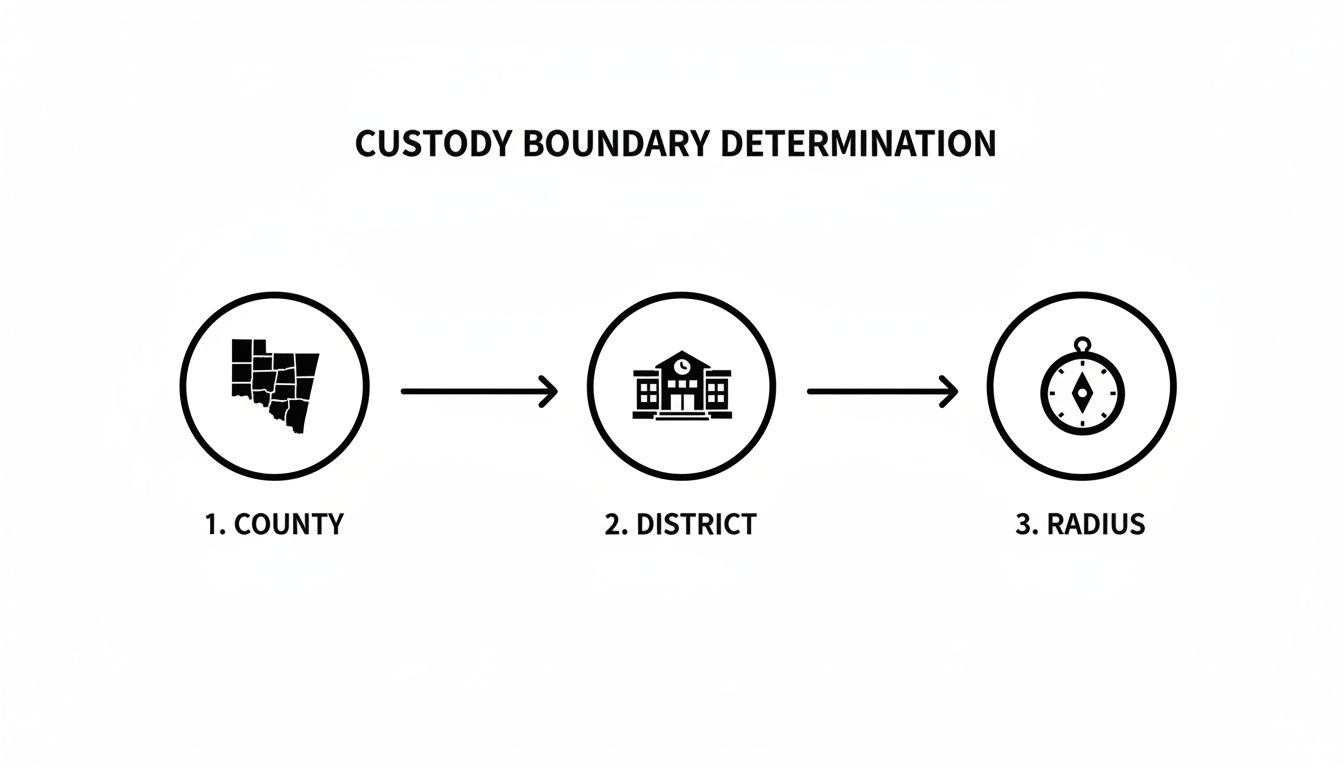
Understanding these standard restrictions helps you build a stronger case for why a modification is not only needed but is also in line with your child's well-being.
What Counts as a Material and Substantial Change?
That legal phrase, "material and substantial change," can feel a bit fuzzy. In a real-world courtroom, however, judges are looking for concrete, life-altering events. For a family in Northeast Houston, this might look like:
- A Significant Career Opportunity: Landing a new job or a major promotion that comes with a much higher salary, better benefits, or a career path that promises greater long-term stability for your child.
- Remarriage: Marrying a new spouse who lives or works in another city, especially if you can show that this new family unit will provide a more stable and supportive home for the child.
- Specialized Care Needs: The need to move closer to a specific medical facility or school that provides essential services for a child with special needs that aren't available locally in the Kingwood area.
- Family Support System: Moving to be near grandparents, aunts, and uncles who can provide a critical support network for both you and your child.
Simply stating that one of these events occurred isn't enough. You have to draw a direct line from that change to why the move has become necessary and how it ultimately benefits your child. This modification process is quite different from how orders are first created. You can learn more about that initial stage by reading about temporary custody orders in Texas and how they are first established.
Building Your Case for the Child's Best Interest
Proving that the move is in your child’s "best interest" is truly the heart and soul of your modification case. Your job is to paint a clear picture for the judge, supported by solid evidence, that shows how your child's world will improve after the move.
You must demonstrate to the court that the benefits of the move for your child will outweigh the potential disruption of moving away from the other parent. The focus must remain squarely on the child's well-being.
This requires a thoughtful and detailed argument. You’ll need to present evidence showing how the relocation will positively impact your child’s:
- Emotional and Physical Well-being: Will they live in a better home or a safer neighborhood? Will they have more opportunities for sports, hobbies, or other activities they love?
- Educational Opportunities: Is the new school district ranked higher? Does it offer special programs, like advanced placement or gifted-and-talented tracks, that would benefit your child?
- Relationship with Both Parents: This is crucial. You must present a realistic, detailed, and workable plan for how your child will maintain a strong and consistent relationship with the other parent. This should include a proposed long-distance visitation schedule, a plan for handling travel costs, and creative ways to use technology for frequent communication.
Successfully navigating a geographic restriction Kingwood custody modification is a serious legal challenge. It demands careful planning, strong evidence, and a deep understanding of what local Harris and Montgomery County judges look for. You don't have to figure this out alone. The experienced attorneys at The Law Office of Bryan Fagan are here to help you build the strongest case possible. We invite you to schedule a free consultation at our Kingwood office to discuss your family's unique situation and explore your legal options.
How to Enforce a Geographic Custody Order
That pit-in-your-stomach feeling when you find out your co-parent has moved away with your child—and didn't get permission—is something no parent should ever experience. One minute you're planning a normal weekend pickup, and the next you’re hit with the shocking realization that your child is no longer where they are supposed to be. This isn't just a broken promise; it's a direct violation of a court order, and Texas law gives you a powerful and immediate way to fight back.

When you're facing this kind of crisis, you have to act fast. The most critical first step is filing what’s known as a Motion for Enforcement with the same court that issued your original custody order, whether that's right here in Harris County or a nearby county court.
Taking Immediate Legal Action
A Motion for Enforcement is your official way of raising a red flag to the court, letting the judge know their order has been ignored. It’s not just a complaint; it’s a formal request for the judge to step in and uphold the rules they put in place to protect your child's stability. To be effective, this document needs to be crystal clear.
Your filing needs to spell out for the judge:
- The exact part of the order that was violated (for example, the clause defining the geographic restriction kingwood custody).
- Precisely how and when it happened (like the date your co-parent moved and their new, unapproved address).
- What you are asking the court to do, which almost always includes ordering the immediate return of your child.
Filing this motion kicks off a legal process designed to safeguard your rights and, more importantly, get your child back to a stable, familiar environment.
The Consequences of Violating a Court Order
Judges in Kingwood—and all over Texas—take it very personally when their orders are disregarded. Once your motion is on file, the court will set a hearing where the other parent has to show up and answer for their actions. If the judge agrees that they intentionally and knowingly broke the rules, the penalties can be significant.
In an enforcement case, the court's number one job is to force compliance with the order and do what's best for the child. That almost always means ordering the child to be brought back to the designated area immediately.
Beyond just ordering the child’s return, a judge has a whole toolkit of penalties to discourage this from ever happening again. The other parent could be facing:
- Being held in contempt of court, a serious legal finding with steep consequences.
- An order to pay for your attorney’s fees and any court costs you incurred.
- Fines or even jail time, particularly if it's not the first time or the violation was especially blatant.
- "Make-up" possession time with your child to compensate for the periods you lost.
In the most serious situations, a parent’s choice to unilaterally move could cause the judge to rethink the entire custody arrangement, including who has the right to decide where the child lives. When one parent proves they're willing to put their own wishes ahead of court orders and the child’s best interest, it sends a powerful message to the court—and not a good one. Understanding how to navigate this process is key, and our Kingwood enforcement lawyers are here to help you do just that.
Feeling helpless in this situation is normal, but you are not powerless. The Law Office of Bryan Fagan is a local firm dedicated to helping Kingwood families protect their children and enforce their rights. Contact our Kingwood office for a free consultation to talk about your specific case and learn what immediate steps we can take.
Common Questions About Kingwood Custody Restrictions
When you're staring at a custody order with a geographic restriction, it’s easy to feel overwhelmed. The legal language is dense, and the stakes for your family couldn't be higher. For parents in Kingwood, Humble, and across Northeast Houston, getting straight answers is the first step toward regaining a sense of control.
This is where we can help. We've compiled some of the most frequent questions we hear every day in our Kingwood office. Our goal is to cut through the jargon and give you the practical, clear advice you need to understand your rights and options.
What if My Ex and I Both Agree on a Move?
This is one of the most common—and dangerous—misconceptions we see. Many parents assume that if they and their co-parent are on the same page about a move, they can just pack up and go. This is a critical mistake that can land you in serious legal hot water.
Even if you have a verbal or even a written agreement, your current court order is the only thing that is legally binding. A handshake deal won't hold up in court.
A private agreement between parents does not override a court order. To make a move legally official, you must go back to court and have a judge sign a new, modified order that formally changes the geographic restriction.
Why is this step non-negotiable? Without a new court order, the parent who moves is technically violating the decree. Imagine this scenario: your ex gives you their blessing to move, but a year later, they change their mind. They could file an enforcement action against you, and the judge would have no choice but to uphold the original order. To protect yourself and make your agreement legally sound, you have to file a Petition to Modify and get an updated order signed.
Does My Child Get a Say in Moving When They Turn 12?
The law in Texas does change a bit once a child hits the age of 12. At that point, they have the right to speak with the judge in private (in chambers) and state their preference about where they want to live. This is a big deal, and many parents think it means their child’s wish is the final word. That's not quite how it works.
A child’s preference is just one piece of the puzzle. The judge’s decision must always come back to the "best interest of the child" standard.
Here’s a glimpse into what a Kingwood judge is really thinking about:
- The Child’s Stated Desire: The judge will absolutely listen to what your child has to say.
- The Child’s Maturity: The court also has to figure out why the child wants what they want. Are the reasons thoughtful and mature, or are they based on superficial things, like which parent has a pool or looser rules?
- The Big Picture: Finally, the judge has to weigh the child's preference against all the other factors—things like each parent’s stability, the quality of schools in each location, and how the move would impact the child's relationship with the other parent.
So, while your 12-year-old’s opinion definitely matters and carries weight, it doesn't automatically control the outcome of a relocation case.
How Do I Prove a Move Is Best for My Child?
This is the heart of any relocation case. You can't just tell the judge a move will be better; you have to show them with solid, compelling evidence. Your job is to paint a clear picture of how this move will genuinely improve your child's life.
To build a winning case, you need to gather proof. Think like a storyteller and focus on these key areas:
- Educational Opportunities: Don't just say the schools are good. Bring in school district report cards, information on special programs (like gifted and talented or special needs support), and details about unique extracurriculars.
- Financial Improvement: Show the judge your new job offer letter, recent pay stubs, and a budget demonstrating how that extra income will directly benefit your child—through a safer home, better healthcare, or savings for college.
- Stronger Support System: Get affidavits or be prepared to have family members testify about the support network they can provide in the new city. Show the judge photos of the new home, the neighborhood, and the local parks.
- A Detailed Visitation Plan: This is crucial. You must present a realistic, detailed long-distance possession schedule. Show the judge you've thought it all through: who will handle travel, who will pay for flights, and how you’ll use technology like FaceTime to keep the other parent deeply involved.
A well-prepared case demonstrates that you've considered every angle from your child's point of view.
Will Moving Affect My Summer and Holiday Visitation?
Yes, almost certainly. If you get the court's permission to modify a geographic restriction kingwood custody order and move a significant distance away, your old possession schedule just won't work anymore. The standard order is built for parents living in the same general area, like Kingwood and Humble.
When a judge approves a long-distance relocation, they will create a new possession schedule to fit the new reality. For the non-primary parent, this usually means fewer but longer visits. For example, instead of getting the first, third, and fifth weekends, they might get the child for the entire summer (minus a week or two for the primary parent) and for every spring break.
The goal is to restructure the time to ensure the child continues to have a meaningful, high-quality relationship with both parents, even with miles between them.
Navigating the complexities of a geographic restriction can feel overwhelming, but you don't have to face it alone. The dedicated attorneys at The Law Office of Bryan Fagan – Kingwood TX Lawyers are here to provide the clear guidance and strong representation you deserve. As a local firm, we are committed to helping our neighbors in Kingwood, Humble, and Porter. If you have questions about your custody order, we invite you to schedule a free, no-obligation consultation at our Kingwood office to discuss your family’s future. Visit us at https://kingwoodattorneys.com to get started.