Skip to content
When you're facing a divorce in Kingwood, it often feels like you want the process over with as quickly as possible. However, Texas law intentionally puts the brakes on, requiring a mandatory 60-day waiting period for nearly every case.
This "cooling-off" period starts the day after the Original Petition for Divorce is filed. It’s designed to give you and your spouse a moment to breathe, step back from the emotional whirlwind, and make sure you're not making life-altering decisions in the heat of the moment. For our neighbors in Kingwood and the surrounding communities, understanding this rule is the first step toward navigating the divorce process with confidence.
Understanding The Texas Divorce Waiting Period
If you're filing for divorce in Kingwood, this waiting period is one of the first procedural hurdles you'll encounter. It's a fundamental part of the Texas divorce process, applying to everyone from Humble to Northeast Houston. It's less of a delay and more of a built-in safety measure designed to protect you.
The whole point of this 60-day rule is to prevent rash choices. When emotions are running high, it's easy to make a call you might later regret. This window of time is valuable for several reasons:
- Time to Reflect: It gives you a structured pause to be absolutely certain that ending the marriage is the right path forward.
- A Chance to Negotiate: It creates space for you and your spouse to discuss critical issues like property division or child custody without the immediate pressure of a final court hearing.
- Preparation is Key: This is your time to gather financial documents, speak with your Kingwood attorney, and start mapping out a clear legal strategy for what comes next.
The Legal Foundation of the 60-Day Rule
This isn't just a courthouse suggestion; it's a hard-and-fast rule written directly into state law. Under Section 6.702 of the Texas Family Code, every divorce petition filed in Texas kicks off this mandatory 60-day waiting period.
This rule applies across the board. It doesn’t matter if your divorce is completely amicable and uncontested or involves complex property disputes and children. The law ensures everyone has this time so that final decisions aren't rushed. You can explore more about the timeline for finalizing a divorce in Texas to see how this 60-day period fits into the bigger picture.
For our clients in the Kingwood area, we see this waiting period as an opportunity. It's the time we use to lay a strong foundation for your case, ensuring all details are handled with care and precision before your divorce is finalized.
Ultimately, this period is there to protect you. It ensures that when you finally stand before a judge in a Harris County court, your decisions are thoughtful, well-documented, and legally sound. At The Law Office of Bryan Fagan, we guide our clients through this phase, helping them use the time productively to prepare for their next chapter.
If you have questions about how to start the divorce process or what this waiting period really means for your family, our Kingwood office is here to help. Schedule a free consultation with our team today to get the clear, compassionate advice you deserve.
How The 60-Day Rule Shapes Your Divorce Timeline
When people first come to our Kingwood office for a divorce consultation, there's a common misconception we hear all the time. Many folks believe the 60-day waiting periodis the divorce timeline. But that's not quite right. It’s better to think of it as the starting block, not the entire race.
How this mandatory wait actually impacts your divorce depends almost entirely on one thing: whether your case is contested or uncontested.
For some families in Humble and Northeast Houston, especially those who agree on everything, those 60 days can feel like the longest part of the process. In an uncontested divorce, where you and your spouse have already worked out property division, child custody, and support, this waiting period is simply time for your attorney to draft the final paperwork. Once the 60 days are up, you're pretty much ready to go.
But for many others, this period is just the beginning of a much longer road. If you and your spouse can't agree on key issues, you have a contested divorce, and those first 60 days are used very differently.
Uncontested vs. Contested Timelines
In an uncontested divorce, the path is fairly straightforward. During the 60-day wait, our team serving Kingwood residents is busy preparing the Final Decree of Divorce. This is the comprehensive legal document that spells out every last detail of your settlement. Since you've already reached an agreement, our goal is simple: be completely ready to walk into court the moment the waiting period is over.
A contested divorce, on the other hand, uses this time for critical legal groundwork. Think of it as building the foundation for the rest of your case. This often includes:
- Discovery: This is the formal process where we exchange financial records and other important information with your spouse. It’s all about getting the facts on the table.
- Negotiation: Your attorneys will start talking, trying to resolve disputes and find common ground on the issues you disagree on.
- Temporary Orders: If there are immediate concerns about who lives in the house, who has the kids when, or how bills get paid, we can ask the court for temporary orders to set some ground rules while the divorce is pending.
This basic timeline shows where the waiting period fits in for every Texas divorce.
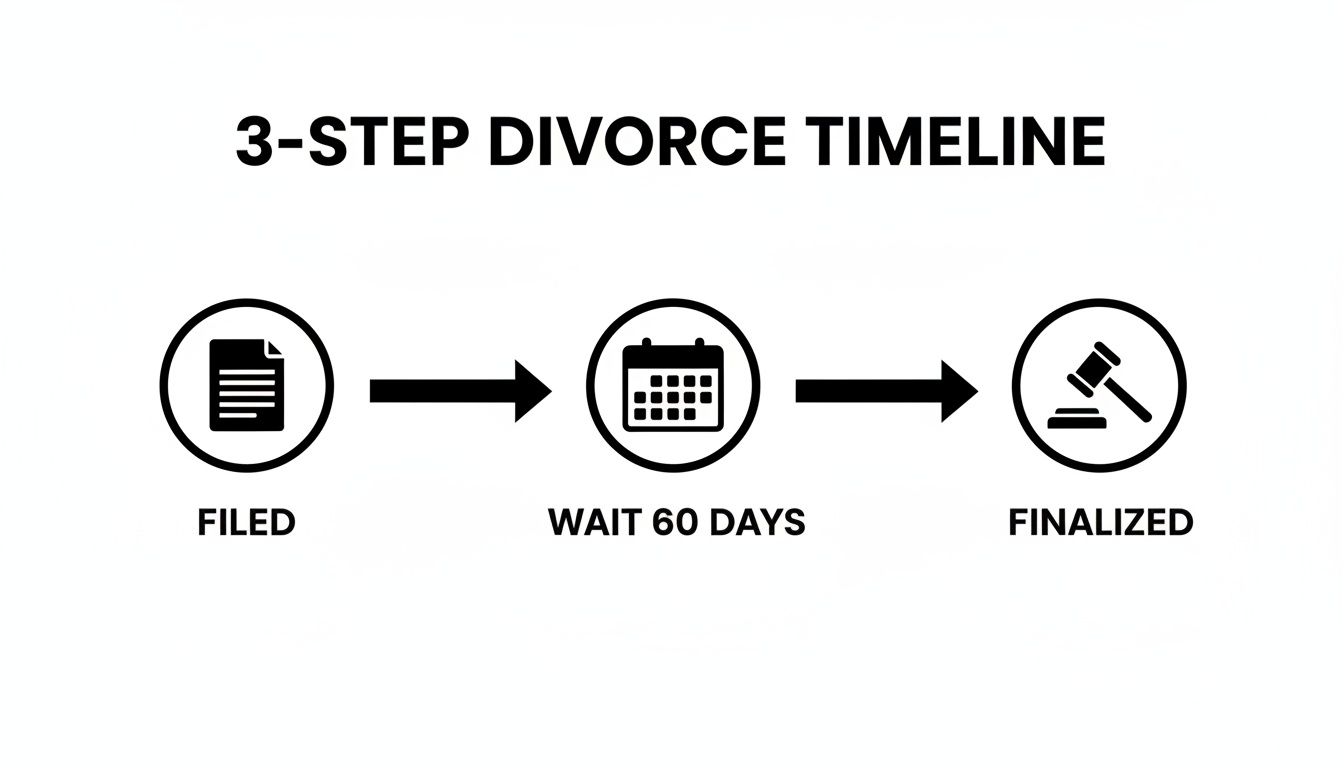
As you can see, the 60-day wait is a mandatory middle step. The total time it takes to get from "filed" to "finalized," however, can change dramatically.
Setting Realistic Expectations for a Harris County Divorce
Understanding this difference is key to setting realistic expectations. In our experience helping local families, Texas divorces split into two very different paths. Uncontested cases often wrap up within 3-6 months after being filed. Contested divorces, however, can easily stretch to 6-12 months or even longer.
These longer timelines aren't arbitrary; contested cases often involve mediation, detailed evidence gathering, and multiple court hearings, all of which take time. You can discover more insights about these divorce timelines on our blog.
It's essential to remember that while the law sets a 60-day minimum, the busy dockets in the Harris County court system often mean that even simple divorces take a bit longer to schedule for a final hearing.
This reality makes it even more important to use that waiting period productively. Here in Kingwood, we treat these 60 days as a crucial preparation phase. Whether your divorce is straightforward or complex, our goal is to use this time to build a solid foundation for your case so we're ready to move forward efficiently the second the waiting period ends.
If you're not sure how the divorce waiting period in Texas will affect your specific situation, the best thing you can do is get clear legal advice. Our team is here to provide the guidance you need. We invite you to schedule a free, no-obligation consultation at our Kingwood office to talk through your case and get a better understanding of the road ahead.
Meeting Texas Residency And Filing Requirements First
Before that 60-day divorce waiting period in Texas can even start, you have to get through the courthouse door first. Think of the state's residency rules as the key—without meeting them, you can't officially begin the legal process. For our clients here in Kingwood and the surrounding areas, these rules are strict and non-negotiable.
The law lays out two simple but firm benchmarks. First, either you or your spouse must have called Texas home for at least the last six months. Second, one of you has to have lived in the specific county where you plan to file—for most of our Kingwood clients, that's Harris County—for a minimum of 90 days right before filing.
These rules aren't just arbitrary. They exist to make sure a Texas court has the proper authority, or what lawyers call "jurisdiction," to handle your case. It stops people from simply picking a random state or county to file in just because they think the laws might be more favorable.
How Residency Rules Play Out in Northeast Houston
Let's make this practical. Say a couple has lived in Humble for the last five years. No problem there. They easily meet both the six-month state and 90-day county requirements, so they can file in Harris County without a hitch.
But what about a different situation? Imagine one spouse moves to a new apartment in Kingwood from Louisiana. Three months later, they want to file for divorce. They’ve met the 90-day Harris County residency rule, but they fall short on the six-month statewide requirement. They'll have to wait another three months before they can legally file their petition. It's so important to get this right from the very beginning to avoid having a judge dismiss your case, which just creates frustrating delays and extra costs.
Starting the Clock: The Original Petition for Divorce
Once you're sure you meet the residency requirements, the next move is filing the Original Petition for Divorce. This is the formal legal document that kicks off your case and, crucially, starts that 60-day waiting period clock.
The petition itself contains the basic facts about you, your spouse, and your marriage. It also states the legal reason for the divorce. In Texas, the most common ground is "insupportability"—what most people call a no-fault divorce. It just means the marriage has broken down and can't be fixed, without pointing fingers or placing blame.
Filing the Original Petition for Divorce is the official starting gun for the legal process. It’s the action that puts the court on notice and formally begins the divorce waiting period Texas requires.
Getting this document filed correctly is a critical first step. At The Law Office of Bryan Fagan, we make sure all the paperwork for our Kingwood clients is prepared with precision and submitted properly to the Harris County District Clerk, starting your case on solid legal ground. If you're not sure whether you meet the residency rules or you're ready to get started, we invite you to our Kingwood office for a free consultation. We're here to give you the clarity and guidance you need.
Exceptions To The 60-Day Waiting Period
The divorce waiting period in Texas is one of the most steadfast rules in family law, but the legal system always puts one thing first: safety. Because of this, Texas law carves out very specific, serious exceptions to the 60-day rule, designed to protect victims of family violence in Kingwood and the surrounding communities.
While that "cooling-off" period is helpful in most divorces, it should never trap someone in a dangerous environment. The law recognizes that sometimes, you need to act immediately to protect a spouse or a child. These exceptions aren't handed out easily and require concrete legal proof.
When Safety Is The Top Priority
The Texas Family Code gives a judge the power to waive the 60-day waiting period if there's a documented history of family violence. This is a critical lifeline for vulnerable people in Northeast Houston who need to get legally and physically away from an abusive partner as fast as possible.
A judge can grant this waiver under two main circumstances:
- Criminal Conviction: One spouse has been convicted of (or received deferred adjudication for) a criminal offense involving family violence against the other spouse or someone in their household.
- Active Protective Order: An active protective order or a magistrate's emergency protection order is in place to keep one spouse safe from the other.
This provision highlights a core legal principle: your safety and your children's safety come before anything else. These aren't just loopholes; they are emergency escape hatches built into the law for the most dire situations.
A Common Misconception About Waiving The Wait
A question we hear all the time from clients in Kingwood and Humble is whether they can skip the waiting period if both spouses are on board. It’s a completely understandable myth, but mutual agreement is not a valid reason to waive the 60-day wait.
The only legally recognized exceptions to the Texas divorce waiting period involve documented family violence. Even if you and your spouse agree on everything and want it over with, you still must wait out the mandatory 60 days.
This rule exists to make sure that even in the most amicable splits, big decisions about property and children are made thoughtfully, not rushed. The law is meant to be applied consistently to all families, making a single, crucial exception for cases where someone's safety is on the line.
At The Law Office of Bryan Fagan, we handle these sensitive cases with the urgency and care they demand. If you're facing a situation that involves family violence, please know that the law is on your side and protections are available. We encourage you to contact our Kingwood office for a free, confidential consultation to talk through your options for getting safe and moving forward.
Making The Most Of The Waiting Period
That mandatory divorce waiting period in Texas can feel like an eternity, especially when you’re just ready to move on with your life. We get it. But what if you saw those 60 days not as a delay, but as a head start? For our clients here in Kingwood, we treat this time as a critical window to lay a strong, stable foundation for their next chapter.
This isn’t just idle time. It's an opportunity to get organized, make clear-headed decisions, and work hand-in-glove with your attorney. By using these two months wisely, you can sidestep a lot of future stress and put yourself in a much better position for a favorable outcome once the clock runs out.
Create Your Financial Inventory
First things first: get your financial house in order. A divorce, at its core, is the dissolution of a financial partnership. To divide everything fairly, you absolutely must have a complete and accurate picture of your marital estate.
Start putting together a comprehensive folder—it can be a physical binder or a digital one on your computer—and begin gathering every essential document. This isn't just about preparing for a legal battle; it's about giving yourself a true understanding of your financial reality as you get ready to stand on your own two feet.
Your document checklist should include:
- Income Records: Recent pay stubs, W-2s, and tax returns going back at least three to five years.
- Bank Statements: Statements from every single checking, savings, and money market account you and your spouse hold.
- Property Documents: Deeds to your home, vehicle titles, and recent property tax statements.
- Debt Information: All statements for mortgages, car loans, credit cards, and student loans.
- Retirement and Investment Accounts: 401(k), IRA, pension, and any brokerage account statements.
Think of this as creating the blueprint for your financial future. A meticulously organized financial inventory is the single most powerful tool you and your Kingwood attorney can have in your corner during negotiations.
This process can stir up a lot of emotions, but it’s a non-negotiable step. At The Law Office of Bryan Fagan, we walk our Northeast Houston clients through this from start to finish, making sure they know what’s needed and why it’s so vital to their case.
Establish Stability With Temporary Orders
While you have to wait 60 days to finalize the divorce, you absolutely do not have to live in limbo. This waiting period is the perfect time to work with your attorney and ask the court for Temporary Orders. These are legally binding court orders that create structure and predictability for your family while the divorce is ongoing.
Temporary Orders tackle the urgent issues right away, bringing immediate clarity and cutting down on potential conflicts. They typically cover critical arrangements like:
- Child Custody and Visitation: Setting up a temporary possession schedule so the kids have a consistent, stable routine.
- Child Support: Making sure your children’s financial needs are met from the very beginning.
- Spousal Support: Providing temporary financial help to a spouse if the situation calls for it.
- Use of Marital Property: Deciding who will live in the family home in Kingwood and who gets to use which car.
- Payment of Bills: Clearly outlining who is responsible for the mortgage, utilities, and other monthly bills.
These orders bring a sense of immediate relief and stability, which is invaluable when kids are involved. The divorce waiting period in Texas isn't a timeline you have to just endure; you have powerful legal tools at your disposal. For many families, exploring divorce mediation in Texas during this time can also be a really productive way to work through these temporary issues together.
By proactively seeking Temporary Orders, you and your attorney can ensure your family’s needs are protected from day one. If you’re a resident of Kingwood, Humble, or the surrounding areas, our team is ready to help you use this waiting period to your advantage. Schedule a free consultation at our Kingwood office to talk about building a solid strategy for your case.
Finalizing Your Divorce After The Waiting Period
Once the mandatory 60-day divorce waiting period in Texas has passed, the finish line is finally in sight. For many of our clients in Kingwood, this moment brings a mix of relief and uncertainty about what comes next. The final steps depend heavily on one key factor: whether your divorce is uncontested or contested.
Either way, having all your ducks in a row with your paperwork is what prevents any frustrating last-minute delays. All that proactive work you did during the waiting period is about to pay off.
The Final Hearing For An Uncontested Divorce
If you and your spouse have managed to reach a complete agreement on every single issue, the final step is usually a brief court appearance often called a "prove-up" hearing. This isn't the dramatic courtroom trial you see on TV; it's a short, straightforward process to make your divorce official.
During this hearing, one of you will stand before a Harris County judge and give some simple testimony. You'll confirm some basic facts about your case and present the agreed-upon Final Decree of Divorce for the judge to sign. Once that ink is dry, your divorce is legally complete.
The Path Forward In A Contested Divorce
For contested divorces, the end of the waiting period doesn’t automatically trigger a final hearing. Instead, it signals that it's time to shift gears and formally resolve your disputes. This is where the legal process can really kick into high gear.
Typically, this next phase will involve one or more of the following:
- Mediation: Think of this as a structured negotiation. A neutral third-party mediator sits down with both of you (and your attorneys) to help you find a middle ground and hopefully hammer out a settlement.
- Settlement Negotiations: Behind the scenes, your attorneys will continue talking, trading proposals, and trying to find a resolution that keeps you out of the courtroom.
- Trial: If all else fails and you simply can't agree, your case will be set for trial. This is where you'll present evidence and arguments, and a judge will make the final decisions for you.
The end of the divorce waiting period in Texas is a major turning point. It's when you officially shift from preparing for the divorce to actually resolving it, allowing you to close this chapter and start fresh.
As your divorce is finalized and you begin to look toward the future, the focus shifts to personal well-being. It can be helpful to explore resources on how to heal after divorce for guidance on navigating your recovery with compassion.
Getting through these final stages requires a steady, experienced hand to protect your interests and make the process as smooth as possible. Here at The Law Office of Bryan Fagan, we guide our Kingwood and Northeast Houston clients through to the very end with confidence. If you're nearing the end of your waiting period, contact our Kingwood office for a free consultation to ensure you’re fully prepared to finalize your divorce.
Common Questions About the Texas Waiting Period
Going through a divorce brings up a ton of questions. Here in our Kingwood office, we find that getting clear answers about the divorce waiting period in Texas can really help lower the stress of the whole process. Let’s walk through some of the most common questions we hear every day.
Can we just skip the 60-day wait if we both agree to it?
This is easily the most common question we get, and the answer is a straightforward no. The 60-day waiting period is a hard-and-fast rule in Texas. Even if you and your spouse have worked everything out perfectly and are in complete agreement, the law doesn't allow you to waive it.
The only exceptions are for very specific, documented cases of family violence. For virtually everyone else in the Kingwood and Humble areas, this 60-day period is a mandatory step. Think of it as a required "cooling off" period to make sure the decision is final and well-considered.
So, when does the 60-day clock actually start ticking?
The countdown begins the day after the Original Petition for Divorce is officially filed with the court. If you're filing locally, that would be the Harris County District Clerk's office.
A lot of people think the clock starts when they move out or decide to split up, but that's not how it works legally. The only date that matters is the formal filing date. This is why it’s so important to have your petition filed correctly and quickly—it gets the ball rolling and prevents any avoidable delays.
The legal start date isn't flexible. It's tied directly to the moment your case is officially opened with the court, and that’s the starting line for the mandatory wait.
What do we do about kids and bills while we're waiting?
You don't have to put your life on hold for two months. This is where Temporary Orders come in. While you're in that 60-day waiting period, your attorney can ask the court to put these legally-binding rules in place to create some much-needed stability.
These orders are designed to answer all the immediate, pressing questions. For our clients in Northeast Houston, they typically sort out things like:
- Who the kids will live with for now (temporary custody).
- How child support will be paid.
- Who gets to stay in the house.
- Who is responsible for paying the mortgage, car notes, and other bills.
Temporary Orders are incredibly helpful. They provide a clear roadmap for how things will work while the divorce is ongoing, which helps keep conflict to a minimum when everything feels up in the air.
If my divorce is uncontested, will it be final on day 61?
Legally, yes, it could be. Realistically, it’s not very likely. Once the 60 days are up, you still have to get on the court's calendar for a final hearing where the judge will sign your Final Decree of Divorce.
The court dockets in a place as busy as Harris County are usually jammed. Scheduling that final, brief hearing might take another few days or even a couple of weeks. That said, for a truly uncontested divorce where all the paperwork is in perfect order, the process moves pretty quickly once the 60-day divorce waiting period in Texas has passed. The trick is being fully prepared to go the moment you're eligible.
Navigating the complexities of a divorce can feel overwhelming, but you don't have to do it alone. The experienced team at The Law Office of Bryan Fagan – Kingwood TX Lawyers is here to provide the clear, compassionate guidance you deserve. We serve our neighbors in Kingwood, Humble, and Northeast Houston, offering practical legal advice tailored to your unique situation. Schedule a free, no-obligation consultation with us today by visiting https://kingwoodattorneys.com.