Skip to content
Life changes, and what worked for your family when your custody order was first signed might not work today. If you're a Kingwood parent facing this reality, you’re likely wondering if you can update your agreement. The short answer is yes, but it’s not as simple as just wanting a change. As your local Kingwood family law attorneys, we want to help you understand the process. Under Texas law, you have to prove two things to a judge: that there's been a material and substantial change in circumstances, and that the new arrangement is in your child's best interest.
This is the legal foundation for any custody modification case in Texas, and our goal is to help you navigate it with confidence.
When Can You Modify a Custody Order in Kingwood?
For families in Kingwood, Humble, and the surrounding Northeast Houston communities, a conservatorship order is more than just paper—it’s the rulebook for your co-parenting life. But Texas courts understand that life is unpredictable. A job loss, a new marriage, or a child's evolving needs can make the old rules feel obsolete and unworkable.
The court's high standard of a "material and substantial change" is there for a reason: to protect children from the instability of constant court battles. It ensures changes are only made when they are genuinely necessary for the child's well-being.
What Qualifies as a Material and Substantial Change?
So what does that legal phrase actually mean for you and your family? It's not about minor frustrations or disagreements over the schedule. A material and substantial change is a significant shift in the life of the child or one of the parents that makes the current order unworkable or even harmful to the child.
Think of it this way: your original order was based on a snapshot of everyone's lives at that moment. A modification is only possible when a new snapshot looks so dramatically different that the old rules no longer fit the picture.
At The Law Office of Bryan Fagan, we see a lot of situations that qualify with the Kingwood families we represent. Here are some common examples:
- A parent gets a new job that requires a major relocation or involves a completely different work schedule, making the current pickup and drop-off times impossible.
- The child's needs have changed—perhaps due to a new medical diagnosis, academic struggles, or intense extracurriculars that the current schedule simply can't support.
- One parent has remarried, bringing a new stepparent and family dynamic into the child's life.
- Serious concerns have surfaced about the child's safety or well-being in one parent's home, like substance abuse, neglect, or an unstable environment.
The most important thing for any parent in the Porter or Kingwood area to remember is that the change must directly impact the child. A judge's decision will always, without exception, come down to what is in the best interest of the child.
Before filing, it's helpful to understand the different pathways a modification can take. Most situations fall into one of a few common categories, each with its own requirements.
Paths to Custody Modification in Kingwood
This table breaks down the primary ways a custody order can be modified, helping you identify which path best fits your family's situation.
| Modification Type | Key Requirement | Typical Scenario for Kingwood Families |
|---|---|---|
| Agreed Modification | Mutual consent from both parents | Both parents in Humble agree that the current possession schedule isn't working due to a child's new school activities or a parent's new work-from-home flexibility. |
| Contested Modification | Proof of a material and substantial change of circumstances | One parent wants to relocate from Kingwood for a new job, but the other parent objects, forcing a judge to decide what is best for the child. |
| Emergency Modification (TRO) | Evidence of immediate physical or emotional danger to the child | A parent discovers the other is abusing drugs or alcohol while the child is present, requiring immediate court intervention to protect the child's safety. |
Understanding which category your case falls into helps set realistic expectations for the process, timeline, and potential for conflict.
The One-Year Waiting Period and Its Exceptions
Texas law generally promotes stability by making parents wait at least one year from the date the current order was signed before they can file to modify it. This rule, found in Texas Family Code § 156.102, is designed to prevent the courts from being overloaded with requests based on minor or temporary issues.
However, there are critical exceptions every Kingwood parent should know. This waiting period does not apply if:
- The child's physical or emotional well-being is at risk.
- The person with the right to decide the child's primary residence has voluntarily given up care and possession of the child for at least six months.
- Both parents sign and file a petition agreeing to the modification.
If your situation is urgent and involves an immediate threat to your child, you can’t afford to wait. In these cases, you may need to file for emergency relief. Our firm can help you determine if your circumstances qualify for a temporary custody order to protect your child while the modification case moves forward.
How to File for Custody Modification in Harris County
When your life changes, your custody order often needs to change with it. For parents in Kingwood, navigating the Harris County court system can feel overwhelming, but it doesn't have to be. Let's walk through the practical, on-the-ground steps to get the process started.
It all begins with a single, crucial document: the Petition to Modify the Parent-Child Relationship. Think of this as your formal request to the court, the legal document that kicks everything off and sets the stage for your entire case.
Getting the Paperwork Right: Your Petition to Modify
Your petition is your chance to tell your story to the judge. It needs to clearly and convincingly explain three things: who is involved, what you are asking for, and why it's necessary now.
The "why" is the most important part. You must spell out the “material and substantial change in circumstances” that has happened since your last custody order was signed. You also have to connect that change directly to why your proposed modification is in your child’s best interest.
For instance, maybe you’re a parent in Porter whose job now requires frequent, unpredictable overnight travel, making the current possession schedule impossible. Your petition wouldn't just say "my job changed." It would detail the new demands and explain how a different schedule would give your child the consistency they need.
A word of advice: Be specific. Be factual. A judge is far more persuaded by a clear, detailed account of how circumstances have impacted your child than by vague complaints or emotional pleas. Our experienced attorneys can help you craft this document effectively.
Once your petition clearly lays out your case, it’s time to make it official.
Filing the Petition and Notifying the Other Parent
With your petition drafted, the next move is to file it with the Harris County District Clerk's office. This is what officially opens your case. You'll pay a filing fee, and the clerk will assign your case to one of the family courts that handles matters for the Kingwood area.
But filing is only half the battle. The other parent must be formally told about the lawsuit. This isn't just a courtesy; it's a constitutional right known as service of process. The court needs proof that the other parent knows what's happening and has a fair chance to respond.
You generally have two ways to handle this:
- Personal Service: This is the go-to method. A sheriff, constable, or certified private process server will hand-deliver a copy of the filed petition and a citation to the other parent. It's direct and legally solid.
- Waiver of Service: If you’re on good terms with the other parent, they can sign a "Waiver of Service." By signing this, they agree they've received a copy of the lawsuit and waive the need for formal delivery. This can save time, hassle, and money.
It's also important to have a realistic grasp of the timing involved. Texas law generally wants to see at least a year pass before modifying an order, all in the name of stability for the child.
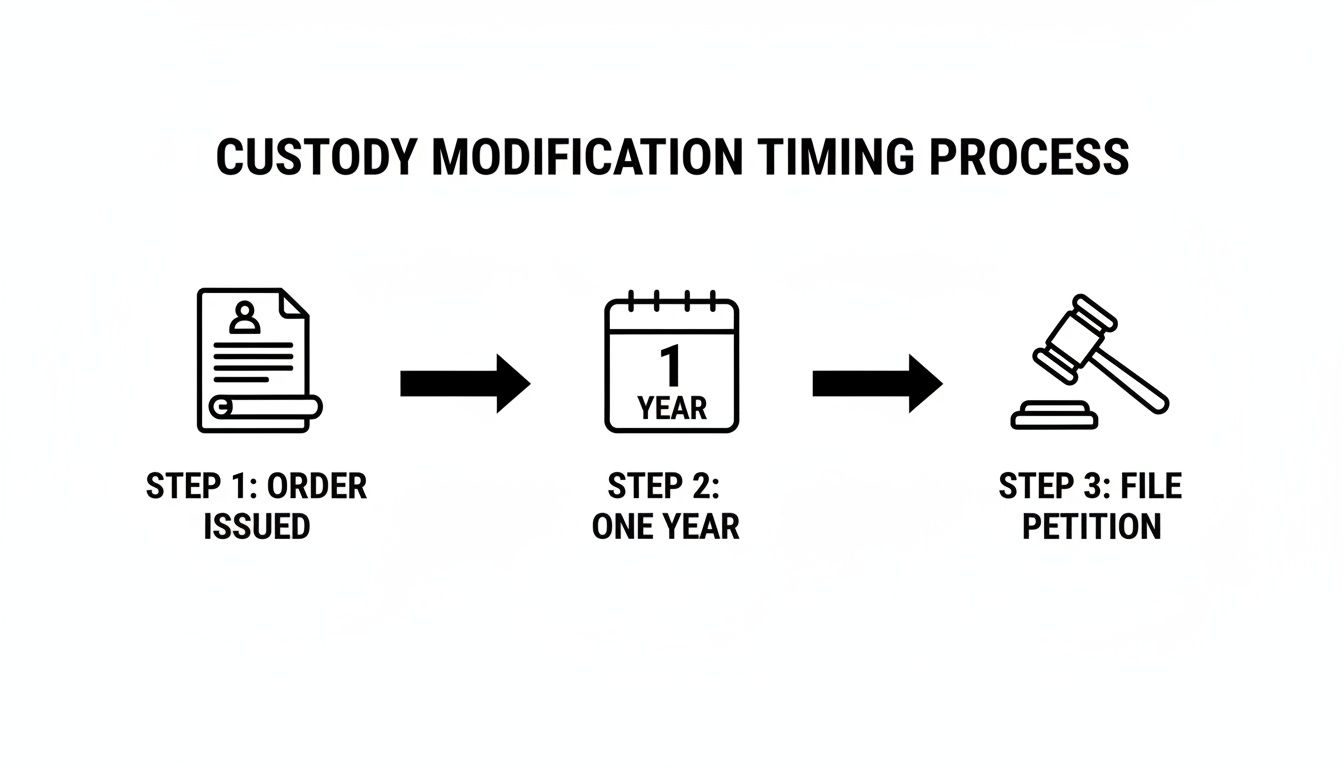
As you can see, this one-year waiting period is standard, but it’s not absolute. There are important exceptions for emergencies (like endangerment) or if both parents agree to the change.
Getting these initial steps right is non-negotiable. A mistake in your petition or an error in how you serve the other parent can cause major delays or even get your case thrown out, forcing you to start all over again. For parents across Northeast Houston, a clean start can make all the difference.
The journey of a custody modification in Kingwood is a precise one, but you shouldn't have to guess your way through it. The team at The Law Office of Bryan Fagan has guided countless local parents through drafting powerful petitions, filing them correctly in Harris County, and ensuring service is handled by the book. Contact our Kingwood office for a free consultation to talk about your situation and see how we can help.
Building Your Case to Modify Custody in Kingwood
Filing the initial paperwork is just the first step. The real work in any custody modification case begins now. To convince a Harris County judge to change your order, you have to build a powerful case that proves the modification is truly what's best for your child.
It’s not enough to just tell the judge that things have changed. You have to show them. Hard evidence is what separates a convincing argument from just another he-said, she-said dispute.

What Kind of Evidence Do You Need?
Think of yourself as a detective building a case. We tell our clients in Kingwood and the surrounding areas to start collecting evidence immediately. The more thorough you are from the beginning, the stronger your position will be later on.
The best cases don't rely on a single piece of evidence. Instead, they weave together different types of proof to paint a clear, undeniable picture for the judge.
Here are some of the most impactful forms of evidence we see in our practice:
- Written Communication: This is often a goldmine. Text messages, emails, and even social media DMs can create a concrete timeline. A series of texts showing the other parent consistently canceling visits or making disparaging remarks about you is powerful, documented proof.
- Official Records: These are hard to argue with. Think school report cards showing a sudden nose-dive in grades, attendance logs from your child's school in Porter detailing frequent absences, or medical records confirming a new health issue.
- Witnesses: A neutral third party can be incredibly persuasive. This might be a teacher, a school counselor, or a family friend from Northeast Houston who has personally witnessed the problems you're trying to address.
When you're putting your case together, it helps to think like a lawyer. Understanding the basics of how to write a legal brief can help you organize your arguments in a way that makes sense to the court.
One of the best things you can do is keep a detailed, dated journal. Every time something happens—a missed pickup, a disturbing phone call, an issue at school—write it down. Note the date, time, and exactly what occurred. This log becomes an invaluable tool for refreshing your memory and structuring your case.
How to Organize Your Proof for Court
Having a mountain of evidence is great, but if it's a disorganized mess, it will just confuse the judge and dilute your message. The goal is to present a clean, chronological story that's easy to follow.
We often have our Kingwood clients create a dedicated binder—it can be physical or a digital folder—with clearly labeled sections for each category of evidence.
For instance, you could have tabs for:
- Text Messages: Print out screenshots and arrange them by date.
- School Documents: Keep all report cards, attendance printouts, and teacher emails together.
- Witness Information: Create a contact sheet for each potential witness with a brief summary of what they can testify to.
This kind of preparation does more than just help your attorney. It shows the court you are organized, serious, and credible. Sometimes, the evidence points to a deeper problem, like one parent trying to turn the child against the other. Knowing how to prove parental alienation involves a very specific and careful approach to gathering proof.
Building a solid case for a custody modification in Kingwood takes real effort. You need to be diligent and focused on the facts, but you don't have to navigate this alone. The attorneys at The Law Office of Bryan Fagan have been through this process countless times. We can help you pinpoint the most crucial evidence and present it in a way that gives you the best chance of success.
If you're ready to take the next step, contact us to schedule a free consultation at our Kingwood office. Let's talk about your situation and start building the compelling case your child deserves.
Navigating Mediation and Court Hearings Near Kingwood
So, you've filed the paperwork to modify your custody order. What happens next? Many Kingwood families are surprised to learn that the next step isn't necessarily a dramatic courtroom showdown. In fact, Harris County courts will almost always require you and the other parent to try and work things out first through mediation.

This is your chance to find common ground with the help of a neutral, trained mediator. It’s less of a fight and more of a structured negotiation aimed at helping you and the other parent build a solution that actually works for your family.
The Mediation Process in Harris County
Mediation is a confidential, private meeting. It's you, the other parent, both of your attorneys, and the mediator in a room (or virtual room) hashing things out. The mediator’s role isn’t to pick a side or tell you what to do. Their job is to facilitate the conversation, point out the strengths and weaknesses of each person’s position, and find areas where you might be able to agree.
We've seen countless parents from Humble to Porter walk into mediation expecting a battle and walk out feeling empowered. Instead of putting your family's future in a judge's hands, you get to keep control.
Here’s why it’s so often the better path:
- Saves Money: A mediated agreement almost always costs significantly less than fighting it out in a contested trial.
- Saves Time: You can resolve your entire case in a single day, versus waiting months for your turn on a crowded court docket.
- Creates Better Solutions: You can agree to creative possession schedules and unique terms that a judge simply doesn't have the power to order.
- Lowers the Temperature: When you work together to find a solution, it can set a much healthier tone for your co-parenting relationship moving forward—a huge win for your child.
If you reach an agreement, your lawyers will draft a document called a Mediated Settlement Agreement (MSA). Once you sign it, that's it. The deal is binding and irrevocable. The MSA is then filed with the court and becomes your new, official custody order.
What Happens If You Can’t Agree?
While the vast majority of our cases settle in mediation, sometimes parents are just too far apart on the issues to find a middle ground. If you can’t reach a full agreement, your next step is preparing for a final hearing in front of the judge who presides over cases in the Kingwood area.
This is a much more formal, structured event. It’s where your attorney will present your evidence, question witnesses, and make legal arguments to prove your case. Knowing what to expect can take a lot of the anxiety out of the process.
A Key Takeaway: The judge has one, and only one, guiding principle: the best interest of the child. Every piece of evidence you introduce, every argument you make, must be laser-focused on showing why your proposed change is what's best for your child's physical and emotional well-being.
At The Law Office of Bryan Fagan, we handle the legal heavy lifting—cross-examining the other party, objecting to improper evidence, and arguing the law. Your job is to be the star witness, telling your story clearly and honestly when it’s your turn to testify. For more on this, our guide on how to prepare for a custody hearing in Texas is a fantastic resource.
The judge listens to both sides and then makes a ruling. That ruling becomes the new final order that you both must follow. Whether you get there through a cooperative mediation or a contested hearing, the goal remains a stable, predictable outcome for your child. Navigating a custody modification in Kingwood takes experience and a solid strategy, but you don't have to do it alone. Call The Law Office of Bryan Fagan today for a free consultation at our Kingwood office.
Common Reasons and Pitfalls in Custody Modifications
Life happens. That’s the simplest way to put it. The custody order that seemed perfect when your child was a toddler might feel completely unworkable now that they're a pre-teen. When Kingwood parents come to our office, it's almost always because a major life shift has made the old arrangement unsustainable.
Understanding what a Harris County judge considers a significant change—and, just as importantly, what common mistakes can sink your case—is the first step toward getting an order that reflects your family's new reality.
Common Reasons for a Custody Modification
From our experience helping families across the Kingwood, Humble, and Porter areas, the reasons for wanting a modification almost always boil down to a handful of major life events. A judge will look at every situation, but they’re always asking one fundamental question: what is in the child’s best interest?
- A Parent Relocates. This is probably the most frequent reason we see. A parent gets a fantastic job offer in downtown Houston, needs to move closer to an ailing family member, or simply needs a fresh start. A move of any significant distance almost guarantees the old possession schedule won't work anymore.
- Drastic Changes in a Parent’s Schedule. Life doesn't always stick to a 9-to-5 schedule. A promotion that comes with heavy travel or a switch to an overnight shift can make it physically impossible to follow the existing custody plan.
- The Child's Own Wishes. Texas law is clear on this. Once a child is 12 years of age or older, they can speak with the judge in private to state their preference for which parent they want to have the right to designate their primary residence. A judge isn't required to follow the child's wish, but they absolutely must take it into consideration.
- Serious Safety or Stability Concerns. This is the most critical category. If you have real evidence that your child is in an unsafe or unstable environment with the other parent—we're talking about issues like substance abuse, neglect, or exposure to criminal activity—the court needs to know about it immediately.
- Remarriage and Blended Families. A parent getting remarried is a huge change. It brings a new stepparent and sometimes new stepsiblings into the mix. While often a wonderful thing, it can also create friction or instability that justifies taking a fresh look at the custody arrangement.
Always remember, the court’s primary focus is not on what’s convenient or "fair" to you or the other parent. It's about what provides the most stable, nurturing, and safe life for your child. Every single point you make has to circle back to that core principle.
Major Pitfalls to Avoid in Your Case
Just as crucial as knowing what to do is knowing what not to do. The emotional stress of a custody case can lead to poor decisions that seriously undermine your credibility with the judge. Here are some of the most damaging mistakes we see parents make.
Don't put your child in the middle. This is the cardinal sin in custody cases. Never, ever use your child as a messenger, ask them to pick a side, or try to coach them on what to tell a judge or lawyer. Judges in Harris County have zero tolerance for this behavior and see it as a form of parental alienation that harms the child.
Don't make accusations you can't prove. If you're going to allege something serious like drug use or neglect, you better have solid, credible evidence to back it up. Throwing mud without proof won't just fail; it will make you look vindictive and untrustworthy in the court's eyes.
Don't violate the current order. Until a judge signs a new, modified order, your current one is the law of the land. It doesn't matter how unfair you think it is. If you start withholding visitation or making your own changes to the schedule, you're showing disrespect for the court's authority, and that will be used against you.
Don't air your grievances on social media. You have to assume that every single thing you post online will be screenshot and presented to the judge. A frustrated rant on Facebook, a check-in at a bar, or a photo that could be taken out of context can be devastating to your case. The smartest move? Just stay offline until it's over.
Navigating a custody modification in Kingwood requires a clear head and a steady hand. The Law Office of Bryan Fagan is here to provide the experienced, practical guidance you need to avoid these pitfalls and protect what matters most. Contact our Kingwood office today to set up a free, confidential consultation and talk about your specific situation.
Kingwood Custody Modification Frequently Asked Questions
When you're staring down a possible change to your child custody order, the number of questions can be overwhelming. As a law firm that lives and works right here in the Kingwood community, we’ve heard these same concerns from your neighbors. Let's walk through some of the most common questions we get and provide some clear, straightforward answers for local families.
What Does a Custody Modification Cost in Kingwood?
This is almost always the first thing parents want to know, and the honest answer is: it really depends. The final cost comes down to one simple factor—the level of conflict between you and the other parent.
- Agreed Modifications: If you’re both on the same page about the changes, the process is incredibly straightforward and much less expensive. Your main costs are attorney's fees to draft the new Agreed Order correctly and the court's required filing fees. This is your most affordable path, by far.
- Contested Modifications: This is where costs can climb. If you can't find a middle ground, your case will involve mediation, detailed preparation for court hearings, and maybe even a final trial. The more issues you disagree on, the longer the battle, and the higher the cost in legal fees, mediator fees, and other court-related expenses.
We always urge our Kingwood clients to try and find common ground. It's not just about saving money; it’s about reducing the stress and emotional strain on your entire family.
Can We Just Agree to Changes Without Going to Court?
It’s fantastic when co-parents, whether in Humble, Porter, or right here in Kingwood, can talk and agree on a new schedule that works better. But you have to understand that a verbal or "handshake" agreement is not legally enforceable. It offers you absolutely no protection.
An informal agreement can fall apart in an instant. If the other parent decides tomorrow to go back to the old court-ordered schedule, there is nothing you can do legally to stop them. You’re left with no recourse.
To make any change stick, a judge must sign a new, Modified Order. This is the only way to make the new terms official and legally binding, protecting both you and your child's stability.
Can I Stop My Ex from Moving Away with Our Child?
This is a high-stakes, emotional issue we handle frequently for families across Northeast Houston. If your current custody order includes a geographic restriction, and most Texas orders do, the other parent can't just pack up and move away with your child. They need either your written agreement or the court's permission.
Typically, this restriction keeps the child's primary residence within a specific area, like Harris County and its surrounding (contiguous) counties. If the other parent wants to move outside that zone, they have to file a formal Petition to Modify. They then have the burden of proving to a judge that the move is actually in your child's best interest. You have every right to appear in court and contest their request, and the judge will weigh a long list of factors before making a final decision.
How Long Does a Custody Modification Take?
The timeline for getting a custody modification in Kingwood can vary dramatically depending on how well you and the other parent are cooperating.
- An agreed modification can be finalized pretty quickly. Depending on how busy the Harris County court dockets are, we can sometimes wrap these up in as little as 30 to 60 days.
- A contested modification is a much longer road. The process involves filing petitions, formally serving the other party, exchanging information (a process called discovery), mandatory mediation, and often multiple court hearings. It's not uncommon for these cases to take anywhere from six months to over a year to fully resolve.
The only way to get a realistic timeline is to talk through the specifics of your case with an experienced local attorney who knows the ins and outs of the Harris County family court system.
Every family's story is different, and these answers just scratch the surface. If you are thinking about a custody modification in Kingwood, you deserve advice that fits your specific situation. At The Law Office of Bryan Fagan – Kingwood TX Lawyers, we provide that exact kind of personalized guidance. We're right here in your community, ready to listen and help you find the best way forward for your family. Contact us today at https://kingwoodattorneys.com to schedule a free, no-obligation consultation at our Kingwood office.