
When you're facing a divorce in Kingwood, the word "discovery" can sound pretty intimidating and formal. Let's break it down in simple terms.
Think of it like this: before you can fairly divide everything you and your spouse have built together, you need a complete inventory. Discovery is simply the official legal process for creating that inventory. It's how we gather all the puzzle pieces—financial records, property deeds, and other important facts—from your spouse so we can see the full picture of your marital estate. For our Kingwood clients, this isn't just a suggestion; it's a structured information exchange required by Texas law to make sure both of you are working from the same set of facts.
Demystifying The Discovery Process In Divorce

If you're just starting the divorce journey, you're probably hearing a lot of legal jargon that sounds overly complicated. At The Law Office of Bryan Fagan, our goal is to make Texas law make sense for our Kingwood neighbors. The concept of discovery is actually straightforward: it's the official phase before a trial where you and your spouse are required to exchange all relevant information and documents.
The whole point is to ensure transparency and eliminate surprises down the road. It forces everything out into the open so that any negotiations happen with all the cards on the table. In any Kingwood divorce where you and your spouse don't agree on everything, this isn't an optional step—it's a fundamental part of the Texas legal system designed to protect you.
This process is absolutely vital whether you're trying to figure out property division, child custody arrangements, or spousal support.
Why Transparency Is Your Best Ally
Imagine trying to split a pie without knowing how big it is or what ingredients are in it. That's exactly what trying to get divorced without discovery would feel like. For any divorce in Northeast Houston, this process ensures that every asset, every debt, and every source of income is accounted for.
The discovery process is the bedrock of a fair divorce settlement. It replaces suspicion with facts, allowing both parties to make informed decisions about their financial futures based on a complete and accurate picture.
This formal exchange gives your attorney the tools needed to build a strong case for you. Sometimes that means uncovering assets your spouse was trying to hide, and other times it’s just about verifying that the income they've stated is accurate. It’s a critical tool used in a huge number of the 673,989 divorces reported in the U.S. in 2022, especially when finances are a point of contention.
What Discovery Aims To Achieve
For our clients here in Kingwood, Humble, and the surrounding areas, just understanding the goals of discovery can take away a lot of the stress. The entire process is designed to do a few key things:
- Gather Essential Evidence: This covers everything from bank statements and tax returns to property deeds and retirement account information.
- Uncover Hidden Assets: If you have a gut feeling that your spouse isn't being completely honest about their finances, discovery gives us the legal power to investigate.
- Support A Fair Division: Texas is a community property state. Discovery is how we figure out the true size of the community estate to ensure a "just and right" division.
- Establish Factual Grounds: The information we gather is used as evidence to back up requests for things like child support, spousal maintenance, or other court orders.
For Kingwood residents going through a divorce, understanding the "why" behind discovery is the first step toward taking control of the process. The table below gives a quick summary.
Why Discovery Is Crucial For Your Divorce
| Purpose of Discovery | Why It Matters for Your Case |
|---|---|
| Full Financial Disclosure | Ensures all assets and debts (bank accounts, property, 401ks, credit cards) are identified so nothing is overlooked. |
| Verify Income and Lifestyle | Provides a clear picture of both spouses' earnings, which is essential for calculating child support and spousal maintenance. |
| Prevent Hidden Assets | Gives your attorney the tools to legally investigate and find any money or property your spouse might be trying to hide. |
| Level the Playing Field | Guarantees that you and your spouse are negotiating based on the same set of facts, leading to a fairer outcome. |
| Strengthen Your Case | Builds the factual foundation your attorney needs to advocate for a just and right division of your community property. |
Ultimately, discovery isn't something to fear. It’s a powerful tool that brings clarity and fairness to a difficult situation.
This stage is one of the most important steps after the initial divorce papers have been filed. To get a better sense of how the whole journey begins, you can read our guide on how to file for divorce in Texas.
By embracing this process, you and your legal team can move forward with confidence, knowing your decisions are based on facts, not guesswork. If you have questions about what discovery will look like in your divorce, our Kingwood office is here to help. Schedule a free consultation with us today to talk about your specific case.
The Four Main Tools of Divorce Discovery
In a Texas divorce, discovery isn't just one big, vague step. It's actually a collection of specific legal tools your attorney can use to formally request information. For our clients in Kingwood and the surrounding Humble area, we like to think of these as instruments in a legal toolkit—each one is designed for a very specific job.
Knowing what these four main tools are takes the mystery out of the process. You'll see exactly how we work to gather the facts needed to build your case and protect your interests. Let's break down each one.
1. Requests for Production: Getting the Actual Documents
The most common tool in the kit is the Request for Production of Documents. This is exactly what it sounds like: a formal, written request sent to your spouse asking them to produce physical copies of documents and other tangible evidence. This is how we move from what someone says to what the paperwork proves.
For example, instead of just taking your spouse's word for their income, we would request their pay stubs, W-2s, and the last three years of tax returns. This tool lets us see the real numbers on paper, which is absolutely essential for creating an accurate financial snapshot for your Northeast Houston divorce.
Commonly requested items include:
- Bank and credit card statements
- Mortgage and loan paperwork
- Statements for retirement and investment accounts
- Deeds to property and titles to vehicles
- Financial records for any businesses, if applicable
2. Interrogatories: Asking the Written Questions
Next up are Interrogatories. These are simply a list of written questions that your spouse is required to answer in writing and under oath. Think of it as a detailed, formal questionnaire covering the marriage, finances, and property.
The goal here is to fill in the gaps that documents alone might not cover. We might ask something like, "Please list all financial accounts you have held an interest in over the last five years, including any accounts that have since been closed." Because the answers are given under oath, answering untruthfully is the same as lying in court. It’s a powerful way to compel honesty on crucial details.
3. Requests for Admission: Nailing Down the Facts
Requests for Admission are a series of straightforward statements that your spouse must either admit or deny. This tool is incredibly efficient for settling undisputed facts and narrowing down the issues that actually need to be fought over in court.
For instance, we might send a request that states: "Admit that the 2022 Ford F-150 was purchased during the marriage using community funds." If your spouse admits it, we no longer have to spend time and money proving the truck is community property. It’s settled.
By getting a simple "yes" or "no" on key facts, Requests for Admission can streamline your divorce, saving you time and reducing legal fees. It forces clarity and prevents your spouse from changing their story later on.
This tool helps us lock in important details, making the whole process more direct and less costly for our Kingwood clients.
4. Depositions: The In-Person Interview
Finally, we have Depositions. A deposition is a formal, in-person interview where your spouse (or another relevant witness, like a business partner) answers questions from your attorney—all under oath. A court reporter is present to record every word, creating an official transcript.
Depositions are often reserved for more complex cases, especially when we need to dig into nuanced financial details or if there are concerns about hidden assets or dishonesty. It’s a unique opportunity to ask follow-up questions in real-time and observe how the other person responds. For a Porter resident dealing with a complex business valuation, a deposition of their spouse and the company accountant can be a game-changing step.
Each of these four tools serves a distinct purpose, but they all work toward the same goal: uncovering the complete and truthful information needed to secure a fair and just outcome in your divorce.
At The Law Office of Bryan Fagan, we strategically deploy these discovery tools to build a rock-solid foundation for your case. If you're worried about getting the full financial picture in your divorce, call our Kingwood office today for a free, no-obligation consultation to discuss your options.
Navigating the Texas Divorce Discovery Timeline
Knowing what to expect from the divorce discovery timeline can make a world of difference. It helps manage the stress and anxiety that naturally comes with this process. For folks here in Kingwood and Porter, the timeline isn't random; it's a structured process governed by the Texas Rules of Civil Procedure. Think of it less like a chaotic free-for-all and more like a carefully scheduled exchange of information designed to keep your case moving forward.
Discovery doesn't just happen overnight. The starting gun usually fires after the initial divorce petition has been filed and your spouse has submitted their formal response, which is called an "Answer." Once both sides have officially entered the case, the clock starts ticking on this fact-finding phase. This structured start ensures everyone has a fair amount of time to prepare.
Key Deadlines You Need to Know
The single most important deadline to keep in mind is for written discovery. This includes things like Interrogatories and Requests for Production. Once your spouse's attorney sends these requests, you generally have 30 days to provide your answers and hand over the requested documents. This isn't a suggestion—it's a hard deadline set by Texas law.
That 30-day window is crucial. It keeps both parties honest and prevents one side from deliberately dragging their feet to stall the divorce. For our clients in Northeast Houston, we make calendar management a top priority because missing these deadlines can create serious problems for your case.
Of course, we're all human. Sometimes gathering years of financial records takes longer than expected. In those cases, attorneys can often agree to an extension. But this is a professional courtesy, not a right. The best strategy is always to start collecting your documents as soon as possible to avoid a last-minute scramble.
The Role of a Discovery Control Plan
In more complex divorces, especially those here in Kingwood with significant business assets or heated custody disputes, the court might step in and establish a discovery control plan. This is just a fancy term for a custom-built schedule, created by the judge, that lays out all the deadlines for the entire discovery period.
A discovery control plan is the official roadmap for the information-gathering phase of your case. It tells everyone when discovery opens and, more importantly, when it must be finished, preventing the process from dragging on forever.
This plan sets a firm endpoint, often called the "discovery period deadline." All depositions must be taken, and all written questions and document requests must be exchanged before this date hits. Having an experienced Kingwood attorney who knows how to navigate these court-ordered plans is absolutely vital to keeping your divorce on track and on budget.
The infographic below shows how the different discovery tools typically fit into this timeline.
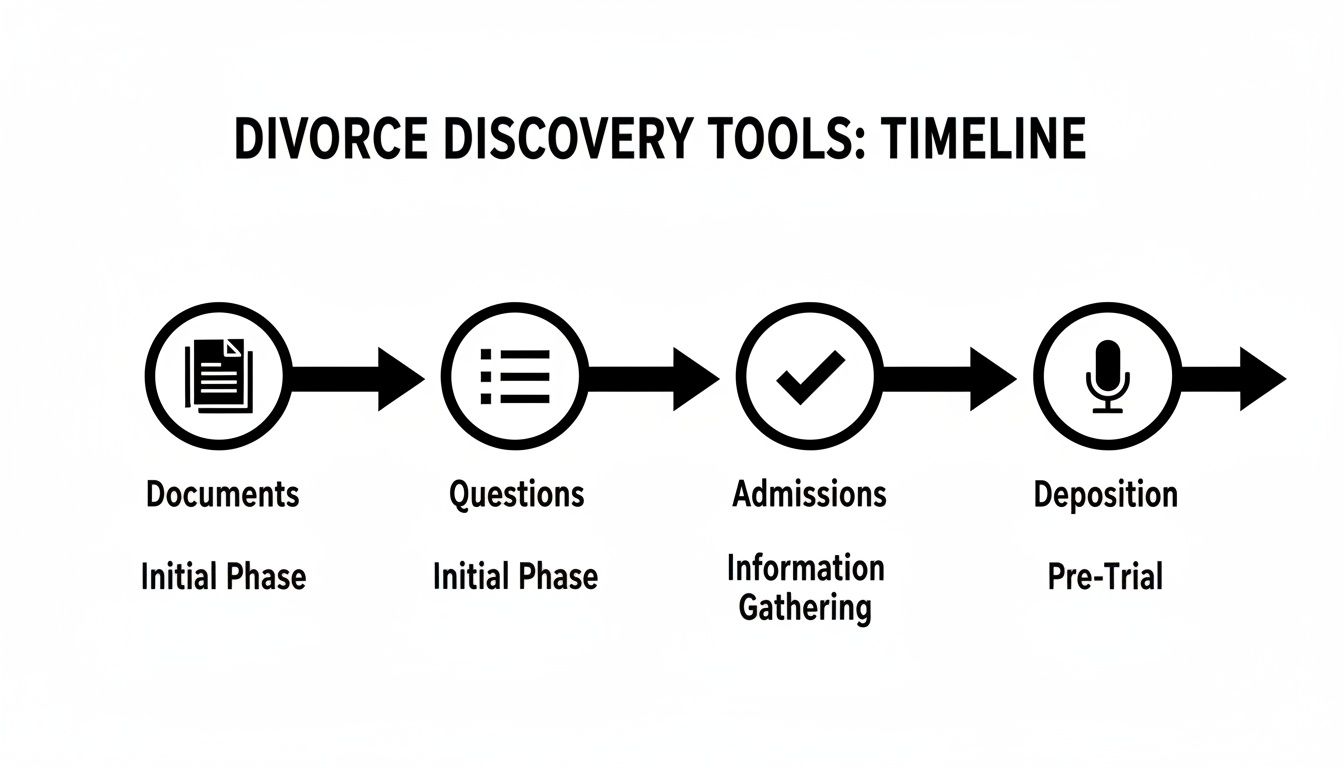
As you can see, each step—from initial document requests to face-to-face depositions—builds on the last, helping both sides assemble a complete and accurate picture of the marital estate.
Staying on top of these deadlines is one of the best ways to avoid unnecessary delays and extra legal fees in your divorce. At The Law Office of Bryan Fagan, we obsess over these details so you don't have to. We manage the calendar meticulously to ensure every deadline is met and your case moves along as smoothly as possible. If you're feeling overwhelmed by the discovery process, schedule a free consultation at our Kingwood office. We're here to give you the clear, practical guidance you deserve.
Your Essential Divorce Discovery Document Checklist
Receiving a formal request for documents can be one of the most intimidating moments in a divorce. It often feels like a demand for every piece of paper you’ve ever touched. For our clients here in Kingwood and the surrounding communities, our goal is to cut through that anxiety and replace it with organized control.
The best approach is to tackle it with a clear, simple checklist. When you break down the mountain of requests into manageable categories, you can start gathering what you need without feeling completely buried. Getting a head start not only smooths out the entire process but also significantly reduces stress, ultimately saving you time and money.

To make this easier, we've organized the typical document requests into the same core categories your attorney will use. Think of this as your roadmap for gathering the financial story of your marriage.
Core Documents for Divorce Discovery
Below is a straightforward table outlining the key documents you'll almost certainly need to locate and organize. This isn't an exhaustive list for every single case, but it covers the foundational paperwork required in most Texas divorces.
| Document Category | Examples of What to Gather |
|---|---|
| Financial Records | Statements for all checking, savings, investment, and retirement accounts (401(k)s, IRAs) for the last 3-5 years. This includes both joint and individual accounts. |
| Income & Employment | Personal and business tax returns (with all schedules and W-2s/1099s) for the last 3-5 years. Also include recent pay stubs and any employment contracts or bonus plans. |
| Property & Assets | Deeds, mortgage statements, and property tax records for any real estate. Vehicle titles and loan documents. Appraisals or receipts for valuable items like jewelry, art, or collectibles. |
| Debts & Liabilities | Credit card statements for all accounts for the last few years. Statements for mortgages, car loans, student loans, and any other personal loans or lines of credit. |
Starting with these categories helps you focus your efforts and see real progress, which can make a huge difference in your mindset during a challenging time.
Why Are All These Documents Necessary?
It’s natural to feel like these requests are invasive, but there's a clear legal purpose behind them.
The goal isn't to be nosy; it’s to create a complete and accurate balance sheet of your marital life. Texas law requires this transparency to ensure the court can make a "just and right" division of your community property.
Without this full picture, it's impossible to achieve a fair outcome. These documents are the evidence that tells the story of what you both own and what you both owe.
This structured exchange of information is standard practice. In fact, tax returns and several years of bank records are requested in 60–90% of contested divorces across the U.S. that involve property or support issues. Courts consistently uphold these requests because full financial disclosure is the bedrock of a fair resolution. You can discover more insights about divorce discovery standards to see how common this is.
By organizing your paperwork into these simple categories, you can turn a daunting task into a series of achievable steps. If you live in Kingwood, Humble, or anywhere in Northeast Houston and need help preparing for discovery, The Law Office of Bryan Fagan is here to provide practical, supportive guidance. Schedule a free consultation with our team today, and let us help you get organized for the road ahead.
Handling Common Discovery Roadblocks
In a perfect world, discovery would be a simple, cooperative exchange of information. But anyone who has gone through a tough divorce in Northeast Houston knows it rarely works that way. So, what happens when your spouse flat-out ignores requests, drags their feet on purpose, or worse, tries to hide assets? These are real-world problems, and thankfully, Texas law has real-world solutions.
It’s completely normal to feel frustrated and even helpless when you’re dealing with an uncooperative spouse. The key is to remember that you have options. Discovery isn't a suggestion; it’s a legal requirement. Ignoring it has consequences, and we know exactly how to enforce your rights.
Taking Action with a Motion to Compel
When your spouse blows past a discovery deadline without providing documents or answers, we don’t just sit back and wait. Our primary tool is filing a Motion to Compel. This is a formal, legal document we submit to the court explaining that the other party is refusing to play by the rules.
Filing this motion officially puts the problem on the judge's radar. The court will schedule a hearing to figure out if your requests were fair and if your spouse had any legitimate reason to refuse. In most standard divorce cases in Kingwood, the judge will side with the request for information and issue an order for the uncooperative spouse to produce everything by a new, non-negotiable deadline.
A Motion to Compel escalates your request into a direct court order. It's the legal system's way of saying, "The time for games is over. Comply, or face the consequences."
This step is absolutely critical. It holds the other party accountable and prevents them from using stall tactics to gain an unfair advantage or hide the truth.
The Consequences of Non-Compliance
Texas judges have very little patience for people who ignore their orders. If your spouse still refuses to cooperate after the court has compelled them, the penalties get much more serious. They could be facing:
- Fines: The court can hit them with monetary fines for their refusal to follow the order.
- Paying Your Attorney's Fees: A judge can order your spouse to reimburse you for the legal fees you spent just to get them to comply.
- Unfavorable Rulings: In more extreme situations, the court can punish them by refusing to let them introduce evidence related to the very topics they wouldn't provide information on.
These penalties exist for a reason—to protect your right to a fair process and an equitable division of your marital estate. The focus on fact-finding in divorce has become more robust as divorce itself has become more common. For context, global divorce rates climbed in the latter half of the 20th century, and the U.S. has consistently had one of the higher rates, which you can see in this breakdown of divorce rates by country on worldpopulationreview.com. This trend makes strong enforcement tools more vital than ever.
Successfully navigating these roadblocks means having an attorney who isn’t afraid to be firm. Knowing how to choose a divorce attorney with a proven track record in contested discovery is crucial for protecting your financial future.
At The Law Office of Bryan Fagan, we prepare our Kingwood clients for these potential fights from day one. We don’t back down, and we make sure you get the full and fair disclosure you are entitled to under the law. If you’re worried your spouse won’t be transparent, schedule a free consultation at our Kingwood office.
How Discovery Shapes Your Final Divorce Settlement
Discovery isn't just about shuffling through stacks of paperwork. It's the critical process of building the foundation for your final divorce agreement. For our clients here in Kingwood, grasping this is everything. The information you gather gives you negotiating power, and that power is what leads to a fair outcome. It takes the entire process from a he-said-she-said argument to a conversation based on cold, hard facts.
This is the phase where the real financial story of your marriage finally comes to light. In Texas, the law requires your marital estate to be divided in a "just and right" manner. But how can you get a fair division if you don't have a complete list of every single asset and debt? You can't. Discovery is how you get the proof needed to value everything correctly and make sure nothing gets hidden or overlooked.

From Information to Negotiation Strength
Think of every document you collect and every answer you get during discovery as a bargaining chip. Uncovering a secret bank account or getting a professional valuation for a family business in Humble can completely change the game. That's how simple information becomes real leverage.
When you can lay undeniable proof on the table—proof of an asset's true value or a hidden income stream—the entire dynamic of the negotiation shifts in your favor. Your spouse can no longer get by with vague statements or fuzzy math. This evidence-based strategy is exactly how our Kingwood attorneys argue for your fair share of the community property.
The information gathered during discovery is your most powerful tool in settlement negotiations. It allows you to advocate from a position of strength, ensuring the final agreement is based on reality, not assumptions.
This is why we push for a thorough discovery process from the start. It's not just a gut feeling; practitioner surveys show that when both sides have all the financial cards on the table, settlement rates go way up. In fact, comprehensive research indicates that a full exchange of documents leads to a negotiated agreement in an estimated 70–85% of financially contested cases, which means you're far less likely to face a costly trial. To see how these trends play out, you can read more about divorce statistics.
Impact on Support and Long-Term Stability
Discovery’s reach goes far beyond just splitting up property. The documents and testimony gathered are absolutely essential for getting child support right and figuring out if spousal support is needed.
Here’s a closer look at how it directly affects these critical issues for families in Northeast Houston:
- Child Support Calculations: Discovery verifies both parents' real income using pay stubs, tax returns, and business records. This ensures child support is calculated based on actual earnings, not just what a spouse claims to make.
- Spousal Support (Alimony): To make a strong case for spousal maintenance, you have to prove your financial need and your spouse's ability to pay. Discovery unearths the evidence for both—from bank statements showing your monthly expenses to investment records proving your spouse has the money to help. For a deeper dive, check out our guide on alimony in Texas.
At the end of the day, a well-handled discovery process is what protects your financial future. It ensures your divorce settlement is fair and sustainable, giving you the stability you deserve as you start your next chapter.
If you live in Kingwood or anywhere in Northeast Houston and have questions about how discovery will shape your settlement, The Law Office of Bryan Fagan is here to help. Contact us today for a free, confidential consultation to talk about your case.
Common Questions About Divorce Discovery in Texas
Going through a divorce brings up a lot of questions, and the discovery process is often at the top of the list for our clients in Kingwood and Humble. Let's tackle some of the most common concerns we hear so you can feel more prepared for what's ahead.
Here are the answers to the questions we get asked most often.
How Much Does The Discovery Process Cost?
There's no single price tag for discovery—it really depends on how complicated your case is. If you and your spouse are on the same page and willing to be transparent with your finances, the costs can be pretty low.
But if we're dealing with hidden assets, a complex family business in Kingwood, or a spouse who digs in their heels and refuses to cooperate, the costs will naturally go up. While it might seem like a big expense at the time, think of thorough discovery as an investment. Getting a complete and accurate financial picture from the start is one of the smartest things you can do to protect yourself and prevent expensive legal battles later on.
Can My Spouse Just Refuse to Provide Documents?
Absolutely not. While someone can object to a request that is genuinely irrelevant or way too broad, they can't just ignore the entire process. Texas law is very clear: both sides have to participate in good faith.
If your spouse won't cooperate, our Kingwood attorneys don't just let it go. We can file what’s called a Motion to Compel. This is a formal request asking the judge to order them to hand over the information. If they ignore a direct court order, they could face serious consequences, like fines or even being forced to pay your attorney’s fees for the trouble.
Your right to full financial disclosure is protected by law. A spouse’s refusal to cooperate is not the end of the road; it's a roadblock our legal team is fully prepared to overcome.
Is Discovery Necessary for an Amicable Divorce?
Even if you’re parting on good terms, we still strongly recommend a formal exchange of information. It protects both of you by making sure your final agreement is built on a solid foundation of accurate financial facts. This simple step can prevent huge misunderstandings and regret down the road.
For straightforward cases here in Northeast Houston where everyone is working together, we can use simpler, more streamlined methods. A Sworn Inventory and Appraisement, where you each list all assets and debts under oath, is a great way to get the same transparency without all the formal back-and-forth and expense.
Navigating the complexities of divorce discovery requires experienced guidance. At The Law Office of Bryan Fagan – Kingwood TX Lawyers, we are committed to providing our community with the support and legal skill needed to protect your future. If you are facing a divorce in Kingwood, Humble, or the surrounding Northeast Houston areas, contact us to schedule a free consultation to discuss your case. https://kingwoodattorneys.com