
An arraignment hearing is where a criminal case officially begins. It’s the first time you will stand before a judge in a Texas courtroom, be formally told what charges you’re facing, and be asked how you plead. This isn’t a trial to decide guilt or innocence, but it’s a critical first step where major decisions about your freedom, bail, and legal rights are made. For many folks in Kingwood, this is their very first, and often intimidating, encounter with the court system, and we want you to feel prepared.
Your First Day in Court: Navigating the Arraignment Hearing

Receiving a notice to appear in court is enough to make anyone’s stomach drop. Whether you’re making your way to a courthouse in Humble, Northeast Houston, or right here in Kingwood, feeling anxious is completely normal. The arraignment is your formal introduction to the criminal justice process, and simply understanding what is going to happen is the best way to feel more in control. At The Law Office of Bryan Fagan, we believe an informed client is an empowered client.
Think of the arraignment as the official kickoff for the legal proceedings. Its main purpose isn’t to weigh evidence but to handle essential administrative tasks.
Here is a practical, step-by-step rundown of what the court will do:
- Formally State the Charges: The judge will read the specific criminal accusations filed against you by the State of Texas.
- Verify Your Identity: The court confirms you are the correct person named in the legal documents.
- Inform You of Your Rights: You will be advised of your key constitutional rights, especially your right to have an attorney.
- Address Legal Representation: The judge will ask if you have hired a lawyer or if you need the court to appoint one.
- Take Your Plea: You will be asked to enter an initial plea—usually “guilty,” “not guilty,” or “no contest.”
- Set Bail and Release Conditions: The court determines if you can be released from custody while the case is pending and what rules you must follow.
This first court date truly sets the tone for everything that follows. The decisions made here can directly impact your freedom for the entire time your case is active.
Why This Hearing Is So Important for Kingwood Residents
Don’t mistake the arraignment for a simple formality. This is a pivotal moment where the conditions of your release are decided. For many defendants across Texas, this means dealing with a cash bond. The numbers paint a clear picture: national research shows that roughly 68% of defendants have a cash bond set at their arraignment, while only 21% are released on their own recognizance (a simple promise to return to court).
Unfortunately, a defendant’s actual ability to pay that bond is often overlooked, despite Texas law stating it should be considered. Having a strong local advocate in your corner at this stage is absolutely crucial. An experienced Kingwood criminal defense attorney can fight for a better outcome, like a personal recognizance bond or a much lower bail amount, so you can get back to your family and your job in our community while your case moves forward.
To give you a clearer idea, here is a quick summary of what happens.
Key Events at Your Arraignment Hearing
This table breaks down the main components you can expect during your arraignment hearing in the Kingwood area.
| Event | What It Means for You |
|---|---|
| Charges Are Read | The judge officially tells you what crimes the State of Texas has accused you of committing. |
| Rights Are Explained | You are informed of your constitutional rights, like the right to remain silent and the right to an attorney. |
| Counsel Is Addressed | The court will ask if you have a lawyer. If you cannot afford one, you can request a court-appointed attorney. |
| Plea Is Entered | You will enter an initial plea. Your attorney will almost always advise you to plead “not guilty” at this stage. |
| Bail/Bond Is Set | The judge decides the amount of money or conditions required for you to be released from jail while your case is pending. |
Understanding these steps can help take some of the mystery out of the process.
Navigating the legal system in our local courts requires a clear understanding of the process. Our firm is dedicated to providing practical guidance to our neighbors in Kingwood and the surrounding communities, ensuring you are prepared for every step.
Whether your case is in a Harris County court or over in Montgomery County, the arraignment is where your defense strategy officially begins. Knowing what to expect—from the moment your name is called to when your next court date is scheduled—is empowering. The Law Office of Bryan Fagan is here in Kingwood to make sure you have that knowledge and support from the very start.
Who Is in the Courtroom
Walking into a courtroom for the first time can be incredibly intimidating. It often feels like you’ve been dropped into the middle of a play where everyone knows their lines but you. This is especially true in the local courts around Northeast Houston.
Getting a handle on who’s who and what they do is a simple but effective way to dial down the anxiety. When you can identify the key players, the whole process of an arraignment hearing becomes much less mysterious, and you can feel more in control.
The Key Players and Their Roles
You will see a handful of people in the courtroom, and each has a very specific job. Here’s a quick rundown of who you will meet.
1. The Judge
Sitting up high on an elevated bench, the judge is the ultimate authority in the room. They act as a neutral referee, making sure all the rules are followed. During your arraignment, the judge will officially read the charges against you, explain your rights, and make the critical decisions about your bail and any conditions for your release.
2. The Prosecutor (Assistant District Attorney)
This is the lawyer for the government. In our area, whether it’s Harris or Montgomery County, they are called an Assistant District Attorney, or ADA. It is crucial to understand they represent the State of Texas—not the person who may have accused you of a crime. Their job is to prosecute the case, and at the arraignment, they will state the charges and often argue for a higher bail amount or stricter release conditions.
3. Your Defense Attorney
This is your advocate. Your criminal defense attorney is the only one in the entire courtroom whose job is to protect you. They will stand right beside you, speak for you, advise you on how to plead, and fight for the best possible outcome on bail. They are your shield and your guide through this process.
Having a local Kingwood attorney in your corner means they don’t just know Texas law; they know the local players. They understand the tendencies of the judges and prosecutors right here in our community, which is a huge advantage right from this very first hearing.
4. The Court Clerk
The clerk is the administrative heart of the courtroom. They handle all the official paperwork, create the official record of what happens, and manage the judge’s busy schedule. You will usually see them sitting close to the judge, dealing with files and computer systems.
5. The Bailiff
The bailiff is a uniformed law enforcement officer—usually a sheriff’s deputy—who keeps the courtroom safe and orderly. They are in charge of security, and they also call the cases and make sure everyone adheres to courtroom etiquette.
Once you can put a role to each face, the courtroom starts to feel less like a foreign land. It is a formal environment, yes, but it is run by people with clear responsibilities. Having an experienced Kingwood attorney by your side ensures you have a powerful voice among them. At The Law Office of Bryan Fagan, we are ready to be that voice for you.
The Arraignment Process in Texas Step-by-Step
Knowing what’s coming can make a world of difference when you’re facing a court date. While no two cases are exactly alike, arraignment hearings in Texas—whether in Kingwood, Humble, or elsewhere in Harris County—follow a well-established script.
Think of it as the formal kickoff for your case. It is usually over in just a few minutes, but what happens in that short time sets the stage for everything that follows.
Your Case Is Called
The first thing you will notice is that the courtroom is a busy place. You will take a seat and wait for the bailiff or clerk to call your name and case number. When they do, you will walk to the front and stand before the judge, with your attorney right beside you.
Formal Identification and Charges
The judge’s first order of business is simple: confirming you are who you say you are. They will ask you to state your name for the record.
Once that is done, the judge or prosecutor will read the official charges the State of Texas has filed against you. Hearing the accusations stated so bluntly in a public courtroom can be unsettling. This is one of the first moments you will be glad to have an experienced Kingwood attorney standing with you, offering quiet support.
Explanation of Your Constitutional Rights
Next, the judge will recite a list of your constitutional rights. This isn’t just a formality; it’s a critical protection guaranteed by our justice system.
The judge will confirm that you understand you have:
- The right to remain silent and not say anything that could incriminate you.
- The right to a trial by jury.
- The right to be represented by an attorney.
- The right to confront any witnesses who testify against you.
Listen carefully, but don’t worry—your lawyer will have already walked you through these rights in much greater detail before you even set foot in the courthouse.
Entering Your Plea: The Most Important Decision
After your rights are read, the judge will ask how you plead to the charges. At this point, you have three main choices: guilty, not guilty, or no contest (nolo contendere).
Crucial Advice: In 99.9% of cases, the only plea you should enter at your arraignment is “not guilty.” Pleading guilty this early is like forfeiting the game after the kickoff. You immediately give up your chance to review the evidence, negotiate with the prosecutor, or build any kind of defense.
A knowledgeable criminal defense attorney will always advise you to plead not guilty. This does not mean you are lying; it simply signals to the court that you are using your constitutional right to make the State prove its case.
This infographic shows the key players involved in the process. Your attorney is the critical advocate working on your behalf with the judge and prosecutor.
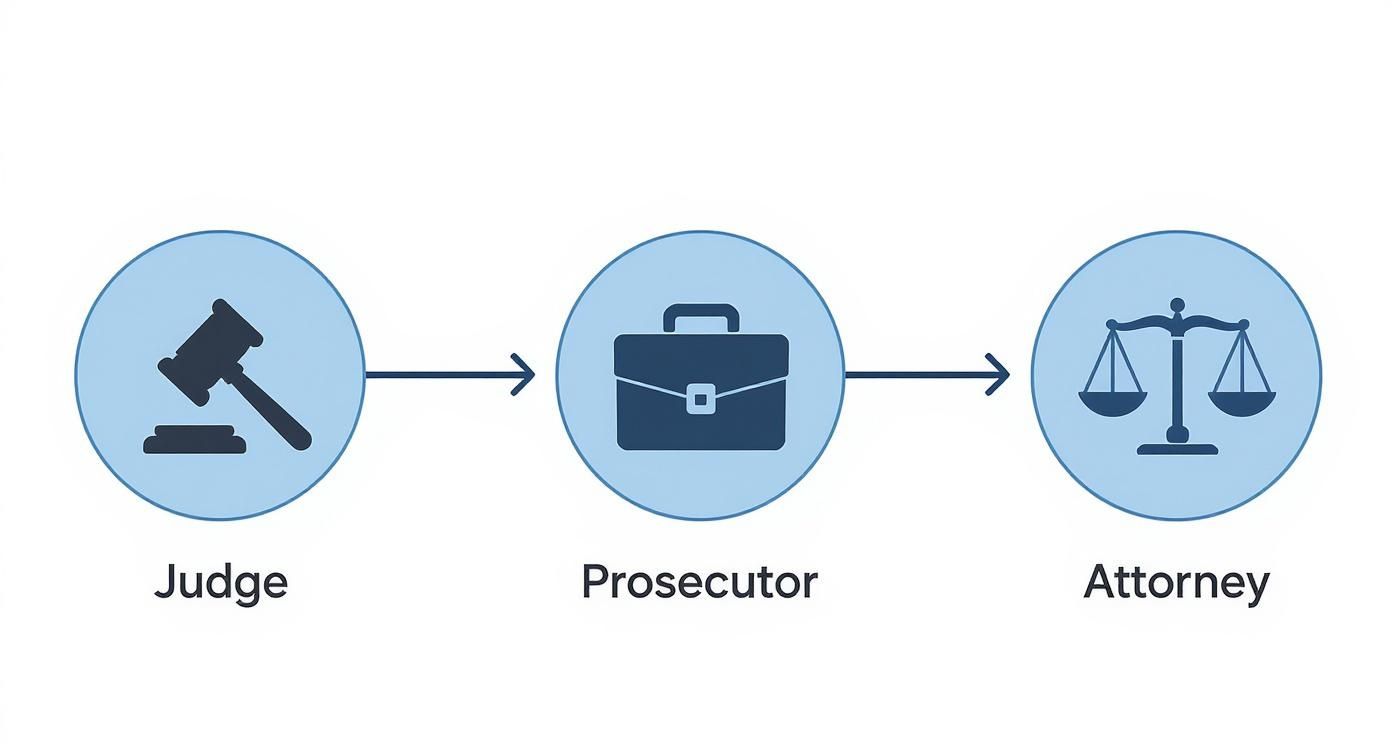
As you can see, your lawyer is the central figure fighting for you, ensuring your voice is heard and your rights are protected every step of the way.
Now, let’s take a closer look at what each plea option really means in a Texas courtroom.
Understanding Your Plea Options at Arraignment
| Plea Type | What It Means | Recommended for Arraignment? |
|---|---|---|
| Not Guilty | You are formally denying the charges and exercising your right to make the prosecution prove their case beyond a reasonable doubt. | Yes. This is almost always the correct plea at this stage. It keeps all your legal options open. |
| Guilty | You are admitting to the charges. You give up the right to a trial and proceed directly to sentencing. | Almost Never. This is an irreversible decision that should only be made after extensive consultation with your lawyer. |
| No Contest | You are not admitting guilt, but you are not disputing the charges. The court will find you guilty and proceed to sentencing. | No. While it can be useful in very specific situations later on, it is not the right move at arraignment. |
Pleading “not guilty” is the standard, strategic move that allows your attorney the time and opportunity to build the strongest possible defense for your case.
Setting Bail and Conditions of Release
The final piece of the arraignment puzzle is bail. This is often where the first real battle is fought. The prosecutor might argue for a high bail amount, painting you as a flight risk or a danger to the public.
This is where having a sharp local attorney truly pays off. Your lawyer will be ready with counter-arguments, emphasizing your ties to the Kingwood or Northeast Houston community, your job, and your family. The mission is simple: secure your release under the best possible terms.
This could look like:
- A Personal Recognizance (PR) Bond: This is the best-case scenario—a written promise to return to court that doesn’t require you to post any money.
- A Lower Bail Amount: We argue for a bond that is fair and that you and your family can actually afford.
- Fewer Release Conditions: We push back against unnecessary and burdensome conditions like GPS monitoring or frequent check-ins.
The judge’s decision on bail determines whether you go home to your family or sit in a jail cell while your case moves forward. Having a powerful advocate from The Law Office of Bryan Fagan fighting for your freedom at this critical moment can make all the difference. Contact our Kingwood office today for a free consultation to discuss your case.
Protecting Your Rights at the Hearing
Knowing your rights is one thing, but actually putting them into action when you’re standing in a Kingwood courtroom is another entirely. An arraignment isn’t just a formality. Think of it as the first line of defense where your fundamental protections are either properly defended or carelessly brushed aside.
The U.S. Constitution and Texas law give you several critical shields from the very beginning of your case. These are practical tools that a skilled lawyer uses to guard your freedom.
The Right to an Attorney
This is, without a doubt, the most important right you have at this stage. The judge will ask if you have a lawyer, and if you cannot afford one, the court is required to appoint one for you. Having an attorney is not an admission of guilt; it’s a sign that you are taking the situation seriously.
Your lawyer is your guide, your advocate, and your voice. At The Law Office of Bryan Fagan, our team—including experienced attorneys like Ryan R. Putz—is dedicated to standing with our Kingwood neighbors from this very first hearing.
The Right to Remain Silent
Everyone has heard the line, “You have the right to remain silent.” At your arraignment, you should only speak when the judge speaks directly to you, and even then, your attorney will guide you on what to say.
Anything you say can and will be used against you. A simple, off-the-cuff comment you think is helpful can easily be twisted by the prosecution. By exercising your right to stay quiet, you prevent yourself from accidentally damaging your own defense before it has even started.
At The Law Office of Bryan Fagan, we advise our Kingwood clients to let us do the talking. Our job is to communicate for you, making sure your own words aren’t turned into weapons against you.
Your Fundamental Rights and Responsibilities
Beyond those two core protections, you have other rights and a few key responsibilities to keep in mind.
Your Additional Rights Include:
- The Right to Be Informed of the Charges: You cannot defend yourself against secret accusations. The court must clearly tell you exactly what offenses the state is charging you with.
- The Right to Reasonable Bail: While release isn’t guaranteed, Texas law is clear that bail cannot be excessive or used as a form of punishment. Your attorney will argue for a fair bond amount based on factors like your ties to the Humble or Porter community, your job, and your family life.
Your Responsibilities Include:
- Appearing at the Hearing: This is non-negotiable. You absolutely must show up for your court date on time. A “Failure to Appear” (FTA) leads to serious problems, like an immediate warrant for your arrest.
- Following Courtroom Rules: This is all about respect. Dress appropriately, address the judge as “Your Honor,” and be quiet and attentive. Showing respect for the court process leaves a much better impression.
Getting defendants to show up for court is a huge logistical challenge. In fact, one study found that without any reminders, only about 47.3% of defendants make it to their arraignment. Simple interventions like text message reminders were shown to boost appearance rates by 9.5%, which shows how easy it is to miss a date without the right support.
Trying to manage these rights and responsibilities on your own is a tough road. The legal system is complex, and one mistake at the arraignment can cause problems for the rest of your case. Having a Kingwood attorney from our firm ensures your rights are actively and aggressively defended from day one.
Don’t leave your future to chance. Schedule a free consultation with The Law Office of Bryan Fagan in Kingwood today, and let us protect what matters most.
So, the Arraignment is Over. What’s Next?
The moment the judge’s gavel falls and the arraignment hearing ends, you might feel a huge weight lift off your shoulders. But that relief is often quickly followed by a simple question: “Now what?” It is crucial to understand that the arraignment isn’t the finish line—it’s the starting pistol. For our clients here in Kingwood and across Northeast Houston, this is the point where the real work on their defense begins.
Once you are out of that courtroom, your case officially moves into the pre-trial stages. This is where your legal team pivots from the fast-paced mode of an arraignment to a proactive, strategic game plan.
The Discovery Phase: Seeing the Prosecutor’s Hand
The very first move your defense attorney will make is to file a request for discovery. This is a formal legal demand that forces the prosecutor to hand over every single piece of evidence they have against you. This is a fundamental constitutional right, ensuring you know exactly what you are up against.
The prosecutor’s file may include:
- Police Reports: The official story from the arresting officers’ perspective.
- Witness Statements: What people who were allegedly there saw or heard.
- Physical Evidence: Lab results from a breathalyzer, photos from the scene, or any objects they collected.
- Video & Audio: This is a big one. We are talking body cam footage, dash cam video, and surveillance recordings, which often tell a very different story than the written reports.
For our clients in Humble and Porter, this discovery phase is often where the cracks in the state’s case start to show. It is where we pinpoint sloppy police work, conflicting stories, or clear violations of your rights—all of which become the building blocks for a powerful defense.
Pre-Trial Conferences and Negotiations
With all the evidence on the table, the next phase usually involves a series of pre-trial conferences. These are meetings between your lawyer, the prosecutor, and sometimes the judge. The purpose is to hash out the case, argue legal points, and see if a resolution can be reached without a trial.
This is where your attorney’s experience as a negotiator truly shines. They will highlight the weaknesses in the prosecution’s case and open a dialogue about potential outcomes. These discussions can lead to:
- Plea Bargains: Working out a deal for a lesser charge or a more lenient sentence.
- Case Dismissal: Arguing that the evidence is simply too weak to move forward.
- Alternative Programs: Exploring options like pre-trial diversion, which can lead to the charges being completely dropped once you’ve met certain conditions.
These negotiations are a massive part of what happens after an arraignment. A huge number of criminal cases in Texas get resolved in this stage, long before a trial.
The time between your arraignment and a potential trial isn’t just a waiting game—it’s a period of intense strategic preparation. Each piece of evidence is a puzzle piece, and our job is to see if they actually fit together to create the picture the prosecutor is trying to paint.
Filing Motions to Level the Playing Field
As your attorney dissects the evidence, they might file a variety of legal motions. A motion is just a formal request asking the court to do something specific. For instance, if the police searched your car without a warrant or probable cause, your lawyer would file a Motion to Suppress Evidence. If the judge grants it, any evidence found during that illegal search gets thrown out. This move alone can cripple a case.
Other motions might ask the judge to dismiss the case entirely. Every motion is a strategic tool designed to protect your rights. This entire process shows why you can’t go it alone. From our Kingwood office, we walk our clients through every one of these steps, making sure they are always informed, prepared, and represented with strength.
If you or someone you know has just had an arraignment, the journey is just beginning. Contact The Law Office of Bryan Fagan today for a free consultation to discuss your next steps.
How a Kingwood Defense Attorney Can Help

Walking into a courtroom by yourself for an arraignment is like trying to navigate a maze blindfolded. The stakes are incredibly high, and even a small misstep can impact your entire case. That is why having an experienced Kingwood defense attorney at your side is not just a good idea—it is absolutely essential.
From the moment you hire our firm, we get to work building a protective shield around you. A lawyer is not just someone who shows up for a court date; we are your strategist, your advocate, and your guide through a system that can feel confusing and intimidating. Our very first step is to sit down with you and explain exactly what to expect so there are no surprises.
We make sure you understand your rights and feel as prepared as possible before you even walk into the courthouse. This preparation helps demystify the process, replacing fear with focus.
Protecting You Inside the Courtroom
When you stand before the judge, your attorney is right there with you. We handle all the talking with the court, which is critical to make sure you do not accidentally say something that could be used against you later.
During the arraignment itself, our legal team takes specific, immediate actions on your behalf:
- Advising on the Correct Plea: We will almost always enter a plea of “not guilty” for you. This is a vital strategic move that preserves all of your legal options.
- Reviewing the Charges: We carefully examine the official complaint filed against you, looking for any errors or inconsistencies that we can challenge right from the start.
- Protecting Your Rights: We are there to be the guardians of your constitutional rights, from your right to remain silent to your right to a fair and just process.
This active defense begins from the first minute you’re in court, setting a firm, confident tone for the rest of your case.
Fighting for Your Freedom on Day One
Perhaps the most important thing an attorney does at an arraignment is argue for fair bail and release conditions. The prosecutor will often push for a high bail amount, a tactic that can keep you locked up while your case moves forward. We push back.
We present a clear picture of who you are—your job, your family, your ties to the Kingwood community—to argue for your release on a personal recognizance (PR) bond or for a bail amount that is actually reasonable and affordable. The outcome of this argument decides whether you go home or stay in jail. The role of money in bail has grown significantly; where money bail was used in 53% of felony cases in 1990, that number jumped to 70% by 2006. The problem is, only about five out of six defendants who get a financial bail can actually afford to post it.
Having a dedicated Kingwood attorney from The Law Office of Bryan Fagan means you have a powerful advocate fighting for your freedom when it matters most. We understand the local courts and know how to make a compelling case for your release.
A skilled lawyer also prevents you from making common but devastating mistakes. We stop our clients from talking to the prosecution, from accepting a bad plea deal out of fear, and from agreeing to release conditions that are overly restrictive. Our job is to be your shield.
The arraignment is the first battle in what can be a long fight. Facing it with a dedicated criminal defense team from our Kingwood office ensures you are treated as a person with rights, a story, and a powerful voice.
If you or a loved one is facing an arraignment in Kingwood, Humble, or anywhere in Northeast Houston, please do not go through it alone. Contact The Law Office of Bryan Fagan today to set up your free, confidential consultation. Let us stand with you from the very beginning.
Frequently Asked Questions About Arraignments
Heading to court for the first time brings up a ton of practical questions. We get calls all the time from folks in Kingwood, Humble, and the surrounding areas with these exact concerns. Getting straight answers can make all the difference, so we have put together a few of the most common questions we hear about what happens at an arraignment hearing.
What Should I Wear to My Arraignment Hearing in a Kingwood-Area Court?
First impressions matter, especially in a courtroom. The simplest rule is to dress like you’re going to a job interview or a church service. Think business casual.
For men, that means a pair of slacks and a collared shirt. For women, a conservative dress, skirt, or pantsuit works perfectly. It is all about showing respect for the court and the process. You want to leave things like jeans, shorts, t-shirts, hats, or sandals at home.
Showing up dressed appropriately sends a clear message: you’re taking this seriously.
Can My Case Be Dismissed at the Arraignment?
This is a common hope, but the honest answer is that it’s extremely rare. An arraignment isn’t the place where your lawyer argues the facts of your case or presents evidence.
Think of it more like an administrative kickoff meeting. The court is officially starting the case, not deciding it. The real work of getting a case dismissed happens later, after your attorney has had a chance to dig into the evidence and file strategic legal motions.
Do I Have to Speak to the Judge Myself?
If you have a lawyer, they will do virtually all the talking. This is one of the biggest advantages of having an attorney with you from day one.
The judge might ask you to state your name for the record or confirm you understand your rights after they have been explained. But that is it. Your lawyer will handle entering your plea, speaking to the prosecutor, and arguing about your bail conditions. This is critical—it keeps you from accidentally saying something that could hurt your case later on.
At The Law Office of Bryan Fagan, we make sure our Kingwood clients walk into that courtroom knowing exactly what to expect. We will be right there beside you, speaking on your behalf and steering you clear of the common pitfalls people face.
What Happens if I Miss My Arraignment Date in Northeast Houston?
Failing to show up for your arraignment is a huge mistake with serious, immediate consequences. If you miss your court date, the judge will issue a bench warrant for your arrest.
On top of that, you will lose any bond money that you or your family posted. If a legitimate emergency keeps you from making it to court, you need to contact a Kingwood attorney right away. We can often get in touch with the court for you, explain what has happened, and ask to reset the date, which can be the key to avoiding that arrest warrant.
Trying to figure out the legal system is overwhelming, but you don’t have to do it by yourself. The team at The Law Office of Bryan Fagan – Kingwood TX Lawyers is here to answer your questions, stand up for your rights, and walk you through every single step. Give our Kingwood office a call today for a free, confidential consultation. Let our experience be your advantage.