Skip to content
When your family is navigating a separation or divorce, nothing feels more important than making sure you remain a constant and loving presence in your children's lives. In Texas, the law provides a specific framework to protect this relationship, though the terminology can be a little confusing at first. What most of us call "visitation" is legally known as "possession and access."
Understanding Visitation Rights in Kingwood
Going through a separation is an emotional rollercoaster. For families in Kingwood, Humble, and the surrounding Northeast Houston area, getting a handle on your legal rights is the first solid step you can take toward building a stable new normal for you and your kids.
Texas law deliberately uses the terms possession and access instead of "visitation." This isn't just legal jargon; it’s a meaningful distinction. The language moves away from the idea that you are just a "visitor" in your child's life. Instead, it affirms your right to have physical possession of your child during scheduled times. The ultimate goal, as a Kingwood court will always emphasize, is to serve the child's best interests by fostering a strong, healthy connection with both parents.
The Possession Order: A Roadmap for Co-Parenting
The cornerstone of Texas visitation rights is the Possession Order. This is a formal, legally binding document signed by a judge that maps out exactly when each parent has the right to have the child. Think of it as a clear and predictable guide for your co-parenting journey.
A well-drafted Possession Order removes the guesswork and helps prevent future disagreements by clearly defining the schedule.
- Weekend and Weekday Schedules: It specifies when the child will be with each parent throughout the school year.
- Holiday Divisions: It details how you’ll share or alternate major holidays like Thanksgiving and Christmas.
- Summer Vacation: It lays out a plan for how extended summer breaks will be handled.
This court-ordered schedule provides the consistency that children and parents both need to thrive. For a Kingwood family, it means you'll know exactly how to plan around Humble ISD school breaks or coordinate summer plans when one parent lives in Kingwood and the other in Porter.
The point of a Possession Order isn’t about creating a winner and a loser. It's about establishing a reliable routine that supports your child’s emotional stability and protects your relationship with them, no matter how your family's shape has changed.
Here at The Law Office of Bryan Fagan, our Kingwood attorneys know that no two families are the same. We are a local, client-focused firm providing trusted representation right here in your community. Our job is to help you see how the law fits your unique situation, cut through the legal confusion, and offer the compassionate, practical advice you need to protect your family.
If you have concerns about your visitation rights in Kingwood, Texas, you don't have to figure this out alone. Our local team is ready to listen, answer your questions, and explain your options. We invite you to schedule a free, no-obligation consultation at our Kingwood office to talk about your case and find a clear path forward.
How the Texas Standard Possession Order Works
So, what does a typical visitation schedule actually look like for a family in Kingwood or Humble? When parents can’t agree on a schedule, Texas courts have a default starting point: the Standard Possession Order (SPO). This is the state's standard custody calendar, designed to create a consistent and predictable routine for children.
The SPO is designed to ensure both parents get meaningful time with their children and to keep the child's life as stable as possible after a separation. It is most often used when parents live within 100 miles of each other, which is common for families here in the Northeast Houston area. For instance, it’s a perfect fit if one parent stays in Kingwood and the other moves to a nearby community like Porter or Atascocita.
This schedule becomes the blueprint for your court order, clearly laying out who has the children on which weekends, holidays, and summer breaks.
Breaking Down the Standard Schedule
Under the SPO, the court will name one parent the "primary managing conservator." In simple terms, this is the parent who gets to decide where the child lives. The other parent is named the "possessory conservator," and the SPO spells out their specific visitation schedule.
Here is a practical look at the possessory conservator’s schedule:
- Weekends: They will typically have the children on the first, third, and fifth weekends of any given month.
- Holidays: Major holidays like Thanksgiving and Christmas are split and alternated every year, ensuring each parent gets a chance to build those cherished holiday memories.
- Summer Vacation: This parent usually gets an extended period with the children, typically 30 days, during the summer break.
This predictable rhythm removes the uncertainty and potential for conflict that can come from negotiating the schedule week after week. For a Kingwood family, it means everyone knows exactly what to expect for Humble ISD's spring break or summer vacation.
To help you see how this all fits together, the timeline below shows the journey from a family's separation to getting a formal Possession Order in place.
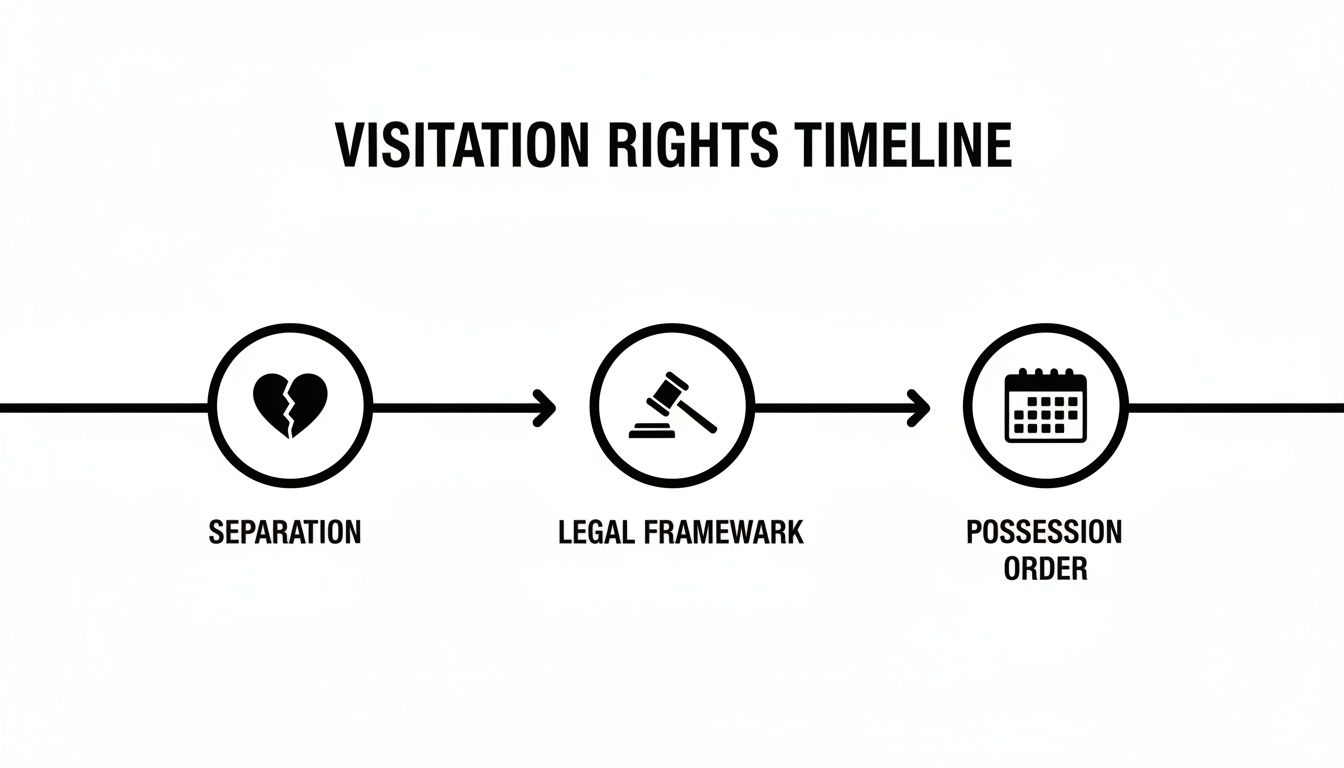
As you can see, a Possession Order isn't just a legal document. It's the final piece of the puzzle that provides structure and stability after the emotional upheaval of a separation.
For a clearer picture, here’s a quick summary of what the possessory conservator's time typically looks like under a Texas Standard Possession Order.
Typical Texas Standard Possession Order Schedule
| Time Period | Possessory Conservator's Visitation |
|---|---|
| School Year Weekends | First, third, and fifth weekends of the month. |
| Summer | 30 days of possession (can be broken up or taken at once). |
| Thanksgiving | Alternating years (e.g., parent gets them in even-numbered years). |
| Christmas/Winter Break | Split, with possession in alternating years. |
| Spring Break | Alternating years. |
This table gives a general outline, but keep in mind that the specific pickup and drop-off times are also detailed in the final court order.
Is the Standard Order Always the Rule?
Not at all. While the SPO is the default, it's not a rigid, one-size-fits-all mandate. A judge's primary duty is to make a decision that is in the best interest of the child. If the standard schedule simply won't work for your family, the court has the authority to customize it.
The law recognizes that every family is different. The Standard Possession Order is a strong foundation, but it's not set in stone. The goal is to create a schedule that truly supports your child's well-being and protects your parent-child relationship.
For example, what if you're a firefighter in Humble or a nurse in Northeast Houston with a non-traditional work schedule? Or perhaps your child has special needs that require a more unique routine. In those situations, we can help you negotiate a modified order that actually fits your life. Because Texas Standard Possession Orders are a familiar statewide framework, judges are accustomed to making practical adjustments when a family's situation calls for it.
Grasping the details of the SPO is one of the most important things you can do to protect your time with your children. You can learn even more about how a Standard Possession Order in Texas is drafted in our detailed guide. The key takeaway is that you have options, and an experienced local attorney can help you shape an order that works for your family.
Trying to figure out a Possession Order on your own can feel incredibly overwhelming, but you don't have to go it alone. The family law attorneys at The Law Office of Bryan Fagan are here every day helping people just like you. We serve clients throughout Kingwood and Northeast Houston, offering straightforward advice to protect what matters most. If you're ready to talk about your situation, we offer a free, reassuring consultation to help you find the best path forward for you and your family.
When the Standard Order Is Not the Right Fit

The Texas Standard Possession Order is a solid foundation, but real life in places like Kingwood, Humble, and Porter is rarely standard. Texas law understands this. That’s why a judge’s primary duty is to do what is in the best interest of the child, even if that means setting the standard order aside.
Sometimes, the standard schedule is simply impractical. More importantly, there are times when it just isn’t safe. If there are legitimate worries about a child’s physical safety or emotional well-being, a Harris County court won't hesitate to create a custom, non-standard, or even a restricted possession schedule. This isn't about convenience; it's about putting your child’s safety first.
However, adjustments also account for the realities of modern working families. For many parents in the Northeast Houston area, a typical 9-to-5 schedule doesn’t reflect their reality.
When Supervised Visitation Is Necessary
The most significant departure from a standard order is when a court mandates supervised visitation. This is a serious, protective step taken when there's evidence suggesting a parent could be a risk to their child if left alone.
A judge will not order this on a whim. It’s a measure reserved for situations involving credible allegations or a documented history of:
- Family violence or domestic abuse
- Child neglect or endangerment
- Recent drug or alcohol abuse
- Significant mental health struggles that could impair parenting
- A real risk of the parent attempting to abduct the child
In these difficult cases, the court’s aim isn't to punish the parent. It’s about allowing the parent-child relationship to continue, but only within a controlled environment that guarantees the child is safe.
The purpose of supervised visitation is not to punish a parent but to protect a child. It creates a safe bridge, allowing a child to maintain contact with a parent while serious concerns are being addressed.
For a parent in Kingwood terrified about their child's safety, this legal tool can bring an incredible amount of peace of mind, knowing that any visit will be monitored and secure.
How Supervised Visitation Works in Harris County
When supervised visitation is ordered, an approved adult must be physically present for the entire visit. The court order will be very specific about who can serve as the supervisor.
Who Can Supervise?
The judge will name the person or entity in the final order. Common choices include:
- A neutral family member or friend that both parents agree on.
- A professional supervisor at a designated visitation facility.
- A licensed social worker or therapist.
These details are just one piece of a much larger puzzle. An order for supervised visitation often ties into other crucial decisions about a child's life, like who makes educational choices or how child support is calculated. To see just how interconnected these issues can be, you can read more about a recent Texas appellate case on dallasdivorcelawyer.com that breaks down a real-world example.
Customizing Schedules for Non-Traditional Work
Of course, not every change to the standard order stems from a safety issue. Many parents right here in our community—from first responders and nurses to refinery workers—have careers that don't fit the "first, third, and fifth weekend" mold.
If your work schedule is non-traditional, we can help you build a custom possession order that actually works. This could mean a two-week rotating schedule, specific weekday visits that match your days off, or another creative solution. As long as you and the other parent can agree, or if you can prove to the judge that your plan is in your child's best interest, they are usually very open to approving a practical, customized schedule.
We understand that facing a situation that calls for something other than a standard order can feel overwhelming. Whether you're worried about your child's safety or just trying to make a schedule fit your demanding job, you have options. At The Law Office of Bryan Fagan, our experienced Kingwood attorneys navigate these sensitive cases, providing strong, compassionate guidance to protect your child and your parental rights.
If you believe a standard order won’t work for your family, contact our Kingwood office today for a free consultation. We'll listen to your story and help you secure a possession order that truly serves your child.
Protecting a Father's Right to Parenting Time

For fathers in Kingwood, one of the biggest anxieties that comes with a divorce or separation is the fear of being pushed out of their child's life. It's a worry we hear all the time at our Kingwood office, often based on the outdated idea that courts automatically side with mothers.
Let us be clear: that is not how it works in Texas anymore.
Texas law is gender-neutral. A judge cannot base a custody decision on whether a parent is the mother or the father. Every single ruling on conservatorship and possession schedules hinges on one guiding principle: the best interest of the child. This means that as a father, you walk into a Harris County courtroom on equal legal footing. Your rights matter, and your role as a parent is seen as essential.
What Texas Courts Look for from Fathers
So, if a judge isn't looking at gender, what are they looking at? They’re examining your history of involvement. They want to see which parent has been hands-on, taking care of the day-to-day needs of the child.
A judge will want to know who has typically been responsible for things like:
- Taking the child to doctor and dentist appointments in Kingwood or Humble.
- Showing up for parent-teacher conferences and helping with schoolwork.
- Handling the morning routine and getting the child ready for school.
- Coaching the little league team or driving to and from extracurriculars.
The more you can show a consistent pattern of being an active, engaged dad, the stronger your case will be. It’s not about grand gestures; it’s about proving you’ve been there for all the small, important moments that define parenting.
A common misconception is that fathers have to fight an uphill battle for visitation rights in Kingwood. The truth is that Texas courts want to see both parents actively involved. Your documented history as a dedicated father is your most powerful asset.
Setting Realistic Expectations for Parenting Time
While the law gives you an equal shot, it's also important to understand what real-world outcomes often look like. Even when both parents are fantastic, the division of time isn't always a perfect 50/50 split. Statewide statistics show that, on average, fathers in Texas are awarded around 33% of the parenting time in standard possession orders.
That number isn’t a hard limit; it’s a realistic benchmark that shows why having an experienced family law attorney is so critical. Our job is to build a powerful case that highlights your specific contributions as a father and fight for the maximum amount of time that serves your child's best interest. You can read more about how we help fathers by exploring our resources on father's rights in Texas.
For dads in Kingwood, Humble, and Porter, protecting the bond with your child is everything. At The Law Office of Bryan Fagan, we are a local, client-focused firm committed to making sure your side of the story is heard and that your rights are secured in a clear, enforceable court order.
You aren't a "visitor"—you are a parent. If you’re worried about securing your time with your child, we invite you to book a free, confidential consultation at our Kingwood office. Let's sit down, talk about your family, and build a strategy to protect your future together.
Modifying or Enforcing Your Visitation Order
A court order for possession and access is supposed to bring clarity and stability. But life in Kingwood, Humble, and the surrounding areas is anything but static. A visitation schedule that worked perfectly when your kids were toddlers might be completely unworkable now that they're teenagers with their own jobs and social lives.
The good news is that Texas law understands that life happens. You are not trapped by an outdated order. On the other hand, if the other parent is ignoring the current order, you have legal options to protect your time with your children.
How to Modify a Visitation Order in Harris County
To change your current visitation schedule, you must show that there has been a “material and substantial change in circumstances” since the last order was signed. This is the legal standard, and it's there to prevent parents from running back to court for every minor disagreement.
What does a "material and substantial change" look like for a family in our area? It’s a significant life event like one of these:
- A big move: One parent takes a new job and moves from Kingwood to another city, making the old weekend pickup schedule impossible.
- A new work schedule: A parent who used to work a predictable 9-to-5 job is now working nights or rotating shifts, which constantly clashes with their scheduled time.
- Your child's life changes: As kids get older, their needs and wishes become a bigger factor. A teenager’s packed schedule of school, sports, and a part-time job might make the old, rigid schedule a source of conflict.
- A parent's situation improves: A parent may have successfully addressed a past issue, like substance abuse, that once made supervised visitation necessary. Now, a less restrictive order is in the child's best interest.
The first step is to file a "Petition to Modify the Parent-Child Relationship" with the Harris County court. This document explains what has changed and proposes a new schedule that is best for your child. For practical, step-by-step guidance on this legal process, you can learn more about child custody modification in Kingwood right here on our site.
What Happens When a Parent Violates the Order?
It is incredibly frustrating to show up for your scheduled weekend in Porter, only to have the other parent refuse to let you see your child. This isn't just a broken promise; it's a direct violation of a court order.
You do not have to accept it. You have the right to file an enforcement action. This is a legal proceeding where you ask a judge to force the other parent to follow the rules of your Possession Order.
When a parent decides to ignore a court-ordered visitation schedule, they aren't just messing up your weekend plans—they are breaking the law. An enforcement action is your tool for holding them accountable and reclaiming your precious time with your child.
To win an enforcement action, your documentation is crucial. You must be crystal clear about every date and time you were denied your court-ordered possession. The more detailed your notes, texts, and emails are, the stronger your case will be.
Consequences for Violating a Visitation Order
Harris County judges do not take it lightly when parents willfully disobey their orders. If the court finds that your co-parent violated the schedule without a valid reason, the judge has several powerful remedies.
Potential outcomes of a successful enforcement action include:
- Make-Up Time: The judge will almost certainly order make-up visitation to compensate you for the time you lost.
- Fines and Attorney's Fees: The non-compliant parent can be fined and ordered to repay the money you spent on an attorney to bring the case.
- Jail Time: For repeated or blatant violations, a judge can sentence the other parent to jail time. Recent Texas law created a "three strikes" rule, which can make a third conviction for violating a custody order a state jail felony.
Whether your family's new reality requires a change to your order or you need to hold the other parent accountable, you shouldn't have to navigate this alone. The Law Office of Bryan Fagan is committed to providing clear, decisive representation for families across the Kingwood area. We know what's at stake and are ready to help you take the right legal steps.
If your possession order isn't working or isn't being followed, call us. Schedule a free consultation at our Kingwood office today, and we can talk through a strategy to protect your parental rights.
Your Kingwood Visitation Questions, Answered
When you're facing a child possession order, questions can pile up fast. The legal jargon alone can be confusing, but getting straight, practical answers makes all the difference. Here at The Law Office of Bryan Fagan, we’ve spent years helping parents across Kingwood, Humble, and Northeast Houston navigate these exact issues. Let's walk through some of the most common questions we hear every day.
Can My Child Refuse to Go to Visitation in Texas?
This is a tough and stressful situation for parents. The short, legal answer is no—a child can't simply refuse court-ordered visitation. A possession order is a binding command from a judge that everyone, including the children, must follow.
But real life is rarely that simple, especially with teenagers. For kids aged 12 and older, a Texas judge can choose to speak with them privately to hear their thoughts on the visitation schedule. It's crucial to understand that their preference is just one of many factors the judge considers. The court's responsibility is to decide what is in the child’s best interest, which may not always align with what the child wants.
If your child is refusing to go, letting them stay home could land you in trouble for violating the court order. This refusal is often a symptom of a deeper problem. It might be time to consider family counseling or file a formal request to modify the order. Our Kingwood attorneys can help you navigate this delicate situation, protecting your rights while prioritizing your child's well-being.
What Are Grandparents' Visitation Rights in Kingwood TX?
We all know how precious the bond between grandparents and grandchildren can be. Unfortunately, Texas law doesn't give grandparents an automatic right to see their grandkids. The law strongly presumes that parents have the right to make decisions for their own children.
For a grandparent in the Porter or Humble area to get court-ordered access, they have to clear a very high legal bar. They must file a lawsuit and prove that denying them access would significantly harm the child's physical or emotional well-being. This is a much tougher standard to meet than just showing it would be nice for the child to see them.
Grandparent access cases are legally challenging. The law presumes that a fit parent acts in their child’s best interest, so you must present compelling evidence to the contrary to secure visitation rights.
These cases typically arise when the grandparent’s own child is no longer in the picture—perhaps they are deceased, incarcerated, or have had their parental rights terminated. If you're a grandparent in Northeast Houston trying to hold on to that vital relationship, getting solid legal advice is the most important first step.
How Long Does It Take to Get a Visitation Order in Harris County?
The timeline for getting a final visitation order depends entirely on your situation.
Agreed Orders: If you and the other parent can agree on a schedule, the process can move very quickly. Our attorneys can draft the final paperwork, and a judge can often sign off on it within a few weeks, making it official without a drawn-out court fight.
Contested Cases: If you can’t agree, you're looking at a full legal process: filing the lawsuit, serving the other parent, exchanging information (discovery), attending mediation, and potentially going through hearings and a final trial. A contested case in Harris County can easily take several months, and sometimes over a year, to resolve.
Our Kingwood lawyers always aim to resolve cases through negotiation and mediation first. But we are always prepared to fight for you in the courtroom when necessary. Understanding how firms market themselves, for example through local SEO for lawyers, can help you find local, experienced representation.
What if the Other Parent Lives More Than 100 Miles Away?
When a significant distance separates parents, the standard "first, third, and fifth weekend" schedule is not practical. The Texas Family Code provides a different Standard Possession Order for parents who live more than 100 miles apart.
With this long-distance plan, the non-primary parent usually gets:
- To pick one weekend a month for possession.
- Possession for the entire spring break every year.
- A longer summer possession, typically 42 days, to make up for less frequent visits during the school year.
This schedule is designed to help the parent-child bond flourish despite the distance. If you’re a Kingwood parent trying to create a long-distance plan, our firm can help you customize an order that’s fair and practical for your family.
Figuring out the details of visitation rights in Kingwood, Texas can be a heavy burden, but you don't have to carry it by yourself. The Law Office of Bryan Fagan – Kingwood TX Lawyers is a local, client-focused firm here to give you the clear advice and strong advocacy your family needs. We are dedicated to protecting your time with your children and finding real-world solutions. If you’re ready to take the next step, schedule a free, no-obligation consultation with our Kingwood attorneys today.