Saturday morning in Kingwood often looks the same in the best way. Kids are headed to sports, grandparents are visiting, and families are planning the next week while trying to enjoy the one they’re in. Somewhere between errands and dinner plans, a quieter question tends to surface. If something happened to me, would my family know what to do?
That question isn't about fear. It's about care.
For many families in Kingwood, Humble, Porter, and Northeast Houston, estate planning starts with a simple goal. Keep the house protected, make things easier for the people you love, and avoid leaving a legal mess behind. A trust can help do exactly that. It can also help with privacy, long-term planning, and special family situations that a basic will may not handle well.
People also worry about modern assets that don't fit neatly into old estate planning conversations. Online accounts, cloud photo libraries, and digital records matter too. If you're thinking about that side of planning, this guide on digital estate planning is a helpful companion resource.
Securing Your Family's Future in Kingwood TX
A lot of local families start looking for a trust attorney kingwood after a life change. Maybe they bought a home in Kingwood Forest. Maybe they welcomed a new baby, remarried, or started helping an aging parent. The details differ, but the feeling is familiar. They want a plan that protects the people under their roof.

In my experience, many people delay trust planning because they assume it's only for very wealthy households. That isn't how most Kingwood families live, and it isn't how trust planning works in real life. A trust can make sense for a couple with a house, retirement accounts, and children just as much as it can for someone with a large estate.
Why families start planning now
Trust planning usually begins with one of these concerns:
- Young children at home: Parents want to decide who manages money for their kids, not leave that to chance.
- A home that's part of the family legacy: Many families want to keep real estate from becoming a source of delay or conflict.
- Privacy matters: Some people don't want family financial details becoming part of a public court file.
- A blended family needs clarity: Clear instructions can reduce misunderstandings later.
Practical rule: Estate planning isn't about expecting the worst. It's about making sure your family isn't forced to make hard legal decisions during a hard emotional season.
Local families in Humble and Northeast Houston often feel better once they learn that trust planning can be practical, personal, and manageable. It doesn't have to be dramatic. It can be one of the most grounded decisions you make for your household.
Understanding Trusts and the Role of a Trust Attorney
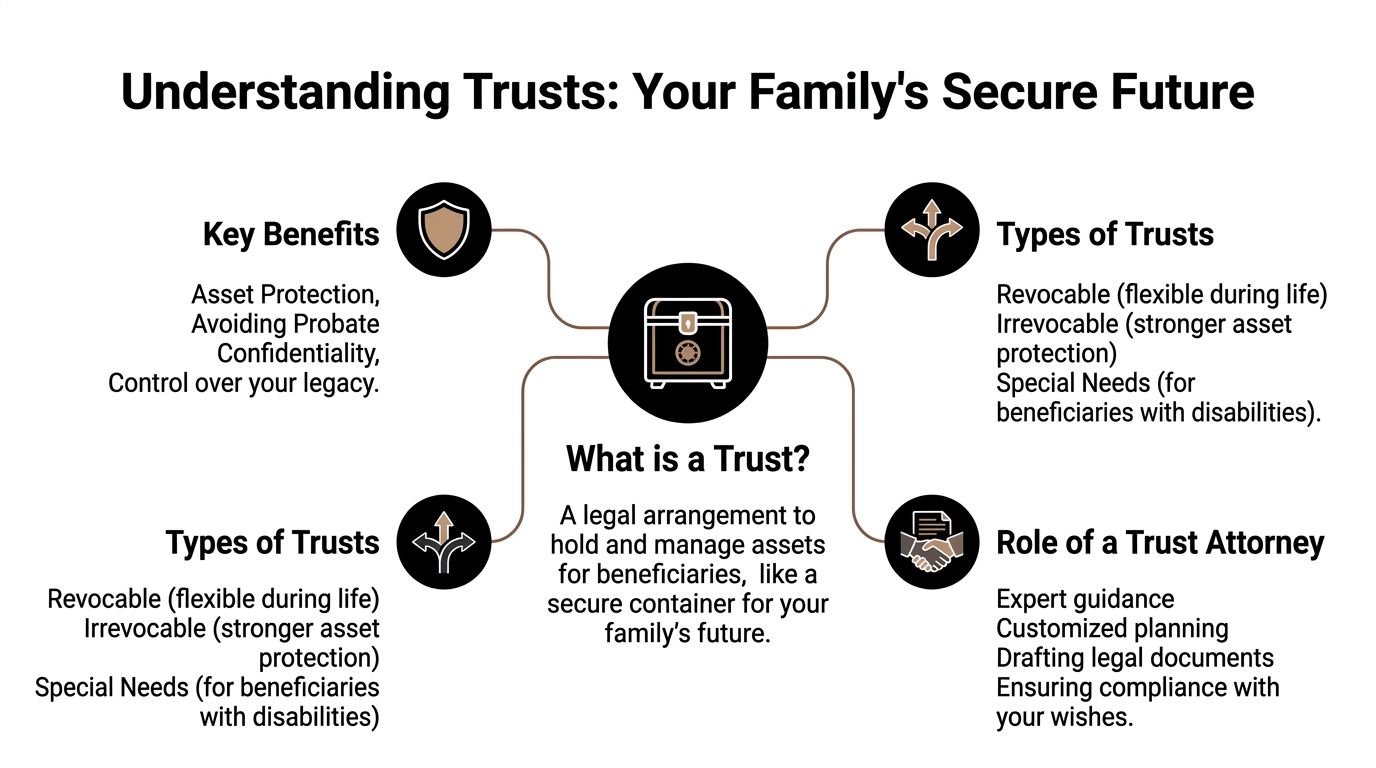
A trust is easiest to understand if you think of it as a secure legal container for your assets. The container doesn't just hold property. It also includes instructions. It says who manages the assets, who benefits from them, and how everything should be handled.
That structure is why trusts are so useful. They combine ownership, management, and instructions into one legal arrangement.
The three people every trust involves
Most trusts involve three roles. One person can hold more than one role, depending on the type of trust.
| Role | Plain-English meaning | Common example |
|---|---|---|
| Grantor | The person who creates the trust | You |
| Trustee | The person or institution managing the trust | You now, then a successor later |
| Beneficiary | The person who receives the benefit of the assets | Your spouse, children, or another loved one |
That simple framework clears up a lot of confusion. People often assume a trust means giving everything away immediately. That's not always true. In many trusts, especially revocable ones, you can remain in control during your lifetime.
What a trust attorney does
A trust attorney doesn't just fill in blanks on a form. A good attorney matches the legal tool to your family situation, your property, and Texas law.
That matters in Kingwood because local families often have issues that online templates don't handle well, such as:
- Community property questions: Married couples in Texas need to think carefully about what belongs to whom and how property should transfer.
- Homestead concerns: Your residence may need special planning choices.
- Minor children or special needs planning: Distribution timing matters.
- Funding details: A trust only works as intended when assets are properly connected to it.
A trust document can be beautifully written and still fail in practice if the assets never get moved into the trust.
That's one reason people look for a trust attorney kingwood instead of relying on a generic website. Texas law has its own rules, and local families deserve advice that fits real life in Kingwood, Humble, and Porter.
Choosing the Right Trust Revocable vs Irrevocable in Texas
When deciding between trust types, people often choose between two priorities. One is flexibility. The other is protection.
A revocable living trust is the flexibility option. An irrevocable trust is closer to a lockbox. Both can be useful. The right one depends on what problem you're trying to solve.
Revocable living trusts and control
A revocable living trust lets you keep control of your assets during your lifetime while setting up a smoother transfer later. In Texas, that's a major reason families choose this option.
Texas probate proceedings can extend 6 to 18 months on average, and benchmark data from Houston-area estates shows revocable trusts reduce administration timelines by 80 to 90% compared to testacy, while also preserving privacy because trusts are not filed publicly like wills, according to McNamara Lawyers' discussion of revocable and irrevocable trusts in Kingwood.
That sounds technical, so here's the plain version. If your house and other titled assets are properly placed into the trust during your lifetime, those assets can pass under the trust structure instead of through the regular probate process.
Irrevocable trusts and stronger protection
An irrevocable trust usually involves giving up direct control over assets placed into it. In exchange, you may gain stronger asset protection and planning options that a revocable trust can't provide.
This kind of trust often comes up in conversations about:
- Long-term care planning
- Creditor protection
- Estate tax planning for larger estates
- Special needs planning for a loved one
The tradeoff is real. You get less flexibility, but potentially much more protection.
A simple comparison
| Feature | Revocable trust | Irrevocable trust |
|---|---|---|
| Control during your life | You usually keep it | You usually give up direct control |
| Main goal | Probate avoidance and smoother administration | Asset protection and advanced planning |
| Privacy | Often strong because trust terms aren't filed like a will | Also used for private planning |
| Ability to change | Usually easier to change or revoke | Usually much harder to change |
If you want a deeper side-by-side explanation, this page on revocable trust vs irrevocable trust is a useful next step.
Which one fits your family
A revocable trust often fits families in Kingwood who want organization, privacy, and a simpler transition after death. Parents of young children, married couples with a home, and people who want one coordinated estate plan often start here.
An irrevocable trust may fit a narrower set of goals. A business owner worried about future exposure, a retiree thinking ahead about long-term care, or a family providing for a beneficiary with special needs may need the stronger features this type of trust can provide.
The best trust isn't the most complex one. It's the one that solves your problem without creating new ones.
The hard part for many families isn't understanding the words revocable and irrevocable. It's seeing how those words affect the house, the bank accounts, the children, and the future. That's where careful Texas-specific advice matters.
Is a Trust Right for Your Kingwood Family?
You don't need a dramatic estate to need a trust. You need a reason. Around Kingwood, Humble, Porter, and Northeast Houston, those reasons show up in everyday life.

Four common local situations
A couple in Kingwood has two school-age children and a home they worked years to buy. They don't just want to name who gets what. They want someone trustworthy managing the children's inheritance until the kids are mature enough to handle it. A trust can set those rules clearly.
A small business owner in Humble wants to separate family protection from business risk as much as possible. That doesn't mean a trust solves every liability issue, but the right planning can be part of a larger protection strategy.
A blended family in Northeast Houston wants to provide for a surviving spouse while still making sure children from a prior marriage are included. A trust can add structure and reduce the chance that good intentions get lost later.
A retiree in Porter is healthy today but worried about long-term care costs down the road. That concern is common, and it's one reason families ask about more protective trust options.
When an irrevocable trust becomes part of the conversation
In Kingwood, irrevocable trusts may help with asset protection from creditors and Medicaid spend-down planning through legal title divestiture. They can also work with Texas homestead protections when a homestead is transferred, and eligibility planning may involve a lookback period. For beneficiaries with disabilities, special needs trust structures can preserve SSI at $943 per month in 2024 without disqualification, as discussed by The Law Office of CiCi Cunningham on trust planning.
For families beginning the long-term care conversation, this article on understanding Medicare coverage for nursing home costs is worth reading because it helps clarify what Medicare may and may not cover before you make legal planning decisions.
Signs a trust may make sense
- You own a home: Real property often drives the need for smoother planning.
- You have children or grandchildren: Timing and management matter as much as the gift itself.
- You value privacy: Some families want to keep financial matters out of public court records.
- Your family structure is complicated: Remarriage, disability planning, or uneven financial maturity can all point toward trust planning.
A trust isn't for everyone. But if any of those situations sound familiar, it's worth having the conversation.
The Trust Planning Process Step by Step
A lot of Kingwood families come in with the same concern. They understand why a trust may help, but they are not sure what happens after they say, "Yes, let's do this."
The process is usually more practical than people expect. It helps to view it like putting a house plan on paper before building. First you decide what you want protected, then you choose who will carry out the plan, and then you make sure the legal documents match real life. For a family with a home in Kingwood Forest, retirement accounts, and children still in school, each step should connect to those specific assets and goals.

What the process usually looks like
Begin with a planning meeting
You talk through your family, your property, and what you want the trust to do. For some Kingwood parents, the goal is avoiding court involvement if they become incapacitated. For others, it is making sure a child does not receive assets outright at age 18.Make an inventory of what you own
Your attorney will usually ask about your home, bank accounts, investment accounts, business interests, life insurance, and beneficiary designations. In Texas, married couples often need to sort out what is community property and what may be separate property. That part matters because the trust has to match how assets are owned.Choose the people who will serve in key roles
You will decide who acts as trustee now, who takes over later if needed, and who receives the trust property. This sounds simple, but it often raises good questions. Is your backup trustee organized? Do your children need staggered distributions? Should one beneficiary's share stay in trust longer?Draft the trust and related documents
The trust document is only part of the plan. Many families also prepare related estate planning documents so the pieces work together instead of pulling in different directions.Review the draft in plain language
You should be able to explain the basic plan back in your own words. If a provision about your Kingwood home, your spouse's rights, or your children's inheritance feels unclear, stop there and ask. Good trust planning should make your choices clearer, not harder to follow.Sign the documents correctly
Execution matters. Legal documents need to be signed the right way to hold up when your family needs to rely on them.Fund the trust
This is the step families often overlook. Funding means retitling assets or updating certain designations so the trust controls the property it is supposed to manage. If your plan includes your house, the deed may need attention. If it includes financial accounts, ownership or beneficiary details may need updating.
Important note: An unfunded trust often leaves assets outside the plan, which can create delays and extra court work later.
If you want a practical preview before your meeting, this guide on how to set up a trust in Texas explains the basics in a straightforward way.
After signing, the plan should not go in a drawer and stay frozen for years. Revisit it after a marriage, divorce, birth, death, major purchase, move, or big change in finances. A trust works best when it reflects your current family life in Kingwood, not the version of life you had five or ten years ago.
Key Questions to Ask Before Hiring a Trust Attorney
Hiring a trust attorney isn't just about finding someone who can prepare documents. You're choosing a professional who should understand Texas law, family dynamics, and the practical details that make the plan work.
A good consultation should leave you more informed, not more confused.
Your due diligence checklist
Bring questions like these to any meeting with a trust attorney kingwood:
How much of your work involves Texas estate planning?
You want someone who regularly works with trusts, wills, probate, and related planning issues.How do you handle trust funding?
This is one of the most important questions. Drafting is only part of the job.How do you explain community property issues for married couples?
Texas law can affect how assets are characterized and transferred.What documents usually go with the trust plan?
A trust often works alongside powers of attorney and other planning documents.How will we communicate during the process?
Clarity matters. You should know who to contact and what happens next.What is your fee structure?
Ask whether fees are flat or based on time, and ask what services are included.
For more ideas, review these questions to ask estate planning attorney.
If an attorney welcomes careful questions, that's usually a good sign. Trust planning should feel collaborative, not rushed.
The right fit often comes down to communication. You want someone who can explain difficult issues in a way that makes sense to your family.
Frequently Asked Questions About Trusts in Texas
What's the difference between a will and a trust
A will gives instructions for what should happen after death, but it generally works through probate. A trust can hold and manage assets under its own terms. For many families, the biggest practical difference is how property is transferred and how much court involvement may be required.
Can I create a trust myself with an online service
You can create documents online, but that doesn't mean the plan will work the way you think it will under Texas law. People often run into trouble with asset titling, unclear trustee powers, blended family issues, and missing supporting documents. A trust also has to fit your property and family structure. That's where personalized legal advice helps.
How long does it take to set up a trust in Kingwood
It depends on your goals, the complexity of your assets, and how quickly information is gathered. Drafting the documents is only part of the timeline. Reviewing, signing, and funding the trust all matter. A simple plan may move fairly smoothly. A plan involving business interests, special needs planning, or multiple properties may take more coordination.
Do I still need a will if I have a trust
Often, yes. Many trust-based estate plans still include a will. That will can help address assets that weren't moved into the trust and support the overall plan.
Can a trust help if I have a loved one with special needs
In many cases, yes. Families often explore specialized trust planning so they can provide support without disrupting eligibility for certain benefits. This needs careful drafting because the details matter.
Your Trusted Legal Partner in Kingwood and Northeast Houston
Trust planning is one of the clearest ways to protect the people you care about. It can help your family avoid delay, reduce confusion, and create a plan that fits your home life, finances, and long-term goals.
For Kingwood families, this isn't just a legal task on a checklist. It's a practical decision about what happens to your house, your savings, and the people who depend on you. For residents in Humble, Porter, and Northeast Houston, the same is true. Clear planning now can spare your family stress later.
A local attorney should be able to explain Texas law in plain language, answer questions without pressure, and help you build a plan that works in real life. If you're looking for a trust attorney kingwood, start with a conversation. You don't need to know everything before you ask for guidance.
If you're ready to talk through your options, schedule a free consultation with Law Office of Bryan Fagan – Kingwood TX Lawyers. Their Kingwood office serves local families who want clear, practical guidance on trusts, wills, probate, and estate planning.