Skip to content
Yes, Texas is what's known as a no-fault divorce state. This is a huge relief for many families in Kingwood and nearby communities because it means you don't have to point fingers or prove someone did something wrong to end your marriage. The legal reason you can use is called insupportability, which is the most common path for families in Kingwood and Humble because it keeps things simpler, more private, and focused on finding practical solutions for your family's future.
Navigating Your Divorce Path in Kingwood
When a marriage is ending, the last thing anyone in Kingwood wants is a long, drawn-out court battle. Thankfully, Texas law offers a way to avoid that. While you can file for a "fault-based" divorce, the no-fault option is there for couples who have simply grown apart and agree the marriage can't be saved. Our local firm is dedicated to helping Kingwood residents find the most peaceful path forward.
Think of it like dissolving a business partnership. Sometimes, the partners just decide to go their separate ways. It’s not because one person did something wrong, but because their goals have changed and they can no longer work together. A no-fault divorce works the same way—it recognizes that the marriage has broken down due to insupportability, which is just the Texas legal term for "irreconcilable differences."
No-Fault vs Fault Divorce in Texas at a Glance
For families in Kingwood and Northeast Houston, understanding the fundamental difference between no-fault and fault-based divorce is the first step. This table breaks down the core distinctions in simple terms to help you see which path might be a better fit for your circumstances.
| Aspect | No-Fault Divorce (Insupportability) | Fault-Based Divorce |
|---|---|---|
| Primary Reason | "The marriage has become insupportable due to discord or conflict of personalities." | One spouse committed a specific wrongful act (e.g., adultery, cruelty, abandonment). |
| Proof Required | No proof of wrongdoing is needed. You only need to state the marriage is broken. | You must present evidence (texts, emails, witness testimony) to prove the fault. |
| Typical Tone | Generally more amicable and cooperative. | Often contentious and emotionally charged. |
| Impact on Timeline | Usually faster, as there's no need to argue over who is to blame. | Can be significantly longer due to discovery and court battles over the fault claim. |
| Cost | Typically less expensive due to fewer court hearings and legal disputes. | More costly because proving fault requires more legal work, time, and resources. |
| Privacy | Keeps personal marital problems out of the public court record. | The details of the misconduct become part of the public record. |
Ultimately, the choice depends on your specific situation. The no-fault path is designed for a more peaceful resolution, while the fault-based path is reserved for cases where one spouse's actions were the direct cause of the marriage's end and may influence the court's decisions.
Why No-Fault is a More Compassionate Approach
Choosing a no-fault divorce doesn't mean it will be easy, but it changes the entire conversation. Instead of digging up the past to assign blame, you and your spouse can focus on the future—creating a stable plan for yourselves and your children.
For families here in the Kingwood area, this approach has some real, practical benefits:
- Less Conflict: You avoid the emotional drain and bitterness that comes from having to prove things like cruelty or adultery in a courtroom.
- More Privacy: Your family's personal business stays out of public records, which protects everyone's dignity.
- Saves Time & Money: No-fault divorces almost always wrap up faster and with lower legal fees than messy, fault-based fights.
- Better for Co-Parenting: When you start your next chapter on more amicable terms, it lays a much healthier foundation for raising your children together in the Kingwood or Humble communities.
The ability to file for a no-fault divorce in Texas empowers couples to end their marriage with dignity. It allows them to focus on constructive solutions for property division and child custody rather than dwelling on the reasons for the split.
Texas was actually ahead of the curve on this. After California led the way in 1969, Texas added its own no-fault grounds in 1970. But instead of getting rid of the old laws, Texas created a hybrid system. You can still file based on fault, but you also have the option of citing insupportability or living apart for three years. This flexibility has been a game-changer for families in Northeast Houston, giving them the power to choose the divorce process that makes sense for them.
Here at The Law Office of Bryan Fagan – Kingwood TX Lawyers, our Kingwood attorneys understand that this is more than just a legal case—it's your life. We are your local, experienced, and client-focused law firm. If you're facing this difficult time, reach out to our local Kingwood office for a free, confidential consultation to talk about your situation and see how we can help.
Understanding the Grounds for Divorce in Texas
While the no-fault route is what most families in Kingwood take, it’s important to know that Texas law actually gives you options. Choosing the right legal grounds for your divorce is a strategic move, one that can really shape the final outcome. This isn't just about ending a chapter; it's about setting the stage for your future.
Here at The Law Office of Bryan Fagan – Kingwood TX Lawyers, we work with clients all over Humble and Northeast Houston to weigh these options carefully. Let’s break down the specific grounds available in simple terms, starting with the one most people use.
The No-Fault Ground: Insupportability
The simplest and most common reason for divorce in Texas is insupportability. This is our state's official term for a "no-fault" divorce.
When you file on this ground, you're essentially telling the court that "the marriage has become insupportable because of discord or conflict of personalities that destroys the legitimate ends of the marital relationship and prevents any reasonable expectation of reconciliation."
In plain English? It just means you and your spouse can no longer get along, and there’s no realistic chance of patching things up. You don't have to point fingers or air your private disagreements in a courtroom. For many couples in Kingwood, this is the most dignified and cost-effective way to move forward.
Choosing insupportability allows a couple to focus on solutions for the future, like co-parenting and dividing assets, rather than getting stuck on past mistakes. It shifts the focus from blame to resolution, which is healthier for everyone involved, especially children.
When Fault-Based Grounds Make Sense
Even though a no-fault divorce is often easier, there are times when filing on fault-based grounds is the right call to protect your interests. Proving that your spouse was at fault can directly influence how a judge divides your property or makes decisions about spousal support.
The main fault-based grounds in Texas law include:
- Adultery: This means one spouse was unfaithful during the marriage. If you can prove it, a Harris County judge might award you a larger share of the community property. For instance, if your spouse spent joint savings from your Northeast Houston home to fund an affair, that’s a financial wrong the court can address.
- Cruelty: This involves behavior that makes living together unbearable, and it can be physical or emotional abuse. Proving cruelty can be crucial for getting protective orders and can heavily influence custody decisions.
- Abandonment: This applies if your spouse left you on purpose, intended to abandon you, and stayed away for at least one year. For a family in Porter, this could be a huge factor if one parent has been gone and hasn’t provided any financial support.
- Felony Conviction: If your spouse was convicted of a felony and has been in prison for at least one year, you can use this as grounds for divorce.
Since Texas introduced no-fault divorce back in 1970, the state has operated with a unique hybrid system. This dual approach allows for strategic filings that can lead to better outcomes in more complicated cases. While insupportability keeps things simple for many, fault grounds like adultery—which is cited in around 60% of fault-based cases—give you leverage when it comes to property or support negotiations. This balance helps keep Texas divorce rates fairly stable while still providing a legal path for spouses who have been wronged. For a closer look at these trends, you can explore the 2023 divorce rate data in Texas.
Making the Right Choice for Your Kingwood Family
Figuring out whether to file for a texas no-fault state divorce or to use fault-based grounds is a decision you shouldn’t make on your own. A no-fault filing is almost always simpler and less hostile, which is often what’s best for families with children.
But if your spouse's actions have caused real financial or emotional damage, filing on fault grounds might be the only way to get a just and fair result. An experienced Kingwood divorce attorney can help you look at the evidence, understand the pros and cons, and pick the strategy that truly aligns with your goals.
Your situation is one of a kind, and the right path forward depends entirely on your circumstances. The team at The Law Office of Bryan Fagan – Kingwood TX Lawyers is right here in Kingwood to give you the practical, compassionate advice you need. Schedule a free consultation with us today to talk through your case and understand all your options.
How No-Fault Divorce Impacts Children and Property
When a marriage is coming to an end, the two questions that loom largest for most Kingwood families are, "What's going to happen with our kids?" and "How are we going to split up everything we own?" Opting for a Texas no-fault divorce creates a path to answer these questions with far less conflict, but it’s important to know that it doesn't change the fundamental legal rules Texas courts follow.
The core idea behind dividing property in Texas is that the split must be "just and right." A lot of people mistakenly believe that "no-fault" means everything gets chopped right down the middle, 50/50. That's not how Texas law works. A Harris County judge has the final say and can divide your assets in a way they believe is fair, which may or may not be an equal split.
Dividing Your Marital Estate
Texas is a community property state. In simple terms, this means that most of what you and your spouse earned or acquired while you were married belongs to both of you, no matter whose name is on the bank account or the car title. It helps to think of it as a shared portfolio you built together during your marriage.
- Community Property: This is the house you bought in Humble, the 401(k) accounts you both paid into, the family minivan, and the credit card debt you racked up together.
- Separate Property: This is anything you owned before the wedding, or anything you received as a personal gift or inheritance during the marriage. So, if your grandfather left you his classic car, that's yours alone.
Filing on no-fault grounds helps steer the conversation away from finger-pointing and toward a more business-like division of your community property. Instead of spending time and money trying to prove who was wrong, you can focus on the practical task of listing out what you own and negotiating a fair settlement. You can get a deeper look at this process in our guide on how to protect assets in a divorce.
Even in a no-fault case, the division of property must be 'just and right.' This standard gives a Harris County judge the flexibility to consider many factors, ensuring a fair outcome for both spouses as they start their new lives.
For most families in Northeast Houston, this approach is simply more efficient and less costly. It allows you to untangle your financial lives with a clear head, free from the emotional burden of having to prove wrongdoing in a courtroom.
Putting the Children First
When kids are part of the picture, Texas law is crystal clear: every decision is driven by one overarching principle—the best interest of the child. This is the bedrock of every custody, visitation, and child support order that comes out of a Kingwood divorce case.
Choosing a no-fault divorce can be one of the best things you do for your children. It sets a less combative tone for the co-parenting relationship you'll have for years to come. When kids see their parents communicating with respect and working as a team, it gives them the stability they need to navigate the changes ahead.
Judges in Harris County really want to see parents who can cooperate. Taking a no-fault route shows the court that you're putting your kids’ well-being ahead of your own disputes. This often leads to better, more collaborative custody agreements where both parents stay deeply involved. By sidestepping a messy, fault-based fight, you shield your children from a world of unnecessary stress and help them adjust to their new reality in a much healthier way.
At The Law Office of Bryan Fagan – Kingwood TX Lawyers, we know that your children and your financial security are what matter most. Our Kingwood attorneys are here to offer the steady, experienced guidance you need. We'll help you handle these sensitive issues with care and work to ensure your final divorce decree truly reflects what's best for your family's future.
The No-Fault Divorce Process in Harris County Step by Step
Filing for divorce can feel like trying to navigate a maze in the dark. For families here in Kingwood and the surrounding Northeast Houston area, simply knowing the path forward makes a world of difference. The Texas no-fault divorce process is actually designed to be a clear, structured journey. Having a step-by-step guide can lift a huge weight of stress and uncertainty off your shoulders.
Let's walk through the key stages of filing for a no-fault divorce right here in Harris County, from the very first piece of paper to the final decree. Think of this as your practical roadmap—it will help you understand what to expect at each turn.
Step 1: Meeting the Residency Requirements
Before anything else can happen, you have to meet a basic residency rule set by Texas law. This is a non-negotiable first step.
To file for divorce in Harris County, at least one spouse must have:
- Lived in Texas for a minimum of six months.
- Lived in Harris County specifically for at least 90 days right before filing the petition.
For most of our clients in Kingwood, Humble, and Porter, this requirement is easily met. It's simply the court's way of confirming it has the proper jurisdiction to handle your case.
Step 2: Filing the Original Petition for Divorce
The official start of your divorce is a document called the Original Petition for Divorce. This is the legal paperwork that formally opens your case with the Harris County Civil Courthouse.
In a no-fault divorce, the petition is refreshingly straightforward. It will simply state that the marriage has become "insupportable," which is the legal term for irreconcilable differences. That simple statement is all it takes to get the process started without assigning blame. An experienced attorney can make sure this document is filled out perfectly to avoid any unnecessary delays. You can find more specifics on this initial stage in our guide on how to file for divorce in Texas.
Step 3: Notifying Your Spouse and the Waiting Period
Once the petition is filed, your spouse has to be formally notified. This is a critical legal step called "service of process," and it ensures both of you are officially aware that a case has begun. After your spouse has been served, Texas law kicks in with a mandatory 60-day waiting period.
This 60-day "cooling-off" period is required in nearly every Texas divorce. It gives both of you time to either consider reconciliation or start working through the details of your separation without the pressure of rushing into life-altering decisions. A judge cannot sign a final divorce decree until this period is over.
The 60-day waiting period isn't a delay tactic; it’s a thoughtful part of Texas law designed to give families a moment to breathe and approach major decisions about their future with care and deliberation.
Step 4: Negotiation, Mediation, and Final Agreement
This is where the real work begins. During the waiting period and after, you and your spouse will need to come to an agreement on all the key issues: how to divide your property and debts, who the children will primarily live with, and the terms of child and spousal support.
Fortunately, most of this is handled outside of a courtroom through direct negotiation or, more commonly, mediation. Mediation is a highly effective process where a neutral third-party mediator helps you and your spouse find common ground and craft solutions that work for your family. For families in our Kingwood community, it’s often the most productive and cost-effective way to reach a settlement.
Once you’ve reached an agreement on everything, your attorneys will draft the Final Decree of Divorce. This is the binding legal document that details every single term of your split. It’s the single most important document in your entire case, as it will govern your rights and obligations for years to come.
This infographic highlights the key areas that your Final Decree of Divorce must resolve before a judge can approve it.
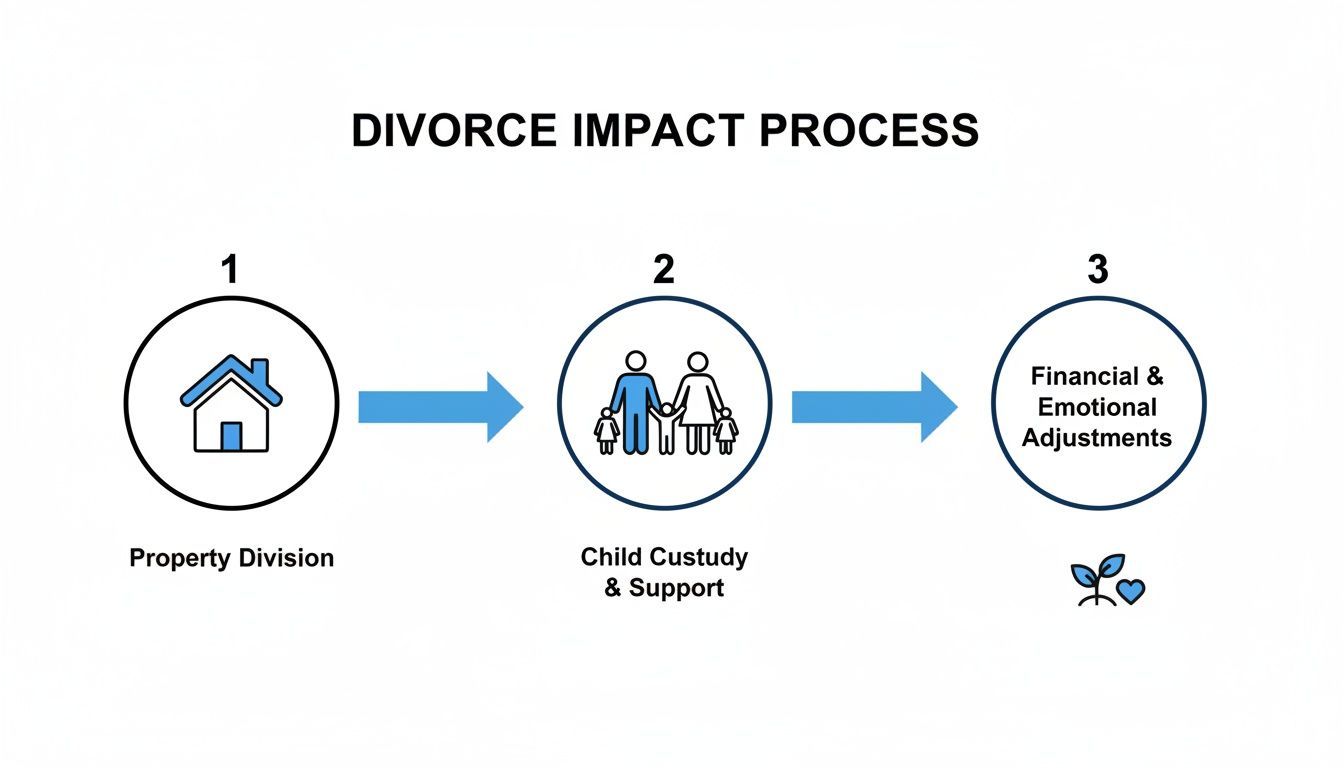
As you can see, every aspect of your shared life—from your house to your parenting schedule—must be carefully addressed and agreed upon in writing.
Having a local Kingwood attorney from The Law Office of Bryan Fagan – Kingwood TX Lawyers guide you through these steps can be invaluable. We know the Harris County court system inside and out, and we’re here to demystify the process for you. Contact us for a free consultation to discuss your situation and learn how we can help you move forward with confidence.
Why You Still Need a Lawyer for a No-Fault Divorce

One of the most common myths we hear from folks here in Kingwood is that a "no-fault" divorce is simple enough to handle on your own. It's an understandable assumption. While the no-fault path is certainly less confrontational, treating it like a simple DIY project can be a very expensive mistake.
Even the most amicable splits have hidden legal complexities. These are the kinds of details that can create major headaches down the road if they aren’t handled correctly from the start.
Protecting Your Financial Future
When you and your spouse agree on the big picture, it’s easy to think dividing your assets will be simple. But for most families in Humble and Northeast Houston, a marriage creates a tangled financial web that truly requires a professional eye to untangle fairly and legally.
An experienced lawyer becomes essential when dealing with:
- Complex Asset Division: How do you correctly value and divide a small business started during the marriage? What about retirement accounts like a 401(k) or a pension? These often require special legal orders (QDROs), and a mistake here can have devastating, long-term financial consequences.
- Hidden Debts and Assets: An attorney knows exactly what to look for to ensure all community property and debts are fully disclosed. Without that professional guidance, you could easily end up responsible for a debt that isn't yours or miss out entirely on assets you're entitled to.
- Drafting an Ironclad Decree: The Final Decree of Divorce isn't just a piece of paper; it's a legally binding contract that will govern your future. Vague or poorly worded terms can lead to incredibly stressful and expensive legal battles years from now. A lawyer makes sure the language is precise, enforceable, and leaves no room for misinterpretation.
Ensuring Your Children's Best Interests
When kids are involved, the stakes are infinitely higher. A casual handshake agreement on custody and support is simply not enough to protect your parental rights or ensure your children's stability.
An experienced family law attorney does more than just file paperwork. They act as your advocate and strategist, ensuring that the final divorce agreement is fair, comprehensive, and built to last. This foresight is what prevents future conflicts and truly secures your new beginning.
A Kingwood family law attorney will help you create a Possession Order (the official custody and visitation schedule) that is clear, detailed, and actually works for your family's unique situation. They also ensure child support is calculated accurately according to Texas law, which shuts the door on future disputes. A professionally drafted order provides the legal backing and clarity you both need to co-parent effectively.
It might seem counterintuitive, but having skilled legal counsel on both sides is often what makes the no-fault system work so well. It’s a key reason Texas now has one of the nation’s lowest divorce rates, at just 1.4 per 1,000 people in 2021. The ability for attorneys at firms like ours to guide families through a smooth, uncontested process helps people transition peacefully.
A great way to start this collaborative process is through mediation, which you can learn more about in our guide on divorce mediation in Texas.
Even in a Texas no-fault state divorce, having a dedicated lawyer from The Law Office of Bryan Fagan – Kingwood TX Lawyers in your corner is your best protection. Contact our Kingwood office for a free consultation to discuss how we can help secure your future.
Your Top Questions About No-Fault Divorce in Kingwood
Even when you have a good handle on the basics, it's natural to have more specific questions pop up as you think about a Texas no-fault state divorce. Here at The Law Office of Bryan Fagan – Kingwood TX Lawyers, we talk with families from Kingwood every single day. We've found that getting simple, straight answers to your biggest concerns can bring a huge sense of relief and clarity.
Let's dive into some of the questions we hear the most from our clients in Kingwood and Northeast Houston.
How Long Does a No-Fault Divorce Actually Take in Harris County?
One of the biggest myths is that "no-fault" means "instant." That’s just not how it works in Texas. State law sets a firm timeline, and the absolute fastest any divorce can be finalized is 61 days. This is due to a mandatory 60-day waiting period that kicks in the day after your divorce petition is filed.
Realistically, though, you should expect an uncontested, no-fault divorce in Harris County to take somewhere between three to six months. This window gives everyone enough time for the practical, step-by-step process: filing the initial paperwork, formally notifying your spouse, working through the details of your property and any children's issues, and carefully drafting the Final Decree of Divorce. If you hit a snag or have even a small disagreement, the timeline can definitely stretch out longer.
Does "No-Fault" Mean My Spouse's Affair Is Totally Irrelevant?
This is probably one of the most critical and misunderstood parts of a no-fault divorce. Filing on the grounds of "insupportability" simply means you don't have to prove your spouse did something wrong to get the divorce granted. It absolutely does not mean a judge will turn a blind eye to bad behavior, especially when it's time to divide your assets.
If you can show that your spouse had an affair and used community money to fund it—think expensive gifts, secret trips, or apartment rent—a Harris County judge can view this as a "fraud on the community." When that happens, the judge has the power to award you, the wronged spouse, a larger, disproportionate share of the marital estate to make things right. So, while the affair isn't the legal reason for the divorce on paper, its financial impact can still be front and center.
Choosing a no-fault filing is a strategic decision about the legal grounds for your divorce. It doesn't erase the facts of the marriage, and a Texas judge can still consider actions like adultery when making a 'just and right' division of your property.
What’s the Ballpark Cost for an Uncontested Divorce in the Kingwood Area?
The cost of a divorce can be all over the map, but an uncontested, no-fault divorce is hands-down your most affordable option. For a truly uncontested case in the Kingwood, Humble, and Northeast Houston area—where you and your spouse are on the same page about everything from the very beginning—you can expect the cost to range from a few thousand dollars to several thousand. The final number really depends on the complexity of your finances and your attorney’s specific fee structure.
Typically, this cost covers:
- Attorney's fees for preparing all the legal documents.
- Filing fees paid to the Harris County District Clerk.
- The cost of having your spouse formally served with the lawsuit.
- Time your lawyer spends negotiating and finalizing the decree.
The secret to keeping costs low is simple: cooperation. The more you and your spouse can agree on without fighting, the less you'll spend on legal fees. But be careful—trying to save money by going it alone often backfires, leading to much more expensive problems down the road.
Can We Still Wind Up in Court With a No-Fault Filing?
Yes, you certainly can. Filing on no-fault grounds just sets the legal stage for why you're divorcing. It doesn't automatically make your case "uncontested." A truly uncontested divorce is one where both of you agree on all the terms—how to divide the house and retirement accounts, who the kids will live with, child support, and everything in between.
If you file for a no-fault divorce but can't see eye-to-eye on one of these crucial issues, you'll likely need a judge to step in and make the call. This could mean going to court for temporary orders hearings, attending mediation (which judges often require), or even heading to a final trial.
This is exactly why having a skilled Kingwood divorce attorney is so important, even in what seems like a straightforward case. Your lawyer can guide you through negotiations, fight for you in mediation, and if it comes to it, stand up for you powerfully in a Harris County courtroom to make sure your rights and your family’s future are protected.
Working through the details of a Texas no-fault divorce can feel overwhelming, but you don't have to figure it all out on your own. The dedicated team at The Law Office of Bryan Fagan – Kingwood TX Lawyers is here to offer the clear advice and compassionate support you deserve. We are proud to serve our neighbors in Kingwood, Humble, and Northeast Houston. Schedule your free, confidential consultation today by visiting our Kingwood family law website and let us help you take the next step with confidence.