Skip to content
Figuring out a child custody schedule can be one of the most stressful parts of a separation for any parent. If you're a parent here in Kingwood or Northeast Houston, it helps to know that Texas has a default framework called the Texas Standard Possession Order (SPO). It's not just a set of suggestions; think of it as a pre-made calendar designed by the state to give your child a consistent, stable relationship with both parents.
What is a Standard Possession Order in Texas?
When parents decide to live apart, the biggest question is always, "How are we going to share our time with the kids?" The Texas legislature created a default answer to this question: the Standard Possession Order, or SPO. It’s a very detailed schedule that lays out the minimum amount of time the non-primary parent (the "possessory conservator") gets with the child.
This schedule is a legally binding court order, not just a casual agreement. For families all over Kingwood, Humble, and Northeast Houston, the SPO provides a predictable and reliable roadmap for co-parenting. The entire point is to create stability for children over the age of three by making sure they have regular, ongoing contact with both of their parents.
Why Is The SPO So Important?
Here’s the key thing to understand: Texas courts automatically assume that the SPO is in the best interest of the child. This is the single most important legal standard in any custody case. The judge will start with the SPO as the default plan unless one parent can present compelling evidence that it wouldn't be good for the child.
The SPO is designed to be fair and, just as importantly, to cut down on potential arguments by clearly defining everything.
- Which weekends the kids are with each parent.
- How weeknight visits work during the school year.
- A clear, rotating schedule for big holidays like Thanksgiving and Christmas.
- How to split up the long summer vacation.
Getting a handle on the SPO is your first step toward building a new, stable routine for your kids. It acts as a solid baseline. From there, you and the other parent can either stick to the standard schedule or, if you both agree, create a custom plan that fits your family's unique circumstances better.
The Texas Family Code lays out the Standard Possession Order as the default for a reason: it gives kids a predictable routine and guarantees both parents get to have a meaningful presence in their lives. For most families in our area, it’s the bedrock of their co-parenting journey.
Local Guidance for Kingwood Families
For parents right here in the Kingwood area, a Standard Possession Order will come up in a divorce or a "Suit Affecting the Parent-Child Relationship" (SAPCR). Depending on where you live, your case will likely be heard in the Harris County or Montgomery County family courts. It’s a real advantage to have a local attorney who knows the ins and outs of these specific courts and the judges who preside over them.
At The Law Office of Bryan Fagan, we sit down with Kingwood families every day to explain how the SPO applies to their specific lives. We understand that no two families are the same. While the SPO is a fantastic starting point, it's not always a one-size-fits-all solution. Our team is here to give you practical, straightforward advice to protect what matters most.
If you’re facing a custody situation in Northeast Houston and need to understand your rights under the Texas Standard Possession Order, you don't have to navigate it on your own. Schedule a free consultation with our experienced Kingwood family law attorneys to get clear answers and explore your options.
Decoding the Standard Possession Order Calendar
When you first hear the term "Standard Possession Order," or SPO, it can sound awfully official and complicated. But let’s break it down into simple terms. At its heart, the SPO is simply a detailed calendar designed by Texas law to give children a stable, predictable routine after their parents separate. For families here in Kingwood and the surrounding communities, getting a handle on this calendar is the first step toward minimizing conflict and creating a new normal that works for everyone.
The cornerstone of the SPO gives the non-primary parent (the law calls this the "possessory conservator") possession on the first, third, and fifth weekends of a month. It’s a simple rule of thumb that provides a consistent rhythm. Keep in mind, not every month has a fifth weekend, but when one rolls around, that time is designated for the non-primary parent.
Weekends and Weeknights Under the Modern Schedule
So, what exactly counts as a "weekend"? This is where an important update to Texas law comes into play. For most families today, a weekend starts when school lets out on Friday and doesn't end until school resumes on Monday morning.
This is the schedule under what's called the Expanded Standard Possession Order (ESPO). As of September 1, 2021, this expanded version became the default schedule for parents who live within 50 miles of each other. This change was a big deal for families across Northeast Houston, from Humble to Porter, because it automatically provides more parenting time than the older, more traditional SPO.
The journey from feeling overwhelmed by legal terms to feeling confident in your co-parenting schedule is a common one. This timeline shows how that process often unfolds.
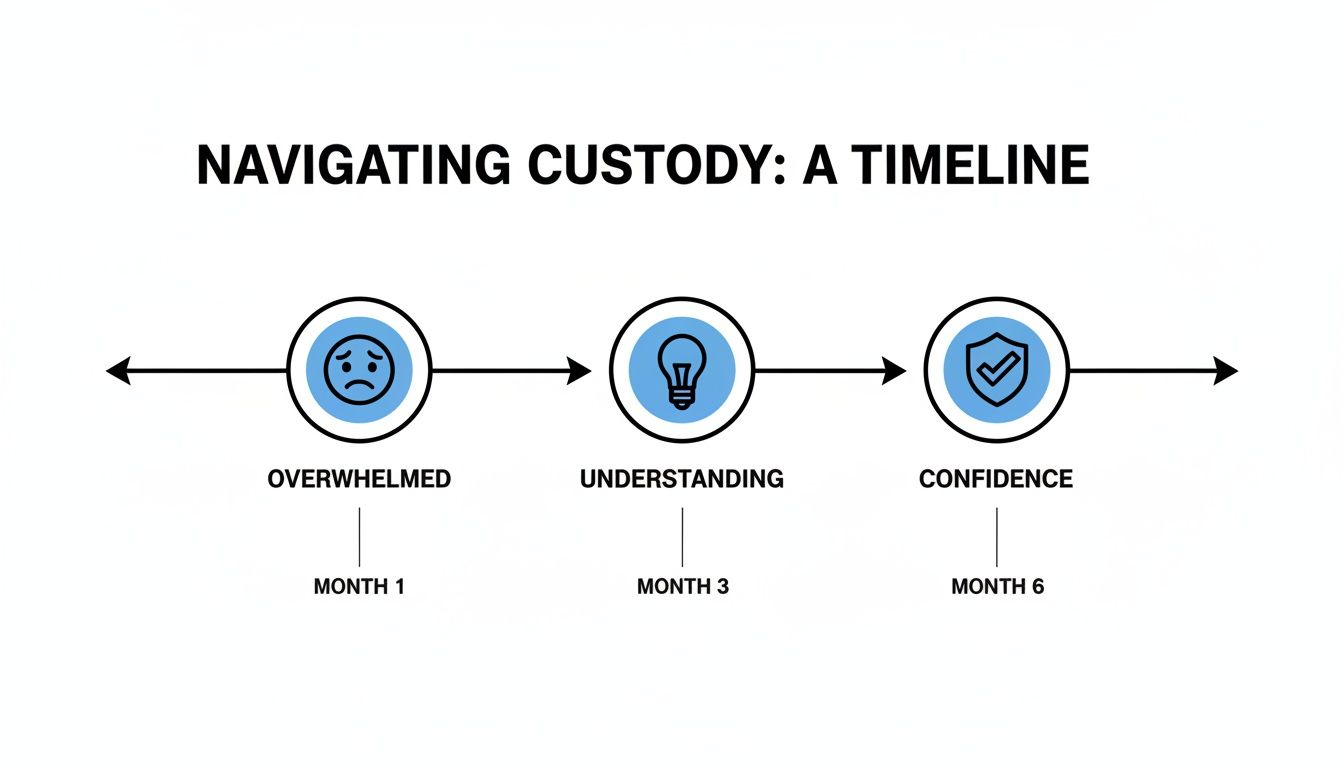
As you can see, with the right guidance from a local Kingwood law firm, the confusion fades and a clear path forward emerges.
The ESPO doesn't just affect weekends; it also boosts midweek time. During the school year, the non-primary parent also typically has the child for an overnight visit every Thursday. This isn't just a quick dinner visit—possession starts when school is dismissed on Thursday and ends when the child is dropped back off at school on Friday morning. That extra overnight is invaluable, as it lets both parents participate in the real-life stuff: homework, dinner conversations, and getting ready for the school day.
The Texas legislature's decision to make the Expanded SPO the default for parents living within 50 miles sends a clear message: frequent, meaningful, and consistent contact with both parents is what's best for a child's well-being.
A Closer Look at Expanded Possession Time
So, what does this look like over the course of a year? The table below breaks down the key differences between the old Standard Possession Order and the current Expanded Standard Possession Order, which is the presumptive schedule for parents living less than 50 miles apart.
Standard Possession vs Expanded Standard Possession Order (Under 50 Miles)
| Possession Time | Standard Possession Order (SPO) | Expanded Standard Possession Order (ESPO – Default) |
|---|---|---|
| Weekends | Begins Friday at 6 p.m., ends Sunday at 6 p.m. | Begins when school is dismissed on Friday, ends when school resumes on Monday. |
| Thursdays (School Year) | A 2-hour visit from 6 p.m. to 8 p.m. | Overnight possession, from school dismissal on Thursday to school resuming on Friday. |
| Overall Impact | Less overnight time, more exchanges. | Significantly more overnight time, fewer exchanges, more involvement in daily school life. |
As you can see, the ESPO creates more opportunities for the non-primary parent to be an integral part of their child’s everyday life, not just a "weekend visitor." This shift is about fostering deeper relationships.
The Real-World Impact for Your Family
All told, the Texas Family Code's framework is designed to give the non-primary parent substantial time with their kids. Under an Expanded SPO, this parent typically has the children for about 35-40% of the year, which translates to roughly 128-140 overnights. This includes the first, third, and fifth weekends, those crucial Thursday overnights, a rotating holiday schedule, and a solid 30-day block of time in the summer.
For parents in our Kingwood community, this means you can build a schedule where both parents are deeply involved in school nights, extracurriculars, and the simple day-to-day moments that truly matter. The predictability allows everyone to plan months in advance, cutting down on those frustrating last-minute conflicts. If you're trying to picture how this might apply to your family, our guide on shared custody arrangements in Texas provides even more context.
Establishing this routine gives children a powerful sense of security and helps manage expectations for everyone. At The Law Office of Bryan Fagan, we specialize in helping Kingwood parents navigate every line of their possession order, so they can turn their focus to what's most important: co-parenting effectively.
How Holiday and Summer Schedules Work
Once you get the hang of the regular weekly schedule, the next big piece of the puzzle is figuring out holidays and summer vacation. For many Kingwood families, these special times can unfortunately become a source of major stress. The Texas Standard Possession Order (SPO) was designed specifically to head off these arguments by creating a clear, predictable roadmap that everyone can plan their lives around. The goal is to let you focus on what matters—making memories with your kids.

At its core, the system is pretty simple: it works on a rotation of odd-numbered and even-numbered years. This ensures that over time, both parents get to experience the big holidays with their children. It’s a practical solution that cuts down on the need for constant back-and-forth negotiation.
The Holiday Rotation Explained
The first thing to understand about the holiday schedule is that it always trumps the regular weekend schedule. If a holiday weekend falls on a weekend that would normally be yours, the special holiday rules take over. No exceptions.
Here’s a quick breakdown of how the major holidays are usually divided:
- Thanksgiving: The non-primary parent gets the kids for the entire Thanksgiving break in odd-numbered years (like 2023, 2025). The primary parent has them for the break in even-numbered years (like 2024, 2026).
- Christmas/Winter Break: This long break from school is split right down the middle. The non-primary parent gets the first half in even-numbered years and the second half in odd-numbered years.
- Spring Break: This one also alternates. The non-primary parent gets the kids for the whole week of Spring Break in even-numbered years, and the primary parent has them in odd-numbered years.
This calendar-flipping approach is really the heart of the Texas SPO. For example, during Christmas break in an even year, the non-primary parent will typically have the children from the moment school lets out until noon on December 28th. In an odd year, they get the back half, from noon on December 28th until school starts up again. This rotation is used in the vast majority of Texas custody orders because it provides stability and significantly reduces the kind of conflict that leads people back to court. You can actually discover more insights about the legislative intent behind these schedules to see why Texas courts rely on this system so heavily.
Special Rules for Mother’s Day and Father’s Day
The SPO carves out a special exception for Mother's Day and Father's Day. These two days are too important to leave to a rotation. The rules are simple and designed to honor each parent’s unique role.
- The mother always has possession of the child for Mother's Day weekend. It doesn't matter whose "turn" it is.
- The father always has possession of the child for Father's Day weekend. Same rule applies.
For parents here in Kingwood and Humble, this means you can count on spending these special days with your child, every single year, without any question or confusion.
Planning for Summer Possession
Summer break is a huge opportunity for bonding, and the SPO gives the non-primary parent a significant chunk of time to make that happen. This is typically an extended period of 30 days.
To lock in their preferred dates, the non-primary parent must give the other parent written notice by April 1st each year. This 30-day period can be used all at once or split into two smaller blocks, as long as each block is at least seven consecutive days.
What happens if you miss the deadline? If the non-primary parent forgets to send their notice by April 1st, the SPO has a fallback plan. Their summer time automatically defaults to a 30-day block from July 1st to July 31st.
This framework gives families in Northeast Houston plenty of time to plan summer camps, family vacations, and other activities without last-minute scrambling. Knowing these deadlines is the key to a smooth, conflict-free summer.
Navigating all these dates can feel like a lot at first, but the SPO is designed to bring clarity and predictability to your family's life. At The Law Office of Bryan Fagan, we help Kingwood-area parents make sense of every line in their possession order. If you have questions about your holiday schedule or need help planning for the summer, we invite you to schedule a free consultation with our team to get the answers you deserve.
When Does the Standard Possession Order Not Make Sense?
In Texas, the Standard Possession Order (SPO) is the default playbook for most custody schedules. Why? Because the courts start with the assumption that it's what’s best for the child. But here’s the most important thing to remember: the law’s number one priority is a child’s physical and emotional well-being. Always.
This means the SPO is a guideline, not a straitjacket. There are absolutely times when a judge will look at a family's situation and decide that the standard schedule just won't work—or worse, that it would be harmful.
For families here in Kingwood and the surrounding Northeast Houston area, it’s critical to know when these exceptions apply. If your circumstances are anything but standard, the court has the power to create a custom-fit order that truly protects your child.
Special Rules for Children Under Three
One of the biggest and most common exceptions to the SPO involves the little ones. The Texas Family Code is very specific here: the standard order is only presumed to be in the best interest of children over the age of three. For infants and toddlers, the rulebook gets a rewrite.
The logic is simple. A two-year-old’s world and needs are entirely different from a ten-year-old’s. At this tender age, the primary goal is helping the child form a strong, secure bond with both parents. This is usually accomplished with a schedule that looks a bit different:
- Shorter, more frequent visits: Think several shorter visits with the non-primary parent during the week, rather than a full weekend away.
- No long overnight stays at first: For babies and young toddlers, overnights are often phased in slowly as the child grows and becomes more comfortable.
- Close proximity is key: The schedule is often designed with the assumption that parents live near each other, like in Humble or Porter, to make frequent handoffs possible without putting too much stress on the child.
This approach allows a strong parent-child relationship to develop without the anxiety that long separations can cause for very young children.
When Safety Concerns Change Everything
A court’s duty to protect a child overrides everything else. If there's credible evidence of family violence—either a history or a pattern of it—the assumption that the SPO is best goes right out the window. Texas law is crystal clear and tough on this point. A judge will not put a child in a standard schedule if it would put them or the other parent in harm's way.
Other serious red flags can also force a court to create a much more restrictive, customized order:
- Substance Abuse: A parent struggling with active drug or alcohol addiction may be limited to supervised visitation.
- Child Neglect or Abuse: Any documented history of this will lead a court to drastically alter or even deny standard possession.
- Serious Mental Health Problems: If a parent's mental health condition makes it unsafe for them to care for a child alone, the court must intervene.
In these tough cases, a judge might require supervised visitation, meaning a neutral third party has to be present for any and all contact. The point isn't to punish the parent, but to shield the child while still—if possible—allowing for a safe parent-child connection. For Kingwood parents facing these scary situations, you need to know the court has options. You can get a better sense of how these protective measures are put in place by reading our guide on temporary custody orders in Texas.
A finding of family violence by a court completely changes the custody conversation. The law shifts from presuming the SPO is best to requiring the court to design an order that prioritizes the safety and well-being of the child and the victim-parent above all else.
At The Law Office of Bryan Fagan, we've guided many Kingwood families through these exact challenges. We understand how difficult and stressful this can be. If you’re worried that a standard possession order isn’t safe or right for your child, schedule a free, confidential consultation at our Kingwood office. We're here to listen and help you figure out the best path forward.
What Happens When Your Possession Order Needs to Change?
Life moves on, and what worked for your family two years ago might not make sense today. That Standard Possession Order, once a perfect fit, can start to feel clunky and impractical as your kids get older, your job changes, or life simply happens.
The good news is that for families here in Kingwood and the surrounding areas, a court order isn't a life sentence. It’s a living document. The Texas Family Code provides a clear process for changing it. And just as importantly, it gives you a way to hold the other parent accountable if they refuse to follow the rules.
So, whether your schedule needs a major overhaul or you just need the current one to be respected, you have options. Understanding how to modify or enforce your order is key to protecting your child’s stability and your own peace of mind.
How to Modify Your Possession Order
You can’t just go back to court because you’d prefer a different weekend. To officially change a possession order, Texas law requires you to prove two things.
First, you have to show the court there’s been a “material and substantial change in circumstances” since the judge signed the last order. This is a high bar. It means something significant has happened that makes the old schedule unworkable or no longer good for your child.
What counts as a "material and substantial change"? Based on what we see with families across Northeast Houston, it often looks like this:
- One Parent Moves Away: A relocation to another city or out of state obviously makes the original pickup and drop-off plan impossible.
- A Major Job Change: Maybe a parent switches to a night shift or a job with constant travel, making it difficult to stick to the schedule.
- The Child’s Needs Change: As kids grow, their needs evolve. A teenager with a part-time job and a competitive sports schedule has a different life than a first-grader. Sometimes, an older child will even have a strong, mature preference for a new arrangement.
- A Parent’s Unsafe Lifestyle: If one parent develops issues with substance abuse or moves into a living situation that puts the child at risk, that’s a huge red flag for the court.
After proving a major change has occurred, you also have to convince the judge that your proposed new schedule is in the best interest of the child. That's the court's ultimate priority, every single time.
What to Do When the Other Parent Won't Follow the Order
Few things are more infuriating than a co-parent who treats a court order like a suggestion. Maybe they’re consistently late, cancel your weekends at the last minute, or just refuse to bring your child back on time.
When this happens, you don’t have to just put up with it. Your next step is to file an enforcement action.
Think of an enforcement action as telling the judge, "The rules are already in place, but one person isn't following them. I need your help to make them." It’s not about changing the order; it's about making sure the existing order is obeyed.
The absolute key to a successful enforcement case is documentation. You need proof. Start a log or a dedicated calendar immediately. For every single violation, write down the date, time, and exactly what happened. Save every text message and email that shows the other parent breaking the rules.
An enforcement action can lead to serious consequences for the parent who is ignoring the order. A judge can:
- Order make-up possession time to compensate you for the visits you lost.
- Force the other parent to pay fines and cover your attorney's fees.
- In cases of repeated or severe violations, a judge has the power to order jail time for contempt of court.
Walking into a courtroom can feel intimidating, but solid preparation makes all the difference. You can learn more about how to prepare for a custody hearing to get a better sense of what to expect.
Whether you're in Kingwood, Humble, or Porter, you have rights when your life changes or when your co-parent refuses to play by the rules. At The Law Office of Bryan Fagan, we've helped countless local families navigate these exact challenges. If you need to update your order or enforce the one you have, our experienced team is ready to fight for you. Schedule a free consultation at our Kingwood office to get clear answers and a solid plan.
Common Questions About the Texas SPO
Once you start looking at the details of a Texas Standard Possession Order, some very practical, real-world questions almost always come up. For families here in Kingwood and Humble, getting clear answers to these common scenarios can be the difference between a smooth co-parenting relationship and constant conflict.
We've gathered the questions we hear most often from our local clients to help you understand how the SPO actually plays out in day-to-day life.
What Happens if a Holiday Falls on My Regular Weekend?
This is easily one of the most common points of confusion for parents. The rule, however, is simple and absolute: the holiday schedule always trumps the regular weekend schedule.
Let’s say it’s the third weekend of November in an odd-numbered year. That would normally be the non-primary parent's weekend. But if that weekend is part of the Thanksgiving holiday, and it's the primary parent's year for Thanksgiving, the primary parent gets the child for that entire holiday break.
The non-primary parent's regular weekend possession is essentially skipped to make way for the holiday. The Texas Family Code is written this way on purpose—to ensure children get to enjoy whole, uninterrupted holiday time without being shuffled back and forth.
How Does the Order Change if We Live Over 100 Miles Apart?
When life takes parents farther apart, the Standard Possession Order has to adapt. For parents in Texas living more than 100 miles from each other, the typical first, third, and fifth weekend schedule just isn't practical.
In these long-distance situations, the SPO usually gives the non-primary parent the right to choose one weekend per month for their visits. To make up for seeing their child less frequently, this parent typically gets more extended time during school breaks.
- Spring Break: They will have the child for every Spring Break, every single year.
- Summer Possession: Their summer period is extended from 30 days to 42 days.
- Weekday Visits: The standard Thursday evening visits are usually eliminated because of the travel involved.
If you’re a parent in the Northeast Houston area and a long-distance move is on the horizon, it's critical to get a clear, written order that spells out travel arrangements, who pays for what, and notice requirements. Getting this right from the start prevents a world of disagreement later.
Can My Teenager Refuse to Follow the Custody Order?
This is a tough one, and it's a situation we see many local families struggling with. The short legal answer is no—a child cannot legally refuse to follow a court order until they turn 18. Both parents are required by law to encourage their child to comply with the possession schedule.
But we all know the reality. Forcing a teenager to do something they’re dead set against can feel impossible and can seriously damage your relationship. When this happens, it often signals a deeper issue that needs to be addressed.
In Texas, a judge can interview a child 12 or older in private to hear their preference, but the judge is not required to follow it. The only standard is the "best interest of the child." Before turning this into a court battle, it’s often more productive to try family counseling or mediation. If the problem persists, filing to modify the possession order might be the next logical step.
While a child's preference is a factor a court can consider, it is not the deciding one. The court's primary duty is to uphold what is in the child's best interest, which may or may not align with the teenager's wishes.
How Do I Get a Standard Possession Order Started in Kingwood?
To get a legally enforceable standard possession order in Texas, one of the parents has to file a lawsuit. It’s called a "Suit Affecting the Parent-Child Relationship," or SAPCR for short. For anyone living in the Kingwood area, this case would typically be filed in the family courts of Harris County or Montgomery County.
This suit is the formal legal step that asks a judge to make official orders on everything involving your child: custody (conservatorship), visitation (possession), and child support.
You and the other parent can always work together on an agreement and submit it to the judge for approval. If you can’t agree, a judge will hear from both of you and make the decisions. The best first step is to talk to a local family law attorney who knows the ins and outs of our local court system.
At The Law Office of Bryan Fagan – Kingwood TX Lawyers, we help families navigate this process every single day. If you’re ready to establish a clear and stable future for your children, we’re here to provide the trusted, local guidance you deserve. Don't go through this alone—schedule a free, no-obligation consultation with our Kingwood team today to talk about your case.