When a loved one passes away, the last thing your family wants to deal with is a confusing legal process. But for many, that's what "probate" feels like. In Texas, probating a will is the formal court procedure that validates the will and officially empowers an executor to carry out its instructions.
For families here in Kingwood, Humble, and Northeast Houston, this process almost always takes place in the Harris County courts. Think of it as the legal system's way of making sure your loved one's final wishes are honored correctly, providing peace of mind during a difficult time.
What Probating a Will Means for Your Kingwood Family
Losing a family member is hard enough. Sifting through complex legal jargon only adds to the stress. Many of our clients from the Kingwood area come to us feeling completely lost about what probate really is and how it affects them locally.
At its core, probate is simply the official process of transferring a person's property after they've died, all under the supervision of a court and according to their will. The court's job is to confirm that the will is authentic, legally valid, and truly the final testament of the person who passed.
This court approval is absolutely essential. Without it, institutions like banks, mortgage companies, and the Harris County Clerk’s office can't legally transfer assets—whether it's a home in Kingwood, a car, or a savings account—out of the deceased's name and into the hands of the rightful heirs.
Key Probate Terms for Texas Residents
Getting a handle on the terminology can make the whole process feel less intimidating. Here’s a simple explanation of the essential roles you'll encounter during the probate process in Harris County.
| Term | What It Means for a Kingwood Family |
|---|---|
| Decedent | This is the legal term for the person who has passed away. |
| Executor | This is the person named in the will to manage the estate. They handle the paperwork, pay off debts, and distribute assets. It's a position of significant trust and responsibility, often held by a close family member. |
| Beneficiaries | These are the people, family members, or even charities named in the will who will inherit from the estate. |
| Estate | This refers to all the property, assets, and debts left behind by the decedent. |
Understanding these terms helps clarify everyone's role as you move forward with the process.
The Key Players in Texas Probate
Let’s put those terms into a real-world scenario. Imagine a father in Kingwood passes away. His will names his eldest daughter as the executor.
Her first legal step is to file an application to probate the will in Harris County. Once the court approves the will and appoints her, she receives what are called "Letters Testamentary." This document is her official authority to act on behalf of the estate. From there, she can follow the will's instructions to distribute her father’s assets to her siblings, who are the beneficiaries.
The primary goal of probate is to ensure a person's final wishes are carried out legally and transparently, providing closure for the family and a clear transfer of property.
Why Is Probate Necessary?
You might be wondering why the court needs to be involved at all. Probate serves a few critical functions. First, it creates a clean and permanent legal record of the asset transfer, which helps prevent future arguments over who owns what.
It also establishes a formal process for creditors to make claims against the estate. This ensures that any legitimate debts are paid before the beneficiaries receive their inheritance, protecting them from being pursued later on.
It’s crucial to know that not everything goes through probate. Some assets, like life insurance policies or retirement accounts with named beneficiaries, pass directly to heirs outside of the court process. To get a better grasp on this, our guide on probate and nonprobate assets breaks down the differences clearly for our Kingwood clients.
To build a solid understanding, it can be helpful to review the basics of what is probate and how it works. While the thought of court proceedings can seem overwhelming, the system is really there to provide a structured, predictable path during a difficult time.
You don't have to navigate this alone. The Law Office of Bryan Fagan is located right here in Kingwood, ready to help our neighbors. Schedule a free, no-obligation consultation, and we can answer your questions with the compassion and clarity you deserve.
Choosing the Right Type of Texas Probate
Once you’ve confirmed that probate is necessary, the big question for most Kingwood families becomes, "Okay, but what kind of probate do we need?" Texas law is actually quite flexible here, offering a few different paths. The one you take has a huge impact on the time, cost, and level of court supervision involved in settling your loved one's affairs.
Not every estate is the same, and the law understands that. A straightforward, undisputed estate in Humble with no outstanding debts will be handled very differently from a complex one where family members in Northeast Houston don't see eye to eye. Figuring out your options from the get-go makes the whole process feel less intimidating.
This chart gives you a bird's-eye view of how the process flows from the estate, through the executor, and finally to the beneficiaries.
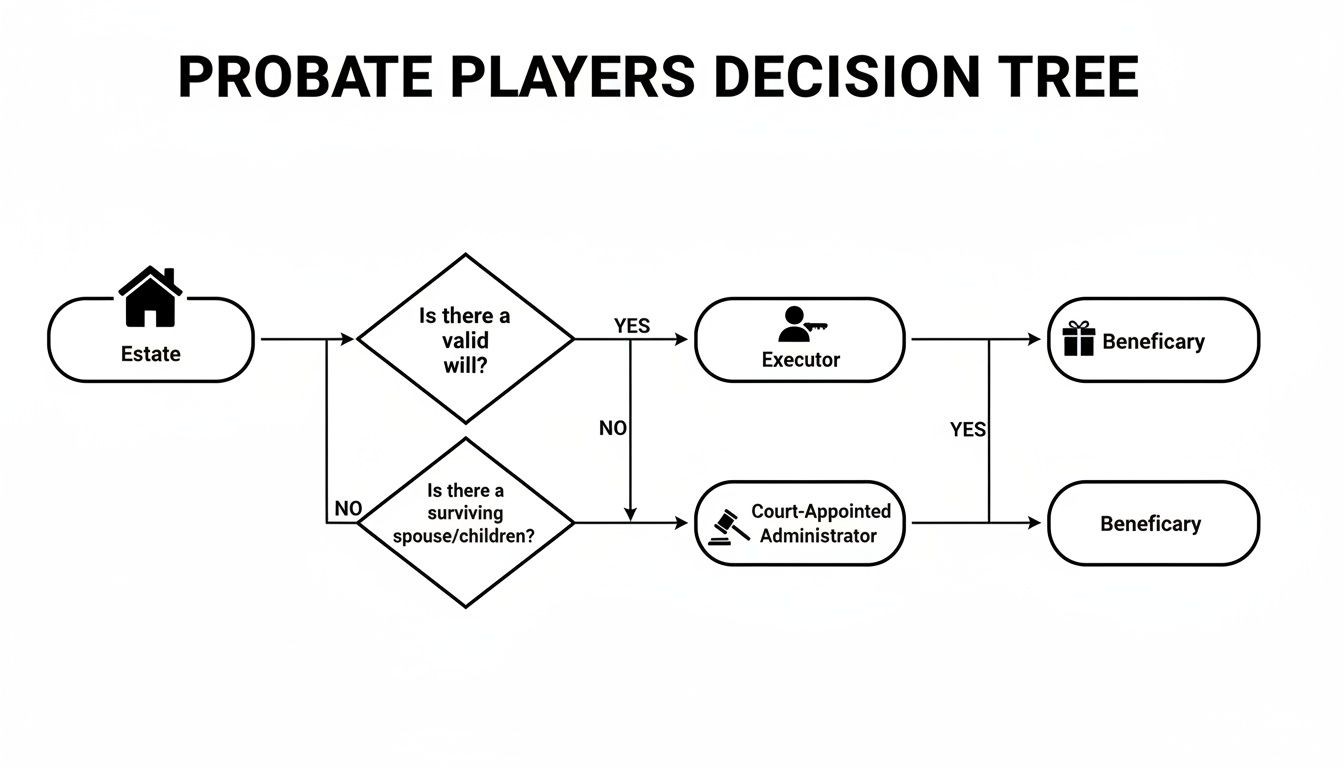
As you can see, the executor plays a pivotal role. They're the one tasked with carrying out the will's instructions and making sure assets get to the right people.
Independent Administration: The Texas Default
Hands down, the most common and preferred way to handle things is through an Independent Administration. Frankly, this is what makes probating a will in Texas so much more efficient than in many other states.
If the will specifically calls for an independent administration—and most wills drafted by an experienced attorney will—the court appoints the executor and then largely steps back. The executor can pay debts, sell property, and distribute assets without running to the judge for permission at every turn.
For a family in Kingwood, this is a game-changer. It dramatically cuts down on legal fees, speeds everything up, and lets the family manage things more privately and with less stress.
Dependent Administration: When the Court Needs to Supervise
On the flip side, a Dependent Administration is a tightly controlled process. It’s not the default, but it’s the right call in certain situations:
- The will is silent. If the will doesn't specifically request independent administration, the court plays it safe and requires supervision.
- There’s family conflict. If beneficiaries are arguing over the estate, a judge might order a dependent administration to keep everything transparent and above board.
- The estate has major debt problems. Heavy court oversight can protect everyone involved—creditors and heirs alike—by ensuring all financial moves are made by the book.
In this scenario, the executor usually has to post a bond and get the court’s green light for almost every task, from paying a simple utility bill to selling a car. While it offers a layer of protection, all that back-and-forth with the court makes the process much longer and more expensive for families in the Porter area.
The core difference comes down to autonomy. An independent administration trusts the executor to do the right thing. A dependent administration requires the court to verify every single step, adding significant time and cost.
Muniment of Title: A Shortcut for Simple Estates
Texas offers another unique, streamlined option called Probate as a Muniment of Title. This isn't a full-blown administration. Instead, it’s a legal process that essentially asks the court to recognize the will as the official document transferring property to the beneficiaries.
It's a great option, but it only works if the estate meets two key criteria:
- There is a valid, original will.
- The estate has no unsecured debts. The only exception is debt secured by real estate, like a home mortgage.
Imagine a simple estate in Kingwood where the main asset is a house with a mortgage, and there are no credit card bills or outstanding medical debts. A Muniment of Title could be the perfect solution—it's quick, cost-effective, and avoids the need to appoint an executor altogether.
Of course, the best strategy is always to plan ahead. You can find out more about how smart estate planning can help your family sidestep these issues in our guide on how to avoid probate in Texas. Making informed decisions now can save your loved ones a world of stress down the road.
Choosing the right probate path is a critical first step. At The Law Office of Bryan Fagan, we can review your loved one's will and financial situation to map out the most direct and effective route for your family.
Taking the First Steps in the Harris County Probate Court
Getting the probate process started often feels like the hardest part. For families in Kingwood and Northeast Houston, staring at a pile of legal requirements and paperwork can be overwhelming. But if you break it down into a few manageable actions, it becomes much less intimidating. Let's walk through the practical, step-by-step guidance on how to get started the right way in the Harris County court system.
First things first, you need to be aware of the clock. In Texas, you have a strict four-year deadline to file a will for probate, and that clock starts ticking the moment your loved one passes away. If you miss this window, the consequences are severe. The court will almost certainly refuse to probate the will, meaning the estate is treated as if a will never existed. This throws the family into a more complicated and costly heirship proceeding, where the state decides who gets what—not your loved one.
Gathering Your Essential Documents
Before you can file a single form, you need to collect a few crucial documents. These are the absolute foundation of your probate case.
- The Original Will: The court needs the real deal—the actual, signed, original will. Copies are a no-go unless you’re prepared for a complex legal battle to prove up a lost will, which is a headache you want to avoid.
- A Certified Death Certificate: You'll need an official copy of the death certificate to legally establish that the person has passed away. You can order one from the Texas Department of State Health Services or the vital statistics office in the county where the death occurred.
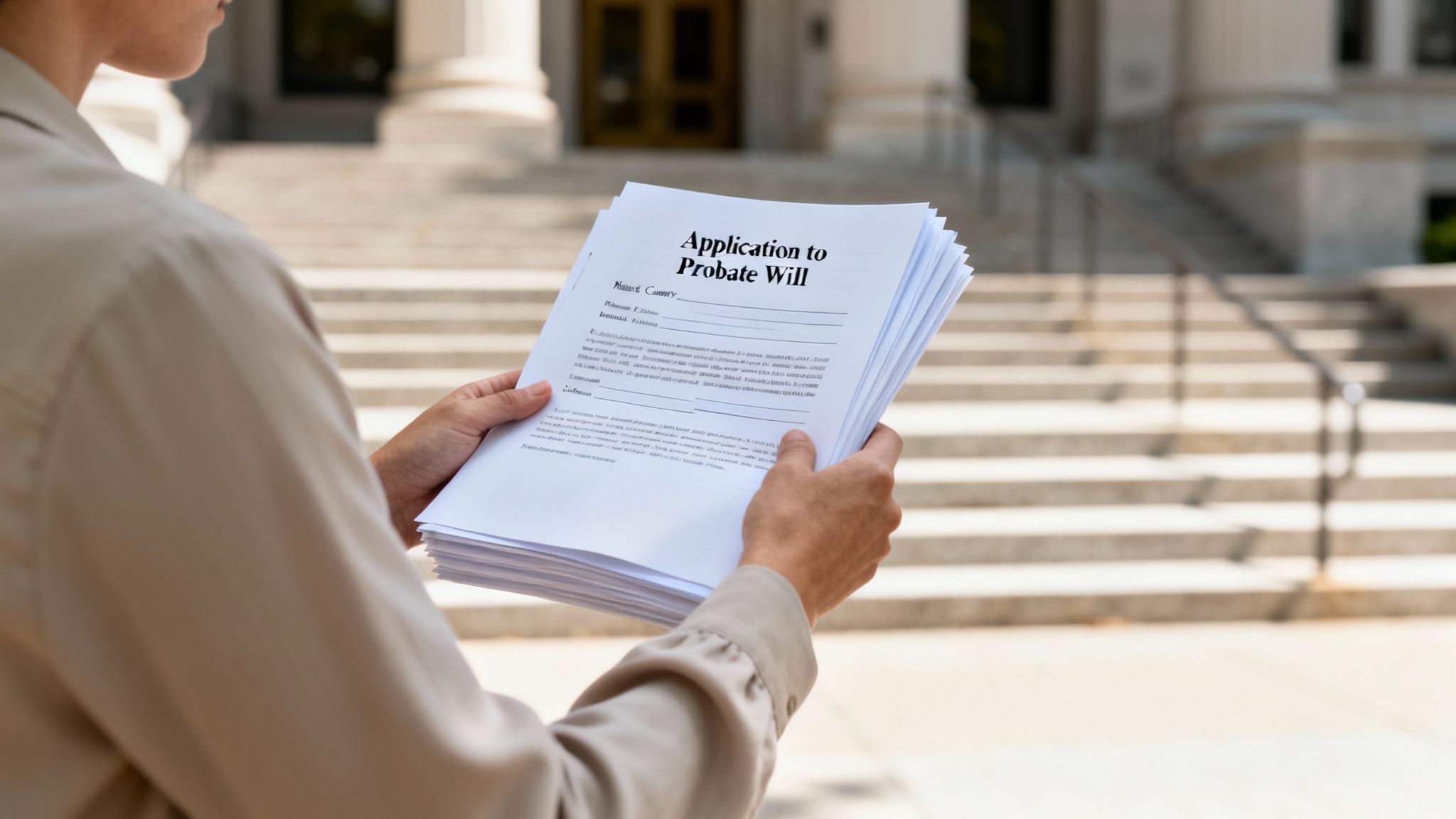
- The Application to Probate Will: This is the formal petition that officially kicks everything off. It contains all the essential details about the deceased, the named executor, the beneficiaries, and the estate itself.
Filling out the application with perfect accuracy is non-negotiable. Once it's ready, it must be filed with the Harris County Clerk. For our clients in the Kingwood and Humble areas, this means a trip downtown to the Harris County Civil Courthouse.
What Goes into the Application to Probate Will?
This document is much more than a simple form; it's a formal legal request to the court. While the specifics can vary slightly, you can expect it to include:
- The decedent’s full name and date of death.
- The decedent’s address, which confirms that Harris County is the correct jurisdiction for a Kingwood resident.
- The name and contact information for the person asking to be appointed executor.
- A list of all beneficiaries named in the will, including their ages and addresses.
- A sworn statement that the will is valid and was never revoked.
- A general description of the estate’s property and its estimated value.
After the application is filed, the county clerk will post a public notice at the courthouse. This is a legal formality designed to give anyone with a potential interest a chance to contest the will. This notice has to stay up for at least ten days before you can schedule a hearing with the judge.
That four-year deadline is no joke. Once it passes, the will is essentially just a piece of paper, and the estate is forced into intestate succession—a path that might completely contradict the deceased's wishes. Here in Harris County, the probate courts handle thousands of estate cases every year, and disputes over missed deadlines are all too common. To get a better handle on these foundational rules, you can read more about Texas probate laws and their impact.
The Initial Court Hearing
Once the mandatory waiting period is over, the court will schedule a brief hearing. This is not the dramatic courtroom showdown you see on TV. For an uncontested will in Harris County, it's usually a very straightforward and quick affair.
At the hearing, the judge will simply ask the proposed executor a few questions under oath to confirm the information in the application. The whole point is to verify the will's validity and officially appoint the executor.
If everything checks out, the judge will sign an Order Admitting Will to Probate. Then, within about 20 days, the court will issue Letters Testamentary. This is the golden ticket—the official document that grants the executor the legal authority to start managing the estate.
Getting these first steps right is the key to a smooth process. At The Law Office of Bryan Fagan, our Kingwood-area attorneys handle these filings every single day. We can ensure your application is drafted perfectly and filed on time, taking that initial pressure completely off your shoulders. Schedule a free, no-obligation consultation with us today, and let's get this started with confidence.
Fulfilling Your Duties as an Executor
Being named the executor of a loved one's will is a heavy responsibility, but it's also a final act of trust. If you're in this position in Kingwood, Humble, or anywhere in Northeast Houston, it can feel overwhelming, especially while you're grieving. The key is to take it one step at a time with practical guidance.
Once the Harris County court officially appoints you, you'll receive a document called Letters Testamentary. This is your golden ticket. It's the legal proof you need to show banks, government agencies, and anyone else that you have the authority to act on behalf of the estate.

Securing and Inventorying Estate Assets
Your first job is to get a handle on everything your loved one owned. Think of yourself as the temporary protector of the estate. You need to locate, identify, and safeguard all the assets—from bank accounts and investment portfolios to real estate, vehicles, and even sentimental personal items.
For example, if there's a house in Kingwood, you're responsible for making sure the doors are locked, the mortgage and utility bills are paid, and the homeowners' insurance stays active. You hold onto it until it's ready to be sold or passed on to the heirs.
The court gives you a deadline for this. Within 90 days of your appointment, you are required to file a document called an "Inventory, Appraisement, and List of Claims." This is essentially a detailed spreadsheet for the court, listing all the estate's property and its fair market value on the day your loved one passed away. Getting this right is critical, as it creates the official record of what the estate contains.
Managing Debts and Notifying Creditors
Next up is dealing with the decedent’s final bills. This is where meticulous record-keeping becomes your best friend.
You have a legal duty to notify creditors. For secured debts, like a mortgage or car loan, you'll typically send a notice by certified mail. For all other potential "unsecured" creditors (think credit cards or medical bills), Texas law requires you to publish a notice in a local newspaper that serves the Kingwood or greater Northeast Houston area. This public notice starts a clock, giving creditors a limited time to come forward and make a claim against the estate.
A word of caution: don't just start paying bills from your own pocket or in a random order. Texas law sets a specific priority for how debts get paid. Funeral costs, legal fees, and secured debts usually come first. Following this order protects the estate and you from liability down the road.
You'll use the estate's funds—not your own—to settle any valid claims that are properly submitted.
Communicating with Beneficiaries
This might be one of the most important—and most overlooked—parts of being an executor. Keeping the beneficiaries in the loop is not just a courtesy; it's a duty. Consistent, clear communication can prevent a world of hurt, suspicion, and family drama.
You don't need to write a novel. A quick email update every few weeks can work wonders. Let them know what you've accomplished, like filing the inventory or settling a major debt, and what's coming up next. This transparency goes a long way in making everyone feel understood and supported during an already difficult time.
To help you stay on track, a comprehensive executor duties checklist like this one can be an invaluable tool.
Distributing the Assets and Closing the Estate
The finish line is in sight. Once all assets are collected and all legitimate debts and expenses are paid, your final major task is to distribute what's left to the beneficiaries. You must follow the instructions in the will to the letter. You don't have the authority to change the distribution, even if you personally believe a different arrangement might be "more fair."
Before you hand anything over, you'll prepare a final accounting. This document shows every dollar that came into the estate and every dollar that went out. Once the beneficiaries sign off on this accounting and receive their inheritance, you can file the last bits of paperwork to formally close the estate with the Harris County court.
Being an executor for someone in the Kingwood community is a meaningful way to honor their memory. It takes patience and organization. If you find yourself in over your head, you don't have to go it alone. The Law Office of Bryan Fagan is here to provide the local, experienced guidance and legal support you need. Schedule a free, no-obligation consultation, and let us help you navigate this process with confidence.
Understanding Probate Costs and Timelines
When a loved one passes, two practical questions almost always come up first for families here in Kingwood and Northeast Houston: "How much is this going to cost?" and "How long is this going to take?"
Those are perfectly normal, important questions. Getting straight answers helps you prepare for the road ahead. While every probate case is unique, our experience working with local families in the Harris County courts allows us to give you a realistic picture of what to expect.
Probate isn't a sprint; it's a journey with legally required waiting periods and procedural hurdles. A clean, uncontested case is always the fastest, but any complications can easily add months to the process.
A Realistic Timeline for Probate in Harris County
For a simple estate without any family fights, you're generally looking at a six-month to one-year timeline. I know that sounds like a long time, but each step has its own clock. Just filing the application, waiting for the mandatory public notice period, and getting that first hearing can take a few weeks to a month right out of the gate.
Once the executor is officially appointed, a big chunk of time is spent on their duties. For example, there's a hard 90-day deadline to file a detailed inventory of the estate's assets with the court. A notice also has to be published for any potential creditors. Those two steps alone account for several months.
The biggest wildcard in any probate timeline is conflict. If beneficiaries decide to contest the will or old family disagreements flare up, the process can drag on for well over a year. That not only extends the timeline but also significantly drives up the stress and legal costs for everyone involved.
For a more detailed look at each stage, you can learn more about how long probate takes in Texas in our dedicated article on the topic.
Demystifying the Costs of Probate
The cost of probate isn't just one bill. It's a combination of different expenses, and understanding what they are helps you see where the money is going. It also highlights how smart choices, like opting for an Independent Administration, can save your family a significant amount of money in the long run.
Here are the usual expenses you can expect:
- Court Filing Fees: The Harris County Clerk charges a fee just to open the case, which is usually a few hundred dollars.
- Attorney's Fees: This is typically the largest expense. Our firm often uses a flat fee for straightforward cases, but if things get complicated or contested, billing shifts to an hourly rate.
- Executor's Fee: The person in charge of the estate is entitled to be paid, usually a percentage of the estate's value. However, when it's a close family member from the Kingwood community, they often choose to waive this fee.
- Notice to Creditors: There's a small cost to publish a notice in a local newspaper.
- Appraisal Fees: If the estate has unique property, like collectibles or artwork, you might need to hire a professional appraiser to determine its value.
Sample Expense Breakdown for a Modest Kingwood Estate
Let's make this real. Imagine a typical estate in Kingwood with a house, a car, and a couple of bank accounts, going through a smooth Independent Administration. Here’s a rough idea of the costs:
| Expense Category | Estimated Cost Range | Notes for Kingwood Families |
|---|---|---|
| Court Filing & Posting Fees | $300 – $500 | These are the standard administrative fees set by Harris County. |
| Attorney's Fees (Flat Rate) | $2,500 – $5,000 | This is for a simple, uncontested probate. Complications would move this to an hourly rate. |
| Notice to Creditors Publication | $100 – $200 | The final cost depends on which newspaper we use to serve the Northeast Houston area. |
| Letters Testamentary | $2 per copy | You'll need several official copies to show banks, mortgage companies, etc. |
This table really shows why Independent Administration is such a game-changer. It cuts out the need for constant court supervision and the attorney involvement that comes with it, which can easily double or triple the legal fees in a Dependent Administration.
We know that navigating the financial and time commitments of probate can feel overwhelming. At The Law Office of Bryan Fagan, we pride ourselves on being completely transparent. When you come into our Kingwood office for a free consultation, we can give you a much clearer estimate based on your family's specific situation, so you can plan with confidence.
Got Questions About Probating a Will? We Have Answers.
Even with a roadmap laid out, it’s only natural to have more questions when you're facing probate in Texas. Every family's situation is unique, and the legal details can seem overwhelming. Our attorneys have spent years helping Kingwood families through this, and a few key questions always come up.
Losing someone is difficult enough without legal confusion piling on. Let's clear up some of the most common concerns we hear from our local clients.
Does Every Single Will in Texas Have to Be Probated?
This is a big one, and the short answer is no, not always. While probate is the formal court process for validating a will and transferring assets, some things are specifically set up to skip court altogether.
These are what we call "non-probate" assets. They pass directly to a named person upon death because a beneficiary was designated ahead of time. Think of it like a pre-approved transfer.
Common examples include:
- Life insurance policies: The payout goes straight to the person you named.
- Retirement accounts (401k, IRA): These transfer directly to the chosen beneficiary.
- Bank accounts with a "Payable on Death" (POD) clause: The funds are released to the designee.
- Property held in a living trust or real estate owned as "joint tenants with right of survivorship."
For estates in Texas that are on the smaller side (under $75,000, not counting the primary home), there's a simplified option called a Small Estate Affidavit. But for most families we work with here in Kingwood, if your loved one owned a house or other major assets in their name alone, probating the will is the only way to legally pass that ownership to the heirs.
What if a Loved One in Kingwood Dies Without a Will?
When someone passes away without a will, it's known in legal terms as dying "intestate." At that point, Texas law takes over completely, and your loved one's specific wishes, even if they were well-known, no longer legally matter. The court has to follow a rigid formula to decide who gets what.
This process, called a "determination of heirship," is much more involved than a standard probate. The state's rules are based strictly on family lines—was the person married? Did they have children from different partners? Who are their closest living relatives? For instance, what a surviving spouse inherits can vary wildly depending on whether the property was community or separate.
Dying without a will almost always guarantees a more complex, expensive, and time-consuming process for the family. It's the single most compelling reason we urge every Kingwood resident to have a properly drafted, updated will.
How Do I Avoid Common Mistakes During Probate in Harris County?
Getting through probate smoothly in Harris County often boils down to steering clear of a few common traps. One of the biggest mistakes we see is missing the four-year filing deadline. You have to start the process within four years of your loved one's passing, and that clock starts ticking right away.
Another trouble spot is how the executor handles the estate's finances. You absolutely cannot mix your personal money with the estate's funds. It's also critical to be incredibly diligent when you create the official inventory of assets for the court. Finally, poor communication with the beneficiaries is a recipe for disaster—it breeds suspicion and can lead to drawn-out disputes.
To keep things on track, maintain meticulous records of every single transaction, communicate openly and regularly with all the heirs, and treat every court deadline as non-negotiable. The best way to avoid these pitfalls, of course, is to work with a local attorney who knows the Harris County system inside and out. Our Kingwood team has helped countless families navigate this, and we can make sure it’s done right.
The path through probate can feel like a maze, but you don't have to find your way alone. The team at The Law Office of Bryan Fagan – Kingwood TX Lawyers is here to offer the clear, compassionate guidance you need. We know the local Harris County courts and are committed to helping our Kingwood neighbors honor their loved ones' final wishes with dignity and confidence.
For practical advice that fits your family's unique situation, schedule a free, no-obligation consultation with us today.