When someone in Kingwood passes away, the legal questions usually show up before the family has had time to breathe. One person is sorting mail. Another is trying to find the will. Someone else is asking what to do with the house, the bank account, or the car title.
That’s often the moment people first hear the word probate.
Probate sounds intimidating, but in plain English, it’s the court process used to settle a person’s estate after death. In many cases, it’s how the court confirms a will, gives an executor authority to act, and creates a clear path for paying debts and transferring property to the right people.
For families in Kingwood, Humble, Porter, and Northeast Houston, one of the biggest frustrations is that the process feels local and not local at the same time. Your loved one lived in Kingwood. Your family is here. But the probate court handling the case is in downtown Houston. That disconnect confuses a lot of people.
If you’re searching for probate court kingwood texas, you’re probably not looking for theory. You want to know where to file, what happens next, what mistakes to avoid, and whether your family can get through this without unnecessary stress. That’s exactly where a clear roadmap helps.
Losing a Loved One A Kingwood Family's First Steps
A common Kingwood scenario goes like this. A parent passes away, and the family gathers in the home near Forest Cove, Bear Branch, or Kings Point. The refrigerator is still full. Bills are still arriving. A son or daughter finds a folder in a desk drawer labeled “Will,” but no one is sure what to do with it.
That first week feels strange because grief and paperwork arrive together.
Probate is often the process that gives structure to that chaos. It doesn’t erase the emotional side of losing someone. It does give the family a legal way to move forward, one step at a time.
What families usually need to do first
Most families in Kingwood and Humble should start with a short checklist:
- Locate the original will: A copy may help you understand the plan, but the original document matters in many probate cases. If you’re still trying to track it down, this guide on how to find a deceased person's will is a helpful place to begin.
- Order death certificates: Banks, title companies, and the court will usually require them.
- Pause major financial moves: Don’t start transferring property or closing accounts based on assumptions.
- Secure the home and records: Gather deeds, account statements, insurance information, and tax records in one place.
One practical issue families often face right away has nothing to do with court filings. It’s the house. There may be furniture, boxes, medical equipment, and years of belongings to sort through. If you’re handling that part too, this resource on how to handle an estate cleanout after a family member passes away can help you think through the logistics carefully.
Practical rule: Don’t assume probate means family conflict. In many Kingwood estates, probate is the formal process that lets the right person act legally.
Some estates are straightforward. Others involve blended families, missing paperwork, or disagreement over who should handle things. Either way, taking calm, organized first steps usually prevents bigger problems later.
Understanding Probate Why Kingwood Cases Go to Houston
Probate court acts a bit like a referee. The court doesn’t take over your family’s life, but it makes sure the legal rules are followed. It checks whether a will can be admitted, confirms who has authority to act for the estate, and creates a record of what happens.

Why a Kingwood probate case goes downtown
This is the part that catches many local families off guard.
Kingwood, as an unincorporated community within Harris County, falls under the exclusive jurisdiction of Harris County's five statutory probate courts. These courts handle matters appertaining to or incident to an estate, and filing elsewhere can lead to dismissal according to this Texas probate court jurisdiction explanation.
In plain language, that means a probate case for a Kingwood resident usually doesn’t get filed in a neighborhood court near Lake Houston. It goes through the Harris County probate system in downtown Houston.
What these courts handle
The Harris County probate courts handle issues such as:
- Probating a will: Asking the court to recognize the will as valid
- Heirship matters: Determining who inherits when there isn’t a valid will
- Executor or administrator appointments: Giving someone legal authority to act
- Guardianship cases: For minors or incapacitated adults
- Certain trust and estate disputes: Including disputes tied to estate administration
That’s why searching “probate court kingwood texas” can feel misleading. The family and the property may be in Kingwood or nearby Humble, but the legal authority sits with Harris County’s specialized probate courts.
Why that system isn’t a bad thing
There’s an upside to this structure. These courts deal with probate matters every day. They aren’t general courts occasionally seeing an estate case. Probate is their regular work.
That matters because probate has its own language, deadlines, filings, and hearing practices. A court that handles these cases routinely is better set up to process them in an orderly way.
The downtown location often feels inconvenient at first, but specialized probate courts usually make the process more predictable for Kingwood families.
What local residents should expect
If your loved one lived in Kingwood, Porter, Humble, or another Northeast Houston area within Harris County, you should expect some combination of these logistics:
- Filing through the Harris County system
- A court assignment through the county process
- Hearings that may be in person or, in some matters, remote
- Documents filed electronically in many cases
- Communication with banks and title companies after court authority is issued
For many families, the main value of local counsel isn’t changing where the court is. It’s having someone who knows how to move a Kingwood matter through the Harris County system without confusion.
The Texas Probate Process A Step-by-Step Walkthrough
The probate process feels much more manageable when you can see the path ahead. Most families don’t need a law school explanation. They need to know what happens first, what happens second, and what the executor does.
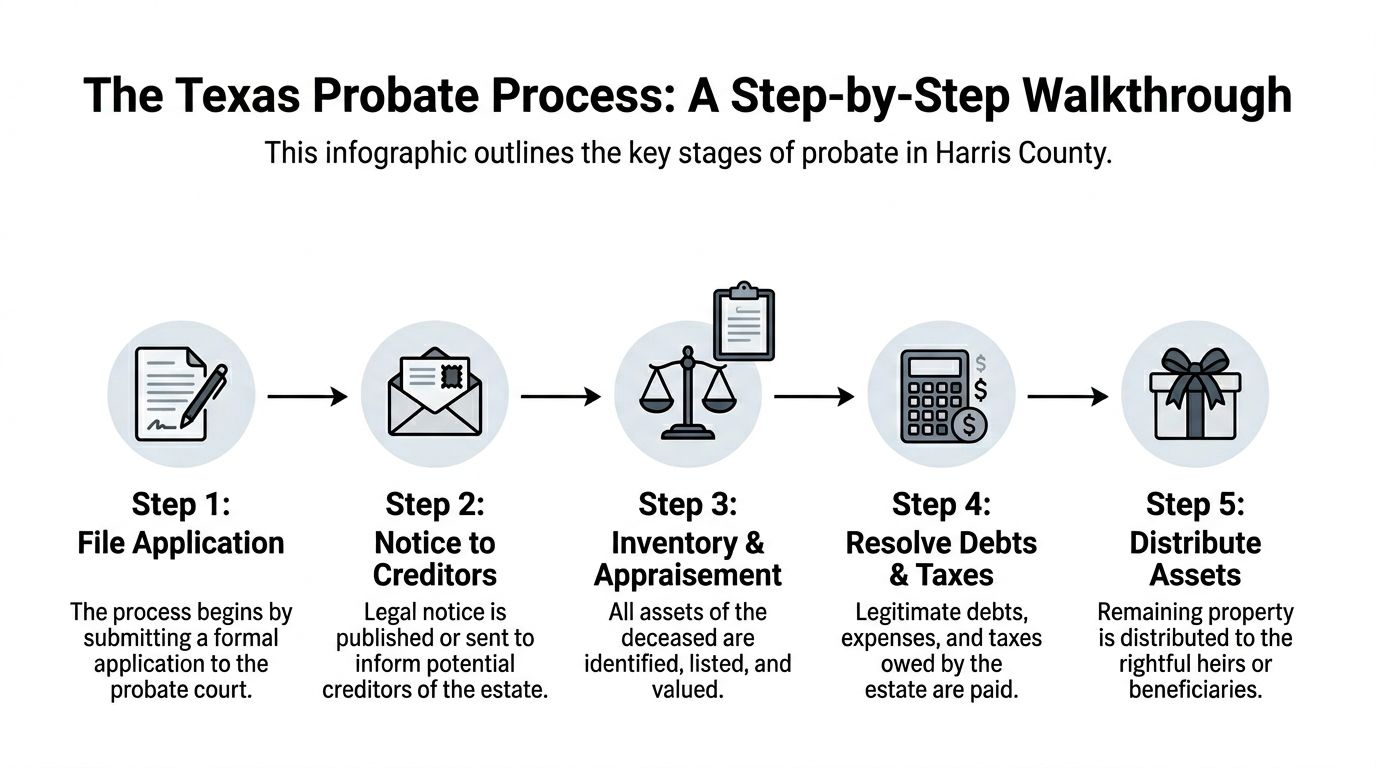
Step one is opening the case
Probate usually starts with filing an application in the proper Harris County probate court. If there’s a will, the filing asks the court to admit the will to probate and appoint the named executor.
For readers who want a fuller breakdown of the filing side, this guide on how to probate a will in Texas is a useful companion.
Harris County probate courts use standardized filing fees of $360 for most new estate proceedings, and the courts follow structured weekly dockets. For example, Wednesdays are typically used for Probate of Wills & Administrations, while Fridays are reserved for Mental Health cases, according to the official Harris County Probate Courts website.
Step two is the hearing
After filing, the case is set on the court’s docket. In an uncontested matter, the hearing is often short, but it still matters. The judge may want testimony or other required proof before signing the order.
For a Kingwood executor, this is the moment when the process starts to feel real. The court is no longer just paperwork. It is deciding whether the estate can move forward.
Step three is getting legal authority
Once the judge signs the order, the executor or administrator can usually receive Letters Testamentary or another form of court authority, depending on the case.
Those letters matter because financial institutions often won’t speak with a family member based only on a death certificate or a copy of the will. They want proof that the court has authorized someone to act.
Step four is dealing with creditors
The estate representative has duties after appointment. One of the biggest is handling creditor notice properly.
That usually includes:
- Publishing notice when required: This puts creditors on legal notice.
- Reviewing claims carefully: Not every bill presented to the estate is valid or payable in the form demanded.
- Avoiding early distributions: Families sometimes want to divide property too soon, before debts are sorted out.
Step five is identifying the estate property
This part sounds simple, but it often takes real work. The executor has to identify what the deceased owned, what passes through probate, and what may transfer outside probate.
Examples may include:
- A home in Kingwood
- Bank accounts in one person’s name
- Vehicles
- Personal property
- Business interests
- Investment accounts that don’t already have beneficiary designations
Some assets never become part of the probate estate because they pass by contract or title. That’s one reason executors should avoid guessing.
A good inventory is more than a list. It’s the map the executor uses to decide what the estate can pay, transfer, or protect.
Step six is paying proper debts and expenses
The estate may need to pay funeral costs, final bills, administrative expenses, and valid creditor claims. Sometimes there are tax questions too.
This stage often causes anxiety because families worry they’ll have to pay estate debts personally. In many cases, the issue is whether the estate owes a debt, not whether an heir owes it from personal funds. The details matter, and the answer depends on the facts.
Step seven is distributing what remains
After the legal requirements are handled, the remaining estate property can be distributed to the beneficiaries named in the will, or to heirs under Texas law if there is no will.
This can include signing deeds, transferring account balances, assigning title, or distributing personal property.
A simple roadmap for Kingwood executors
Here’s the probate path in compact form:
- File the application
- Attend the hearing
- Receive court authority
- Notify creditors and gather records
- Prepare the inventory and appraisement
- Resolve debts and expenses
- Distribute property and close out the matter
Families in Kingwood, Humble, and Northeast Houston usually feel better once they know probate is not one giant event. It’s a sequence. When handled in order, it becomes far less overwhelming.
Independent vs Dependent Administration What It Means for You
Not all probate cases move the same way. In Texas, one of the biggest differences is whether the estate proceeds as independent administration or dependent administration.
That choice affects time, cost, paperwork, and stress.
The short version
Independent administration gives the executor more room to act without asking the court for approval at every turn. Dependent administration involves more court supervision.
For many families, that difference is huge.
According to Texas probate jurisdiction and administration guidance, 80-90% of probates close in under 6 months with independent administration, compared to 12-24+ months for dependent administrations. The same source states this can reduce attorney fees from $10k-$30k in a dependent case to $3k-$8k in an independent one.
Independent vs. Dependent Administration in Harris County
| Feature | Independent Administration | Dependent Administration |
|---|---|---|
| Court supervision | Limited ongoing supervision | Ongoing court oversight |
| Speed | Often faster | Usually slower |
| Cost | Often lower | Often higher |
| Executor flexibility | Broader authority to act | Needs court approval for more actions |
| Best fit | Uncontested estates with cooperation | Disputed or more complex oversight situations |
Why independent administration is often preferred
If a valid will authorizes it, or the heirs agree and the law allows it, independent administration often makes life easier for the person handling the estate.
That usually means:
- Fewer court appearances
- Less waiting for approvals
- More efficient asset collection and distribution
- Lower legal expense in many cases
For a family in Kingwood trying to manage work, school schedules, and property issues after a death, that efficiency matters.
When dependent administration shows up
Dependent administration is more court-controlled. It may be necessary when there’s conflict, uncertainty, or a need for stronger judicial oversight.
That can happen when:
- Heirs don’t agree
- Someone challenges the executor
- There are serious questions about estate handling
- The estate has unusual complications
Dependent administration isn’t a punishment. Sometimes it’s the structure a case needs. But families should understand that added supervision usually means more hearings, more approvals, and more delay.
What this means in real life
For a straightforward estate in Humble or Kingwood, independent administration often feels like a practical tool. It still requires legal care, but it avoids turning every estate decision into a court event.
For a contested estate, dependent administration may provide guardrails that keep the process accountable.
The type of administration doesn’t just change paperwork. It changes how much freedom the executor has to move the estate forward.
One of the most useful things a person can do during estate planning is create a will that supports a smoother administration later. That single decision can save surviving family members time, money, and unnecessary strain.
Smarter Alternatives to Full Probate in Texas
Full probate isn’t always necessary. In some estates, there’s a more efficient path.
That matters in Kingwood, where many families own a home, have a few bank accounts, and want a clean transfer without opening a larger court process than the situation requires.

A broader trend supports that planning mindset. According to this discussion of Texas probate options, Harris County probate initiations were down 18% in 2025 due to pre-death planning, with tools like Transfer-on-Death deeds and revocable trusts becoming more popular. Because that source refers to 2025, it should be read as a future-dated trend claim rather than a present fact.
Small Estate Affidavit
A Small Estate Affidavit can be an option for some estates under Texas law. It’s commonly discussed for estates valued under $75,000, excluding certain property categories under the legal standard referenced in the brief.
This can be useful when the estate is modest and the family needs a simpler route to transfer assets.
Still, not every estate qualifies. The details matter, especially when real property, debts, or title issues are involved.
Muniment of Title
A Muniment of Title is often a strong fit when there is a valid will and the estate doesn’t need full ongoing administration.
Families in Kingwood sometimes use this option when the main issue is transferring title to real property and there aren’t broader administration needs. It’s leaner than full probate, but it still requires doing it correctly.
Planning tools that work before death
Some probate avoidance tools are created before anyone passes away. Those may include:
- Transfer-on-Death deeds: These can help real property pass outside full probate in the right circumstances.
- Revocable living trusts: Property placed into a trust may avoid probate.
- Beneficiary designations: Many financial accounts transfer by beneficiary form instead of by will.
- Joint ownership arrangements: Some assets pass automatically depending on how title is held.
If you want a more focused look at these options, how to avoid probate in Texas covers many of the planning strategies families ask about most.
A quick video can also help make these choices easier to visualize.
Why alternatives need careful review
Probate avoidance is helpful only when it aligns with the facts.
A family may think, “There’s a will, so we can skip court,” when the better answer is muniment of title. Another family may assume they need full probate, when a small-estate procedure could work. In some situations, opening probate is still the safest and cleanest option.
For local families comparing options, one practical route is to gather the will, deed, account information, and debt picture, then review the choices with a probate attorney or a local firm that handles estate administration, such as the Law Office of Bryan Fagan – Kingwood TX Lawyers.
Common Probate Pitfalls and How to Avoid Them
Probate problems rarely start with dramatic courtroom fights. More often, they begin with a wrong assumption, a missed step, or rushed paperwork.
In the Kingwood area, one recurring issue is filing confusion. According to the Harris County Probate Court No. 4 FAQ material, 15% of probate filings from Kingwood ZIP codes face venue or procedural disputes, and Harris County expanded Zoom hearings for non-testimonial matters, reducing average first-hearing waits from over 60 days to around 30 days through those remote options. That information appears in the Harris County Probate Court No. 4 frequently asked questions.
Mistake one is filing before confirming the right setup
Families sometimes rush to file before confirming venue, court assignment procedures, or the exact type of case needed.
A better approach is simple:
- Confirm the decedent’s last residence
- Identify whether there is a will
- Check whether the estate may qualify for an alternative procedure
- Make sure the filing matches the facts
Mistake two is treating a Zoom hearing casually
Remote hearings are convenient, but they still require preparation.
Show up early, test your audio, keep your documents ready, and answer the judge directly.
That sounds basic, but it matters. Judges still expect clear testimony, proper dress, and organized responses.
Mistake three is distributing property too soon
An executor may feel pressure from relatives who want quick access to money, vehicles, or family keepsakes. But early distributions can create real problems if debts, title issues, or later disputes appear.
Waiting until the estate is ready isn’t delay for delay’s sake. It protects the executor.
Mistake four is trying to solve every issue informally
Families in Northeast Houston often want to keep things friendly, and that instinct is understandable. But “We all agree” can fall apart once property values, stepfamily concerns, or creditor letters enter the picture.
When the estate has tension, written procedure matters more than verbal promises.
Frequently Asked Questions About Probate in Kingwood
Do I need a lawyer for probate in Kingwood
Not every probate matter requires the same level of legal help, but many do benefit from it. The biggest issue isn’t whether probate looks simple on the surface. It’s whether the filing, notices, authority, and distribution are being handled correctly.
If the estate includes real property, missing heirs, family conflict, creditor issues, or title questions, legal guidance is often worth serious consideration.
Why isn’t there a probate court in Kingwood itself
People ask this all the time. The short answer is that Kingwood falls within Harris County’s probate court structure, so the case goes through the county’s statutory probate courts in downtown Houston.
That’s normal for local families, even if it feels inconvenient at first.
What if there is no will
If there’s no valid will, the estate may still go through probate. The court may need to determine heirship and appoint an administrator.
That process is often more involved than a straightforward will probate because the court has to establish who inherits under Texas law rather than follow written instructions from the decedent.
What happens if a family member contests the will
A will contest can slow things down and raise the stakes quickly. The court may need to hear evidence about capacity, execution, undue influence, or other issues.
When that happens, the case shifts from paperwork management to litigation risk. Families should treat that as a serious legal matter, not a side disagreement.
How much does probate cost
The total cost depends on the type of estate, the procedure used, and whether the matter is contested. Some costs are court-related, while others involve legal work, notices, document preparation, title issues, and administration tasks.
The most useful way to think about cost is this: a clean, uncontested estate usually costs less than a disputed one, and an efficient procedure usually costs less than full supervised administration.
How long does probate take
The answer depends heavily on the kind of administration, whether anyone objects, how organized the records are, and how quickly the executor completes required tasks.
Some estates move efficiently. Others take much longer because of family disputes, missing information, real estate complications, or creditor issues.
Can a will be filed years after death
Timing matters in Texas probate. If a family has waited a long time, they should get legal advice quickly before assuming all options are gone.
Late-filed cases may still have paths forward in some circumstances, but delay tends to make everything harder.
Are probate records public in Harris County
In general, probate records in Texas are widely public, and Harris County provides public access tools for searching probate matters through the county system. That means filings and case information are often available for review.
For many families, that’s another reason to be thoughtful and accurate with what gets filed.
Your Next Steps with a Trusted Kingwood Attorney
Probate is a legal process, but for most families it starts as a personal burden. Someone has died. Paperwork is piling up. Relatives have questions. No one is fully sure what happens first.
The good news is that probate usually becomes much less intimidating once you know the right court, the right filing path, and the right procedure for the estate in front of you. A will may need formal probate. A simpler estate may qualify for a more efficient option. A contested matter may need close guidance from the beginning.
For people in Kingwood, Humble, Porter, and Northeast Houston, local perspective helps. You want someone who understands the Harris County probate system, but also understands the practical concerns of families who live out here and don’t want every answer to require guesswork and a drive downtown.

If you’re dealing with a recent loss, trying to locate a will, deciding whether probate is necessary, or worried about a dispute, it helps to sit down with someone who can explain your options in plain English. That conversation can save time, prevent filing mistakes, and give your family a clear plan.
If you need help with probate court kingwood texas issues, the Law Office of Bryan Fagan – Kingwood TX Lawyers welcomes you to schedule a free consultation at our Kingwood office. We serve families in Kingwood, Humble, Porter, and Northeast Houston with practical guidance on wills, probate, estate administration, and related legal concerns. If you’re not sure what kind of probate matter you have, that’s okay. We can help you understand the next step.