When you're putting together an estate plan, one of the most important concepts to understand is the difference between probate and nonprobate assets. Simply put, it all comes down to how your property gets to your loved ones after you pass away. For families here in Kingwood, getting this right is the cornerstone of a solid estate plan.
Think of it this way: probate assets are locked in a legal box that only a Texas judge can open through a court process. Nonprobate assets, on the other hand, have their own key—like a beneficiary designation—and go directly to the person you named, skipping the courthouse altogether.
Understanding Your Estate and the Probate Process
The path your assets take can dramatically affect how much time, money, and stress your family has to deal with later on. It's the difference between a smooth transition for your loved ones in Humble and a long, public court battle.
This flowchart gives you a clear visual of how an estate is divided.
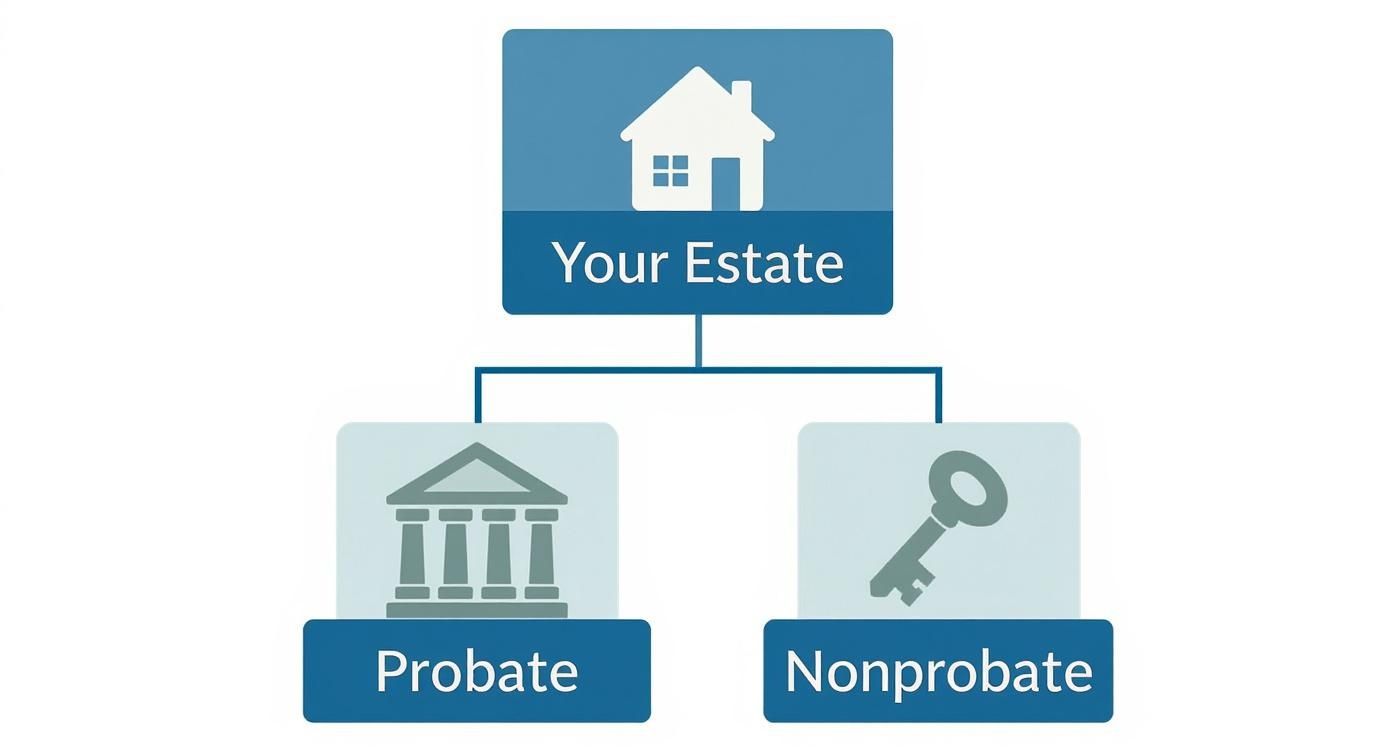
As you can see, your estate splits into two very different streams. Nonprobate assets flow directly to your beneficiaries, while probate assets have to make a detour through the court system.
What Is a Probate Asset?
A probate asset is any piece of property that you own in your name alone, without any mechanism for it to automatically transfer to someone else upon your death. Because there's no pre-set instruction, these assets are essentially stuck until a Texas court steps in to authorize their transfer.
This court process, known as probate, is where a judge validates your will (if you have one), makes sure your final bills are paid, and then legally transfers the property to your intended heirs. In Texas, the whole thing is governed by the Texas Estates Code. Because it’s a court proceeding, it’s also a matter of public record, which can be a slow and intrusive process for your family. You can learn more about the specifics of the court process in our guide on how to probate a will in Texas.
Common examples we see for Kingwood residents include:
- The family home or a piece of land titled only in one person’s name.
- A personal checking or savings account that doesn't have a "Payable on Death" (POD) beneficiary listed.
- Valuable personal belongings like vehicles, jewelry, art, or family heirlooms that are passed down through a will.
What Is a Nonprobate Asset?
Nonprobate assets are the opposite—they are specifically set up to bypass the court. They transfer directly to the individuals you’ve chosen because they have a built-in transfer mechanism, like a named beneficiary or a joint owner with a "right of survivorship."
This direct transfer is faster, completely private, and usually much less expensive than dealing with the probate court.
At The Law Office of Bryan Fagan, we see smart use of nonprobate assets as one of the most effective strategies for protecting a family’s privacy and financial security right here in Northeast Houston. Our Kingwood team is experienced in helping local clients structure their estates for maximum peace of mind.
To make this even clearer, here's a quick side-by-side comparison.
Probate vs. Nonprobate Assets at a Glance
This table gives you a quick summary of the key differences to help you see how these asset types are handled for Kingwood residents.
| Feature | Probate Assets (e.g., Solely Owned Home) | Nonprobate Assets (e.g., Life Insurance, Joint Accounts) |
|---|---|---|
| Transfer Method | Through the court-supervised probate process. | Automatically to a designated beneficiary or joint owner. |
| Control | Governed by your will (or Texas law if no will). | Controlled by a beneficiary designation or account titling. |
| Privacy | Becomes public record through court filings. | Remains a private transaction. |
| Speed & Cost | Can be time-consuming and expensive. | Typically fast, simple, and low-cost. |
Ultimately, understanding this distinction is the first step toward building an estate plan that actually works the way you want it to.
If you have questions about your own assets and how they're structured, our Kingwood office is here to help. We offer a free, no-obligation consultation to talk through your situation and give you the clear, practical guidance you deserve.
What Are Common Probate Assets in Texas?
When you hear the word "probate," it might seem like a distant, complicated legal term. But for families right here in Kingwood, Humble, and across Northeast Houston, it becomes very tangible when you start looking at the actual things a person owned. Let’s walk through the most common types of probate assets we see in Texas estates.
Think of a probate asset as any piece of property titled solely in the deceased person's name. It has no built-in, automatic way to pass to someone else upon death. These assets are essentially frozen in time until a Texas probate court gives the legal authority to transfer them.
Real Estate Owned by One Person
For many folks in our area, the single biggest asset they own is their home. If a house, a vacation property, or a piece of land is titled only in the name of the person who passed away, it’s headed for probate.
Here’s a practical, step-by-step view of what happens:
- The will is submitted to the local probate court (e.g., in Harris County for our Kingwood clients).
- The court validates the will and officially appoints an executor.
- Only then does the executor have the legal power to sign the deed over to the intended heir.
It doesn't matter if the will is crystal clear about who gets the house; the will is simply the instruction manual for the probate process, not a way around it.
Bank and Financial Accounts Without Beneficiaries
This one trips up a lot of families. We’re not just talking about huge investment portfolios; this applies to everyday bank accounts in our Kingwood community.
- Checking and Savings Accounts: A standard bank account in one person’s name without a Payable-on-Death (POD) designation is a classic probate asset. Without that POD instruction, the bank can't legally release the funds to anyone—not even a spouse or child—without a court order.
- Investment Accounts: Brokerage accounts holding stocks, bonds, or mutual funds that are missing a Transfer-on-Death (TOD) beneficiary fall into the same category. The financial institution’s hands are tied until the court officially appoints an executor.
A frequent mistake I see as a Kingwood estate planning attorney is people thinking a will gives them immediate access to a loved one's bank account. In reality, the will only kicks in after the probate court says so. Naming beneficiaries directly on your accounts is what lets them bypass that entire process.
Personal Property and Possessions
This bucket holds everything else you own that doesn’t have a title or a beneficiary form. While some of these items might not have a high price tag, their sentimental value is often priceless, and they are still legally part of the probate estate.
Common examples include:
- Vehicles: Cars, trucks, boats, or RVs titled only in the deceased's name.
- Valuables: Jewelry, artwork, antiques, and other valuable collections.
- Household Items: Furniture, electronics, tools, and other personal belongings.
- Family Heirlooms: Cherished items passed down through generations.
The executor is responsible for gathering all these assets, creating an inventory for the court, and then distributing them according to the will. If there's no will, Texas law decides who gets what, and that plan might be very different from what you would have wanted.
Knowing which assets are probate assets is the first step toward preventing headaches for your family down the road. If you're a Kingwood resident not sure how your property is titled, our team at The Law Office of Bryan Fagan is here to help. We offer a free consultation to look at your specific situation and give you the clear, local guidance you need.
Exploring Nonprobate Assets That Bypass Texas Courts
Think of probate as the standard, local route your estate has to take after you're gone—a path that often involves detours through the Texas court system. Nonprobate assets, on the other hand, are the express lane. They are powerful tools that let your property pass directly to your loved ones, making for a seamless and private transfer without any court intervention. For folks in Porter and Northeast Houston, mastering these strategies is one of the smartest ways to keep control over your legacy.

The secret behind how nonprobate assets work is surprisingly simple: you name a beneficiary right on the account or title itself. This creates a contractual agreement that, upon your passing, legally overrides anything you’ve written in a will. The transfer is automatic, which can save your family a tremendous amount of time, money, and emotional strain.
Assets with Beneficiary Designations
This is the most common and direct way to create nonprobate assets. All it takes is filling out a simple form to build a direct pipeline for your assets to flow to the people you care about most.
- Life Insurance Policies: The death benefit from a life insurance policy goes straight to the beneficiary you named. It completely bypasses the probate process and never becomes part of your court-supervised estate.
- Retirement Accounts: Money held in 401(k)s, IRAs, and 403(b)s is transferred directly to the designated beneficiaries. It's a powerful way to pass on wealth without court oversight.
- Bank Accounts (POD): Many Kingwood residents set up their checking and savings accounts as Payable-on-Death (POD). This simply means the person you name can claim the funds with a death certificate, avoiding probate altogether.
- Investment Accounts (TOD): In the same way, brokerage accounts holding stocks, bonds, or mutual funds can have a Transfer-on-Death (TOD) designation to ensure a smooth transition of those investments.
These designations are incredibly powerful, yet they're so often overlooked. It's a sad reality, but recent data shows a huge gap in estate planning. Roughly 55% of American adults don't have any estate planning documents—no will, no trust, nothing. While about 31% have a will, only a mere 11% have a trust, which is a fantastic vehicle for managing all kinds of assets. This lack of planning creates major headaches for families, especially when simple nonprobate tools could have made all the difference. You can read more about these estate planning statistics and their impact.
Property Owned Jointly with Right of Survivorship
Another highly effective way to steer clear of probate is through joint ownership. In Texas, when you own property as Joint Tenants with Right of Survivorship (JTWROS), it automatically passes to the surviving owner when one owner dies. It’s that simple.
This is a go-to strategy for married couples in Kingwood for things like:
- The family home
- Joint bank accounts
- Cars and other vehicles
The magic words here are "right of survivorship." Without that specific legal language in the deed or account agreement, the deceased person’s share could end up right back in the probate pile.
At The Law Office of Bryan Fagan, our Kingwood lawyers advise our clients to be meticulous about how their assets are titled. A few carefully chosen words on a deed can be the difference between a simple transfer and months spent in probate court.
Assets Held in a Living Trust
For those looking for a truly comprehensive way to avoid probate, a revocable living trust is one of the most robust tools available. When you transfer your assets—like your house, investments, or bank accounts—into a trust, they are no longer legally owned by you as an individual. The trust owns them.
You stay in the driver's seat as the trustee during your lifetime, managing everything as you always have. Once you pass away, the successor trustee you appointed steps in. Their job is to distribute the assets exactly as you instructed in your trust documents, completely outside the probate system.
Understanding these nonprobate options gives you the power to design an estate plan that truly reflects your wishes and protects your family. If you’re a Kingwood resident wondering how to best structure your assets, we invite you to schedule a free consultation with our local team. We’ll provide the clear, compassionate guidance you need.
How to Plan Your Estate to Minimize Probate in Kingwood
Knowing the difference between probate and nonprobate assets is the first step. The next, and most important, is putting that knowledge into action to protect your family. For anyone in Kingwood, Humble, or Northeast Houston, a bit of proactive planning can turn a potentially messy court process into a smooth, private transition for the people you love.
This isn’t about looking for legal loopholes. It's about using the well-established tools available under Texas law to make sure your wishes are followed efficiently. By making smart, intentional decisions now, you're giving your family priceless peace of mind for later.
The Power of Beneficiary Designations
One of the simplest and most effective ways to keep assets out of probate is to add beneficiary designations to every account you can. Think of it like pre-addressing your assets. When the time comes, they go directly to the person you named, no court approval needed.
Here's a step-by-step approach:
- List Your Accounts: Make a list of all bank accounts, investment accounts, retirement funds, and life insurance policies.
- Request Beneficiary Forms: Contact each financial institution and ask for their Payable-on-Death (POD) or Transfer-on-Death (TOD) forms.
- Complete and Return: Fill out the forms, clearly naming your primary and contingent (backup) beneficiaries, and return them.
- Confirm Receipt: Follow up to ensure the institution has your designations on file.
This small step can save your family from waiting months for a court to grant access to funds they might need right away.
Using a Revocable Living Trust for Major Assets
When it comes to more significant assets like your family home or a large investment portfolio, a Revocable Living Trust is an incredibly powerful tool. When you set up a trust, you transfer the legal title of your assets from your individual name into the name of the trust. You don't lose control—you act as the trustee during your lifetime—but legally, the trust now owns the property.
Think of a trust as a private instruction manual for your property. When you pass away, your chosen successor trustee simply steps in to manage and distribute everything according to your rules, completely outside the public probate court system. This is a client-focused approach our Kingwood firm recommends for maximum privacy.
This is a game-changer for Kingwood homeowners. By putting your house into a trust, you turn what would have been your biggest probate asset into a nonprobate one, ensuring a seamless handover to your heirs without court interference.
Texas-Specific Strategies for Titling Property
Texas law gives married couples a few unique options to sidestep probate. One of the most common is owning property as Community Property with Right of Survivorship. This special titling allows a surviving spouse to automatically inherit the deceased spouse’s share of the property without needing to go through probate.
But you have to get the wording exactly right on the deed or agreement. Without that specific "right of survivorship" language, the property won't transfer automatically and could end up right back in the probate process. An experienced local attorney can make sure these critical details are handled correctly. There are a number of ways to approach this, and you can learn more about the different methods for how to avoid probate in Texas in our detailed guide.
Your Beneficiary Review Checklist
Life changes, and your estate plan needs to change with it. A surprisingly common—and costly—mistake is forgetting to update beneficiary designations after a major life event. Run through this simple checklist at least once a year to keep your plan on track.
- Review All Accounts: Did you open any new bank or investment accounts this year? If so, do they have a POD or TOD designation?
- Check Named Beneficiaries: Are the people you listed still the ones you want to inherit? Think about changes like a marriage, divorce, or new child.
- Confirm Contingent Beneficiaries: Always name a backup (contingent) beneficiary, just in case your first choice can't inherit for some reason.
- Verify with Minors: If you've named a minor, have you set up a trust or a custodianship under the Texas Uniform Transfers to Minors Act (UTMA)? Minors can't inherit property directly.
Taking these deliberate steps transforms your estate plan from a stack of documents into a dynamic tool that truly protects your legacy. If you're a Kingwood resident ready to structure your assets for maximum privacy and efficiency, our team is here to help. Schedule a free, no-obligation consultation with The Law Office of Bryan Fagan to build a plan that provides real security for you and your family.
Why You Still Need a Will, Even with Nonprobate Assets
It’s a common thing we hear from families in Kingwood: "I've named beneficiaries on my retirement and bank accounts, so I don't need a will, right?" This is one of the most dangerous misconceptions in estate planning. While using nonprobate assets is a smart strategy, a will remains the essential safety net for every single Texas estate plan.
Think of your nonprobate assets as express trains, each heading directly to a specific, pre-determined destination. But what about everything else left at the station? Your will acts as the station director, making sure any forgotten cargo, unexpected arrivals, or special instructions are handled exactly the way you wanted.

Appointing a Guardian for Your Children
For parents in Kingwood and Humble, this is the single most critical reason to have a will. Nonprobate tools like beneficiary designations or even trusts cannot legally name a guardian for your minor children. A will is the only legal document where you can nominate the person you trust to raise your kids if the unthinkable happens.
Without a will, a judge who doesn't know you, your values, or your family will make this deeply personal decision. The court will decide who raises your children, and it might not be the person you would have ever chosen. This reason alone makes a will indispensable for any parent in our community.
Covering Overlooked Probate Assets
Life is full of surprises, and so are estates. It’s nearly impossible to structure every single thing you own as a nonprobate asset. There will almost always be something left over that falls into the probate category.
Just think about these common scenarios:
- Personal Belongings: Your will is what directs who receives sentimental items like family heirlooms, jewelry, art, or furniture. Without one, these prized possessions are divided according to rigid state laws, not your wishes.
- Last-Minute Assets: What about a final paycheck, a tax refund, or even a forgotten savings bond? These would be considered probate assets that need direction from a will.
- Unexpected Inheritance: Imagine you were set to inherit property from a relative but passed away before receiving it. That inheritance becomes part of your probate estate, and your will determines where it goes next.
A will acts as a "catch-all" for any property that doesn't have a direct beneficiary designation. It’s your final instruction manual, ensuring nothing falls through the cracks or, worse, ends up in the hands of the state. As your local Kingwood lawyers, we ensure this vital document is part of every comprehensive plan.
A Cohesive Estate Plan
The most effective estate plans use both probate and nonprobate assets in harmony. Nonprobate assets offer speed and privacy for major accounts, while the will provides comprehensive control and that crucial safety net for everything else. Our guide on the difference between a will and a trust digs deeper into how these powerful documents can work together to create a truly robust plan.
Don’t leave these critical decisions to chance. At The Law Office of Bryan Fagan, we help Kingwood families create complete estate plans that protect every part of their legacy. Schedule a free, no-obligation consultation with our team today and let us help you build the peace of mind you and your family deserve.
Partnering with a Kingwood Attorney for a Secure Plan
Figuring out the difference between probate and nonprobate assets is a great first step, but it's really just the beginning. While this guide gives you the map, you still have to navigate the terrain, and that’s where things can get tricky. Creating a truly solid estate plan—one that holds up under Texas law and actually works for your family—is best done with a professional by your side.
This is where an experienced Kingwood estate planning attorney becomes invaluable.
At The Law Office of Bryan Fagan, we're not just document drafters. We see ourselves as partners, helping you build a legacy that protects the people you love. We live and work here in Northeast Houston, and our commitment is to provide our neighbors with clear, straightforward advice to safeguard everything you’ve built.
Building Your Custom Plan Step by Step
A good estate plan is so much more than a stack of forms. It’s a personalized strategy, carefully designed to match your goals with the specifics of Texas law. We walk you through it, step-by-step, so you feel confident and supported.
Here’s a glimpse of our practical, step-by-step guidance:
- Asset Review: First, we’ll take a complete inventory of everything you own. We'll sit down and clearly separate your probate assets from your nonprobate ones, so you know exactly what you’re working with.
- Property Titling: How an asset is titled can change everything. We can help you get it right, whether that means setting up a joint tenancy with right of survivorship or moving key assets into a trust.
- Beneficiary Alignment: This is a big one. We'll double-check that every single one of your beneficiary designations is current and lines up perfectly with your will and trust, catching any conflicts before they become a problem for your family.
A well-crafted estate plan is one of the greatest gifts you can give your family. It replaces uncertainty with clarity and ensures your legacy is one of peace of mind, not paperwork and court dates. We are a local, experienced, and client-focused firm providing that trusted representation right here in Kingwood.
Your Local Kingwood Legal Team
We know the concerns that families in Kingwood, Humble, and Porter face because we’re part of this community, too. Our job is to help you put a plan in place that gives you genuine security, letting you relax, knowing your wishes are locked in.
Don't leave something this important to chance. We invite you to schedule a free, no-obligation consultation at our Kingwood office to get the conversation started. Let us show you how we can help you build a plan that truly stands the test of time.
Answers to Your Top Texas Probate Questions
https://www.youtube.com/embed/p57ssSlj-pM
As you start to get a handle on the difference between probate and nonprobate assets, a lot of practical questions naturally come up. Let's walk through some of the most common ones we hear from families right here in the Kingwood area.
Getting a clear picture of how Texas estate law works is the first step toward making confident decisions that protect your family and your legacy. Here are a few key points we find ourselves discussing with clients all the time.
Do I Still Need a Will if I Have a Trust?
Yes, you absolutely do. Even if you've set up a solid living trust, you still need a special kind of will known as a pour-over will. Think of it as your estate plan's safety net.
Your trust can only manage the assets you’ve taken the time to formally transfer into it. A pour-over will is designed to catch anything you might have missed—a new bank account, a car you just bought, or any other asset you didn't get around to titling in the trust's name. This will simply directs that those leftover assets get "poured over" into your trust, making sure everything ends up in one place and avoids probate, which was likely your goal from the start.
Can I Just Add My Child's Name to My House Deed to Avoid Probate?
Putting a child’s name on your deed is a popular idea for avoiding probate, but it's a strategy loaded with potential pitfalls. While it technically turns your home into a nonprobate asset, the risks often outweigh the benefits.
By adding your child to the deed, you’ve just given them a real, immediate ownership stake in your property. That means your home is suddenly vulnerable to their financial life—things like lawsuits, a messy divorce, or creditors.
Beyond that, you could trigger gift tax issues or lose the flexibility to sell or refinance your home without their signature. A Revocable Living Trust or a Transfer on Death Deed are almost always safer, more effective ways to keep your house out of probate court without giving up control. A quick consultation at our Kingwood office can help you understand these better options.
What Happens if I Die Without a Will in Texas?
Dying without a will means you die "intestate." When that happens, the State of Texas doesn't get your property, but it does get to decide who does. The law provides a rigid, one-size-fits-all formula for distributing your assets.
This legal formula, laid out in the Texas Estates Code, dictates who gets what based strictly on family lineage—spouse, children, parents, siblings. It doesn't care about your personal relationships, your promises, or what you would have wanted. For blended families, the results can be especially harsh, sometimes unintentionally disinheriting stepchildren or splitting assets in ways you would never have chosen. A will is your chance to make sure you, not the state, have the final say.
Figuring out the best way to handle your probate and nonprobate assets is the cornerstone of a smart estate plan. At The Law Office of Bryan Fagan – Kingwood TX Lawyers, we specialize in providing the clear, local guidance you need to protect what you've worked so hard for. Schedule a free consultation with our Kingwood team, and let's start building that peace of mind today.