Skip to content
When planning for your future, the difference between a Medical Power of Attorney and a Living Will boils down to one simple concept: one document appoints a person, while the other provides instructions.
A Medical Power of Attorney lets you choose a trusted individual to make health decisions for you if you can't. In contrast, a Living Will (which Texas law calls a Directive to Physicians) outlines your specific wishes for end-of-life care. Understanding how these two documents work together is the first step toward creating a solid plan that protects you and your family here in Kingwood.
Your Guide to Texas Advance Directives
When families in Kingwood, Humble, and Northeast Houston begin thinking about estate planning, they're really taking the first steps to make sure their wishes are respected and their loved ones are protected. Two of the most important tools for this are called advance directives. These are legal documents that let you state your healthcare preferences ahead of time, ensuring they can be followed even if you can't speak for yourself.

The two primary advance directives we use in Texas are the Medical Power of Attorney (MPOA) and the Directive to Physicians (Living Will). They serve distinct but equally important roles. At The Law Office of Bryan Fagan, we help Kingwood residents understand these documents in simple terms.
Medical Power of Attorney (MPOA): This document is all about who makes the decisions. You appoint someone you trust—your agent—to be your voice for a wide range of medical choices if you become incapacitated. It's not just for end-of-life situations; it could come into play after a sudden accident or during a temporary illness.
Directive to Physicians (Living Will): This document is about what decisions are made. It contains your specific, written instructions about life-sustaining treatment if you're ever diagnosed with a terminal or irreversible condition. This is your direct command to your doctors.
Here’s a good way to think about it for our clients in the Kingwood area: Your Living Will is a detailed map for a very specific journey (end-of-life care). Your Medical Power of Attorney is the trusted driver who can navigate any unexpected detours along the way.
Comparing Key Features at a Glance
For our Kingwood clients, seeing the differences side-by-side often makes everything click. Here’s a straightforward comparison of these two crucial Texas estate planning tools.
| Feature | Medical Power of Attorney (MPOA) | Living Will (Directive to Physicians) |
|---|---|---|
| Primary Purpose | Appoints a person (agent) to make healthcare decisions for you. | States your specific wishes about end-of-life medical treatment. |
| Who is in Control | Your chosen agent, acting on your behalf. | Your written instructions, as interpreted by your physician. |
| When It's Active | When you are incapacitated and unable to make your own medical decisions. | Only when you have a diagnosed terminal or irreversible condition. |
| Scope of Authority | Broad; covers most medical decisions, not just end-of-life care. | Narrow; limited to life-sustaining treatments in specific scenarios. |
Having both documents in place provides a comprehensive safety net. Your agent has the flexibility to handle unforeseen issues, while your Living Will gives clear, undeniable direction on the most critical end-of-life choices.
The Role of a Medical Power of Attorney
A Medical Power of Attorney, which we often call an MPOA here in Texas, is a critical piece of any Kingwood resident's estate plan. The simplest way to think about it is this: you're appointing a personal healthcare advocate who is legally authorized to speak for you when you can't speak for yourself. This document lets you (the “principal”) name a trusted person (your “agent”) to make medical decisions on your behalf.

Many people mistakenly believe this is only for end-of-life situations, but its reach is much broader. An MPOA kicks in anytime your doctor determines you are incapacitated, even if it's just for a short time. Imagine being in a serious car accident on Kingwood Drive, undergoing a major surgery at a Northeast Houston hospital, or being sidelined by a sudden illness. In those moments, your agent steps in to make sure your medical care continues in a way that aligns with your values.
The Scope of Your Agent’s Authority
Under Texas law, the agent you appoint has significant control over your healthcare. Their most important job is to make the choices they believe you would make if you were able. It’s about honoring your wishes, not their own.
The authority is quite extensive, giving them the power to:
- Consent to medical treatments, from surgeries and medications to different therapies.
- Choose or discharge your healthcare providers, including doctors, specialists, and hospitals in the Northeast Houston area.
- Access your confidential medical records so they can make fully informed decisions.
- Decide on long-term care, such as moving you into an assisted living facility or nursing home.
- Consent to organ donation, autopsy, and how your remains are handled, unless you've already made other arrangements.
It's crucial for families in Humble and Porter to know this document is different from a general durable power of attorney, which handles your finances. Confusing the two is a common mistake. You can get more details on the differences by reading about what is a power of attorney in Texas. Keeping them separate prevents any mix-ups about who is in charge of your health versus your money.
A Medical Power of Attorney provides flexibility for the unknown. It’s impossible to predict every medical scenario, and an MPOA empowers a human advocate—your agent—to interpret your wishes and act in your best interest in real-time.
Choosing the Right Agent in Kingwood
Selecting your agent is, without a doubt, the most important part of creating a Medical Power of Attorney. This person becomes your voice. It’s not just about filling in a name on a form; it's a huge responsibility that requires real thought and open conversation.
Your ideal agent is someone who:
- Understands and respects your values: They must be willing to put their own opinions aside to honor what you would want.
- Can stay calm under pressure: Medical emergencies are incredibly stressful. You need an agent who can think clearly.
- Is a strong advocate: They can't be timid about asking doctors tough questions or pushing back to ensure your wishes are followed.
- Lives nearby or can travel easily: Practicality matters. You need someone who can be physically present at a Kingwood or Houston-area hospital when needed.
Before you sign anything, sit down and have a frank discussion with the person you have in mind. Walk them through your wishes for different medical situations and, just as importantly, confirm they are willing and able to take on this vital role. Taking this step now can save your family from unimaginable stress later on. Here at The Law Office of Bryan Fagan in Kingwood, we can help you formalize this crucial document, making sure your chosen advocate has the clear legal authority they need to protect you.
How a Texas Living Will Works
While a Medical Power of Attorney names a person to speak for you, a Living Will is a direct message from you to your doctors. Here in Texas, the official name for this document is a Directive to Physicians. Think of it as putting your own voice on the record, legally, for one of life’s most critical moments.
This document is laser-focused. It only kicks in under very specific medical circumstances: when a doctor certifies you have a terminal or irreversible condition and you can’t make your own decisions. For families here in Kingwood and the surrounding areas, it's crucial to understand this isn't for a temporary coma after a car wreck or a health crisis you can recover from. It's strictly for end-of-life situations.
Making Your Wishes Known
At its core, a Directive to Physicians spells out what you want regarding life-sustaining treatments. These are the medical interventions that can only delay the moment of death, not cure you. By creating a Living Will, you're making profoundly personal choices ahead of time, which lifts an incredible weight from your family's shoulders.
You get to decide on treatments like:
- Cardiopulmonary Resuscitation (CPR): If your heart stops, do you want medical staff to try and restart it?
- Mechanical Ventilation: Do you want a machine to breathe for you indefinitely?
- Artificial Nutrition and Hydration: If you can no longer eat or drink, do you want to receive nutrients and water through a tube?
Making these calls now gives your doctors and family a clear roadmap. It ensures your final days happen on your terms, guided by your own beliefs.
The Limitations of a Living Will
The idea of a living will has been around for a while. In fact, these laws spread quickly across the United States; 41 states had adopted them by the end of 1986. The problem was that many early versions were too narrow, often only covering specific things like ventilators or feeding tubes in a terminal state. They left a lot of other medical decisions unaddressed, which is where the more flexible medical power of attorney came in. You can learn more about the evolution of these documents and their impact on patient care.
A Texas Living Will is a direct command for a very specific, defined situation. It says, "In this exact scenario, this is what I want." It simply doesn't have the flexibility to handle medical issues outside of that tight focus.
This is precisely why a Living Will, on its own, isn't a complete estate plan. It doesn't give anyone the power to pick your doctors, authorize a new medication for comfort care, or approve a palliative procedure that isn't directly tied to life support. It’s a powerful tool, but a specialized one.
For anyone in Humble or Northeast Houston, the smartest strategy is to see these documents as a team. Your Living Will lays out the hard-and-fast rules for your final moments. Your Medical Power of Attorney gives your agent the authority to manage every other health decision when you can't. Together, they form a complete safety net for your healthcare wishes.
If you're wondering how these documents fit together for your family, the team at The Law Office of Bryan Fagan is here to help. Schedule a free consultation at our Kingwood office to go over your situation and build a plan that's both comprehensive and solid.
Comparing How Each Document Protects You
It’s one thing to know the dictionary definition of a Medical Power of Attorney (MPOA) or a Living Will, but for families here in Kingwood, the real question is how they actually work when a crisis hits. A sudden medical emergency doesn't give you time to consult legal glossaries; it demands clear, immediate direction. The fundamental difference comes down to their approach: one appoints a person, the other issues a command.
Your Living Will is a direct command for a very specific, final situation; your MPOA appoints a trusted voice to speak for you in all other medical situations.
Think of it this way. A Living Will provides a fixed, pre-written answer to one profound question: "Should life-sustaining treatment be withdrawn if my condition is terminal?" In stark contrast, an MPOA provides a flexible problem-solver—your chosen agent—who can step in and answer any number of unexpected medical questions that might come up.
This flowchart helps visualize the decision-making path, showing exactly when each document comes into play.
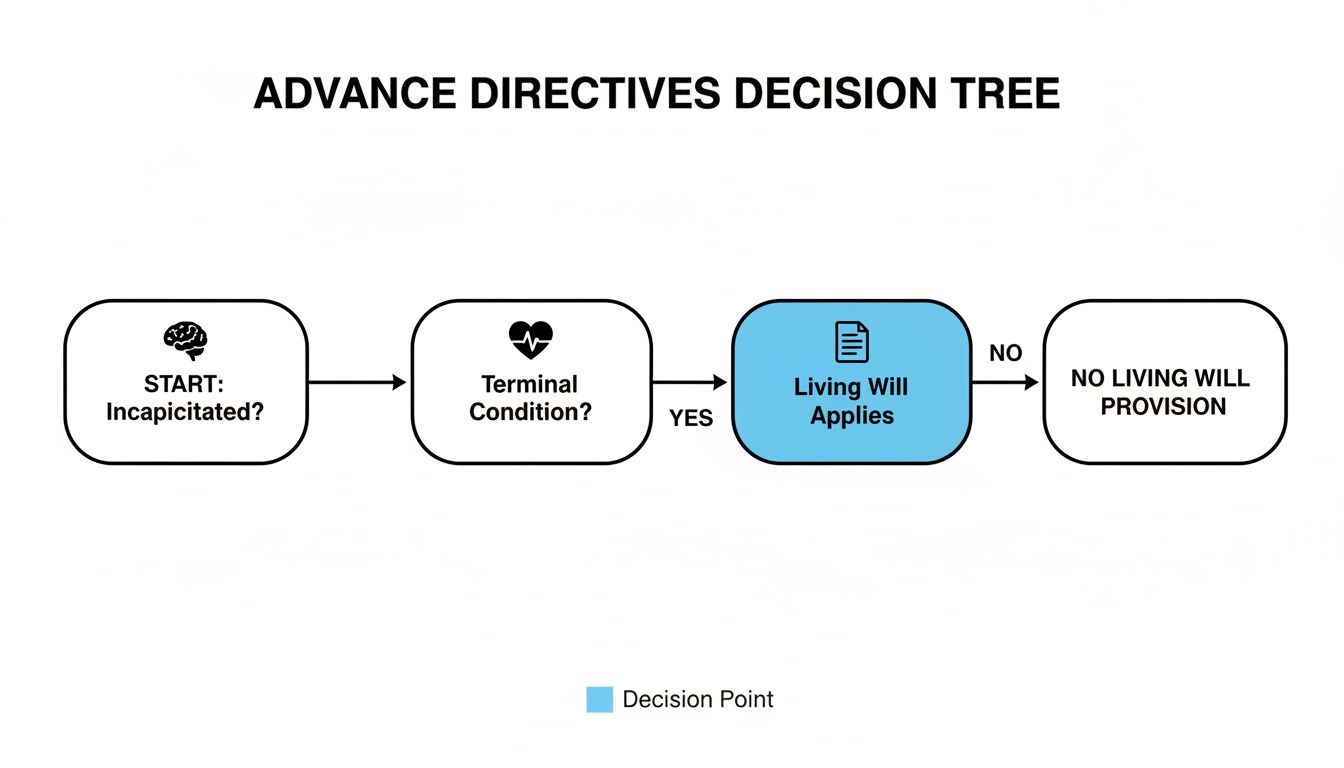
As you can see, the Living Will's authority is triggered only at the very specific intersection of incapacitation and a diagnosed terminal condition. This highlights its narrow but absolutely critical role.
When Does Each Document Actually Take Effect?
The activation trigger is a crucial distinction. An MPOA kicks in the moment your physician certifies that you lack the capacity to make your own healthcare decisions, no matter the cause or prognosis. It’s a safety net for any period of incapacitation, temporary or permanent.
A Living Will, however, remains dormant until two conditions are met simultaneously: you are incapacitated and you are certified by a physician to have a terminal or irreversible condition. This specificity is both its strength and its limitation. It offers undeniable proof of your wishes for end-of-life care but offers zero guidance for any medical event short of that.
Scenario-Based Comparison of Document Authority
Real-world scenarios are the best way to see the practical differences. Here is a step-by-step look at situations that could happen to anyone in Northeast Houston and which document would apply.
| Medical Scenario | Governing Document | How It Works in Practice |
|---|---|---|
| Temporary Coma After Accident on US-59 You're unconscious for several weeks but expected to recover. | Medical Power of Attorney | Your agent steps in immediately. They can consent to surgery, talk to doctors, and manage your care plan until you wake up. The Living Will is irrelevant here. |
| Progressive Illness Diagnosis You're diagnosed with an illness that will eventually impair communication, but it isn't yet terminal. | Medical Power of Attorney | Your agent is essential. They can manage evolving treatments, discuss care options, and even decide on a move to a long-term care facility if needed. The Living Will is not yet active. |
| End-Stage Terminal Diagnosis You're on life support with no hope of recovery, as certified by your doctor. | Both Documents Apply | Your Living Will provides the direct, non-negotiable command to withdraw life-sustaining measures. Your MPOA agent is then responsible for ensuring doctors follow that directive and can make other related decisions (like comfort care) that the Living Will doesn't address. |
These examples show that an MPOA provides the broad, flexible authority for unexpected crises, while the Living Will provides precise, unchangeable instructions for the most profound end-of-life decisions. One is not a substitute for the other; you can learn more about how a Medical POA differs from other types in our guide on durable vs. medical powers of attorney.
For residents in Porter and the surrounding areas, viewing these documents as an "either/or" choice is a common but dangerous mistake. They aren't competitors; they're partners in your comprehensive plan. Together, they ensure your voice is heard and your wishes are respected, no matter what happens.
Common Mistakes to Avoid With Advance Directives
Creating a Medical Power of Attorney and a Living Will is one of the most considerate things you can do for your family. But even the best intentions can go awry, and simple mistakes can completely undermine these critical documents. For our neighbors in the Kingwood and Porter areas, getting this right is key to making sure your wishes are honored during a crisis.

It's easy to put this off. In fact, most people do. A 2007 AARP poll revealed that only 29% of U.S. adults had actually completed a living will or medical power of attorney. This creates a huge gap in planning that often leaves families scrambling and stressed when they are at their most vulnerable. You can read more about the research on advance directive completion rates for a deeper dive.
Choosing an Unprepared Agent
One of the biggest missteps is picking an agent for your Medical Power of Attorney based on emotion or obligation, like automatically naming your oldest child. The person you choose has to be more than just someone you love; they need to be a level-headed advocate who can stand up for you and handle immense pressure.
Think about it: what if your agent is easily intimidated by doctors? Or what if their personal or religious beliefs clash with your end-of-life wishes? When the time comes, they might freeze up or, worse, make a decision based on their values, not yours. This is how people end up receiving medical care they explicitly didn't want, all while creating painful rifts in the family.
Practical Step: Have a direct, honest talk with your potential agent before you finalize anything. Make sure they truly understand what you're asking and are 100% willing to carry out your wishes, no matter how difficult it might be.
Using Vague Language in Your Living Will
Your Living Will has to be crystal clear. Using fuzzy language like "no heroic measures" or "treat me with dignity" is a recipe for disaster. What one doctor considers "heroic," your family might see as standard care. This ambiguity forces your loved ones to argue over your intentions during an already heartbreaking time.
A common pitfall is relying on unverified translations; for your advance directives to be legally binding and accepted, it is often essential to utilize certified document translation services to ensure clarity and precision in any language.
Practical Step: Be specific in your Directive to Physicians. Instead of making broad statements, spell out exactly what you want regarding:
- Mechanical ventilation (breathing machines)
- Artificial nutrition and hydration (feeding tubes)
- Cardiopulmonary resuscitation (CPR)
This level of detail removes all doubt and gives your medical team a clear roadmap to follow.
Failing to Follow Texas Execution Rules
An advance directive isn't just a signed piece of paper; it's a formal legal document with strict rules under Texas law. A devastating—and surprisingly common—mistake is failing to have it properly signed and witnessed. Just downloading a template and signing it at home isn't enough to make it legally binding.
Under the Texas Health and Safety Code, both a Medical Power of Attorney and a Directive to Physicians typically require two qualified witnesses or a notary. If you skip these formalities, a hospital in Northeast Houston could refuse to honor the document. This leaves your family with no legal authority, often forcing them into a costly and emotionally draining court battle for guardianship.
The surest way to sidestep these issues is to work with an experienced local attorney. Here at The Law Office of Bryan Fagan, we guide Kingwood families in creating legally solid advance directives that leave no room for error. Schedule a free consultation with our Kingwood office today, and let us help you protect your family and your peace of mind.
How to Finalize Your Estate Plan in Kingwood
Getting your head around the difference between a medical power of attorney and a living will is a great start, but it's taking action that really brings peace of mind. For those of us here in the Kingwood and Humble areas, finalizing your plan means creating solid legal documents that truly protect you. More than that, it prevents your family from having to make agonizing choices during a crisis.
Think of these documents as partners working together. The Medical Power of Attorney is all about flexibility—it gives the person you trust the power to manage unexpected health problems as they arise. On the other hand, the Living Will provides crystal-clear, non-negotiable directions for your end-of-life care. Together, they form a complete shield for your healthcare wishes.
Taking the Next Steps: Practical Guidance
When you have the right guidance, finalizing your advance directives is a pretty straightforward process. It really boils down to making some thoughtful decisions, getting them down on paper clearly, and making sure every legal box under Texas law is ticked.
Here is a simple step-by-step guide to get you started:
- Reflect on Your Wishes: Think carefully about who you trust to be your agent and what your preferences are for end-of-life care.
- Have the Important Conversations: Talk openly with your chosen agent and your family so everyone is on the same page.
- Get Professional Legal Advice: Work with a Kingwood estate planning attorney to draft documents that are clear, specific, and legally sound under Texas law.
- Execute the Documents Correctly: This includes getting the signing and witnessing done correctly, which is absolutely critical for the documents to be valid. As you finalize these important legal papers, it can also be useful to understand the subtle but important legal differences between digital versus electronic signatures.
- Distribute and Store Copies: Give copies to your agent, doctor, and close family members, and keep the original in a safe, accessible place.
Your goal is to leave no room for ambiguity. A well-drafted estate plan is one of the greatest gifts you can give your family, offering clarity and direction when they need it most.
Don't let uncertainty or questions slow you down. The local, client-focused team at The Law Office of Bryan Fagan is right here in Kingwood to offer guidance you can trust. We can walk you through all the options with our experienced estate planning attorneys in Kingwood, Texas.
Give us a call to schedule a free, no-obligation consultation at our Kingwood office. Let's work together to create a plan that makes sure your voice is always heard, protecting both you and your family's future.
Common Questions We Hear About Texas Advance Directives
When our Kingwood clients start thinking about advance directives, a lot of important questions come up. Getting clear on the details is the best way to make sure your estate plan is rock-solid and actually does what you want it to do. Here are the answers to some of the most frequent questions we tackle in our office.
Can I Change My Mind About My Medical Power of Attorney or Living Will?
Yes, absolutely. Texas law gives you the right to change or completely tear up your Medical Power of Attorney or Living Will at any point, provided you are mentally competent to do so. Life is unpredictable, and it’s only natural that your healthcare preferences might evolve over time.
To make a change, you’ll need to formally execute a new document. It’s absolutely critical to find and destroy every single copy of your old documents to avoid any mix-ups down the line. After that, you need to let everyone know about the update.
- Your new agent (if you’ve updated your MPOA).
- Your immediate family members.
- Your primary care doctor and any hospitals or clinics where you have a patient file.
Making sure everyone is on the same page is the only way to guarantee your most recent wishes are the ones that get followed.
What Happens If I Don't Have These Documents in Place?
If you're ever in a position where you can't make your own medical decisions and you don't have a Medical Power of Attorney or a Living Will, you've essentially lost your voice. Texas law then has to figure out who gets to speak for you, following a strict legal hierarchy—usually starting with a spouse, then an adult child, then a parent.
This isn't just a simple handover. The process can be agonizingly slow and incredibly stressful for your family. It can easily lead to disagreements and, in some cases, a court has to get involved to appoint a legal guardian. By setting up these documents now, you spare your loved ones in Kingwood from that difficult and often heartbreaking situation, ensuring the decisions made are the ones you would have wanted.
Who is the Right Person to Choose as My MPOA Agent?
This is easily one of the most important decisions in this whole process. You need to pick someone you trust implicitly—an adult who not only understands your values but has the strength to stand up for your wishes, especially when things get tough.
Your agent doesn't need to be a Kingwood local, but they must be someone who can communicate clearly with doctors here in Northeast Houston and be available when it counts. The most important step? Sit down and have a very direct, honest conversation with the person you’re considering before you put their name on the paper. You need to know for sure that they understand and are willing to accept this profound responsibility.
Finalizing your advance directives is a powerful step toward protecting yourself and your family. The experienced team at The Law Office of Bryan Fagan – Kingwood TX Lawyers is here to provide the clear, compassionate guidance you need. We invite you to schedule a free consultation at our Kingwood office to ensure your plan is legally sound and perfectly aligned with your wishes.