
When you’re a parent in Kingwood, Humble, or Porter, you know your world revolves around your kids. So, when a divorce or separation puts your family on an uncertain path, the questions about child custody can be overwhelming. As a Kingwood child custody attorney at The Law Office of Bryan Fagan, I've sat with countless local parents just like you, and my job is to bring clarity and strength to your corner.
Understanding Child Custody in Kingwood: A Practical Guide

Stepping into a child custody case in Harris or Montgomery County can feel disorienting. The language is unfamiliar, the process is intimidating, and the stakes couldn't be higher. We’re here to cut through the legal jargon and give you a straightforward guide, explaining how Texas law works and how it applies to families right here in our Kingwood community.
What Does "Custody" Mean in Texas?
Here’s the first thing you need to know: Texas law almost never uses the word “custody.” It's a bit of a curveball, I know. Instead, the law splits the concept into two distinct parts that define your role and time with your child. Understanding these two ideas is the first step toward creating a stable plan for your kids.
Conservatorship: This is all about your rights and duties as a parent. Think of it as your parental “job description.” It defines who makes the big decisions for your child—things like where they go to school, what medical care they receive, and their religious upbringing.
Possession and Access: This is the part everyone usually thinks of as custody. It’s simply the schedule that lays out when your child is with you and when they are with their other parent. This is the calendar that outlines weekdays, weekends, holidays, and summer vacation.
Every single decision a judge makes boils down to one guiding principle: the best interest of the child. This is the North Star of Texas family law. It means the court’s top priority is always your child’s physical and emotional well-being, above all else. For parents who were never married, the path has some unique turns, which we cover in our guide to Texas custody laws for unmarried parents.
To help you keep these terms straight, here’s a quick reference table.
Key Child Custody Terms in Texas Explained
This table is a quick reference guide to help you understand the fundamental legal terms you will encounter during your Kingwood child custody case.
| Legal Term | Simple Explanation for Kingwood Parents |
|---|---|
| Conservatorship | This is your legal role as a parent—the right to make important decisions about your child’s health, education, and general welfare. |
| Possession and Access | This is the physical parenting schedule. It's the calendar that determines where the child lives and when they spend time with each parent. |
| Best Interest of the Child | This is the legal standard judges must use for all decisions. The court will always prioritize what is best for the child’s well-being. |
Knowing these terms gives you a solid foundation for the road ahead.
Your children's stability is everything. Our role is to help you build a legal foundation that supports their happiness and growth, ensuring your parental rights are protected every step of the way.
As a law firm rooted right here in Kingwood, we at The Law Office of Bryan Fagan have a deep understanding of the challenges our neighbors face. We pride ourselves on translating complicated legal rules into practical advice you can actually use. Whether you’re just starting to think about separation or you're already in a dispute, we’re here to help. Call us to set up a free, no-pressure consultation at our Kingwood office to talk about your family and how we can stand by your side.
The Two Types of Texas Conservatorship
When you're facing a child custody case in Texas, you'll hear the term conservatorship a lot. It sounds formal, but it’s simply the legal word for the bundle of rights and responsibilities that come with being a parent. I often tell my clients from Kingwood and Humble to think of it as being a co-chair on the board of directors for the most important venture of their lives: raising their child. As a parent, you have a fundamental duty to make the critical decisions that shape their future.
In any Kingwood child custody case, the judge’s job is to figure out how this "board of directors" will function. Will you and your co-parent share the big decisions, or will one of you have the final say? Texas law gives us two main paths to follow.
Joint Managing Conservatorship (JMC)
By far the most common outcome in our local Harris and Montgomery County courts is a Joint Managing Conservatorship, or JMC. In fact, Texas law actually presumes this is the best arrangement for a child. The courts start with the belief that keeping both parents deeply involved is crucial for a child's stability and well-being. When you're named joint managing conservators, you and the other parent share the power to make key decisions.
Now, this doesn't automatically mean your child splits their time exactly 50/50 between two houses. The focus of a JMC is more on shared parental authority.
For a family in Humble, Porter, or right here in Kingwood, a JMC order means you'll typically have to agree on things like:
- Education: Where will the child go to school? Do they need a tutor?
- Healthcare: Agreeing on non-emergency medical care, like braces or counseling.
- Financial Matters: Making decisions about the child's savings or earnings from a part-time job.
Even in a JMC, one parent is usually named the "primary" conservator. This parent has the exclusive right to decide where the child lives (usually within a specific area, like Harris County and its neighbors) and is the one who receives child support. If you're trying to get a handle on all the terminology, it can be helpful to see the differences between conservatorship and guardianship in Texas, which we break down in another article.
A Joint Managing Conservatorship is Texas's way of promoting true co-parenting. It encourages communication and collaboration, ensuring both parents have a meaningful voice in raising their child, which is so important for families in Kingwood after a separation.
Sole Managing Conservatorship (SMC)
While JMC is the goal, some situations are just not safe or practical for shared decision-making. When that’s the case, a judge can order a Sole Managing Conservatorship (SMC). This is a much rarer outcome and is reserved for cases where serious issues could put a child at risk.
With an SMC, one parent is given the exclusive authority to make almost every major decision for the child, no agreement needed. The other parent is then named the "possessory conservator," which means their rights are mostly limited to visitation (or what the law calls "possession and access").
A judge in a Kingwood courtroom would only consider an SMC if there’s a proven history of serious problems, such as:
- Family violence or domestic abuse
- Child abuse or neglect
- A long-standing battle with substance or alcohol abuse
- Such extreme conflict that co-parenting is simply impossible
- One parent has been completely absent from the child’s life for a long time
It’s also important to acknowledge that biases can exist. For instance, national data has historically shown mothers are often favored in custody battles. While Texas law is written to be gender-neutral, the reality on the ground is that fathers in Harris County may face an uphill battle. The latest divorce and custody statistics for Texas on familylaw-tx.com show that fathers in our state receive, on average, only about 33% of parenting time. This highlights just how critical it is for local dads in the Northeast Houston area to build a strong case that demonstrates their stability and active involvement.
Navigating the choice between a JMC and an SMC is one of the most pivotal moments in a custody case. A dedicated Kingwood child custody attorney at The Law Office of Bryan Fagan can help you figure out what makes the most sense for your family and fight to protect your child’s future. To get started, schedule a free consultation with us today and let's build a clear strategy together.
Possession Orders and Visitation: Building Your Family's New Calendar
After a court determines who holds parental rights and duties (conservatorship), the next step is to create the actual schedule. We call this the possession order in legal terms, but what it really is is your family's new calendar—the roadmap that dictates when your children will be with each parent. For anyone going through a separation in Kingwood, getting this schedule right is absolutely essential for bringing stability and predictability back into your children's lives.
Let’s be honest, this is often the hardest part of any custody case. Deciding where the kids will wake up on a school day or spend their holidays can bring up a lot of emotions. To provide a fair and consistent starting point, Texas law created what’s known as the Standard Possession Order (SPO).
Think of the SPO as the default template for parenting time. Courts in Harris and Montgomery counties automatically presume it’s in a child's best interest, making it the most common schedule you’ll see.
What the Texas Standard Possession Order Looks Like
For most families living in the Kingwood area and nearby communities, the SPO gives the non-primary parent a clear and consistent schedule. It generally breaks down like this:
- Regular Weekends: The non-primary parent typically has the children on the first, third, and fifth weekends of any given month.
- Alternating Holidays: To make sure both parents get to build holiday traditions, major holidays like Thanksgiving and Christmas are split and alternated each year.
- Summer Break: The non-primary parent usually enjoys an extended 30-day period with the children during the summer vacation.
This framework is designed to ensure both parents have meaningful, recurring time with their kids. This timeline shows how different conservatorship paths ultimately lead to one of these possession schedules.
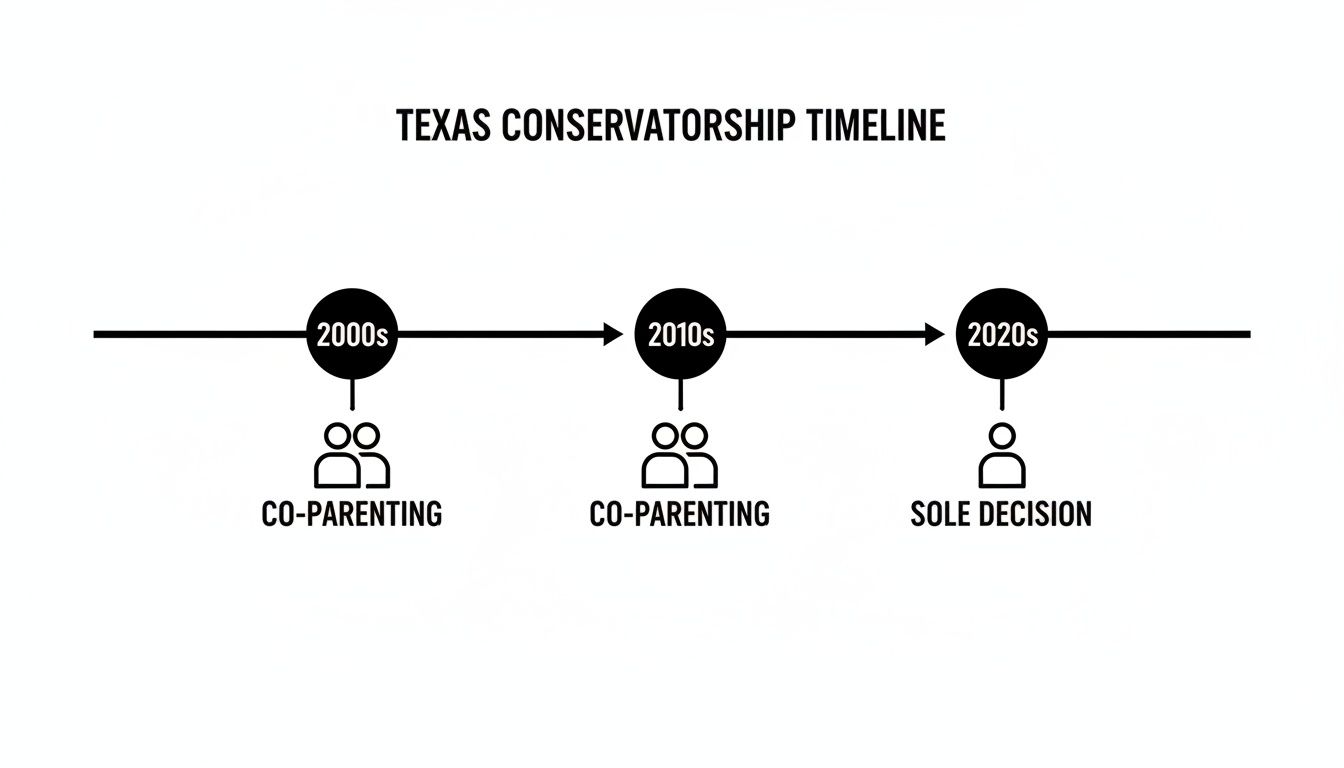
As you can see, whether you and the other parent share decision-making or one person takes the lead, the end result is a formal, court-ordered schedule that maps out parenting time.
What Happens When Parents Live Far Apart?
In a sprawling area like greater Houston, distance is a real factor. The law recognizes this. If you and the other parent live over 100 miles apart, the standard schedule gets a practical adjustment. Instead of the typical weekend rotation, which can be a logistical nightmare, the parent living farther away can opt for a different arrangement.
They might choose to have the children for every school holiday, including the entire Spring Break, and for the whole summer. This trade-off acknowledges the difficulty of frequent long-distance travel while still protecting that parent's ability to maintain a strong bond with their kids.
The goal of a possession order isn't just to divide time; it's to build a reliable rhythm for your child's life. Predictability helps children feel secure, and a well-drafted order provides that foundation for your family here in Kingwood.
Can We Create a Custom Schedule?
Absolutely. The Standard Possession Order is a fallback, not a straitjacket. If you and the other parent can work together, you have the power to create a custom possession schedule that fits your family’s actual life.
I’ve seen this work wonders for clients in our community. A firefighter and a teacher might agree to a schedule based on his rotating shifts rather than traditional weekends. For parents of toddlers, we might design a plan with more frequent, shorter visits to support the child’s attachment. As long as you both agree and it serves your child’s best interest, the court will almost always sign off on it.
You can dive deeper into the specifics by reading our full guide to the Standard Possession Order in Texas.
This is where having an experienced Kingwood child custody attorney by your side really pays off. We can help you anticipate potential problems, talk through all the "what-ifs"—like transportation for exchanges, right of first refusal, and holiday specifics—and make sure your agreement is written into a clear, enforceable order. At The Law Office of Bryan Fagan, we've helped countless Kingwood families craft plans that truly work. Give our Kingwood office a call for a free consultation to start exploring your options.
How Child Support Is Calculated in Kingwood

After figuring out a possession schedule, the next big question for separated families in Kingwood is always about money. Child support is directly tied to custody, specifically to which parent is named the primary conservator. Getting a firm handle on how these payments are calculated is crucial for everyone involved, ensuring the child is supported and the financial arrangement is clear.
To take the guesswork out of it, Texas law uses a straightforward, formula-based system. The idea is to make child support predictable by basing it on a percentage of the paying parent’s income.
Understanding the Texas Child Support Formula
The starting point is what the state calls "net monthly resources." This isn’t just take-home pay; it's a much broader look at a person’s financial picture. A Harris County court will tally up all sources of income—salary, commissions, overtime, freelance work, rental income, you name it. From that total, they subtract things like federal income taxes, Social Security taxes, union dues, and what you pay for the child's health insurance. The number you're left with is the net monthly resources used in the calculation.
From there, the law applies a simple percentage based on the number of children.
- 1 Child: 20% of net monthly resources
- 2 Children: 25% of net monthly resources
- 3 Children: 30% of net monthly resources
- 4 Children: 35% of net monthly resources
- 5 or more Children: 40% of net monthly resources
So, if a parent in Humble has $5,000 in net monthly resources and two children, their guideline child support would typically be $1,250 per month (25% of $5,000).
How a Recent Law Change Affects Kingwood Families
To keep pace with the rising cost of living, Texas periodically adjusts the income cap for these calculations. A recent change has a direct financial impact on families throughout Northeast Houston. On September 1, 2026, the maximum net monthly resources subject to the guidelines jumped from $9,200 to $11,700. This 27% hike, the first major inflation adjustment since 2019, is significant, as you can see in this overview of the Texas child support update at versustexas.com.
This increase means the maximum potential child support payment also went up. For a single child, the maximum guideline amount is now $2,340 per month (20% of the new cap). For anyone with complex finances, it’s more important than ever to have a Kingwood child custody attorney run the numbers.
Child support isn't a penalty—it's a shared investment in your child's future. The law aims to ensure children continue to benefit from both parents' financial resources, just as they would if the family were still together.
Can a Judge Order a Different Amount?
Absolutely. A judge can order child support that's higher or lower than the guideline amount, but they need a good reason. The court has to find that applying the standard formula would be "unjust or inappropriate" in that specific family’s situation.
Some common reasons a judge might deviate from the formula include:
- Special needs of the child, like expensive medical care, therapy, or special education.
- The unique financial ability of each parent to contribute.
- If the non-primary parent has the child for a period significantly different from a Standard Possession Order.
- High travel costs for visitation, especially if parents live far from each other in the greater Houston area.
As you can see, calculating child support is more than just a simple math problem. It requires a deep understanding of what counts as income and what specific facts might convince a judge to adjust the final amount. The attorneys at The Law Office of Bryan Fagan live and breathe these details. Schedule a free consultation at our Kingwood office, and let's make sure your child gets the financial support they need and deserve.
Modifying or Enforcing Your Custody Order
Getting that signed child custody order from a Harris County judge feels like a huge weight has been lifted. You finally have a clear roadmap. But as any parent knows, life rarely sticks to a predictable map for long. What works for your family today might be completely impractical in a year or two.
This is a completely normal part of co-parenting. The good news is that Texas law anticipates these changes. On the flip side, you might find yourself in the incredibly frustrating position where the other parent is simply ignoring the court's rules. For parents in Kingwood, Humble, and the surrounding areas, it’s crucial to know that you have legal tools for both situations. Trying to solve these issues with informal agreements or heated arguments often just makes things worse. The only way to truly protect your rights and your child's stability is by going back through the court system.
When Can You Modify a Custody Order?
You can't go back to court just because you've decided you don't like the custody arrangement anymore. To even get a judge to consider a change, you first have to prove there has been a “material and substantial change in circumstances” since your last order was put in place. Think of this as the legal key you need to unlock the courthouse doors for a modification case.
So, what exactly counts as "material and substantial"? There’s no simple checklist, but a judge is looking for significant life events that directly impact your child's well-being.
Some of the most common reasons we see for a successful modification in our Kingwood community include:
- One parent lands a new job with a radically different work schedule.
- The primary parent needs to relocate outside the geographic area specified in the order.
- A child's needs evolve as they get older, perhaps requiring new medical treatments or specialized educational support.
- A parent's living situation has become unstable or even unsafe.
- The child, if they are over 12, has a strong, clear preference to live with the other parent.
If you think your situation fits this description, your Kingwood child custody attorney can file what’s called a Petition to Modify the Parent-Child Relationship. This kicks off a new legal process, but the court’s guiding star remains the same: every decision will be based on what is in the best interest of the child.
Life changes are inevitable, but your child's stability should remain constant. A modification seeks to adjust your court order to reflect your family's new reality, ensuring the plan continues to serve your child's best interests.
What to Do When the Other Parent Breaks the Rules
Few things are more infuriating than a co-parent who ignores a court-ordered possession schedule, denying you that precious, court-ordered time with your child. In these moments, it is absolutely vital that you don't take matters into your own hands. The proper, and most effective, response is to file an enforcement action with the court.
An enforcement action is exactly what it sounds like: you’re asking a judge to enforce the order and compel the other parent to follow the rules. If the judge agrees that the other parent knowingly violated the order, the penalties can be significant:
- Ordering make-up visitation to compensate for the time you lost.
- Requiring the non-compliant parent to pay for your attorney's fees and court costs.
- Holding the parent in contempt of court, which can result in hefty fines or even jail time in serious cases.
The legal muscle behind enforcement actions is only getting stronger. New Texas laws, set to take effect on September 1, 2026, will dramatically change the game for custody enforcement. These new rules will give parents in Kingwood powerful new tools against visitation denial. A "three strikes" rule, for instance, means that after three separate convictions for interfering with visitation, a custodial parent could face criminal charges. As you can learn more about this new three-strikes law on thecusiclawfirm.com, this is a major shift designed to protect parental rights.
Whether you need to adapt your custody order for a new chapter of life or hold the other parent accountable to the current one, the legal process is complex. The Law Office of Bryan Fagan has guided countless families in Northeast Houston through these exact challenges. Contact our Kingwood office for a free consultation to talk about your specific situation and protect your family's future.
How a Kingwood Child Custody Attorney Can Help
Trying to handle a child custody case on your own can feel like you’ve been dropped into a high-stakes game where you don't know the rules. A dedicated Kingwood child custody attorney does so much more than file paperwork—we're your guide, your strategist, and your staunchest advocate from day one until the case is resolved. Our job is to carry the legal weight so you can focus on what’s truly important: your children.
We've worked with countless families across Kingwood, Humble, and Porter, and one thing is certain: no two situations are the same. That's why we start by listening. We need to hear your story and understand what you hope to achieve before we can build a legal strategy that protects both your child’s best interests and your rights as a parent.
More Than Just a Lawyer
An experienced family law attorney provides critical support that extends far beyond the courtroom walls. We manage the complex legal machinery for you, from drafting the initial petition to gathering the right evidence and meeting every deadline. We become your voice in negotiations, mediation, and, if it comes to it, in front of the judge, making sure your perspective is heard clearly and powerfully.
Here’s our step-by-step approach to helping Kingwood clients:
- Step 1: Free Consultation & Strategy Session: We listen to your story, explain your rights in simple terms, and outline a clear, practical plan for moving forward.
- Step 2: Legal Action & Negotiation: We handle all the legal filings and communicate directly with the other party to negotiate a fair agreement, always keeping you informed.
- Step 3: Mediation or Court Representation: We advocate for you in mediation to find a collaborative solution or, if needed, present a strong, evidence-based case in court to protect your family.
- Step 4: Securing Your Final Order: We ensure your final custody order is clear, enforceable, and provides a stable foundation for your child's future.
Working with a local attorney gives you a home-field advantage. We don't just know the law; we know the Kingwood community and the specific tendencies of the local court system. That kind of insight can make a real difference.
What to Expect in Your Free Consultation
We know that making that first call can feel like the hardest part, so we aim to make it as simple and stress-free as possible. When you come into our Kingwood office for a free, no-obligation consultation, you'll have a confidential, straightforward conversation with one of our attorneys. We’ll listen to your concerns, answer your questions in plain English, and give you an honest take on your situation.
You will walk out of that meeting with a much clearer picture of your rights and a practical plan for what to do next. You don’t have to go through this alone. The Law Office of Bryan Fagan is here to offer the experienced, compassionate, and local representation your family deserves. Contact us today to get started.
Frequently Asked Questions About Child Custody
If you’re heading into a child custody case, your mind is probably racing with questions. It’s completely normal. We hear the same concerns from families all over Kingwood, so we’ve put together some straightforward answers to help you see the path forward.
Can My Child Decide Who They Want to Live With in Texas?
This is a big one we hear all the time from parents in our Northeast Houston community. The short answer is: sometimes, to an extent. In Texas, once a child is 12 years of age or older, the judge is required to interview them in private to hear their thoughts on who they want to live with.
But it’s not quite that simple. A child's preference is just one piece of a much larger puzzle. The judge’s final ruling must follow the "best interest of the child" standard. Think of it like this: the judge has to consider everything—each parent's ability to provide a stable home, the child's emotional and physical needs, and any potential danger. The child's opinion is important, but it won't be the only factor that decides the outcome.
What Happens If We Disagree in Mediation?
In nearly every Harris County custody case, you’ll be required to try mediation first. It's a process designed to help you and the other parent find common ground and avoid a drawn-out, expensive court battle. But what if you just can't agree?
If mediation doesn't resolve all the issues, your case moves on. The unresolved matters are then put in front of a judge for a hearing or a full trial. This is where the judge listens to testimony, looks at the evidence presented by both sides, and makes the final decisions for your family. It’s precisely at this stage that having a sharp Kingwood child custody attorney from The Law Office of Bryan Fagan becomes absolutely critical to argue your case effectively.
How Much Does a Child Custody Case Cost in Kingwood?
There's no single price tag for a custody case, as the cost really depends on how much you and the other parent disagree. If you’re on the same page about most things (an uncontested case), the cost will be significantly lower. If you’re at odds on major issues, it will naturally require more time, negotiation, and potential litigation, which increases the expense.
At The Law Office of Bryan Fagan, we’re committed to being completely upfront about costs. We want to find a practical solution that fits your family's budget while delivering top-notch legal support.
When you come in for your free consultation at our Kingwood office, we’ll sit down, listen to what’s going on, and give you a clear, detailed breakdown of our fees. Our commitment is to our neighbors in this community, helping you get a fair result without any last-minute financial surprises.
Going through a child custody battle is tough, but you shouldn't have to do it by yourself. The Law Office of Bryan Fagan – Kingwood TX Lawyers is right here to give you the local, experienced guidance you deserve. Contact us today to set up your free consultation and take the first real step toward securing your family’s future and your own peace of mind.