When you realize a loved one can no longer take care of themselves, stepping in to manage their affairs is a profound act of love. In Texas, the legal path to do this is called guardianship. For families here in Kingwood, it’s a court-supervised process designed to protect someone who, due to age or disability, can no longer make critical decisions for themselves. Essentially, you're asking a court to grant you the legal authority to act on their behalf, which involves filing an application, providing solid medical evidence, and ultimately, proving to a judge why it's absolutely necessary.
What Guardianship Means and When It Is Necessary

The idea of seeking legal authority over a family member's life can feel overwhelming. For families in Kingwood and Humble, the first step is simply understanding what guardianship really means under Texas law. It's about protection, not control.
At its heart, guardianship is a legal relationship a court creates. A judge appoints a responsible person (the guardian) to look after an incapacitated individual (the ward). The entire arrangement is built to safeguard vulnerable people who can't manage their personal or financial lives on their own anymore.
Common Situations That Require Guardianship
While every family's story is different, certain life events often lead people in Northeast Houston to consider guardianship. You might be facing a situation like one of these:
- Aging Parents with Dementia or Alzheimer's: Maybe your mom is forgetting her medication, or your dad has become vulnerable to financial scams. A guardian can step in to manage their healthcare and protect their finances.
- Adults with Developmental Disabilities: For an adult child who can't grasp complex medical or financial choices, a guardian ensures their best interests are always the priority.
- Minors Without Parental Care: If a child's parents pass away or are no longer able to raise them, a grandparent or aunt in the Kingwood area might seek guardianship to provide a stable home and make necessary legal decisions.
- Sudden Incapacitation: A catastrophic accident or a sudden, severe illness can leave an adult unable to speak for themselves. Guardianship becomes critical for making immediate medical and financial decisions.
The primary goal of a Texas court in any guardianship case is to protect the proposed ward while preserving their independence as much as possible. The court must be convinced that no less restrictive alternative will suffice.
It's crucial to know that guardianship is a serious step because it transfers some of the ward's legal rights to the guardian. That’s why courts in Harris and Montgomery Counties handle these cases with such care. This process is quite different from other legal tools, which often leads to questions about the difference between guardianship and a power of attorney. You can learn more about how a power of attorney works in Texas to see if that might be a better fit for your family’s needs.
At The Law Office of Bryan Fagan, we know how emotionally taxing this decision can be. As your neighbors, we're here to make the process clear and provide straightforward, local guidance right here in Kingwood. If you're weighing your options, scheduling a free consultation with our team can offer the clarity you need to move forward.
Navigating the path to guardianship in Texas isn't about finding a one-size-fits-all solution. Every family's circumstances are different, and the law reflects that. The key is to find the right balance—providing the necessary protection for your loved one without stripping away their independence.
Think of it less as taking over and more as stepping in to help where it's truly needed.
Guardianship of the Person vs. Guardianship of the Estate
For most families we work with in the Kingwood area, the first thing to understand is the two fundamental roles a guardian can play. A judge can appoint you to one, or both, depending on the situation.
-
Guardianship of the Person: This role is all about your loved one's well-being. You're given the authority to make crucial personal and medical decisions. This means choosing where they live (whether it's at home with care, or in a facility), consenting to medical procedures, and overseeing their daily care.
-
Guardianship of the Estate: This is purely about the finances. As guardian of the estate, your job is to manage your loved one’s property, pay their bills, handle their investments, and safeguard their assets from being wasted or falling prey to scams.
It's common for a court to separate these roles. Imagine your father in Humble develops dementia. He might no longer be able to make safe healthcare decisions, but he’s perfectly capable of managing his small pension. In that case, a judge might only grant a guardianship of the person, leaving his financial affairs in his own hands.
Full vs. Limited Guardianship: Finding the Right Fit
Texas courts always aim for the least restrictive option possible. The goal is to preserve as much of an individual's autonomy as we can.
This is where a limited guardianship comes into play. It’s designed for people who can still handle many aspects of their lives but need support in specific, defined areas. For example, our firm once worked with a Kingwood family whose adult son in Porter had a developmental disability. He was happy and independent in his daily life but struggled with understanding contracts and managing his bank account. We established a limited guardianship that gave his parents authority only over his finances, leaving all his personal decision-making untouched.
On the other end of the spectrum is a full guardianship. This is reserved for situations where a person is determined to be totally incapacitated and cannot make any meaningful decisions for themselves. It’s a comprehensive appointment that typically covers both personal welfare and financial matters.
When an Emergency Strikes: Temporary Guardianship
Sometimes, you don't have time to go through the full process. A sudden crisis can demand immediate action, and that’s what a temporary guardianship is for. If a relative in Northeast Houston has an unexpected medical event and is unconscious, they can't consent to a life-saving surgery. A temporary guardianship can be put in place quickly to give a family member the legal power to make that critical decision.
In Texas, a temporary guardianship is a short-term fix, usually lasting up to 60 days. It's designed to act as a bridge, giving you the authority to handle an emergency while you and the court determine if a more permanent solution is needed.
To help you see how these options compare, here's a quick overview of the different types of guardianship you might encounter in Texas.
Guardianship Types in Texas at a Glance
This table compares the key features of different guardianship options available to Texas residents, helping you understand which may apply to your family's needs.
| Type of Guardianship | Primary Responsibility | Common Scenario in Kingwood |
|---|---|---|
| Guardianship of the Person | Making personal, medical, and welfare decisions. | An elderly parent with Alzheimer's who needs help with daily care and medical consent. |
| Guardianship of the Estate | Managing finances, property, and assets. | An individual who has become vulnerable to financial scams but can still manage their own healthcare. |
| Full Guardianship | Managing both personal and financial affairs completely. | A person who has suffered a severe traumatic brain injury and is unable to make any decisions. |
| Limited Guardianship | Assisting with only specific, court-ordered decisions. | An adult with a developmental disability who lives independently but needs help with legal contracts. |
| Temporary Guardianship | Addressing an immediate, short-term emergency. | An incapacitated person requiring urgent surgery when no medical power of attorney exists. |
Choosing the right path requires careful thought and a clear understanding of your loved one's specific challenges and abilities.
The need for these legal tools is only growing. As populations age worldwide, more families are facing these difficult decisions. In Japan, for instance, the number of people aged 75 or older was projected to top 13 million by 2025, leading to a sharp rise in dementia cases—a common catalyst for guardianship proceedings.
For those specifically focused on caring for an aging parent, the journey has its own unique emotional and legal challenges. We provide more focused guidance on how to obtain guardianship of a parent, walking you through the specific steps involved. Here at The Law Office of Bryan Fagan, our Kingwood attorneys are ready to help you navigate these options. Schedule a free consultation with us to talk about your family's needs and find the most supportive way forward.
Navigating the Guardianship Process in Harris and Montgomery Counties
Securing guardianship is a formal legal process, but it doesn't have to be overwhelming. For families here in Kingwood and the surrounding areas, breaking it down into clear steps can make the entire journey feel much more manageable. Think of this as your practical roadmap for what to expect when you're working with the Harris and Montgomery County courts.
The real work begins long before you step into a courtroom. It starts with careful preparation—gathering the right information and filing the right paperwork to officially bring your request before a judge.
Step 1: Filing the Application
The first official move is to file an Application for Appointment of Permanent Guardian. This is the legal document that gets the ball rolling, and it's submitted to the court in the county where your loved one lives. For our clients in Kingwood, that almost always means we're filing with either the Harris County or Montgomery County probate courts.
This application is the foundation of your entire case, so it needs to be solid. It requires specific, detailed information, including:
- The proposed ward’s full name, age, and current address.
- A clear, concise explanation of why a guardianship is truly necessary.
- Your name and your relationship to the person you're trying to help.
- A complete list of close family members who must be officially notified.
Getting this part right from the start is critical. Even small errors or forgotten details can cause frustrating delays, which is one of the main reasons having an experienced Kingwood attorney on your side from day one can be a game-changer.
Step 2: Obtaining the Doctor's Letter
Along with your application, you must file a Certificate of Medical Examination (CME). This isn't just any doctor's note; it's a specific court-required form that has to be filled out and signed by a Texas-licensed physician. And there's a deadline: the doctor must have examined your loved one within the last 120 days.
Frankly, this is the most important piece of evidence you'll submit. The CME gives the court a professional, unbiased medical opinion on your loved one’s condition. The doctor will describe the nature and severity of the incapacity and explain how it impacts their ability to make decisions about their health, safety, or finances. A vague or poorly completed CME is a red flag for the court and will almost certainly get your case stalled.
A strong, well-documented Certificate of Medical Examination is the cornerstone of a successful guardianship application. It provides the objective medical evidence a judge needs to justify removing a person's legal rights.
Step 3: The Attorney Ad Litem Investigation
Once your application is filed, the court’s own protective process begins. The judge will appoint an attorney ad litem. This is an independent lawyer whose only job is to represent the best interests of the person who might need a guardian—the "proposed ward." They don't work for you, and they don't work for the court. Their sole focus is on your loved one.
The attorney ad litem will then conduct their own thorough investigation. This typically involves:
- Visiting and interviewing the proposed ward in person.
- Speaking with you and any other family members involved.
- Carefully reviewing all the medical records, including the CME.
- Contacting doctors, caregivers, or anyone else who has firsthand knowledge of the situation.
This is standard procedure in both Harris and Montgomery County. After the investigation, the ad litem files a formal report with the judge, offering their professional opinion on whether a guardianship is needed and if you are the right person for the job.
This flowchart shows the main types of guardianship we see in Texas—whether you need to manage personal care, financial matters, or a specific, limited set of decisions.
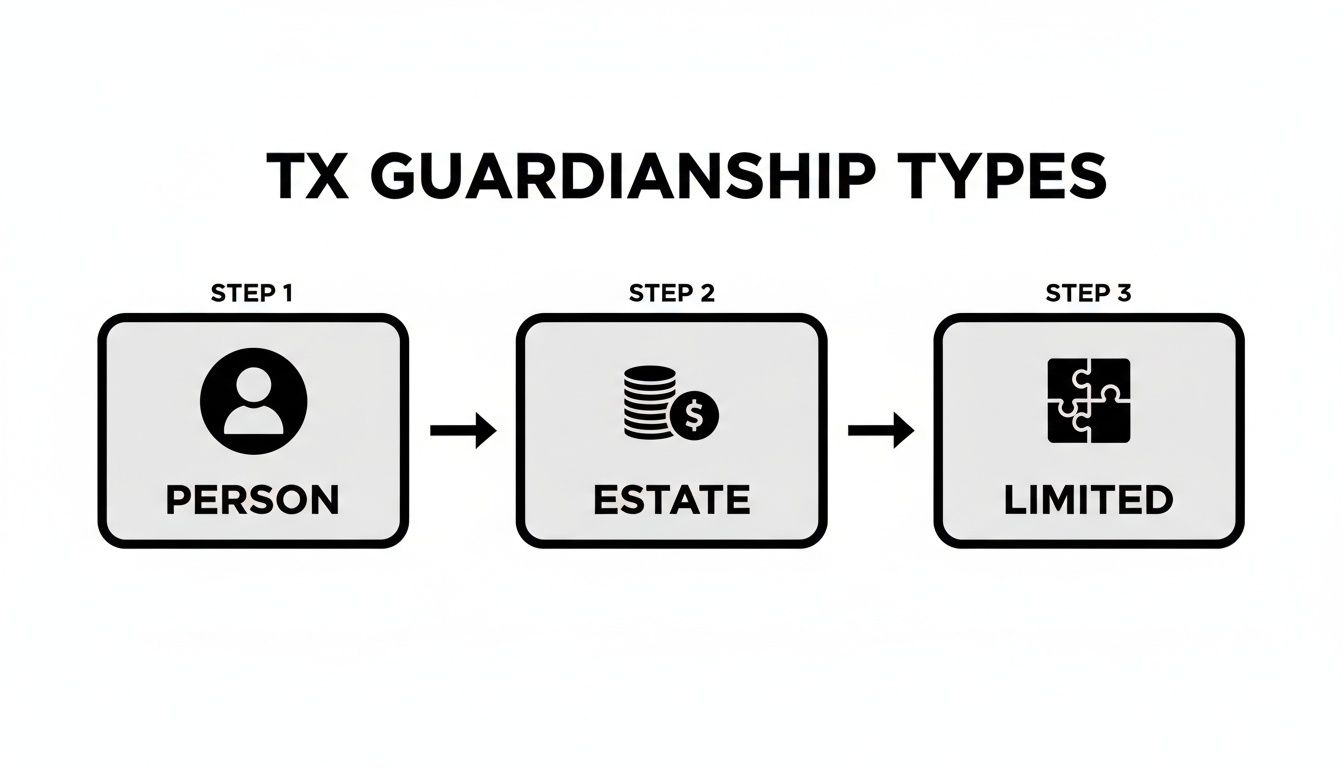
It’s a simple visual that can help you start thinking about whether your loved one needs help with day-to-day personal decisions, their estate, or just a few key areas.
Step 4: The Guardianship Hearing
The final step is the court hearing. This is where the judge will hear all the evidence and make a final ruling. You, your attorney, and the attorney ad litem will all need to be there.
During the hearing, your lawyer needs to prove two essential things to the judge: incapacity and suitability.
- Proving Incapacity: You must show with "clear and convincing evidence" that your loved one can no longer manage their own personal care or financial affairs. Evidence will include the CME and live testimony from you and possibly other key witnesses like doctors or caregivers.
- Proving Suitability: You also have to prove that you are qualified and the most appropriate person to serve as guardian. This means showing you have a clean criminal record, no conflicts of interest, and the ability to handle the job's responsibilities. The court will order a background check on you.
The sheer volume of these cases nationally underscores how vital these legal protections are. In the United States, an estimated 1.3 million adults are under the care of a guardian, who together manage assets worth around $50 billion. And that number is likely on the low side; in 2021 alone, 35 states reported over 92,000 new adult guardianship petitions filed. You can learn more about the national scope of these proceedings by checking out research on Taylor & Francis Online.
If the judge finds that a guardianship is in your loved one’s best interest and that you are a suitable choice, they will sign an order appointing you. From there, you'll have to take a formal oath and post a bond (which acts like an insurance policy for the estate) before the court issues your "Letters of Guardianship"—the official document that grants you the legal authority to act.
While the process is detailed, it’s designed to protect the most vulnerable members of our communities in Porter and Northeast Houston. At The Law Office of Bryan Fagan, our Kingwood attorneys are here to walk you through every step with compassion and expertise. If you're starting to think this is the right path for your family, we invite you to schedule a free consultation to talk through your specific situation.
Stepping Up for a Child: Securing Guardianship for a Minor in Texas

Sometimes, the most loving thing you can do is step in to provide a stable home for a child when their parents simply can't. For many grandparents, aunts, and uncles in our Kingwood community, this isn't a hypothetical situation—it's a deeply personal reality. Securing guardianship is the legal process that gives a child the safety, security, and consistent care they desperately need.
These situations often grow out of heartbreaking circumstances. Maybe a parent has passed away or is incarcerated. Perhaps a severe illness or a battle with substance abuse has made it impossible for them to provide care. When life takes these turns, a loving relative often becomes the only steady presence in a child's world.
The Court's Main Concern: The Best Interest of the Child
When a Texas judge in Harris or Montgomery County considers a guardianship case for a minor, they are guided by one single, powerful principle: the "best interest of the child." This isn't just a phrase; it's the legal standard that shapes every decision. The court's entire focus is on placing the child in an environment that will best promote their physical health, emotional well-being, and overall development.
To figure this out, the judge will look at several key factors:
- The child's immediate and future emotional and physical needs.
- Any potential danger to the child, whether it's emotional or physical.
- The stability of the home you can offer.
- Your ability to be a positive influence and provide effective parenting.
The judge’s job is to look past biology and focus squarely on which situation gives the child the best possible chance to thrive. Your job, with the help of a local Kingwood attorney, is to show the court that you are the person who can provide that.
Guardianship vs. Adoption: A Critical Difference
It's really important for families in Porter and Humble to grasp the fundamental difference between guardianship and adoption. They create two very different legal realities.
Adoption is permanent. It legally severs the relationship between a child and their biological parents, creating a brand new, legally binding parent-child bond with the adoptive parents. Guardianship, on the other hand, is a protective legal status that does not terminate the biological parents' rights.
As a guardian, you have the legal authority to make critical decisions for the child—school, healthcare, day-to-day life—but the parents may still have rights, like visitation. If the situation requires a more permanent solution, a separate legal action might be necessary. It can be helpful to understand the process of termination of parental rights in Texas, as it's a related but distinct legal step.
Think of guardianship as a less permanent solution than adoption. It provides stability now, while leaving the door open for a parent to potentially resume their duties in the future if their circumstances drastically improve.
This distinction matters. Guardianship is a common permanency plan for children in the child welfare system. According to 2023 data from the Adoption and Foster Care Analysis and Reporting System (AFCARS), of the 184,095 youth who left foster care, about 10% went into guardianship arrangements. For comparison, 27% were adopted. This shows just how vital guardianship is for providing stable homes.
Making Your Case to the Court
When you file for guardianship of a minor in Northeast Houston, you need to be ready to prove to the court that you can provide a safe and nurturing home. This means gathering your evidence and painting a clear picture of the stable life you can offer.
Be prepared to provide things like:
- Proof of a Stable Home: This includes evidence of safe housing, a steady income, and your general ability to meet the child's daily needs.
- Evidence of Your Relationship: Show the court the bond you already have with the child. This could be testimony from teachers, neighbors, or friends who have seen you together.
- School and Medical Records: Having these documents ready shows the court you're serious and prepared to manage the child’s education and healthcare from day one.
- A Clear Plan for Their Future: Explain how you’ll support the child’s schooling, hobbies, and emotional well-being as they grow.
You can also expect the court to run a thorough background check. The goal is to ensure there are no red flags that would make you unsuitable as a guardian. Being completely honest and transparent throughout this process is crucial.
Taking responsibility for a child is a life-altering commitment, full of both challenges and incredible rewards. If you're a Kingwood resident considering this journey, you don't have to navigate it alone.
Why You Need a Kingwood Guardianship Attorney
The Texas Estates Code lays out the black-and-white steps for guardianship, but the real-world process is anything but simple. Trying to navigate the court system in Harris or Montgomery County on your own, especially while you're already focused on caring for a vulnerable loved one, can be incredibly draining. This is where having an experienced local attorney on your side can make all the difference.
Think of an attorney as more than just someone who fills out paperwork. They’re your strategist and your advocate, making sure every single detail is handled correctly to prevent frustrating delays or even an outright denial of your application.
When Legal Guidance Becomes Essential
Some situations are just too complex to handle without a legal professional. If you're a Kingwood resident and any of these scenarios sound familiar, your first move should be to call an attorney.
-
Family Disagreements: Nothing complicates guardianship more than when family members can't agree on who should be in charge—or if guardianship is even necessary. These disagreements can quickly escalate into painful, drawn-out court battles. An attorney can help mediate, but if that fails, they know how to build a powerful case to show the court why you’re the best person for the job.
-
Complex Estates: Is your loved one a business owner? Do they have significant assets or complicated investments? Managing the financial side of a guardianship (guardianship of the estate) requires a specific legal and financial skillset. An attorney helps ensure every asset is accounted for, protected, and properly reported to the court, which protects you from potential personal liability down the road.
-
Contested Hearings: If someone formally objects to your application, you’re headed for a contested court hearing. This isn't a simple conversation; it’s a formal legal proceeding where you have to present a compelling case. A guardianship lawyer knows exactly how to gather the right evidence, question witnesses, and make a persuasive argument to a judge.
-
Finding a Less Restrictive Alternative: A good attorney won't push you straight into a full guardianship. They’ll explore every possible option with you, like durable powers of attorney or a supported decision-making agreement. Their primary goal is to find the solution that best fits your family’s unique needs, protecting your loved one while preserving as much of their independence as possible.
Having a local attorney who knows the ins and outs of the Harris and Montgomery County courts is a game-changer. They’re familiar with the judges, the court staff, and the specific local rules that can trip people up. That inside knowledge can make the entire process feel much smoother and far less stressful.
You Don't Have to Face This Alone
Taking on the responsibility of guardianship is a profound act of love. From the initial steps of proving incapacity to the strict annual reporting you'll have to do once appointed, the duties are significant. But the most important takeaway from this guide is simple: you are not alone in this process.
The Law Office of Bryan Fagan has deep roots in the Kingwood community. We understand the unique challenges families in Humble, Porter, and Northeast Houston are up against because we're your neighbors. Our team is here to offer clear, compassionate guidance to help you protect the people who matter most.
We invite you to schedule a free, no-obligation consultation at our Kingwood office. Let’s sit down and talk through your family’s situation. We’ll answer your questions, lay out your options, and show you how dedicated legal support can give you the confidence and peace of mind you deserve.
Common Questions About Guardianship in Texas
When you're considering guardianship, your head is probably swimming with questions. It's a big step, and it’s completely normal to feel a bit overwhelmed. Families across Kingwood, Humble, and the surrounding areas often come to us with similar concerns, so let's walk through some of the most common ones.
What’s the Realistic Cost of a Guardianship Case?
This is usually the first question on everyone's mind, and the honest answer is: it depends. The total cost really hinges on how complex the situation is.
You’re generally looking at a few key expenses. First, you have the court filing fees in Harris or Montgomery County, which usually run a few hundred dollars right off the bat. Then, the court will appoint an "attorney ad litem" to represent your loved one's interests, and you'll be responsible for their fees. This can range from $500 to over $2,000, depending on how deep their investigation needs to go.
Finally, you have your own attorney's fees. Most guardianship lawyers, including our team here in Kingwood, bill on an hourly basis. A simple, uncontested case where everyone is on the same page might only be a few thousand dollars. But if it's a complicated situation with family disagreements or a large estate, the costs can climb significantly higher.
How Long Does This Whole Process Take?
We know you want to get help for your loved one as soon as possible. In a typical, uncontested guardianship here in Texas, you can generally expect the process to take anywhere from one to three months. That's from the day we file the application to the day you stand before a judge for the final hearing.
That timeline isn't arbitrary; it includes a few non-negotiable steps:
- A mandatory waiting period: The law requires this to make sure all family members and other interested parties are properly notified.
- The ad litem's investigation: This attorney needs time to do their job right—meeting the proposed ward, digging into medical records, and talking to everyone involved.
- Getting on the court's calendar: We're always subject to the court's schedule for the final hearing date.
If things get contentious and someone objects, that timeline goes out the window. A contested case will take much longer because it involves more legal back-and-forth.
What If Another Family Member Fights the Guardianship?
This is where things can get difficult, both legally and emotionally. A "contested guardianship" happens when someone, often another relative, objects to what you're trying to do. They might argue that a guardianship isn't needed at all, or they might challenge your ability to be the one in charge.
When an objection is filed, the case shifts gears and starts to feel more like a lawsuit. Both sides will have to go through a formal process called discovery, where we exchange evidence, interview people under oath (depositions), and build a case. The entire dispute is then settled by a judge in a contested hearing, which is essentially a trial.
In a contested case, the judge has one primary focus: what is in the absolute best interest of the person who needs help. They will meticulously sift through all the evidence from both sides to decide if a guardianship is necessary and, if so, who is the best person for the job.
These disputes are incredibly stressful. Having a seasoned Kingwood guardianship attorney in your corner isn't just a good idea—it's essential for navigating the complex legal arguments and presenting the strongest possible case for your loved one.
I’ve Been Appointed Guardian… Now What?
Your work has just begun. Once a judge officially appoints you as guardian, you take on the role of a fiduciary. That's a legal term with a lot of weight behind it; it means you are legally and ethically bound to act only in the best interests of the person you're caring for (the "ward"). The court will be watching.
You'll have some very specific, ongoing responsibilities, including:
- Filing a detailed inventory: Right after you’re appointed, you have to create a complete list of all the ward's property and assets and file it with the court.
- Submitting annual reports: Every year, you must file a report on the ward's health and living situation. If you're managing their finances, you'll also have to file a detailed accounting of every single dollar that came in and went out.
- Getting the court's permission: You can't just make major decisions on your own. Selling the ward's house, making big investment changes, or other significant actions require you to get a judge's approval first.
These duties are serious. Failing to keep up with them can lead to being removed as guardian or even facing legal trouble. Our best advice? Start keeping perfect records from day one. It's the key to doing this job right.
At The Law Office of Bryan Fagan – Kingwood TX Lawyers, we know these aren't just legal questions; they're about protecting someone you care deeply about. Our local team is here to give you the clear, compassionate, and experienced guidance you need. If you're in the Kingwood area and thinking about guardianship, we hope you'll schedule a free, no-pressure consultation to talk about your family's unique situation.