When you have a blended family, estate planning is all about striking a delicate balance. You want to make sure your current spouse is taken care of, but you also need to ensure the inheritance you’ve set aside for your children from a previous relationship is secure. If you don’t have a specific plan in place, Texas law can step in with default rules that might not be what you wanted at all, making a tailored strategy crucial for keeping the peace for your family in Kingwood.
Protecting Everyone You Love in Kingwood

When families in Kingwood and the greater Humble area join together through remarriage, it’s the start of a wonderful new chapter. It’s also the start of a more complex family tree. This new dynamic means a standard, off-the-shelf will just won’t cut it. A generic plan could accidentally leave your own children out in the cold or, worse, spark conflict between your spouse and your kids down the line.
Here at The Law Office of Bryan Fagan, we’ve seen these exact situations play out far too often. Our mission is to help our neighbors in Northeast Houston sidestep these heartbreaking outcomes. For blended families, proper estate planning isn’t just about money and assets; it’s a profound act of love that brings clarity, security, and peace of mind to everyone you care about.
Why a Custom Plan Is Non-Negotiable
A plan that’s built specifically for your family’s unique situation tackles the tough questions head-on. It ensures your legacy is one of thoughtful provision, not painful confusion. It puts you firmly in control of how your assets are handled, giving you the power to care for everyone according to your wishes.
A well-structured estate plan is the single most effective tool for preventing future family disputes. It replaces assumptions and ambiguity with a clear, legally-binding roadmap that honors your wishes and protects your loved ones.
Think about what a truly personalized plan can do for your Kingwood family. It can achieve several critical goals at the same time:
- Provide for Your Spouse: You can set things up so your partner has the financial stability they need for the rest of their life.
- Safeguard Your Children’s Inheritance: It guarantees that the assets you intend for your biological children actually get to them.
- Prevent Unintentional Disinheritance: A custom plan overrides the default Texas inheritance laws, which rarely match the intentions of a blended family.
- Minimize Conflict: When your wishes are spelled out clearly, there’s little room for misunderstandings or legal fights between family members.
Working through these sensitive issues requires a careful hand and a deep understanding of Texas law. As a local Kingwood law firm, we’re committed to providing the practical, step-by-step guidance you need to build a plan that truly fits your family. Don’t leave something this important to chance. Schedule a free, no-obligation consultation with our Kingwood office today and let’s talk about how to secure the future for everyone you love.
Why Standard Wills Often Fail Blended Families
Using a generic, one-size-fits-all will for a blended family is a lot like trying to use a map of downtown Houston to find your way around Kingwood—it’s the wrong tool for the job and will probably lead you somewhere you never intended to go. For blended families, relying on a simple will is often a recipe for unintended consequences, emotional distress, and expensive legal fights.
The heart of the problem is that standard wills just don’t account for the unique dynamics of a second marriage, especially when there are children from a previous relationship. These documents are usually built for a “traditional” family structure, creating huge gaps when applied to the realities of modern families.
The Dangers of Texas Intestacy Laws
If your will is unclear, invalid, or you pass away without one entirely, Texas law takes over. The state’s rules of intestacy will decide who gets your property, and these default rules are rigid, rarely matching what a blended family would have wanted. They are designed to distribute property based on bloodlines and marital status, not the personal relationships or promises you’ve made.
A common and heartbreaking scenario we see in our Kingwood office involves the family home. Under Texas law, if you die without a will, your surviving spouse has certain rights to your shared home. However, your children from a previous marriage are also legally entitled to your share of that community property.
This can force an awful situation where your surviving spouse might have to sell the home or try to buy out your children’s interest just to keep living there. It’s a scenario that creates immediate conflict and financial hardship, pitting the people you love against each other right after you’re gone.
The Risk of Disinheritance
Even with a basic will, the danger of accidentally disinheriting your own children is very real. Think about a common setup for a family in Porter or Humble: you write a simple will leaving everything to your new spouse, trusting they will “do the right thing” and eventually pass the remaining assets to your children.
But life is unpredictable. Your spouse could remarry, have more children, or simply change their own will years later. The assets you intended for your kids could end up going to their own biological children or a new spouse. Once you’re gone, you have no legal control, and your children could be left with nothing.
Without a tailored plan, state intestacy laws could default assets to the new spouse, disinheriting prior kids entirely. Blended families face 40% higher dispute rates over inheritances compared to traditional families, a statistic that highlights the urgent need for careful planning. You can explore more insights about these unique challenges for blended families at TIAA.org.
Standard Plan vs Custom Plan Outcomes in Texas
To truly see the difference thoughtful planning makes, let’s compare what typically happens with a standard plan (or no plan at all) versus a customized one designed for a blended family’s specific needs.
| Scenario | Outcome with a Standard Plan | Outcome with a Custom Blended Family Plan |
|---|---|---|
| Protecting the Surviving Spouse | Spouse may be forced to sell the family home or share assets with stepchildren immediately, causing financial strain. | Spouse can live in the home for life and receive income from a trust, ensuring their financial security is not compromised. |
| Inheritance for Your Children | Children from a prior marriage risk being completely disinherited if the surviving spouse remarries or changes their will. | A trust guarantees that your children receive their intended inheritance after the surviving spouse passes away. Assets are protected for them. |
| Family Harmony | High potential for legal battles, resentment, and fractured relationships between the surviving spouse and stepchildren. | Clear instructions minimize ambiguity and conflict. Everyone understands the plan, which helps preserve family relationships. |
| Probate Process | A simple will must go through the public, costly, and time-consuming probate process, opening the door for challenges. | A trust-based plan can avoid probate entirely, keeping the process private, efficient, and less expensive for your loved ones. |
The contrast is stark. A custom plan gives you control, prevents conflict, and ensures your intentions are legally binding and carried out exactly as you wish.
Understanding the Difference Between a Will and a Trust
Many people think a will is the only tool they need, but for blended families, it often falls short. A will simply directs who gets what and has to go through probate, which is a public court process. It doesn’t offer any ongoing control or protection for your assets after you’re gone.
A trust, on the other hand, is a powerful tool that can manage assets for years according to your specific instructions. For a deeper dive, we explain this in our guide on the difference between a will and a trust.
Think of a trust as a secure vault with a detailed rulebook you write yourself. It can ensure your spouse is cared for while guaranteeing your children receive their inheritance after your spouse passes. This level of control is something a standard will simply cannot offer. Without these more advanced tools, you’re leaving your family’s future to chance.
At The Law Office of Bryan Fagan, our Kingwood lawyers provide the trusted representation you need to move beyond generic templates and create a plan that truly works. Schedule a free consultation with our team to discuss how we can protect both your spouse and your children.
Essential Tools for Your Blended Family Estate Plan
Crafting a solid estate plan for a blended family is a lot like building a custom home—you need more than just a basic blueprint. A simple will is a start, but it’s really just the foundation. To truly protect everyone you love, you need a full toolkit of legal documents, each one designed to handle the unique dynamics of your family. These instruments give you the control you need to make sure your wishes are followed to the letter.
Instead of just relying on a will, the smart approach is to use several legal tools that work together. This strategy creates a resilient framework that can support your spouse for the rest of their life while also ensuring your children’s inheritance is protected. For families here in Kingwood and the surrounding Northeast Houston area, getting familiar with these tools is the first real step toward achieving peace of mind.
This visual really drives home the difference between a generic will and a custom-tailored estate plan built for the realities of a blended family.
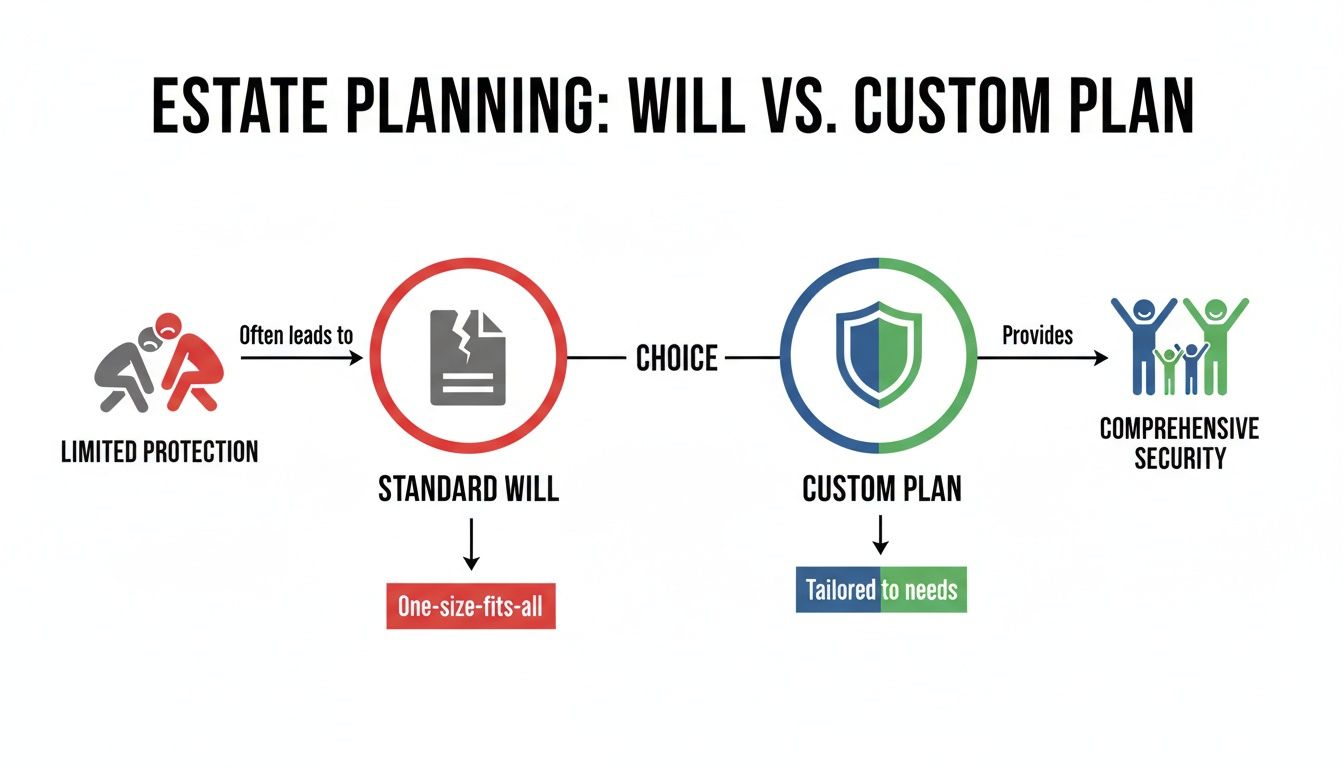
As you can see, a custom plan acts like a shield, preserving family harmony and making sure your assets go exactly where you intend. A standard plan, on the other hand, often leaves the door open for conflict and outcomes you never wanted.
The Power of Trusts in Blended Family Planning
For most blended families, a trust is the single most effective tool you can use. Think of it like a secure vault you create to hold your assets. You get to write the rulebook for how that vault is managed, both while you’re alive and long after you’re gone.
A couple of trusts are especially powerful for blended families:
- Revocable Living Trust: This is a flexible tool that you can change at any time as your life and family circumstances evolve. It lets you manage your assets seamlessly and, when you pass away, ensures they are distributed according to your precise instructions—all while avoiding the public and often expensive probate process.
- Qualified Terminable Interest Property (QTIP) Trust: This one is a real game-changer for blended families in Texas. A QTIP trust lets you provide for your surviving spouse for their entire lifetime. They can receive income from the trust and even continue living in the family home. But here’s the key: the trust guarantees that when your spouse eventually passes away, the remaining assets go to your children, not to your spouse’s heirs or a potential new partner.
This strategy strikes the perfect balance between taking care of your spouse and protecting your children’s inheritance. It eliminates the ambiguity that can lead to your kids being unintentionally disinherited down the road.
Planning for Incapacity with Powers of Attorney
A good estate plan isn’t just about what happens after you die. It’s also about having a plan in place if you become unable to make decisions for yourself. This is where Powers of Attorney become absolutely vital.
A trust can provide for a surviving spouse for life and then pass assets to your children, which helps ease a lot of tension. But it’s just as important to plan for incapacity with powers of attorney and living wills. It’s a critical step, especially when you consider that a staggering 55% of Americans haven’t prepared for it. You can see more on this in the 2025 Trust & Wills report.
In Texas, there are two key documents every adult should have:
- Durable Power of Attorney: This document lets you name a trusted person (your “agent”) to handle your finances if you can’t. This person can pay your bills, manage your investments, and take care of property matters, keeping your family’s financial life running smoothly.
- Medical Power of Attorney: This appoints someone to make healthcare decisions on your behalf if you’re incapacitated. For blended families, this clarity is crucial. It prevents potential disagreements between your spouse and your adult children over your medical care.
Deciding who to give this authority to is a deeply personal choice. To give you a clearer picture, we’ve put together a detailed guide on what a power of attorney is and how it all works under Texas law.
By combining a thoughtfully drafted will with strategic trusts and powers of attorney, you build a comprehensive plan that accounts for nearly any possibility. At The Law Office of Bryan Fagan, our Kingwood attorneys are here to help you select and customize the right tools for your unique family. Schedule a free consultation today to start building that shield for your family.
Aligning Your Beneficiary Designations
One of the most devastating—and surprisingly common—mistakes we see in blended family estate planning happens completely outside of the will. It’s a blind spot for so many people. They don’t realize that a will has absolutely no power over certain kinds of assets.
We call these non-probate assets, and they pass directly to the person you name on a form, bypassing your will entirely. This list includes some of your most valuable accounts:
- 401(k)s and other company retirement plans
- Individual Retirement Accounts (IRAs)
- Life insurance policies
- Annuities
- Payable-on-death (POD) bank accounts
Each of these is governed by its own powerful document: the beneficiary designation form. Whoever is named on that form gets the asset, period. It doesn’t matter what your will says.
The Cautionary Tale of a Forgotten Form
Let me tell you a story we’ve seen play out for families right here in Kingwood. A man gets remarried and builds a wonderful new life with his second wife. He does the responsible thing and hires an attorney to draft a new will, carefully providing for his new spouse and his adult children from his first marriage. He walks away feeling like he’s got everything covered.
Years later, he passes away. His family is grieving when they make a shocking discovery: a huge life insurance policy he took out during his first marriage still lists his ex-wife as the sole beneficiary.
Despite his new will and his obvious intentions, that entire payout legally belongs to his ex. His current wife and his children get nothing from that policy. What follows is a painful, expensive, and emotionally draining legal battle that could have been avoided with a five-minute phone call. This isn’t some rare, bizarre scenario; it’s a simple oversight with heartbreaking results.
A Step-by-Step Guide to Auditing Your Accounts
Preventing this kind of disaster means you have to be proactive and audit every single one of your accounts. It’s not complicated, but it is absolutely essential to making sure all the pieces of your estate plan work together.
Here’s a practical, step-by-step guide to get it done:
- Create a Master List: Start by making a complete list of all your financial accounts, insurance policies, and retirement plans. Don’t forget that old 401(k) from a job you left a decade ago or small life insurance policies you might have.
- Request the Paperwork: Call each financial institution or insurance company. Don’t rely on your memory—ask them to send you a copy of the current beneficiary designation form on file for each account.
- Review and Compare: Once you have the forms, sit down with your will or trust. Does the person named on your 401(k) form match who you named in your will? If you intended for your spouse to get the life insurance, is she actually listed as the beneficiary?
- Update Everything: If you find a mismatch, request the change-of-beneficiary forms right away. Fill them out, sign them, send them back, and—this is key—get written confirmation that the company has processed the change.
- Name a Backup: While you’re at it, name a contingent beneficiary. This is who inherits the asset if your primary beneficiary has already passed away. It’s a simple step that adds another critical layer of protection.
This simple audit is one of the most powerful steps you can take to protect your blended family. Aligning your beneficiary designations ensures there are no conflicts between your will and your non-probate assets, preventing confusion and securing your legacy for the people you intend.
Remember, this isn’t a “set it and forget it” task. You should pull out this checklist and review your designations after any major life event—a marriage, a divorce, the birth of a child, or a death in the family. Here at The Law Office of Bryan Fagan, we walk our Kingwood clients through this detailed audit to make sure no stone is left unturned.
The Role of Prenuptial and Postnuptial Agreements
When it comes to estate planning for blended families, most of the talk centers on what happens after you’re gone. But honestly, some of the most effective tools for keeping things fair and avoiding family drama are put in place much earlier—often right at the start of a new marriage.
These tools are prenuptial and postnuptial agreements. And let’s be clear: they aren’t about distrust. They’re about creating clarity.
For many professionals and business owners here in Kingwood who are getting remarried, these agreements are just a smart, practical way to build a strong foundation. It’s an opportunity for you and your new spouse to sit down together and map out your financial future, making sure you’re both starting on the same page.
Defining What’s Yours, Mine, and Ours
Texas is a community property state. In simple terms, this means the law splits property in a marriage into two basic buckets: separate and community.
- Separate Property: This includes everything you owned before the marriage. It also covers any gifts or inheritances you personally receive during the marriage.
- Community Property: This is pretty much everything else acquired by either of you while you’re married. The law generally views this as owned 50/50.
In a blended family, it’s easy for these lines to get fuzzy over the years. That’s where the confusion—and potential for conflict—begins. A marital agreement works like a detailed financial blueprint, officially spelling out which assets are separate and will stay that way. This is absolutely critical if you want to protect assets you’ve earmarked for your kids from a previous relationship.
For a deeper dive, you can learn more about what a prenuptial agreement is and see exactly how it functions under Texas law.
How Marital Agreements Protect Your Children
Let’s make this real. Say you own a small business in Humble or have a healthy investment portfolio before you get remarried. A marital agreement can officially classify those assets as your separate property. This one simple step creates a powerful shield for your children’s inheritance.
By defining these assets as separate, you legally ensure they aren’t considered part of the community estate. That means they will pass directly to your children according to your will or trust, without any risk of being divided or claimed by your surviving spouse’s family later on.
Think of a marital agreement as setting the ground rules for your financial life together. It’s a proactive conversation that replaces ambiguity with mutual understanding, preventing future disagreements by making sure everyone’s expectations are aligned.
This isn’t about planning for failure; it’s about building a marriage on a foundation of honesty and transparency. When you clarify property rights and inheritance expectations from the start, you remove a huge potential source of stress and conflict for everyone involved.
At The Law Office of Bryan Fagan, we consider marital agreements an essential piece of a solid estate plan for blended families in our Kingwood community. They connect the worlds of family law and estate planning, creating the kind of clarity that leads to long-term family harmony. Let’s talk about how these proactive tools can bring that same peace of mind to you and your family.
How to Discuss Your Estate Plan with Family

You’ve done the hard work of creating a solid estate plan. Now comes the part that can feel even tougher: talking about it with your family. It’s a conversation many people dread, but for a blended family, it’s one of the most important things you can do to protect the harmony you’ve built in your Kingwood home.
A good estate plan isn’t just about legal documents; it’s about making sure everyone understands your wishes. When your intentions are a surprise, it can breed resentment and confusion after you’re gone, especially between a stepparent and stepchildren. By sharing your plan now, you give your family the gift of clarity and show them that every decision was made with love and careful thought for everyone.
Setting the Stage for a Productive Conversation
Think carefully about the when and where. You’re not holding a formal legal proceeding, you’re having a family conversation. A quiet weekend afternoon at your home in Humble or Porter often works far better than a stuffy, high-pressure meeting. The goal is a calm, open dialogue.
Before you gather the kids, make sure you and your spouse are on the same page. Talk it through privately first so you can present a united front. This solidarity is powerful—it shows your children that the plan is a product of your shared values and goals for the entire family.
Leading with Love and Logic
When you all sit down together, don’t just present the facts. Start with the “why.” Simply stating who gets what without any context can come across as cold and arbitrary. Explaining your reasoning helps everyone see the heart and logic behind your choices.
The need for this conversation is backed by some serious numbers. While 16% of U.S. households are blended families, they face a 40% higher risk of disputes over an estate. With so many marriages being a second one for at least one partner, failing to align your documents and have these talks is often what sparks a legal battle. As you can see from these findings for blended families on Corient.com, being proactive is the best way to protect everyone.
Here are a few tips to help guide the discussion:
- Share Your Core Goals: Kick things off by explaining your primary objectives. You could say, “Our main goal was to ensure your mom/dad is taken care of for the rest of their life, while also making sure the inheritance we want to leave for you kids is protected.”
- Talk About “Fair,” Not Just “Equal”: In a blended family, what’s fair isn’t always a 50/50 split. You might need to explain why certain assets are handled differently, especially if significant separate property was brought into the marriage.
- Be Ready to Listen: This is a two-way street. Give your children a chance to ask questions, share their feelings, and process the information. Making them feel heard is crucial, even if their feedback doesn’t change the plan’s structure.
Remember, this conversation is an act of love and a final piece of your responsible planning. At The Law Office of Bryan Fagan, we can help you prepare for this important step. We offer free consultations at our Kingwood office to help you build a plan that not only protects your assets but also strengthens your family bonds for years to come.
Common Questions About Blended Family Estate Plans
Here in our Kingwood office, we hear a lot of the same questions from blended families. They’re trying to do the right thing, but navigating Texas estate planning laws can feel like a maze. Getting clear, simple explanations is always the first step toward building a plan that truly protects everyone you love.
Let’s walk through a few of the most common questions we get.
If I Remarry in Texas, Does My New Spouse Inherit Everything?
No, not automatically—but this is a huge area of confusion. Texas law definitely favors the surviving spouse, often in ways that can cause unintended consequences for blended families.
Without a plan you’ve created yourself, your assets are split up based on rigid state formulas. For example, your children from a previous relationship are legally entitled to your half of the community property. This can create an incredibly difficult situation, potentially forcing your spouse to sell assets or sparking immediate family conflict.
A custom will or trust is the only way for families here in Northeast Houston to make sure their wishes are actually followed, overriding these one-size-fits-all default rules.
Can a Trust Protect My Home for Both My Kids and My Spouse?
Yes, absolutely. This is one of the most powerful and compassionate tools we use for blended families. A specific type of trust, often called a Marital Trust or a Qualified Terminable Interest Property (QTIP) Trust, is designed to achieve two critical goals at once.
First, it gives your surviving spouse the legal right to live in the family home for the rest of their life, ensuring they have stability and security. Second, the trust legally guarantees that once your spouse passes away, the home’s ownership transfers to your children, not theirs. It’s an elegant solution that we see clients in the Humble and Porter areas use all the time to balance caring for a new partner while protecting their children’s inheritance.
How Often Should We Review Our Blended Family Plan?
Life doesn’t stand still, and neither should your estate plan. As a general rule, we recommend a comprehensive review every three to five years. For blended families, it’s even more crucial to revisit things immediately after any major life event.
You should definitely schedule a meeting with your Kingwood estate planning attorney if any of these things happen:
- The birth or adoption of a new child.
- A child from a previous marriage turns 18.
- Your financial situation changes significantly (for better or worse).
- Family relationships or dynamics shift over time.
Is a DIY Online Will Good Enough for Our Family?
We understand why the low cost is tempting, but for a blended family in Texas, a DIY online will is an enormous risk. These generic templates are simply not built to handle the nuances of Texas community property laws, protections for children from a prior marriage, or specific instructions for dividing assets.
The chances of creating an invalid or ambiguous document are high. That kind of mistake could end up costing your family far more in legal fees, stress, and broken relationships than a professionally drafted plan ever would.
Putting together a solid plan for a blended family requires a thoughtful approach from someone who understands the law and the unique dynamics involved. At The Law Office of Bryan Fagan – Kingwood TX Lawyers, we’re committed to helping our neighbors create plans that bring security and peace of mind.
Schedule your free consultation with our Kingwood office today, and let’s make sure your family’s future is protected.