
When your child's safety is at risk, the panic can be overwhelming. As a parent in Kingwood, you might feel frozen, unsure of what to do first. In these moments, Texas law provides a path for immediate intervention: an emergency custody order, known legally as a Temporary Restraining Order (TRO). It’s designed for one purpose—to protect a child from immediate harm. At The Law Office of Bryan Fagan, we understand how scary this is, and our Kingwood attorneys are here to provide the practical guidance you need, right in your community.
Your First Steps to Protect Your Child in Kingwood

That feeling of dread when you believe your child is in danger is something no parent in Kingwood, Humble, or anywhere in Northeast Houston should have to experience. But when it happens, you need a plan. The legal system can feel intimidating, but it offers a direct way to step in when a child is facing a real and present threat.
It’s crucial to understand that an emergency order isn't about deciding the final custody arrangement. Think of it as a legal fire alarm. Its sole job is to provide immediate, temporary protection until a full hearing can be held. The court’s only focus here is keeping your child safe right now. We are here to help you navigate this process with compassion and experience.
What Qualifies as an Emergency in Texas?
Texas courts don't grant these orders lightly. A judge can issue what's called "ex parte relief"—meaning they can make a decision based on your side of the story alone, without the other parent even being there. Because this is such a powerful measure, the standard of proof is incredibly high.
You must prove that your child is in imminent physical or emotional danger.
This isn't for arguments over screen time or disagreements on discipline. We’re talking about serious, urgent situations. In our experience helping families in the Kingwood area, these cases almost always involve one of the following:
- Family Violence: This could be abuse directed at the child or happening in the child’s presence. A police report or photographic evidence can be key.
- Substance Abuse: A parent’s drug or alcohol problem that puts the child in a dangerous situation. Think DUIs with the child in the car or a parent passing out from intoxication.
- Serious Neglect: Failing to provide basics like food, shelter, necessary medical care, or leaving a young child completely unsupervised.
- Threat of Abduction: Concrete evidence that the other parent is planning to take the child and flee, either out of state or into hiding.
The most common mistake we see is a parent trying to get an emergency order over a major disagreement. The question a Harris County judge will ask is simple: "Will this child suffer harm if I don't sign this order today?" It’s all about immediate danger, not future problems.
Taking Quick and Strategic Action
Once you know your child is at risk, you need to move—but you have to move smart. The initial paperwork you file is everything. It has to paint a clear, factual, and compelling picture for the judge. This starts with filing a Petition (the document that opens a custody case) and, most importantly, a sworn Affidavit attached to your Motion for a Temporary Restraining Order.
Your affidavit is your sworn testimony. It’s your chance to tell the judge exactly what happened, in your own words. It must be a detailed, first-person account of the events that created the emergency. You have to be specific: include dates, times, locations, and what was said.
A vague statement like, "The other parent is a danger," will get you nowhere. A powerful affidavit says, "On Friday, May 15, 2026, at our home in Kingwood, the other parent drank an entire bottle of vodka and passed out, leaving our five-year-old child alone by the backyard pool for over an hour." That’s the kind of specific, factual detail that a judge needs to see.
To help you get organized, here’s a quick checklist of what you'll need to get the process started in Harris County.
Kingwood Emergency Action Checklist
This table breaks down the essential first steps. Having this information organized before you even talk to a local attorney can save precious time.
| Action Item | Why It's Critical for Your Kingwood Case | What to Gather |
|---|---|---|
| Document the Incident(s) | Your affidavit is your testimony. Specifics are what convince a judge of immediate danger. | Dates, times, locations, direct quotes, names of any witnesses. |
| Gather Hard Evidence | Tangible proof supports your sworn statement and makes your case much stronger. | Police reports, CPS records, photos, videos, text messages, emails. |
| Identify the Correct Court | Your case must be filed in the right jurisdiction (usually where the child lives). For Kingwood, this is typically a Harris County Family Court. | Your child's primary address for the last 6 months. |
| Draft the Affidavit & Petition | These legal documents formally request the court's intervention and present your evidence. | A detailed, chronological narrative of the events that created the emergency. |
Having these items ready gives you a solid foundation and shows the court that your request is based on credible concerns, not just emotional distress.
Getting an emergency custody order is a fast-paced process that requires absolute precision. You're not just a worried parent in this moment; you are your child's most important protector. At The Law Office of Bryan Fagan, we know the immense pressure you're under. Our Kingwood attorneys are ready to provide the urgent, local guidance you need. Don't go through this alone—schedule a free consultation with our Kingwood office to talk about how we can help protect your child today.
What a Judge Considers a True Emergency
When you’re terrified for your child's safety, every minute feels like an emergency. We understand that. But when you walk into a Harris County courtroom, the word “emergency” has a very specific and very high legal meaning. Understanding what a judge is looking for is the first and most critical step for any parent in Kingwood, Humble, or Porter who thinks they need an emergency custody order.
The legal standard is "imminent danger." This isn't just a potential problem or a bad situation; it means a child is facing an immediate, clear, and very real risk of serious physical or emotional harm. A judge must believe that if they don't sign an order right now, that child will be hurt. It's a high bar, and for good reason.
A Crisis vs. a Conflict
Many serious parenting issues are incredibly stressful, but they don't meet the legal definition of an emergency. From our experience handling these cases for clients in Northeast Houston, judges simply won't grant an emergency order for common co-parenting conflicts.
Things that usually don't qualify:
- Heated arguments over bedtimes, screen time, or diet.
- Your frustration with the other parent's new boyfriend or girlfriend (unless that person is a direct threat to your child).
- Disagreements about which school to choose or what sports the child plays.
- General unhappiness with how the other parent speaks to you.
While these are all valid frustrations, a court will expect them to be handled during regular hearings, not through an emergency intervention. We cover the standard process in our guide on temporary custody orders in Texas, which explains how these more typical issues are resolved.
Real-World Scenarios That Justify Emergency Action
So, what kind of situation actually rises to the level of imminent danger? Based on years of helping families right here in the Kingwood and Humble communities, we can tell you that judges need to see concrete evidence of a direct threat.
Here are some real-world examples that often get a judge's immediate attention:
- Recent and Documented Family Violence: You have a police report from last week, photos of new bruises, or a string of threatening text messages showing a clear and present danger.
- Severe Substance Abuse Endangering a Child: The other parent was just arrested for a DWI with your son in the car. Or maybe a teacher called to report your daughter's father was visibly intoxicated when he tried to pick her up from her school in Porter. The key is that the drug or alcohol abuse is directly putting the child in harm's way.
- Credible Threats of Abduction: The other parent has suddenly pulled the child out of school, sold all their furniture, and told a mutual friend they’re planning to leave the state. The threat has to be specific and backed by action.
- Extreme Neglect: A child is being left alone for hours in an unsafe apartment, isn't being fed properly, or is being denied necessary medical care to the point where their health is suffering.
The most critical factor for the court is how immediate the threat is. An incident from six months ago probably won't be enough for an emergency order today, unless you can show it’s part of a recent and escalating pattern of dangerous behavior.
In Texas, these emergency orders are a lifeline for children in truly dangerous situations. Courts will only grant these powerful orders when they are presented with solid proof of risks like physical abuse, sexual abuse, or severe neglect.
The bottom line is you have to honestly assess if your situation is a true crisis or a serious conflict. A crisis means the court must act now to prevent harm. A conflict, no matter how upsetting, can be sorted out through the standard court process. Knowing the difference helps you build the right kind of case and sets realistic expectations. If you're stuck and not sure which category your situation falls into, the best thing you can do is talk to a local, experienced family law attorney.
How to Gather Evidence for Your Custody Case
When you're asking a judge for an emergency custody order in Kingwood, you're asking them to take a drastic step. To succeed, you need to back up your request with clear, compelling evidence that proves your child is in immediate danger. This isn't just about telling a story; it's about proving it with facts.
Let’s walk through the types of proof that make a real impact in a Harris County courtroom.
Gathering Official Reports
The best evidence often comes from neutral, third-party professionals. When an official agency gets involved, their reports carry significant weight with a judge because they are seen as objective and unbiased.
- Police Reports: Did you have to call the police because of a violent argument, or because the other parent was driving erratically with your child? Get a copy of that incident report. An official report from the Houston Police Department or Harris County Sheriff's Office provides a credible account of what happened.
- Medical Records: If your child was injured, even if it seemed minor, because of the other parent's neglect or actions, you need those medical records. A report from a Kingwood-area pediatrician or an urgent care visit can directly link the other parent’s behavior to your child’s harm.
- CPS Records: Has the Texas Department of Family and Protective Services (DFPS) ever been involved with your family? Any records from an investigation, open or closed, are absolutely critical. They show a judge a documented history of concern.
This kind of paperwork transforms your personal account from "he said, she said" into a fact-based case for intervention.
Documenting Physical and Digital Proof
So much of our lives are documented on our phones, and this can be a goldmine for evidence. You just have to be smart about how you collect it.
Think about photos or videos that show an unsafe environment—maybe pictures of drugs left out on a coffee table or a video of the other parent acting erratically and screaming. A single, clear clip can be more powerful than hours of testimony.
Text messages and emails are also incredibly important. But be careful—simple screenshots can sometimes be challenged in court. It's much better to use a service for exporting legally admissible texts for court to create a clean, verifiable record of the conversation.
A single, well-documented timeline is far more effective than a scattered collection of angry texts and bad memories. Organize your evidence chronologically to show the judge a clear pattern of escalating danger.
The Power of Witness Statements
Sometimes, the most persuasive proof comes from people who have seen the danger with their own eyes. A formal, sworn statement from a witness, called an Affidavit, allows someone else to provide written testimony directly to the court.
These aren't just letters; they are serious legal documents signed under oath. The best affidavits come from credible, neutral people who can speak to what they've personally witnessed. Think about people in your Kingwood community who have direct knowledge:
- A teacher who noticed your child was constantly hungry, exhausted, or had unexplained bruises.
- A neighbor in your Humble community who saw your child left alone for long periods.
- A family friend who witnessed a violent outburst or saw the other parent intoxicated while they were supposed to be watching the kids.
The person writing the affidavit must have personally seen or heard what they are describing. A statement based on gossip or what they think is happening won't hold up and can actually hurt your case. We can help you identify credible witnesses and make sure their statements are drafted to have the maximum legal impact.
Trying to pull all this together while you’re under immense stress can feel impossible, but it is the most important work you can do for your child’s safety. To see how this evidence fits into the bigger picture, you can learn more about how to prepare for a custody hearing in our complete guide.
If you need help gathering evidence for an emergency custody case in Kingwood, you don’t have to do this on your own. The attorneys at the Law Office of Bryan Fagan are here to guide you, help you organize your proof, and build the strongest case possible. Contact our Kingwood office today for a free, confidential consultation.
The Court Process for an Emergency Order in Kingwood
When your child's safety is on the line, the thought of stepping into a courtroom can be terrifying. For families in Kingwood, that means heading to the Harris County Civil Courthouse, and knowing what to expect can make a world of difference. Let's walk through what the process for getting an emergency custody order actually looks like, so you can feel prepared, not panicked.
It all starts with filing the right paperwork. This isn't just a single form; it’s a strategic set of documents that tell the court your story.
- Original Petition: This is what officially kicks off your custody case.
- Sworn Affidavit: This is your chance to explain, in your own words, the immediate danger your child is in. It has to be factual, incredibly detailed, and signed under oath.
- Motion for a Temporary Restraining Order (TRO): This is the formal request you're making to the judge, asking for the emergency order.
The First Hurdle: The Ex Parte Hearing
Once everything is filed, your attorney will go before a judge for a very quick hearing. This is called an "ex parte" hearing—a legal term that just means the other parent won't be there and probably doesn't even know you've gone to court yet. The judge’s entire decision will be based on the papers you filed, especially your affidavit.
This is your one shot to make a compelling first impression. Because the other parent can't defend themselves, the judge is going to look at your claims with a critical eye. A vague or poorly written affidavit won't cut it. You need to clearly and convincingly lay out the immediate risk. As you gather your evidence, knowing what makes a document legally binding is critical to making sure every piece of proof you present is as strong as possible.
What Happens After the Judge Signs the Order?
If the judge is convinced your child is in immediate danger, they will sign the Temporary Restraining Order. This order is a powerful but temporary shield, typically lasting for only 14 days. It immediately grants you emergency custody and sets very clear boundaries for the other parent, often prohibiting any contact.
But that 14-day period is just the beginning. The TRO itself will contain a date for a second court appearance. This next hearing is where things get serious, as it must happen before the TRO expires. By then, the other parent will have been officially served with the lawsuit and will have the right to show up and tell their side of the story.
The evidence you present is the foundation of your entire case, from that first affidavit to the final hearing.
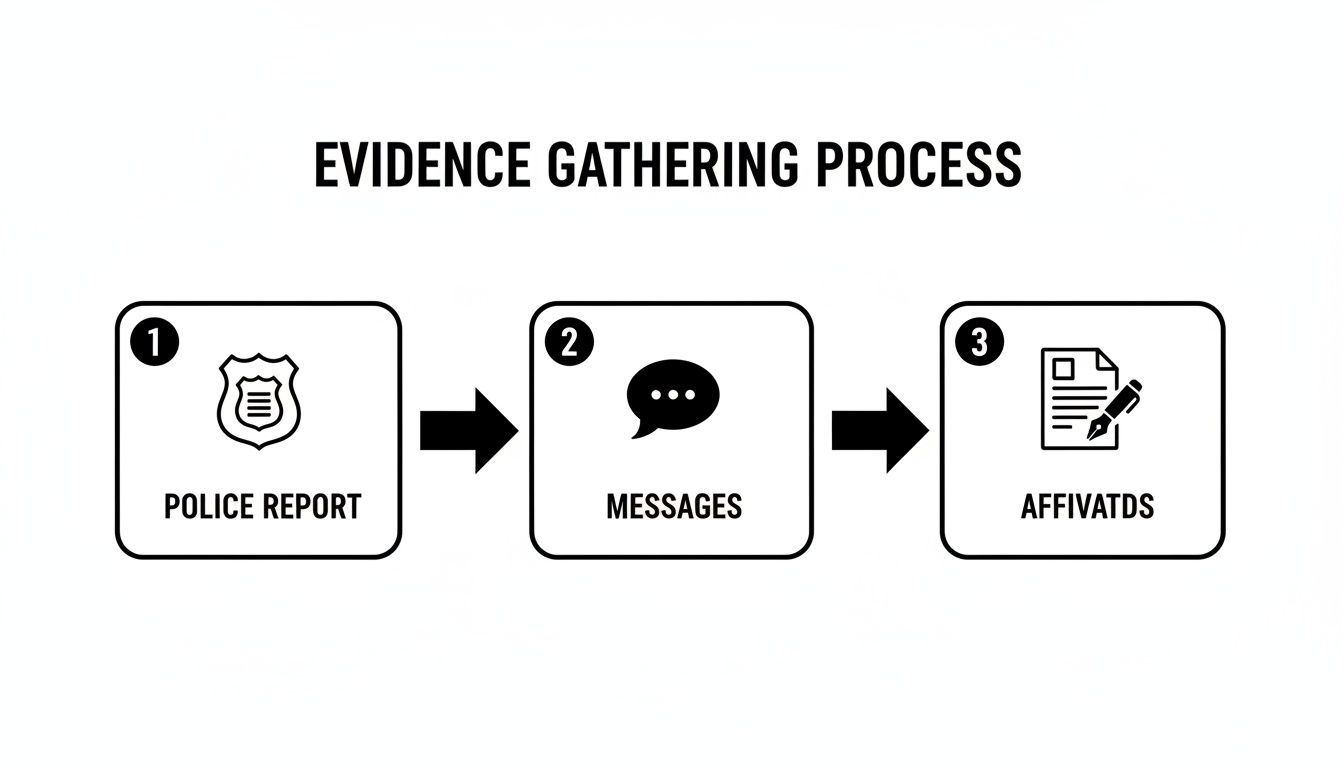
As you can see, the strongest cases are built by layering official reports with personal evidence. A police report combined with threatening text messages and a statement from a teacher creates a much fuller picture for the judge.
Key Takeaway: The initial TRO is a temporary shield. The second hearing is the first real battle, where both sides will be heard. Being prepared for that second hearing is just as important as filing the initial order.
This two-step process is designed to balance immediate protection with the constitutional rights of both parents. At the Law Office of Bryan Fagan, we've guided countless families in Kingwood, Porter, and throughout Northeast Houston through this exact process. We know the Harris County courts, and we can help you prepare every document and plan for every hearing.
If you're facing a crisis, you don't have to face it alone. Contact our Kingwood office for a free consultation to talk through your situation with a lawyer who understands what you're up against.
How a Kingwood Attorney Can Help You Today

When your child's well-being is at stake, the last thing you need is to navigate a complex legal maze by yourself. The stress and fear can be overwhelming, but the attorneys at The Law Office of Bryan Fagan's Kingwood office are right here, ready to provide the urgent, local support you need.
We’ve walked countless parents in Kingwood and Northeast Houston through this exact process. We know the panic you're feeling, and we know that every single second counts when you’re seeking an emergency custody order in Kingwood. Our response is built on a foundation of compassionate listening and immediate, decisive action.
Immediate and Strategic Legal Action
The moment you contact our Kingwood office, your emergency becomes our priority. We start by giving you a safe space to tell us what’s happening. From there, we can quickly map out the strongest legal strategy for your specific situation.
Here’s how we help you hit the ground running:
- Rapidly Gather Critical Evidence: We’ll help you pinpoint the most compelling proof—whether it's text messages, police reports, medical records, or statements from local witnesses who have seen what’s going on.
- Draft Precise Legal Documents: Your affidavit is the cornerstone of your case. We work with you to ensure it’s detailed, factual, and powerfully written to meet the strict legal standards a Harris County judge expects.
- File Your Petition Urgently: We know the ins and outs of the local court system. This allows us to get your case filed correctly and without delay, securing the earliest possible hearing date.
Having an experienced hand guide you through these initial steps is critical. Simple mistakes in the paperwork can get a case dismissed before a judge even sees it. We handle the legal legwork so you can stay focused on your child.
Your Advocate in the Courtroom
Our deep familiarity with the Harris County family courts and the judges who preside over them is a real advantage for our clients. We know which arguments resonate and what kind of evidence they give the most weight. When you walk into that courtroom, you won't be alone—you'll have a prepared, confident advocate right beside you.
Our role goes far beyond just filing papers. We stand with you, representing your case with conviction at both the initial ex parte hearing and the more formal hearing that follows. Our immediate goal is to get the orders needed to protect your child. From there, we build a long-term strategy for your family's future. For a deeper look into custody arrangements, our overview of child custody law for Kingwood, TX residents provides valuable context.
We believe every parent in Kingwood, Humble, and Porter deserves exceptional legal representation when their child’s safety is on the line. Our local presence means we are not just your lawyers; we are your neighbors.
Facing a family emergency is one of life’s most difficult challenges, and you shouldn’t have to carry that weight by yourself. The experienced, client-focused team at The Law Office of Bryan Fagan is here to offer the trusted representation you need, right here in Kingwood. Schedule a free, confidential consultation at our local office today to discuss how we can help protect your child.
Common Questions About Emergency Custody Orders
When you’re worried sick about your child’s safety and thinking about an emergency custody order in Kingwood, a million questions are probably flying through your head. The not-knowing can be just as agonizing as the crisis itself. After helping countless families navigate these exact situations in Kingwood and across Northeast Houston, we’ve heard just about every question there is.
Let's cut through the confusion and get you the straightforward answers you need to feel more in control.
How Long Does an Emergency Order Last?
This is almost always the first thing parents ask. An initial emergency order, known as a Temporary Restraining Order (TRO), is meant to be a fast-acting shield for your child. It's not a permanent fix.
Under Texas law, a TRO is generally only good for 14 days. That might not sound like a long time, but it’s a critical window. The court uses those two weeks to schedule a more thorough follow-up hearing. Your TRO will have the exact date and time for that hearing printed right on it, and it will happen before the initial order expires.
This next hearing is where both parents get a chance to present their side of the story with evidence and testimony. While the 14-day period can sometimes be extended if both sides agree or if the judge sees a compelling reason, the whole point is to move quickly to a more informed decision.
What Happens if the Other Parent Violates the Order?
An emergency order isn't a suggestion; it's a direct command from a judge. If the other parent ignores it—say, by trying to contact the child, sending you harassing texts, or showing up at your home in Kingwood—the court takes that very seriously.
First and foremost, if you feel you or your child are in any danger, call the police. Have your signed court order ready to show the officers. They can enforce the order right then and there. This also creates an official police report, which becomes a crucial piece of evidence proving the violation.
At the same time, you need to contact your attorney immediately. We can then file a Motion for Enforcement. This is a legal step that puts the other parent back in front of the judge to answer for their actions. The consequences can be significant:
- Fines: A judge can impose hefty financial penalties.
- Jail Time: For serious or repeated violations, contempt of court can absolutely lead to jail time.
- Paying Your Attorney's Fees: The judge can order the other parent to cover the legal costs you had to spend just to get them to follow the rules.
A violation does more than just get the other parent in immediate trouble. It shatters their credibility with the judge for the rest of the case, showing they can’t be trusted to follow court directives.
Can an Emergency Order Affect the Final Custody Outcome?
Absolutely. While a temporary order is, by definition, not the final word, it can cast a long shadow over the entire case. The facts and evidence that come out during this initial crisis phase don't just vanish after 14 days.
Think of it as the judge's first real introduction to your family's situation. If you successfully demonstrate that your child was in immediate danger from the other parent, that becomes a foundational fact in your case. The judge isn't going to forget it.
When making final decisions, judges are required by Texas law to consider any history of family violence, neglect, or substance abuse. Securing an emergency order sets a powerful precedent. It establishes a baseline of risk that the other parent now has the burden of disproving. While it’s no guarantee, it often puts you in a much stronger position as you work toward a final, stable custody arrangement for your child's future.
The journey to protect your child can feel overwhelming, but you don't have to navigate it by yourself. The Law Office of Bryan Fagan – Kingwood TX Lawyers is here to offer the urgent, experienced, and steady hand you need. We are local attorneys committed to protecting families right here in Kingwood, Humble, and our neighboring communities. Contact our Kingwood office today for a free, confidential consultation to see how we can stand with you.