Skip to content
When someone you love can no longer make decisions for themselves, the priority is to step in and protect them. But for families in Kingwood, the legal path forward can be confusing. The main thing to understand is that Texas law uses one term, Guardianship, to cover two distinct roles that other states often separate.
A Guardian of the Person is appointed to handle personal and medical decisions. A Guardian of the Estate manages financial matters—this is the role many other states call a conservator.
Understanding the Texas Difference: Guardian vs. Conservator
For families here in Kingwood, Humble, and across Northeast Houston, the realization that a loved one has become incapacitated is emotionally draining. The legal terms thrown around often just add to the stress. You’ve probably heard people in other states talk about getting "conservatorship" for an aging parent, but the legal framework in Texas works a bit differently.
Here in our Kingwood community, we help clients understand that our courts establish a Guardianship. This single legal structure can be divided into two separate roles to protect an incapacitated person, who the court refers to as the "ward."
- Guardian of the Person: This person's focus is squarely on the ward's personal well-being. Their responsibilities revolve around making choices about healthcare, where the person will live, and ensuring their daily needs are met.
- Guardian of the Estate: This is what Texans have instead of a conservator. This guardian is tasked with managing the ward’s finances, property, investments, and other assets responsibly.
Grasping this fundamental distinction is the critical first step for any family in Harris or Montgomery County who is considering this serious legal move.
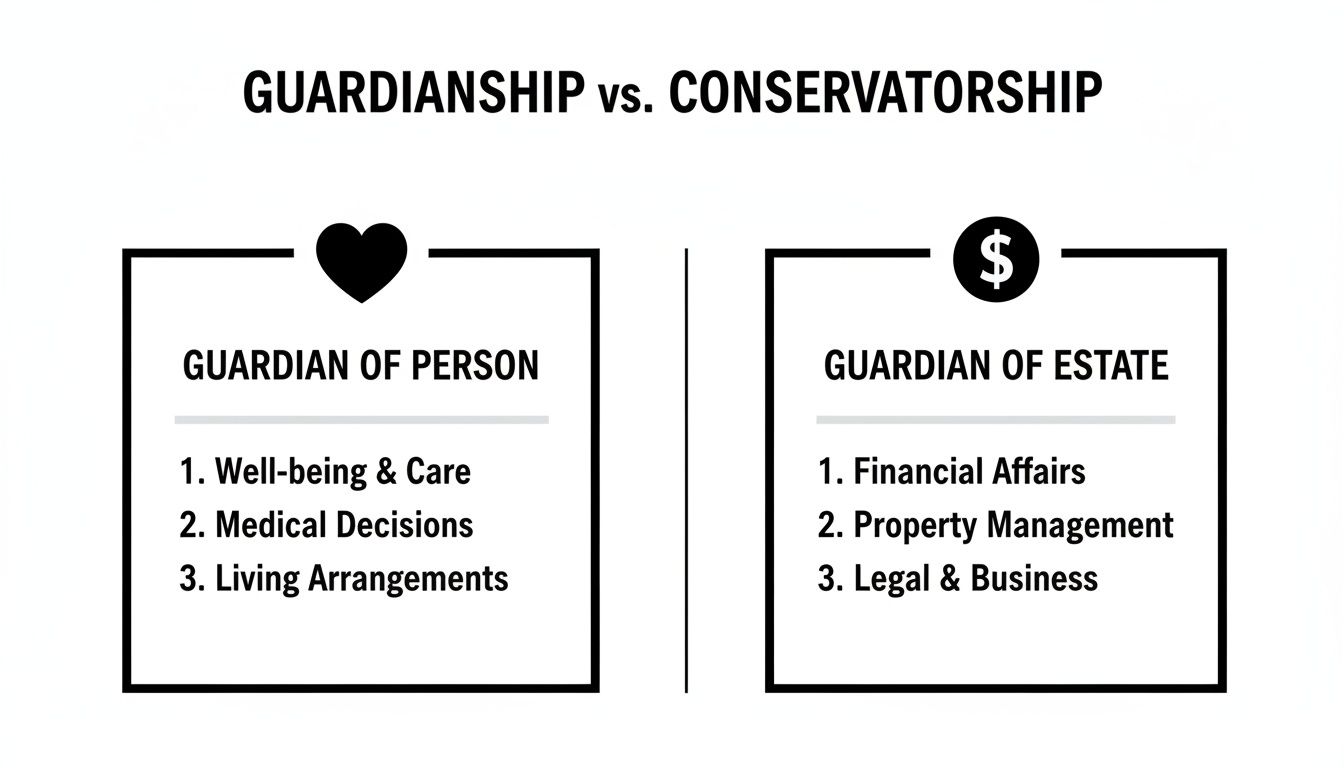
This breakdown clearly separates the duties of personal well-being from financial management, showing how Texas law covers both critical areas under the single umbrella of guardianship.
Key Responsibilities in Texas Guardianship
The real difference between these roles comes down to the scope of authority the court grants. While some states have separate legal proceedings for guardianship and conservatorship, Texas law streamlines them into a single, practical process for Kingwood families.
A Guardian of the Person is responsible for personal care and safety, period. A Guardian of the Estate focuses exclusively on financial and property affairs. Depending on the ward's needs and the family's situation, a court might appoint one person to handle both roles or assign two different people to the jobs.
It's important to remember that this court-ordered structure is fundamentally different from other legal tools, like a Power of Attorney, which a person sets up proactively while they are still of sound mind. You can find out more about how a Power of Attorney works in our detailed guide.
Texas Guardianship Roles at a Glance
To help our Kingwood clients see the difference in black and white, it’s helpful to compare the official Texas legal terms with the common terms you might hear used elsewhere. This table breaks it down simply.
| Primary Responsibility | Official Texas Legal Term | Common Term in Other States |
|---|---|---|
| Personal & Medical Decisions | Guardian of the Person | Guardian |
| Financial & Property Management | Guardian of the Estate | Conservator |
As you can see, what Texas calls a "Guardian of the Estate" is what most of the country refers to as a "Conservator." Knowing the correct local terminology is crucial when navigating the court system in Northeast Houston.
The Guardian of the Person Role Explained
When a Texas court appoints a Guardian of the Person, they’re handing over the profound responsibility of looking after a loved one’s personal well-being. This isn't a role about managing money or assets; it's about safeguarding the health, safety, and basic dignity of someone who can no longer do it for themselves. The guardian steps into a protective role, making the critical life decisions the ward is now unable to make.
For families here in the Kingwood area, this often becomes a painful reality when an aging parent’s dementia advances, or a loved one suffers a debilitating medical event. The duties are intensely personal and demand a deep well of compassion and careful thought.
Core Duties and Responsibilities
A Guardian of the Person’s authority is focused entirely on life care decisions. The simplest way to think about it is that you become the primary advocate for the ward's day-to-day life and long-term health.
Your core responsibilities would include:
- Making Medical Decisions: This means everything from authorizing routine treatments and choosing doctors to consenting to major surgery and managing medications.
- Deciding Living Arrangements: You determine where the ward will live. This could be at home with caregivers, with another relative, or in a long-term care facility in Humble or Northeast Houston.
- Overseeing Daily Care: You are responsible for ensuring the ward has proper food, clean clothing, and the support they need for personal hygiene.
- Providing Consent: The guardian also gives consent for things like social outings, educational programs, and other personal activities.
In every one of these duties, a guardian must always act in the best interest of the ward. That’s not just a nice idea; it’s a legal and ethical standard that guides every single choice.
A Guardian of the Person’s primary duty is to ensure the ward lives with as much dignity, comfort, and independence as possible, given their circumstances. It's a role centered on humanity and care.
A Kingwood Scenario in Practice
Let’s put this into a real-world context. Imagine your elderly mother, who lives on her own in Kingwood, has a major stroke that leaves her incapacitated. She can’t communicate her wishes or handle her daily needs anymore. If the court appoints you as her Guardian of the Person, you would be empowered to:
- Authorize her medical care at HCA Houston Healthcare Kingwood, speaking directly with her doctors to create a treatment plan.
- Evaluate and choose a rehabilitation facility in the nearby Porter area to help her through recovery.
- Arrange for in-home caregivers once she’s stable enough to come home, making sure she is safe and well-supported.
Through it all, you are legally bound to make choices that you believe she would have made for herself, always aimed at preserving her quality of life. The court also requires accountability. Guardians must file an annual report detailing the ward's condition, where they are living, and their overall well-being, ensuring your loved one is truly protected.
The Guardian of the Estate Role Explained
Where a Guardian of the Person looks after healthcare and general well-being, the Guardian of the Estate steps in to handle the ward's financial world. This is the specific role Texas law created for what many other states simply call a "conservator." It’s a position built on an immense amount of trust, designed to shield a vulnerable person's assets from being mismanaged or, worse, exploited.
For families across Northeast Houston, this role becomes critical when a loved one simply can't manage their own finances anymore. The responsibilities are significant and demand a high level of honesty and careful attention. A Guardian of the Estate isn't just paying a few bills; they are, for all practical purposes, taking over the ward's entire financial life.

Financial Duties and Fiduciary Responsibility
At the heart of this role lies a strict fiduciary duty—the single highest standard of care recognized by law. In plain English, this means the guardian is legally obligated to act only in the ward's best financial interests, steering clear of any personal conflicts and managing assets with caution and prudence.
Some of the key responsibilities a Guardian of the Estate must handle include:
- Managing all income and paying all bills, covering everything from the mortgage and utilities to medical co-pays and property taxes.
- Locating, inventorying, and securing all the ward's property, which includes real estate, vehicles, bank accounts, and even valuable personal belongings.
- Handling investments and retirement accounts, making sound decisions to preserve and protect the ward's nest egg.
- Filing annual income tax returns for the ward.
Let's say your father in Porter becomes incapacitated. As his Guardian of the Estate, you would be tasked with managing his pension, ensuring the property taxes on his house are paid, and possibly even selling the home if the funds are needed for his long-term care. Every single action must be carefully documented. Understanding what you're managing is crucial, which is why it helps to know about the differences between probate and nonprobate assets.
The court system in both Harris and Montgomery counties takes the protection of a ward's assets incredibly seriously. A Guardian of the Estate is held to a high legal standard to make sure every dollar is accounted for and used solely for the ward's benefit.
Legal Safeguards and Court Oversight
To prevent any potential for abuse, Texas courts have built several safeguards into the process. For starters, a Guardian of the Estate is almost always required to post a bond. Think of this as an insurance policy that protects the ward’s estate against any potential fraud or mismanagement by the guardian.
Beyond that, the guardian must file a detailed inventory of every single asset with the court right after being appointed. They are also legally required to submit annual accountings that detail every financial transaction—every dollar that came in and every dollar that went out. This level of transparency keeps the guardian accountable and ensures your loved one's financial security is protected right here in Kingwood.
When Guardianship Becomes Necessary in Texas
It's one of the toughest conversations a family can have: realizing a loved one can no longer manage their own affairs safely. For families here in Kingwood, Humble, and across Northeast Houston, that realization is often filled with emotion and uncertainty. How do you know when it’s truly time to step in and seek a court-ordered guardianship? It’s rarely a single moment, but more often a pattern of behavior that shows a clear, consistent inability to make sound decisions about their own well-being or finances.
This difficult crossroads usually appears after a significant life change. While every family’s story is different, certain scenarios consistently lead to guardianship as a necessary act of protection.

Common Scenarios Requiring Guardianship
In our Kingwood practice, we see local families navigating a few common, heart-wrenching situations that ultimately require legal intervention. These examples show when a Guardian of the Person, a Guardian of the Estate, or both, becomes the right path forward.
- A Parent with Advancing Alzheimer’s or Dementia: An elderly parent in Kingwood starts missing bill payments, can't keep track of their medications, and is becoming a target for financial scams. In a situation like this, both a Guardian of the Person to oversee healthcare and a Guardian of the Estate to secure their finances are almost always needed.
- A Special Needs Child Turning 18: A young adult in Porter with severe developmental disabilities is about to turn 18. Once they're legally an adult, their parents no longer have the automatic authority to make medical or financial decisions for them. A guardianship is necessary to continue providing that essential oversight and protection.
- A Loved One Incapacitated by an Accident: A family member is in a serious car accident in Northeast Houston, leaving them in a coma and unable to communicate. A guardian must be appointed quickly to authorize critical medical care and manage their financial responsibilities while they are incapacitated.
When Powers of Attorney Are Not Enough
Many people think a Power of Attorney (POA) is all they need. And while POAs are incredibly useful tools, they have their limits. The biggest one? A person has to be mentally competent to sign one. You can't create a POA after someone has already lost that capacity. Another issue is that the person who granted the POA can revoke it at any time—even if their judgment is severely impaired.
Guardianship becomes the only viable option when:
- There's no Power of Attorney in place.
- The POA is old and doesn't grant the specific authority needed for the current situation.
- There’s evidence that the person named as agent in the POA is mismanaging funds or not acting in the best interest of the individual.
- The incapacitated person is trying to revoke the POA, putting their own safety at risk.
A court-ordered guardianship is the definitive legal backstop. It overrides other documents and puts a formal, supervised plan in place to ensure your loved one is fully protected. Our firm can guide you through every step, and you can get a head start by reading our overview on how to obtain guardianship of a parent in Texas.
A guardianship isn’t about taking control away from someone. It's about providing protection when they’ve lost the ability to protect themselves. The entire process is supervised by a court to preserve their dignity and secure their future.
In many cases, proactive, strategic legacy and estate planning can create alternatives that may lessen the need for a full, court-supervised guardianship later on. This isn't just a local concern; it’s a growing national issue. As of 2021, an estimated 1.3 million adults in the United States were under a guardianship, with courts overseeing roughly $50 billion in assets for these individuals. These figures highlight just how many families find themselves navigating this complex legal landscape.
Navigating the Texas Guardianship Process Step by Step
So, you’ve grasped the difference between a guardian and a conservator (what we call a Guardian of the Estate in Texas). But what happens next? The path to establishing a guardianship can feel like a maze of legal requirements, but it's all designed with one goal in mind: protecting the person who needs help. For families here in Kingwood and the surrounding areas, knowing what to expect can make all the difference.
It all kicks off when you file an Application for Appointment of a Guardian. This is the formal document submitted to the court, usually in Harris or Montgomery County, that explains exactly why a guardianship is needed and who you’re proposing to take on the role. This is the first practical step in the legal process.
The Initial Court Proceedings
Once that application is on the record, the court system immediately kicks into gear to protect the proposed ward's rights. A judge will appoint an attorney ad litem—an independent lawyer whose only job is to represent the ward’s best interests. This attorney meets with your loved one, explains what’s happening in a way they can understand, and then reports back to the court.
At the same time, the court assigns its own investigator to perform a neutral, third-party assessment. Think of this as a fact-finding mission. The investigator looks at the family situation and the ward’s actual needs to give the judge a clear, unbiased picture before any decisions are made.
Medical Evaluation and the Final Hearing
One of the most crucial pieces of the puzzle is a physician's certificate. A doctor has to examine the proposed ward and fill out a specific form detailing their medical condition and level of incapacity. This isn't just a suggestion; it's the hard evidence the court needs to legally determine that a guardian is necessary.
Everything comes together at the final court hearing. The judge will carefully review all the collected information:
- The original application for guardianship.
- The report from the attorney ad litem.
- The court investigator’s findings.
- The official physician’s certificate.
If the judge is convinced that a guardianship is the right move and that the person you've proposed is a suitable choice, they will sign an order making it official. This is a massive responsibility, and it's worth noting who usually steps up. In Texas, it's almost always family. National trends show that family members serve as guardians in roughly 81.6% of cases for White respondents, 71.6% for Black respondents, and a staggering 91.1% for Hispanic respondents.
Navigating the guardianship process in Texas demands meticulous attention to legal detail and strict deadlines. An experienced local attorney can be your guide, ensuring every form is filed correctly and every step is handled properly, giving both you and your loved one peace of mind.
If you're looking for a general overview of the steps involved, this resource on how to get legal guardianship of a parent provides some useful context. Just keep in mind that every state has its own unique laws. For advice that applies specifically to Texas law and the courts right here in Northeast Houston, there's no substitute for talking with a local attorney.
How a Kingwood Guardianship Attorney Can Guide You
Deciding to seek guardianship for a family member is a massive step, often filled with emotion and uncertainty. You know you're trying to protect them, but the legal road ahead can look intimidating. For families in Kingwood, Humble, and across Northeast Houston, this is where having the right legal support makes all the difference.
At The Law Office of Bryan Fagan, our Kingwood attorneys bring both compassion and deep legal knowledge to the table. We’ll sit down with you to clarify the roles of a guardian versus a conservator under Texas law and walk you through the specific state requirements. Our team is meticulous, ensuring every court document is filed correctly while always fighting for your family's best interests.
We live and work in this community, and we're dedicated to helping our neighbors through challenging times. Let us handle the legal complexities so you can focus on what truly matters—caring for your loved one.
When you're ready to explore your options, we invite you to schedule a free, no-obligation consultation at our Kingwood office. Let’s talk about how we can help your family get the support and peace of mind you deserve.
Common Questions We Hear About Texas Guardianship
When families in Kingwood start looking into guardianship, they almost always have questions. It’s a confusing process, and understanding the basics—like the difference between a guardian and what Texas law calls a Guardian of the Estate—is just the first step.
Here are a few of the most frequent questions we get from clients.
How Long Does It Take to Get a Guardianship in Texas?
The timeline really depends on the specifics of the situation. If everyone in the family is on the same page and the evidence of incapacity is straightforward, we can often get a guardianship established in just a few months through the Harris or Montgomery County courts.
But if there’s a dispute, or if the medical or financial details are particularly messy, it will take longer. Having an experienced Kingwood attorney on your side is key to making sure everything is filed correctly, which helps avoid needless delays and gives you a much clearer idea of what to expect.
What’s the Difference Between a Guardian and a Power of Attorney?
This is a big one, and the distinction is crucial. A Power of Attorney (POA) is a document someone signs before they become incapacitated, voluntarily giving another person the power to make decisions for them. Think of it as a proactive step.
A guardianship, however, is a court-imposed solution that happens after a judge has formally declared someone incapacitated. It’s a reactive measure. If there's ever a conflict or a problem with the person acting under a POA, the court-ordered guardianship will always take precedence and override it.
Can One Person Be Both Guardian of the Person and Estate?
Yes, and frankly, it’s the most common arrangement we see in Texas. Courts often appoint one responsible person—usually a spouse, an adult child, or a trusted friend from the Humble or Porter area—to handle both roles. This keeps things streamlined, allowing one person to manage all of the ward's personal and financial affairs.
That said, the court always has the option to split the duties if it's in the ward’s best interest. For instance, a family member might be appointed to manage daily care and medical decisions, while a financial advisor is brought in to oversee a large or complicated estate.
Making sure you're making the right choices for a loved one is everything. If you have more questions about how guardianship works in Texas, the experienced team at The Law Office of Bryan Fagan – Kingwood TX Lawyers is here to offer clear, compassionate guidance. We are proud to serve our Kingwood community and are ready to help you navigate this process. Schedule your free consultation with us today.