In Texas, you don't just stumble into a common law marriage by living together for a certain number of years. It's an intentional act. This arrangement, which the law calls an informal marriage, gives you the exact same rights and responsibilities as a couple who walks down the aisle with a marriage license in hand. For families here in Kingwood, understanding these rules is key to protecting your rights.
What an Informal Marriage in Texas Really Means for Kingwood Residents
I talk to couples all the time in our Kingwood office who share a home, a life, and even children but have never had a formal wedding. One of the first questions they ask is, "Are we actually married?" In Texas, the answer boils down to your actions and what you intended as a couple, not just the number of years on your lease in Humble or Porter.
Let's be clear: an informal marriage isn't a "lite" version of marriage. Once you meet the legal standard, it’s the real deal. You get all the same legal protections for property, inheritance, and benefits. The flip side is also true—if you decide to split up, you can't just walk away. You have to go through a formal divorce, just like any other married couple in Northeast Houston.
The 3-Part Test for a Texas Common Law Marriage
So, what does it take to be seen as married by the law without a marriage certificate? The state has a very specific, three-part test. Simply living under the same roof isn't enough; you have to prove all three elements are true.
The Texas Family Code § 2.401 lays it out plainly. To have a valid common-law marriage, you must have:
- An agreement to be married.
- Lived together in Texas as a married couple.
- Represented to others (or "held out") that you are married.
It’s also important to remember the basics: both of you must be at least 18 years old and not currently married to anyone else. We often see confusion around these rules, but you can discover more insights about the benefits of a Texas common law marriage and how they apply in real-world situations.
Why Knowing Your Marital Status Is So Important
For families here in Kingwood, Porter, and the surrounding areas, getting clarity on your legal status is the first step in protecting your future. If your marriage isn't legally recognized, you could run into serious trouble when it's time to:
- Divide property: If you separate, all the assets you built together could be at risk. Without a recognized marriage, you might not be entitled to a fair share.
- Access crucial benefits: You could be shut out of spousal Social Security benefits, a partner's health insurance plan, or the legal right to make medical decisions in an emergency.
- Handle inheritance: If your partner passes away without a will, their family could contest your right to inherit anything, leaving you with nothing.
Making sure you meet the common law marriage in Texas requirements isn't just a legal checkbox; it's about financial security and peace of mind. Here at The Law Office of Bryan Fagan, we want every Kingwood family to have that clarity.
The Three Pillars Of A Texas Informal Marriage
When a Harris County court looks at a relationship to decide if it's a common-law marriage, they aren't listening for a romantic backstory. They're hunting for cold, hard proof of three specific legal requirements. For couples here in Kingwood and the surrounding areas, getting a firm grip on these "three pillars" is the only way to know where you stand.
To have a valid informal marriage in Texas, you have to prove all three conditions were met at the same time. This isn't a "two out of three ain't bad" situation; you must satisfy every single one.
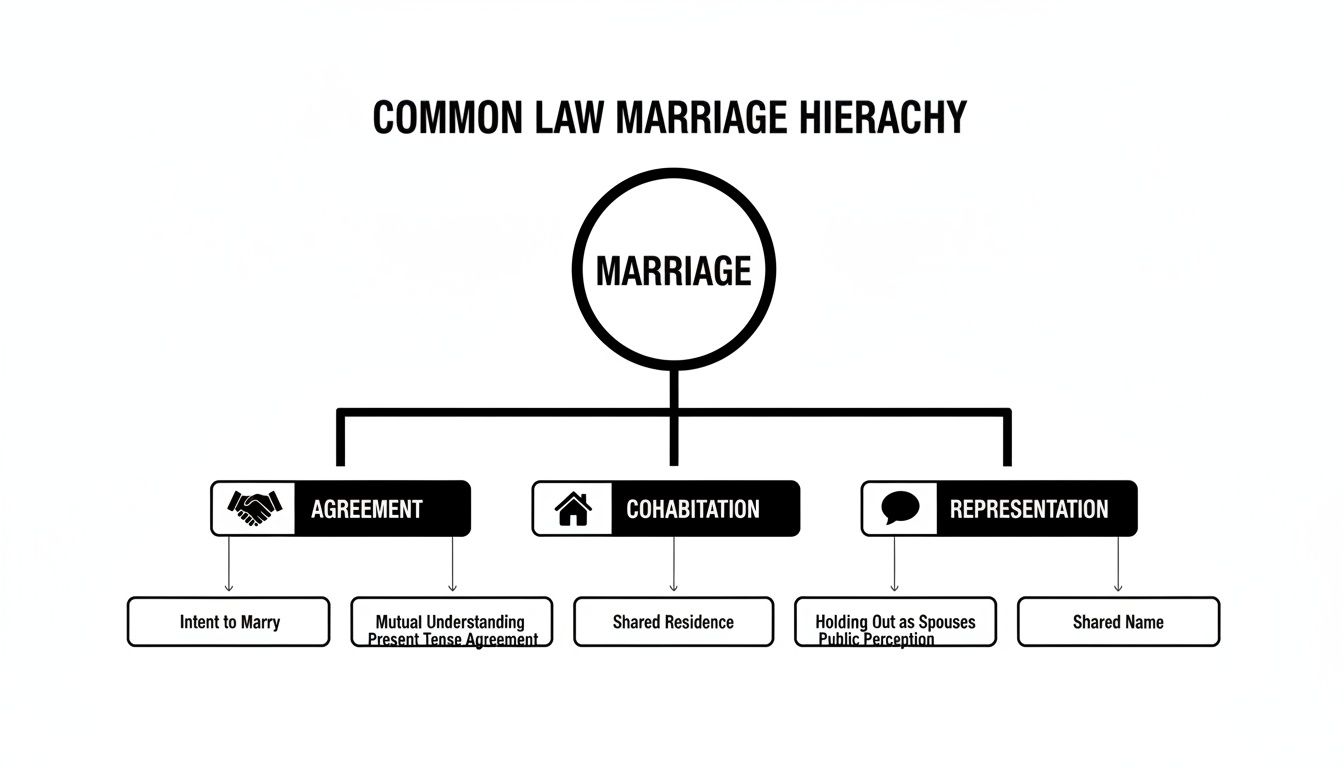
As you can see, a real marriage is built on the foundation of a mutual agreement, living together, and telling the world you're married.
Pillar 1: You Agreed To Be Married
First and foremost, you both must have an agreement to be married. This is all about what you intended in the moment, not some vague plan for down the road. It means you both looked at each other and had a meeting of the minds: "We are married, starting right now."
This agreement doesn't need to be a formal contract signed in front of a lawyer. It’s often proven through your words and actions over time. Maybe you exchanged rings and said, "This makes it official," or perhaps you decided to file joint tax returns because, in your minds, you were already a married unit.
The key here is that it was a shared, present-day decision. A promise to "get married someday" doesn't count. A court will want to see evidence that you both believed your marriage began at a specific point.
Pillar 2: You Lived Together In Texas
The second pillar is cohabitation in Texas as spouses. This is a lot more than just being roommates who split the rent and utilities. Plenty of people in Humble and Porter live together without being married. The law requires you to live together and act like a married couple under the same roof.
Living together as spouses means you're creating a shared life that looks and feels like a traditional marriage. This could mean sharing household chores, merging your finances, and generally operating as a single family unit.
The amount of time you live together doesn't automatically create a marriage. You could share a house for 20 years and not be common-law married if the other two pillars are missing. On the flip side, you could meet all three requirements in a much shorter period.
What the court really cares about is the character of your cohabitation, not just how long it lasted. They're looking for proof that you were building a life together in Texas with the dynamic of a married couple.
Pillar 3: You Represented Yourselves As Married
The final piece of the puzzle is that you held yourselves out to others as being married. This is the public part of the equation. Your private agreement to be married simply isn't enough; you also have to present yourselves as a married couple to the community.
Frankly, this is often the easiest pillar to prove with solid evidence. It comes down to what you say and do in front of family, friends, and the general public. Think about how you introduce each other at a community event in Kingwood or a backyard barbecue in Northeast Houston.
Common examples include:
- Introducing your partner as "my husband" or "my wife."
- Filing joint tax returns, which means declaring your marital status to the IRS under penalty of perjury.
- Listing each other as a "spouse" on a loan application, insurance policy, or at the doctor's office.
- Wearing wedding rings and letting people assume you're married.
- Sending out holiday cards signed with the same last name.
Your story has to be consistent. If you tell your friends you're married but tell your employers you're single to get better benefits, you can seriously undermine your claim. Consistency is what shows the world—and a judge—that you truly believe you are married.
If you’re reading this and feeling unsure whether your relationship checks all three boxes, that’s a clear sign you need to get some clarity. The attorneys at the Law Office of Bryan Fagan are right here in Kingwood, ready to help you figure out your legal status. Schedule a free consultation with us today to protect your family's future.
How to Formally Document Your Marriage Status in Kingwood
So, you've met the three legal requirements and are, for all intents and purposes, married in the eyes of Texas law. That’s great, but relying on memories and circumstances to prove your marriage can get messy down the road. Imagine trying to explain your relationship status during a medical emergency or, worse, after losing your partner. It's a stressful situation no one wants to face.
The good news is that Texas provides a straightforward way to get your marriage on the books officially. You and your partner can file a Declaration of Informal Marriage with the county clerk. This is a simple, sworn statement that affirms you both meet the state's requirements for a common law marriage. It’s an official record that puts any doubt to rest and establishes the exact date your marriage began.

Taking this one simple step can provide incredible peace of mind. It's a proactive move to protect your family, ensuring your rights are instantly recognized by hospitals, insurance companies, and government agencies without you having to scramble for evidence to prove your relationship.
The Process For Kingwood And Northeast Houston Residents
For couples in Kingwood, Humble, and the surrounding Northeast Houston area, you'll be dealing with the Harris County Clerk's office. The process itself isn't complicated, but you need to pay close attention to the details to make sure everything is handled correctly. Here is a practical, step-by-step guide:
- Get the Form: You can download the "Declaration and Registration of Informal Marriage" form directly from the Harris County Clerk’s website or just grab a copy in person.
- Fill It Out Carefully: Complete the form with your full legal names and addresses. You’ll also need to state the date your marriage officially began—this is a crucial detail because it determines when your community property rights kicked in.
- Hold Off On Signing: This is important. You must sign the document in front of the county clerk, not before you get there.
- Visit the Clerk's Office Together: Both of you have to show up in person. Make sure you each bring a valid, government-issued photo ID, like a driver's license or passport.
- Sign, Swear, and File: At the clerk's office, you'll sign the declaration, take an oath, and the clerk will officially file the document. Just like that, your marriage becomes part of the public record.
Why Filing a Declaration Is a Smart Move
Think of the Declaration of Informal Marriage as an insurance policy for your legal status as a couple. It solidifies your rights and can shut down any future challenges from family members or anyone else who might question whether your marriage is legitimate.
It's important to understand that filing this document doesn't create the marriage. It simply creates an official record of a marriage that already exists. Your marriage truly began the moment you met the three requirements: agreement, living together, and presenting yourselves as married.
This formal record is incredibly valuable when it comes to accessing the benefits and protections that come with marriage. These include:
- Health Insurance: Makes it easy to add your spouse to your employer's health plan.
- Inheritance Rights: Secures your legal rights as a surviving spouse to inherit property.
- Social Security Benefits: Helps you qualify for spousal or survivor benefits.
- Financial Matters: Smooths out the process for things like getting a joint mortgage or loan.
While you're formalizing your marriage, it might also be the right time to think about other legal protections. For example, learning what is a prenuptial agreement can offer even more clarity and security around your finances as you build your life together. Taking these official steps provides a solid foundation for your family’s future. If you have any questions about this process, our Kingwood office is here to guide you.
What Does Being in a Common Law Marriage Actually Mean?
Here’s a crucial point many people miss: once your relationship legally qualifies as a common law marriage in Texas, it’s not some "marriage-lite" version. You get the exact same rights, and you take on the exact same responsibilities, as any couple who went to the courthouse with a formal license. Understanding this is absolutely essential for protecting yourself, your partner, and your future here in Kingwood.

This isn’t just about what happens if you break up. These rights and duties kick in immediately and affect your day-to-day life—from financial planning to healthcare decisions. The moment your informal marriage is established, a whole new legal framework applies to your relationship.
Your Financial Life and Community Property
Perhaps the biggest change is that Texas community property laws now apply to you. The concept is pretty simple, but it has huge implications for every couple in Northeast Houston.
Community Property means most of what you and your spouse earn or acquire during the marriage belongs to both of you equally. It doesn't matter whose paycheck it came from or whose name is on the car title. If you got it while married, it's generally considered joint property.
This means things like:
- The paychecks you both bring home from work.
- The house, car, or furniture you bought while living together as a married couple.
- Retirement funds, like a 401(k), that grew during your marriage.
- Even debts that one of you took on during the relationship.
This principle is fundamental. For many couples, common law marriage is an appealing alternative to costly formal weddings. If the relationship ends, all that community property has to be divided in a "just and right" manner—which almost always means something close to a 50/50 split. Without a recognized marriage, you could walk away with nothing, even after years of contributing to the household.
Inheritance and Healthcare Rights
Being a common law spouse also gives you critical rights when it matters most. For any family in the Kingwood area, these protections are vital.
Spousal Inheritance: If your partner passes away without a will (this is called dying "intestate"), you have the same inheritance rights as a ceremonially married spouse. Texas law ensures you receive a significant portion of their estate, protecting you from being left out in the cold.
Medical Decisions: As a legal spouse, you can make crucial medical decisions if your partner is ever incapacitated and can't speak for themselves. You also get hospital visitation rights, which are often denied to a "girlfriend" or "boyfriend."
These aren't automatic, though. If your marriage isn't clearly established, you could face a draining legal and emotional battle to prove your status right after a tragedy. It's far better to have your affairs in order beforehand.
Responsibilities: Children and Splitting Up
With rights come serious responsibilities. If you have children, both of you have equal rights and duties for their custody, care, and financial support. These are not optional—they are legally enforceable obligations.
And if you decide to go your separate ways, you can't just pack a bag and leave. An informal marriage must be formally dissolved through a legal divorce. That means going through the exact same court process as any other married couple, which involves dividing property and potentially dealing with spousal support.
Trying to figure out these complex rights and responsibilities can feel like a lot to handle on your own. At The Law Office of Bryan Fagan, our Kingwood attorneys are here to give you clear, straightforward guidance. We invite you to schedule a free consultation to talk about your situation and make sure your family has the protection it deserves.
Common Myths That Can Jeopardize Your Rights
Misinformation about common law marriage is everywhere, and believing the wrong thing can seriously jeopardize your family's future. Here at our Kingwood law office, we've sat down with too many people who made life-changing decisions based on something they heard from a friend or read online. Let's clear the air and bust some of the most dangerous myths about Texas common law marriage so you can protect yourself.
The biggest one we hear, by far, is the idea that you're automatically married after living together for a certain number of years. This is 100% false. Texas has no "magic number" of years—not seven, not ten, not twenty. Your marital status hinges entirely on whether you met the three legal requirements: you both agreed to be married, you lived together in Texas as a couple, and you presented yourselves to others as a married couple.
The Myth of the "Magic Number" of Years
Lots of couples, especially in areas like Humble and Porter, get tripped up by this. They think that once they’ve shared a home long enough, the law just sort of… makes it official. That's a hazardous assumption to make.
You could live with your partner for decades and never be considered legally married if you didn't meet all three prongs of the test. What really matters is your intent and your actions, not how many pages you've torn off the calendar. This myth can have devastating consequences, particularly if one partner passes away and the other is shocked to discover they have no inheritance rights because a legal marriage never actually existed.
There Is No Such Thing as an "Informal Divorce"
Just as you can't stumble into a common law marriage by accident, you can't just casually end one. This leads us to another dangerous myth: the "common law divorce." Some couples think that because they didn't have a formal wedding, they can just agree to go their separate ways and call it a day. That's not how it works.
A common law marriage is just as real as a ceremonial one. To end it, you must go through a formal, legal divorce proceeding in a Texas court.
Once your relationship is legally recognized as an informal marriage, it’s a binding union. The only way to dissolve it is by filing a Petition for Divorce and having a judge sign a Final Decree of Divorce. Simply moving out or having a conversation about splitting up has zero legal effect. If you don't get a formal divorce, you are still legally married, which can block you from remarrying and create a tangled mess with property and debts down the road.
Proving a Marriage After a Partner's Death
Perhaps the most heartbreaking situations we encounter involve trying to prove a common law marriage after a partner has passed away. A surviving partner in Northeast Houston might assume their rights are secure, only to face a challenge from the deceased's family members who dispute the marriage in order to claim the entire inheritance.
Without a signed Declaration of Informal Marriage on file or a strong collection of evidence, proving you were married can turn into a difficult, uphill legal battle during an already painful time. This is exactly why being proactive is so important. Don't let myths and assumptions put your family's security on the line.
If you have any doubt about your status or your rights, the compassionate attorneys at The Law Office of Bryan Fagan are right here in Kingwood. We strongly encourage you to schedule a free, confidential consultation to get the clarity you and your family deserve.
What's Your Next Move? Protecting Your Family's Future
Knowing where you stand with your marital status gives you and your family a powerful sense of security. You now understand the Texas requirements for a common law marriage—the agreement, living together, and telling the world you're married. But knowing is one thing; acting on that knowledge is what truly safeguards your future.
We've laid out that your rights in an informal marriage are exactly the same as in a ceremonial one. The real challenge comes when you have to prove it. Trying to navigate the legal system during an already emotional time is a burden you shouldn't have to carry alone.
When You Absolutely Need to Speak with an Attorney
Certain life events turn legal advice from a "nice to have" into a "need to have." We strongly urge you to talk with one of our Kingwood attorneys if your relationship is ending or if your partner has passed away. The same goes for when you need to claim spousal benefits like social security or health insurance. Proving your marriage existed at that point can be an uphill, stressful battle.
Planning ahead is just as important. One of the best things you can do for your partner is to create a will, making sure your wishes are respected and they are cared for. Having a local Kingwood attorney review your plans can help you sidestep expensive mistakes that might lead to family fights later on.
Being proactive is the key to protecting your family. If you wait for a crisis to try and establish your legal rights, you could be facing a heartbreaking and costly legal fight. A straightforward consultation today can secure your family’s well-being for years.
The Law Office of Bryan Fagan is right here in Kingwood, ready to help local families get the clarity they need. We invite our neighbors from Kingwood, Porter, and all over Northeast Houston to schedule a free consultation with us. Let’s talk about your situation and figure out the right steps to secure your family's future.
Common Questions We Hear About Informal Marriage
The idea of a "common law" marriage can feel a bit fuzzy, and it's easy to get tangled up in myths and misinformation. To help our neighbors in Kingwood get some clarity, we've put together answers to the questions that come up most often in our office. Think of this as a straightforward guide to understanding your rights and what's really required for an informal marriage in Texas.
We're cutting through the legal jargon to give you direct answers.
How Long Do We Have to Live Together To Be Common-Law Married?
This is easily the biggest misconception out there. The answer is simple: there is no specific time requirement for a common law marriage in Texas. You could share a roof for 20 years and never be married, or you could establish a marriage in a much shorter period.
What truly matters is the moment all three legal requirements click into place at the same time:
- You both agree you're married.
- You start living together in Texas as a married couple.
- You begin holding yourselves out to the public—your friends, family, and community—as being married.
It’s not about the calendar; it's about your shared intent and how you live your lives together.
Can We Be Common-Law Married if We're Planning a "Real" Wedding Later?
Yes, it’s absolutely possible. The law focuses on your present intent. If you and your partner look at each other and agree, "We are married right now," you can meet the standard for an informal marriage, even if you're planning a big ceremony for next year.
The deciding factor is your current belief about your relationship status. A future party doesn't cancel out a present agreement. A judge would look for evidence that you started acting like a married couple from the moment you decided you were one.
What if My Common-Law Spouse Dies Without a Will?
As the surviving spouse in an informal marriage, you have the exact same inheritance rights as someone in a ceremonial marriage. The catch? You'll have to prove the marriage was legally valid in the first place, and you'll have to do it in court.
If there’s no will and no filed Declaration of Informal Marriage, it’s not uncommon for the deceased’s family members to challenge your right to the estate. This can throw you into a difficult and costly legal fight during an already painful time. This is a powerful reason why formally documenting your marriage or creating a solid estate plan is so important for families here in the Humble and Northeast Houston areas.
Do We Need to Get a Divorce To End a Common-Law Marriage?
Yes, you absolutely do. Once an informal marriage is established, it's a real marriage with all the legal weight that comes with it. There’s no such thing as an informal breakup.
There is no "common law divorce." To legally end your marriage, you must file for a formal divorce in a Texas court, just like any other couple. This process involves dividing community property, addressing any child-related issues, and getting a final decree of divorce signed by a judge.
Skipping this step means you are still legally married in the eyes of the law. This can create serious legal complications down the road, especially if you ever decide to marry someone else.
Figuring out the ins and outs of common law marriage calls for clear, reliable advice from a local legal team that gets it. At The Law Office of Bryan Fagan – Kingwood TX Lawyers, we're committed to giving our Kingwood neighbors the support and guidance they need. We are local, experienced, and client-focused, providing trusted representation right here in our community. Whether you need help proving your marriage exists, planning for what's next, or working through a separation, our job is to protect your family's interests.
Schedule your free, no-obligation consultation today and talk things over with an experienced attorney. You can find us online or call our Kingwood office to take the first step in securing your family’s future.
Learn more and schedule your free consultation at https://kingwoodattorneys.com.