
Going through a child custody case is, without a doubt, one of the toughest things a parent can face. For families here in Kingwood, Humble, and across Northeast Houston, the uncertainty can be overwhelming. Finding a local attorney who understands both the Texas Family Code and our community is the first real step toward finding your footing again and protecting your family’s future.
Your Guide to Child Custody in Kingwood

When you first dive into a custody dispute, the legal jargon alone is enough to make your head spin. You’ll hear terms like “conservatorship,” “possession,” and “access,” but what do they actually mean for you and your kids? Here at The Law Office of Bryan Fagan, we see our first job as clearing up that confusion. We want to give you the simple, practical knowledge you need to move forward with confidence.
As your neighbors in Kingwood, we’re here to offer more than just legal advice; we provide steady, supportive guidance. Our goal is to make sure you feel understood and prepared for the road ahead.
Breaking Down Texas Custody Lingo
The best way to think about a Texas custody order is to see it as a detailed blueprint for co-parenting. It has two main components: who gets to make the big decisions, and who has the kids on which days. The Texas Family Code has its own official language for this, but the ideas behind it are simple enough for any Kingwood parent to grasp.
- Who Makes the Decisions (Conservatorship): This is all about parental rights and duties. It outlines who has the final say on major life choices for your child, such as their education, medical treatments, and religious upbringing.
- Who Has the Child (Possession and Access): This is the physical custody schedule. It details exactly when the child will be with each parent, covering everything from weekends and holidays to summer vacations. It’s often called a "possession order."
It’s easy to imagine every case ending in a dramatic courtroom showdown, but the reality is much different—and frankly, much more hopeful. A surprising 90% of child custody cases in the U.S. are actually settled out of court through mediation and negotiation. For Kingwood families, this is a powerful reminder of how important it is to have an experienced lawyer on your side early on. A good attorney can steer you toward a peaceful agreement, saving you a tremendous amount of stress and money. You can learn more by understanding how most custody cases are resolved.
The single most important rule in any Texas child custody case is the "best interest of the child." Every single decision a judge makes—and every argument we make on your behalf—is measured against this standard. It all comes down to what will provide the safest, most stable, and most loving environment for your child to thrive.
To make things even clearer, we’ve created this simple table to help you get familiar with the key terms. It’s a quick reference guide designed specifically for Kingwood parents to understand the language that will define their family’s new chapter.
Texas Child Custody Key Terms at a Glance
This table breaks down the fundamental legal terms used in Texas child custody cases to help Kingwood parents understand their rights and responsibilities.
| Legal Term in Texas | Simple Explanation for Kingwood Parents | What It Means for Your Family |
|---|---|---|
| Conservatorship | This is the "decision-making" part of custody. It assigns the rights and responsibilities of parenting. | It determines who decides on school, doctors, and other major life choices for your child. |
| Possession & Access | This is the physical custody schedule. It lays out when the child lives with or visits each parent. | This is your calendar—it outlines weekends, holidays, and summer vacation time with your child. |
| Possession Order | The official, court-ordered schedule that details possession and access. | This is the legally enforceable parenting time schedule that both parents must follow. |
| Standard Possession Order (SPO) | A default schedule in Texas that is presumed to be in the child's best interest. | This is the starting point for most schedules, often giving one parent the 1st, 3rd, and 5th weekends. |
Understanding these terms is the first step, but you don't have to take the next ones by yourself. The Law Office of Bryan Fagan is a dedicated local firm right here in Kingwood, and our entire focus is helping families in our community find positive outcomes.
We invite you to schedule a free consultation with our team. It’s a no-pressure conversation where you can share your story and we can explain how we can help protect what matters most to you.
Understanding the Types of Texas Child Custody
As a parent in Kingwood, you know that your child's future is everything. The Texas family courts operate on that very same principle. Every decision a judge makes in a Harris or Montgomery County courtroom comes down to one guiding standard: the best interest of the child. This is the foundation for every custody order in the state.
So, what does "custody" really look like in Texas? We don't actually use that word. Instead, the law refers to conservatorship. It sounds formal, but it’s just the legal framework that answers two fundamental questions: who gets to make the major decisions for your child, and where will the child live?
Think of it as the playbook for your co-parenting relationship, outlining each parent's specific rights and responsibilities.
Joint Managing Conservatorship (JMC)
Texas law starts with the belief that kids do best when both parents are actively involved in their lives. This is the default position, and it’s called Joint Managing Conservatorship (JMC). It's by far the most common arrangement for families here in the Kingwood area.
When parents are named Joint Managing Conservators, it means they share the authority to make key decisions. You’ll work together on the big-picture stuff, like:
- Education: Where will your child go to school? Will it be a local campus in Humble ISD, a private school, or another option in the Northeast Houston area?
- Medical Care: Choosing pediatricians, dentists, and any specialists, maybe using providers affiliated with Kingwood Medical Center.
- Psychological Care: Deciding together on therapy or counseling if your child needs extra emotional support.
- Religious Upbringing: Agreeing on the child's religious education and environment.
Even with shared decision-making, one parent is usually designated the "primary" conservator. This parent has the exclusive right to decide where the child lives (often limited to a specific geographic area, like Harris County and its neighbors) and is the one who receives child support payments.
Sole Managing Conservatorship (SMC)
While JMC is the norm, it isn't right for every family. Sometimes, a judge will find that it’s not in the child’s best interest for the parents to share decision-making. In these more serious cases, the court can appoint one parent as the Sole Managing Conservator (SMC).
This is much less common and is typically reserved for situations involving a proven history of family violence, drug or alcohol abuse, neglect, or extreme conflict that makes co-parenting impossible.
The SMC is granted the exclusive right to make almost all major decisions for the child. The other parent is named the Possessory Conservator. They will still have a court-ordered visitation schedule (called "possession and access") but won't have a say in the big decisions.
Key Takeaway: The "Joint" vs. "Sole" distinction is all about decision-making rights. The parenting time schedule itself—the "Possession Order"—is a separate, equally critical part of the final court order. For most Kingwood families, a Standard Possession Order creates a predictable schedule that provides much-needed stability and routine for a child.
It might feel isolating, but navigating a custody case is a shared experience for millions. In the U.S., there are about 13 million custodial parents raising roughly 22 million children. For parents in communities like Kingwood and Porter, this shows just how many local families are working through these same challenges. If you're curious, you can learn more about these national child custody statistics and see the bigger picture.
Getting a handle on these basic custody types is your first step. A good child custody lawyer here in Kingwood can then help you understand how these legal standards apply to your family’s specific circumstances and fight for an outcome that truly protects your child.
The Kingwood Child Custody Process Step by Step
When you're facing a child custody case in Harris or Montgomery County, it's easy to feel lost and overwhelmed. As a firm that has guided countless Kingwood families through this, we want to give you a clear roadmap of what lies ahead. Knowing the path forward can make all the difference, giving you a sense of control during a difficult time.
Here's a breakdown of the typical steps in a Texas custody case, from the first filing to the final order.
Step 1: Filing the Initial Petition
Every custody case begins when one parent files an Original Petition with the court. This is the official starting gun. If you and the other parent are not married, this document is called a "Suit Affecting the Parent-Child Relationship," or a SAPCR for short.
For divorcing couples, custody matters are simply part of the "Original Petition for Divorce." Either way, this petition identifies everyone involved—you, the other parent, and your kids—and tells the court what you're asking for in terms of custody, visitation, and child support.
After the petition is filed, the other parent must be formally notified through a procedure called service of process. You can't just hand them the papers yourself; a professional process server or a sheriff's deputy has to deliver the documents to ensure everything is done by the book.
Step 2: The Temporary Orders Hearing
Your family's life doesn't just hit pause while the legal system works. That's why one of the first and most critical events is the Temporary Orders Hearing. Think of it as a mini-trial where a judge makes immediate, short-term decisions to create stability for your child.
At this hearing, the judge will establish rules on crucial issues like:
- Who will have the right to decide where the child lives (primary conservator).
- What the temporary visitation schedule will be.
- Who pays temporary child support and covers health insurance.
- Whether there will be a geographic restriction, limiting where the child can live.
These orders are incredibly important because they often set the precedent for the final outcome. Being thoroughly prepared is key, which is why we've put together a guide on how to prepare for your custody hearing.
This chart illustrates how Kingwood judges approach building a custody order, starting with the core principle of the child's best interest.
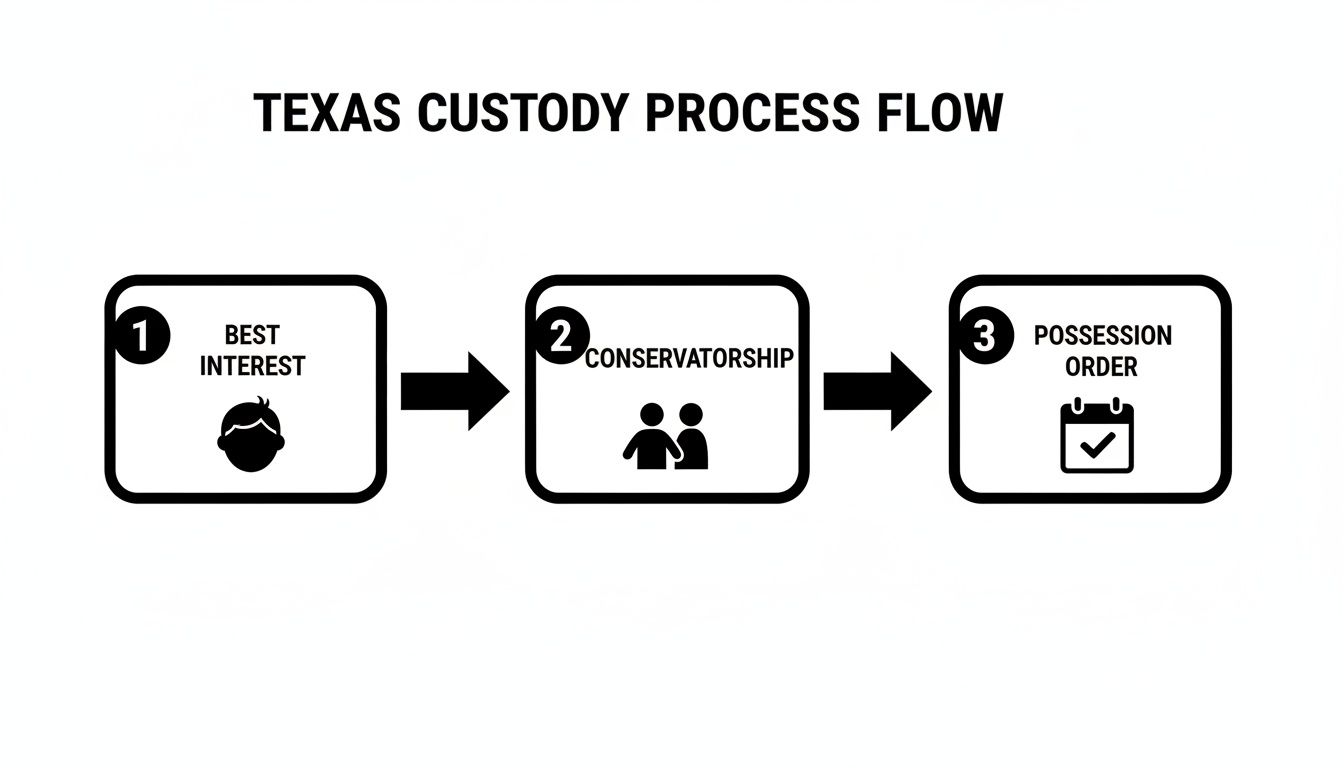
As you can see, everything flows from that central concept to define both the decision-making rights (conservatorship) and the actual parenting schedule (possession order).
Step 3: Discovery and Gathering Evidence
This is the fact-finding stage of your case. It’s a formal process called discovery, where both sides exchange information under oath. This can involve requests for financial statements, pay stubs, emails, text messages, and even your child's school and medical records.
The goal here is simple: to gather the facts. Your attorney will use this phase to collect all the evidence needed to demonstrate to the judge why your requests serve your child's best interests.
Step 4: Mediation – A Chance to Settle
Before you get a final trial date, Texas courts will almost always require you to try mediation. It’s a confidential process where you, the other parent, and your respective attorneys sit down with a neutral third-party mediator.
The mediator isn't a judge. Their job is to help the two of you communicate, find common ground, and hopefully negotiate a resolution yourselves. In our experience, a huge majority of custody cases in the Kingwood and greater Houston area are settled successfully during mediation.
If you reach an agreement, it's written into a Mediated Settlement Agreement (MSA). This is a legally binding contract that, once signed, can't be revoked. The MSA is then used to draft your final court order, allowing you to avoid the expense and emotional toll of a trial.
Step 5: The Final Trial
If you and the other parent simply cannot agree, even after mediation, the case will proceed to a Final Trial. This is where you and your lawyer present your evidence, call witnesses, and make your arguments directly to the judge. The judge then makes the final, binding decisions on all custody issues.
While going to trial is always the last resort, our team is always prepared to fight for you in the courtroom if that's what it takes to protect your family.
You don't have to walk this path alone. Having an experienced guide can make the entire process less stressful and more predictable. Contact our Kingwood office for a complimentary consultation to see how we can help you navigate what's next.
How a Kingwood Child Custody Lawyer Protects Your Family

Trying to handle a child custody case on your own can feel overwhelming. It’s more than just filling out forms; it's about making decisions that will shape your child's life and your relationship with them for years to come. That's where an experienced child custody lawyer in Kingwood, TX, becomes your most important ally.
Hiring an attorney isn't about creating conflict. It's about bringing in a professional who can provide clarity, a clear path forward, and the peace of mind that comes from knowing your rights are protected. At The Law Office of Bryan Fagan, we're not just here to represent you—we're your strategic partners, advocates, and a steady hand during a difficult time.
Building a Winning Case Strategy
From our very first conversation, a good lawyer starts thinking several steps ahead. We work with you to understand what you truly want for your family and then map out a realistic strategy to achieve those goals. It's about seeing the entire chessboard, not just the next move.
A huge part of this is helping you sidestep common mistakes. For instance, we’ll guide you on how to communicate productively with the other parent and document your interactions. This prevents simple disagreements from being twisted and used against you later. We help you build a strong, compelling case from day one.
Gathering the Right Kind of Evidence
A judge's decision ultimately rests on the facts and evidence presented. A successful custody case is built on a solid foundation of proof, and your attorney knows exactly what the court needs to see to understand what’s in your child's best interest.
Think of us as your lead investigators. This crucial work often includes:
- Documenting Communication: We help you collect and organize text messages, emails, and conversations from co-parenting apps to show your consistent involvement and cooperative spirit.
- Obtaining Key Records: We can formally request and analyze school report cards, medical records, and attendance logs to paint a full picture of your child's life under your care.
- Finding Supportive Witnesses: We identify and talk to teachers, coaches, family, and friends who can speak to your character and your strengths as a parent.
Without a professional guiding this process, critical pieces of evidence can fall through the cracks. In particularly challenging cases, this evidence is everything. You can learn more about how we help clients prove difficult issues like parental alienation in our detailed guide.
Negotiating from a Position of Strength
The reality is that most custody disputes in Texas are settled through negotiation, not a dramatic courtroom battle. Your lawyer's skill as a negotiator is perhaps their most powerful asset. We become your voice in mediation and settlement talks, taking that emotional weight off your shoulders.
Our local Kingwood office gives you a distinct advantage. We are in the family courthouses of Harris and Montgomery Counties daily, so we know the judges, the other attorneys, and the local court procedures. This firsthand knowledge helps us shape negotiation strategies that work for local families like yours.
Having a seasoned professional who understands the local legal environment means you're negotiating from a place of strength and confidence. This allows you to focus on what matters most—your children—while we handle the legal complexities and fight to protect your family’s future.
Modifying or Enforcing Your Kingwood Custody Order
Life doesn’t stop just because a judge signs a custody order. For families in Kingwood and across the Houston area, what worked last year might not work today. A new job, a child’s changing needs, or an unexpected move can quickly make your current parenting plan feel completely unworkable.
Thankfully, Texas law anticipates that life happens. When your circumstances change significantly, you have two primary legal options: a modification to update the order or an enforcement to make sure the other parent is following it. A child custody lawyer in Kingwood, TX, can help you figure out which path is right for your family and protect what matters most—your child's stability and well-being.
When Can You Modify a Custody Order?
You can’t ask a court to change your custody order over a minor disagreement or because you’ve simply changed your mind. To even get a judge to consider it, you must prove there has been a "material and substantial change in circumstances" since the last order was put in place.
This legal standard exists for a reason. It prevents the courts from getting bogged down with constant back-and-forth and ensures that custody arrangements are only changed when it's genuinely necessary for the child.
So, what does a "material and substantial change" actually look like? It can be any number of things, but for families in our Northeast Houston community, it often involves situations like these:
- A Parent is Relocating: One parent gets a great job offer but has to move out of the school district, or even out of state.
- Income Has Changed Drastically: A parent loses their job or gets a major promotion, which directly impacts their ability to pay or their need for child support.
- The Child's Needs Have Evolved: As kids grow into teenagers, their school activities, social lives, or even their own preferences might require a totally new possession schedule.
- A Parent's Lifestyle Raises Concerns: If one parent develops a substance abuse problem, gets into legal trouble, or their living situation becomes unstable, that can be grounds for a change.
Family dynamics have shifted dramatically over the decades. While mothers are still the primary conservator in 79.3% of U.S. cases, that figure was over 90% back in the 1980s. This reflects a clear move toward more shared parenting and father involvement. Here in Kingwood, we see this trend every day and often help parents establish joint custody plans that better support a child’s development. If you're interested in the data, you can explore the full custody statistics.
Enforcing Your Possession and Child Support Orders
What do you do when the other parent just decides not to follow the order? It’s an incredibly frustrating position to be in, but you aren’t helpless. When a parent ignores the possession schedule or stops paying child support, you can file an enforcement action with the court.
Think of an enforcement action as asking a judge to step in and be the referee. You’re not trying to change the rules of the game—you’re asking the court to make sure the other player follows the rules that are already in place.
For a parent in Humble or Porter whose ex is constantly late for pick-ups or just skips their weekends altogether, an enforcement action forces them to be held accountable. The same is true for unpaid child support. The court can order make-up visitation time, force the other parent to pay your attorney's fees, and, in more serious cases, issue fines or even jail time for contempt of court.
At The Law Office of Bryan Fagan, our work for our Kingwood clients doesn’t stop once the final order is signed. We’re here for the long haul. If you think your order needs an update or you need help making the other parent comply, schedule a free consultation at our Kingwood office. We’ll listen to what’s going on and help you find the right solution for your family.
Your Kingwood Child Custody Questions Answered
When you’re staring down a child custody issue, the "what ifs" can feel overwhelming. The uncertainty is stressful, and with your family's future on the line, it’s completely normal to have a million questions keeping you up at night. Here at The Law Office of Bryan Fagan, we've found that getting clear, honest answers is the first step toward getting your feet back on solid ground.
We've gathered some of the most common questions we hear from parents right here in Kingwood, Humble, and our corner of Northeast Houston. Think of this as a starting point. Every family is different, and the best guidance will always come from a real conversation about your specific situation.
How Much Does a Child Custody Lawyer in Kingwood, TX Cost?
This is usually one of the very first questions parents ask, and for good reason. The honest answer is: it depends. The cost of a custody case is directly tied to how complex it is. A case where both parents are mostly on the same page will naturally cost far less than one involving serious conflict, deep investigations, and a potential trial.
At our firm, we believe in being completely upfront about costs. Most of our cases work on a retainer system. You make an initial payment that goes into a trust account, and we bill our time against that fund as we work on your case.
When you come into our Kingwood office for a free consultation, we'll talk openly about this. We will give you a realistic estimate based on what you tell us and explain how we work to keep your costs under control. Our job is to fight for the best possible outcome for your family, and that includes being smart and efficient with your money.
Can My Child Decide Who to Live With in Texas?
I get this question almost daily, especially from parents with teenagers. The law in Texas does have a specific rule for this. Once a child is 12 years of age or older, they have the right to speak with the judge and state their preference on which parent they’d like to live with primarily. This is done privately, just between the judge and the child in the judge's office, or "chambers."
Here’s the important part: the child’s preference is not the final word. A judge has to consider many factors, and their final ruling must always be based on the overall "best interest of the child." A child's wish is a significant piece of the puzzle, but it's just one piece.
An experienced Kingwood lawyer can guide you on how to handle this delicate situation. We can help ensure your child's voice is heard by the court without putting them in the middle or making them feel pressured.
Do I Have to Go to Court for a Custody Order in Kingwood?
Probably not. The dramatic courtroom showdowns you see in movies are rare in the Harris and Montgomery County family courts. Most parents are surprised to learn that you don't always have to step foot in a courtroom to get a final, legally binding order.
The vast majority of Kingwood and Humble parents settle their custody arrangements outside of court. This is usually done through negotiations between attorneys or in a formal mediation session. Once an agreement is reached, we draft the official order, and a judge simply signs it.
Our team is skilled in finding common ground through negotiation and mediation. We always push for a collaborative solution first because it saves you the immense emotional and financial cost of a trial. It also gives you and the other parent more control over the final decisions that will shape your family's future.
Once you have that order, the focus shifts to co-parenting. A well-organized plan is key to making it work. For some great ideas on this, check out this complete guide to co-parenting calendars and the tips it offers.
What Should I Bring to a Free Consultation at Your Kingwood Office?
Honestly, the most important thing to bring is yourself. Don't stress about having a mountain of paperwork perfectly organized. Our first meeting is a conversation. It's your chance to tell your story and our chance to listen and explain how we can help.
If you do want to get a head start, bringing a few things can help us get up to speed faster.
- Any Existing Court Orders: If you already have a divorce decree or a previous custody order, a copy is incredibly helpful.
- A Simple Timeline: Just jot down a few key dates—when you separated, when a major incident occurred, etc. It doesn't have to be perfect.
- Your Questions: Before you come in, make a list of everything on your mind. It’s easy to forget a question in the moment.
- Your Goals: Try to think about what a good outcome looks like for you and your kids. What are your biggest priorities?
Again, don't worry if you don't have any of this. The whole point of the consultation is for us to help you figure out the next steps. As a child custody lawyer in Kingwood, TX, my job is to give you a clear path forward for protecting your family, right here in our community.
Your family’s future is everything. If you're dealing with a child custody case in Kingwood, Humble, Porter, or anywhere in Northeast Houston, you don’t have to do it alone. Let our experienced, client-first team at The Law Office of Bryan Fagan – Kingwood TX Lawyers give you the legal guidance and personal support you need.
We invite you to schedule a free, no-pressure consultation at our local Kingwood office to talk about your situation and see how we can protect what matters most. Visit us at https://kingwoodattorneys.com to book your appointment today.