When you lose a loved one, the last thing on your mind is legal paperwork. But if they left a will, you'll likely encounter a process called probate. For our friends and neighbors in Kingwood, this is simply the formal, court-supervised procedure in Texas that authenticates a will and guides the distribution of the person's estate.
It’s a common myth that having a will means you get to skip this step. In reality, the will is the very roadmap the court uses to navigate the probate process, ensuring everything is handled exactly as your loved one wanted. The Law Office of Bryan Fagan is here in Kingwood to make this process as clear and stress-free as possible for your family.
Getting a Handle on the Texas Probate Process
For families here in Kingwood, Humble, and the surrounding Northeast Houston area, "probate" can sound daunting. We understand. But it helps to think of it as the final, official chapter in honoring your family member's life and wishes. The court's oversight provides a structured, legally-sound way to close out their affairs, which ultimately protects everyone involved—from the person in charge to the beneficiaries.
At its core, the process is about two things: validation and supervision. A judge confirms the will is the real deal, officially appoints the executor named within it, and makes sure the estate's assets are managed and passed on according to Texas law.
So, Why is Probate Even Necessary?
You might be wondering if you can just skip it. In most cases, the answer is no. Probate serves some critical functions that protect the integrity of the estate. Without it, trying to transfer assets like a house in Kingwood or a bank account becomes a tangled mess. Financial institutions and title companies won't act without seeing court-approved authority.
Here’s what probate actually accomplishes for local families:
- It Validates the Will: The court puts its official stamp on the will, confirming it's the true and final testament of the person who passed away.
- It Appoints an Executor: This is huge. The court grants the person named in the will (the executor) the legal power to act. This authority comes in a document called Letters Testamentary.
- It Clears Up Debts: Probate creates a formal system for notifying creditors and settling any legitimate debts the deceased left behind.
- It Transfers Title: This is the key to moving assets. Probate provides the clear, legal mechanism for transferring ownership of property—whether it's a home in Porter or an investment account—to the rightful heirs.
To give you a clearer picture, here's a simplified look at the key milestones you can expect when probating a will in Harris County.
Quick Overview of the Texas Probate Process
| Milestone | What This Involves for the Executor |
|---|---|
| File the Application | You'll start by filing an "Application to Probate Will" with the correct Harris County court, a step our Kingwood office can handle for you. |
| Post the Notice | The County Clerk posts a public notice for about 10 days before your hearing can be scheduled. |
| Attend the Hearing | A short, formal court hearing where a judge validates the will and officially appoints you as executor. |
| Get "Letters Testamentary" | This is your official certificate of authority. You'll need it to manage the estate's assets. |
| Notify Heirs & Creditors | You are legally required to send formal notices to all beneficiaries and publish a notice for creditors. |
| File an Inventory | You'll prepare a detailed list of all estate assets, which gets filed with the court. |
| Handle Debts & Distribute | After paying any valid debts, you can finally distribute the remaining assets to the heirs as the will directs. |
| Close the Estate | Once everything is settled and distributed, you can take steps to formally close the probate case. |
This table is just a bird's-eye view, but it shows how the process brings order and legal finality to what is often an emotional and complex time for a family.
Think of probate as the state's way of making sure a loved one's final wishes are honored correctly and fairly. It's a system designed to prevent disputes and provide a clear path forward for your family in Northeast Houston.
Now, probate isn't always the only option. Certain estate planning strategies are specifically designed to keep assets out of the court's hands. If you’re interested in those alternatives, you can read more about how to avoid probate in Texas and see if that approach makes sense for your own planning. For most families dealing with a will right now, though, understanding how to navigate the system is the top priority.
Starting the Probate Process In Harris County
For families around Kingwood and Humble, that first legal step can feel like climbing a mountain. You’ll want to start by finding the original will. Once it’s in hand, the real work begins: filing the Application to Probate Will and for Issuance of Letters Testamentary at the Harris County Clerk’s office.
This application isn’t just paperwork. It’s your formal request to the court to recognize the will’s validity and to name the executor—granting them the authority to handle everything from paying debts to distributing assets.
What Goes Into The Application
Filing accurately is crucial. A small error can send you back to square one and add weeks—or even months—to the timeline. Here’s what you’ll need to include:
- Deceased’s Details: Full legal name, date of death, and county of residence (usually Harris County for our clients in Kingwood).
- Jurisdiction Facts: Confirmation that the court has authority based on where the person lived in Northeast Houston.
- Will Information: The date the will was signed and a statement verifying it was witnessed and executed under Texas law.
- Executor’s Contact: Name and address of the person named to serve as executor.
- Heir List: Every heir’s name, relationship to the deceased, and address—no exceptions.
Getting these facts right up front keeps the process moving. Overlooking an heir, for example, can trigger extra hearings and court notices—and that means more stress for everyone involved.
A correctly filed application is the bedrock of a smooth probate process. It tells the court everything it needs to know to move forward confidently and helps prevent unnecessary hearings or complications for your family.
The Critical Four-Year Filing Deadline
Time isn’t on your side when it comes to probate in Texas. State law under Section 256.003 of the Texas Estates Code gives you a strict four-year window from the date of death to start probate. Miss it, and the will generally can’t be used to distribute the estate.
In practical terms, that means:
- If you file before the deadline, the court follows your loved one’s wishes exactly.
- If you file late, the estate falls back to intestate succession—a set formula based solely on family ties.
Imagine your loved one left a special gift for a friend or favorite charity in Kingwood. Miss the deadline, and those wishes vanish in favor of a rigid statutory distribution.
For a deeper dive into these rules, take a look at the State of Texas probate laws.
If you’re approaching that four-year mark—or you’ve already passed it—reach out to us as soon as possible. A free consultation at our Kingwood office can clarify your options and protect what matters most.
Independent vs. Dependent Administration in Texas
When you begin the probate process in Texas, you'll quickly find there are two main roads you can go down: independent administration and dependent administration. For my clients here in Kingwood and the surrounding Northeast Houston area, figuring out which path applies is one of the first and most important steps. It makes a huge difference in how much time, money, and hassle the whole process will take.
Thankfully, Texas law generally tries to make things as straightforward as possible. Most estates here are settled through independent administration, which is a much simpler and more efficient route.
The Preferred Path: Independent Administration
Think of independent administration as the "express lane" of probate. It allows the executor to handle most of the estate’s business without having to run back to the judge for permission every single time. Once the court appoints the executor and issues Letters Testamentary, that person is largely free to pay off debts, sell property if needed, and distribute assets to the heirs on their own.
This is, by far, the most common way things are done in Texas. An estate typically qualifies for this streamlined process in one of two ways:
- The Will Says So: A well-drafted will almost always includes a simple clause stating that the executor should serve independently. This is a clear instruction from the person who passed away.
- All the Heirs Agree: If the will doesn't mention it (or if there is no will), all of the beneficiaries can collectively sign an agreement asking the court to allow for an independent administration.
For families in places like Humble and Porter, this approach is a game-changer. It means fewer court appearances, lower legal bills, and a much faster settlement. The executor can act quickly and decisively, which ultimately protects the value of the estate for everyone involved.
The real power of independent administration comes down to one thing: trust. The court trusts the executor to do the right thing without constant hand-holding, and that trust saves the estate a significant amount of time and money.
Recent changes in the law have only reinforced Texas's reputation for having one of the most user-friendly probate systems in the nation. In fact, independent administration is now used in roughly 80% of all Texas probate cases. This gives executors more control and helps families move forward sooner.
When The Court Steps In: Dependent Administration
On the other end of the spectrum is dependent administration. This is a much more formal, court-supervised process. Here, the administrator (the person in charge) has to get a judge’s green light for nearly every significant action.
Want to sell the house? You have to file an application and get a court order. Need to pay a major bill or a creditor's claim? Same thing. Every step is monitored.
This level of oversight is really only necessary in a few specific scenarios:
- When the beneficiaries are fighting or there’s a lot of distrust among family members.
- When the will doesn't allow for independent administration and the heirs just can't agree on it.
- When a minor child is an heir, because the court has a duty to protect their inheritance.
While it offers a strong layer of protection in contentious situations, there's no sugarcoating it: dependent administration is slow and expensive. Each motion and court hearing adds to the attorney's fees and drags out the timeline for closing the estate. It's a system designed for complex cases where that judicial oversight is absolutely critical to ensuring a fair outcome for everyone.
It's also worth noting how this differs from other estate planning tools. For instance, trusts are specifically designed to avoid the probate process entirely. To learn more, take a look at our guide on the key distinctions between a will and a trust.
Knowing which path an estate is likely to take helps set the right expectations from the start. Here at The Law Office of Bryan Fagan, we can review your specific situation and walk you through what to expect, right here in our Kingwood office.
An Executor's Guide to Managing the Estate
Being named the executor of a loved one’s will is a huge expression of trust. For many folks here in Kingwood, it can feel like both an honor and a surprisingly heavy weight. The good news? You don't have to be a legal wizard to handle it. Managing an estate is really a series of clear, manageable steps. It just takes organization, diligence, and good communication. Let's walk through what you'll actually be doing.
Your very first task after the initial court hearing is getting your hands on the Letters Testamentary. This is the official document, signed by a Harris County judge, that gives you the legal authority to act for the estate. Think of it as your golden ticket—without it, banks, financial institutions, and other organizations simply won't talk to you.
Securing Your Authority and Notifying Parties
With Letters Testamentary in hand, the real work begins. The Texas Estates Code sets out a few key tasks you need to tackle right away. First up, you have to formally let all beneficiaries named in the will know that it has been admitted to probate. This isn't just a courtesy; it's a legal requirement that must be done within 60 days of the court order.
At the same time, you also need to notify potential creditors. This is typically done by publishing a notice in a local newspaper, like one that circulates widely in the Kingwood and Northeast Houston area. This notice effectively starts a clock, giving anyone the deceased owed money to a specific timeframe to come forward and make a claim. It's a crucial step for settling debts cleanly and protecting the assets that will eventually go to the heirs.
A bit of practical advice: meticulous record-keeping will be your best friend. Log every phone call, save every piece of mail, and track every expense you pay from the estate. This diligence not only keeps you organized but creates a clear trail of your actions if any questions ever come up.
Assembling the Estate's Inventory
Within 90 days of being appointed, you must file a sworn "Inventory, Appraisement, and List of Claims" with the court. This is essentially a detailed snapshot of everything the person owned when they passed away, and it’s one of the most important documents you’ll create.
This process involves a bit of detective work:
- Locating all assets: You'll be sifting through paperwork to find bank statements, investment account details, vehicle titles, and deeds for property, whether it’s a home in Northeast Houston or a vacation spot elsewhere.
- Determining fair market value: You have to assign a value to each asset as of the date of death. For a house in Kingwood, this might mean getting a formal appraisal. For a bank account, it's simply the exact balance.
- Listing all claims: The inventory also needs to include any money owed to the estate—for instance, if the deceased had loaned money to someone and it hadn't been paid back.
This inventory creates a clear baseline for everyone involved—the court, the beneficiaries, and you. A thorough, accurate inventory is legally required before you can start paying debts and distributing what's left. It prevents a world of misunderstandings down the road.
This infographic gives you a great visual of the two main probate paths in Texas.
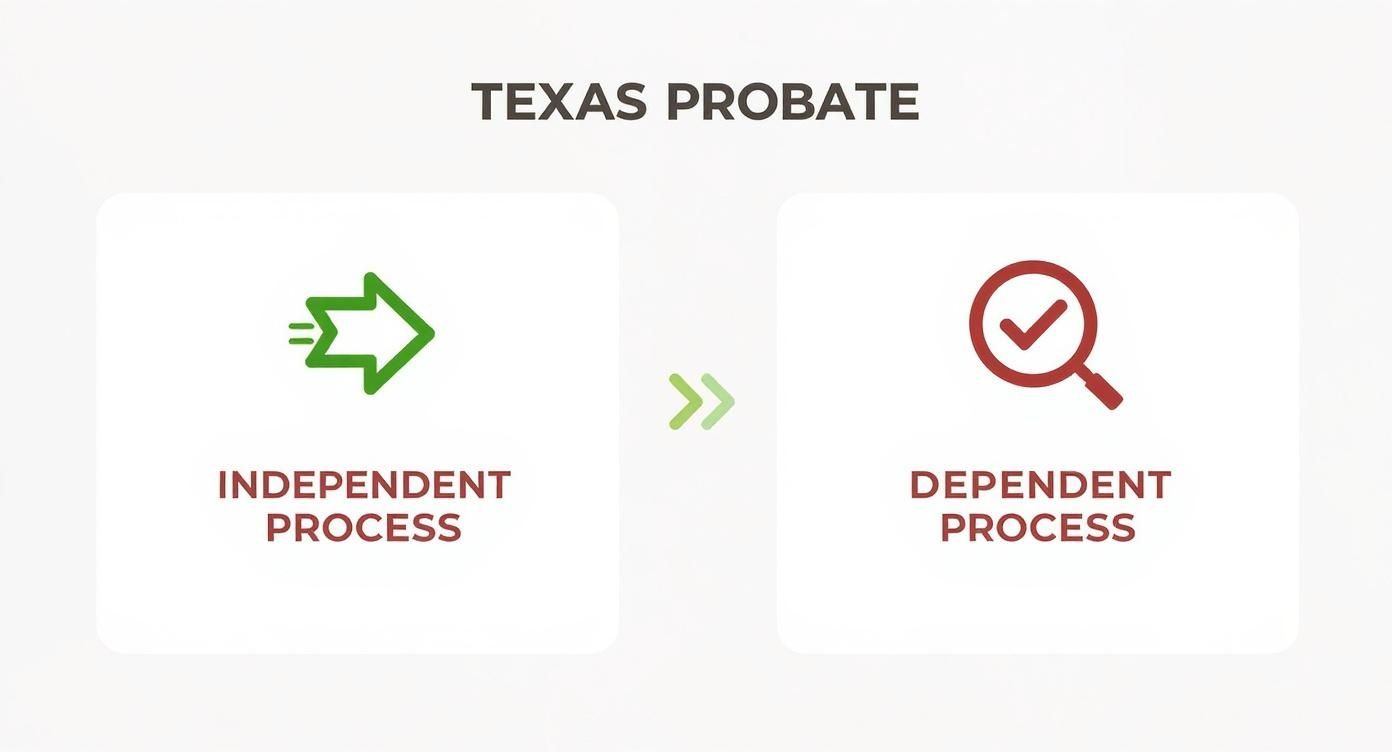
As you can see, independent administration is a much more direct route, which is why it’s the go-to method for most Texas estates when possible.
Maintaining Clear and Honest Communication
Beyond the legal filings, one of your most critical jobs is simply being the central point of communication. Grief can easily fuel tension or suspicion among family members. You can head off a lot of potential conflict with regular, simple updates.
Let the beneficiaries know when the inventory is filed, when you've paid the creditors, and what the rough timeline looks like for distributing assets. Openness builds trust and helps everyone feel respected. Remember, you hold the legal authority, but you're acting in a fiduciary capacity. That’s a legal term that just means you must always act in the best interests of the estate and its beneficiaries.
It's also important to understand how your role is different from others. For instance, being an executor is not the same as having power of attorney; our guide on what a power of attorney is explains that distinct legal authority, which actually ends when a person passes away.
The role of an executor is a marathon, not a sprint. By tackling each duty methodically and transparently, you can honor your loved one's trust and see the process through successfully. If you ever feel overwhelmed by these responsibilities, The Law Office of Bryan Fagan is right here in Kingwood to help. Schedule a free consultation, and we can provide the guidance you need to move forward with confidence.
Timeline and Costs for Probating a Will in Kingwood
When people in Kingwood and Humble start thinking about probating a will, two questions always come up first: How long is this going to take, and what’s it going to cost? It's completely understandable. You're navigating a difficult time, and you need clear, straightforward answers.
Let's break down what you can realistically expect here in Northeast Houston. For a simple, uncontested estate where everyone is on the same page, you’re generally looking at a timeline of about six to twelve months.
This best-case scenario assumes a few things go smoothly:
- The original will is easy to find.
- The application is filed correctly without any hitches.
- Notices to creditors go out promptly.
- We can get the assets appraised efficiently.
Honestly, one of the biggest factors is good communication between the heirs. When everyone works together, the entire process moves along much faster.
What a Typical Timeline Looks Like
The clock starts ticking the day we file the application with the Harris County court.
From there, it usually takes about 30 days for the court to formally approve the executor and issue what are called Letters Testamentary. This is the official document that gives you the authority to act on behalf of the estate.
The next 60 to 90 days are all about legwork. This is when you'll be gathering all the assets, getting them valued, officially notifying any creditors, and preparing the detailed inventory for the court. Once that inventory is filed and approved, you can start paying off any outstanding debts and figuring out how to distribute what's left.
For most straightforward wills, the final assets are often distributed right around the six-month mark.
A Real-World Humble Example
We worked with a family from Humble not long ago who managed to get through an independent probate in just eight months. They were a great example of how being prepared makes all the difference.
We filed everything accurately the first time, they had already talked through the basics with each other, and our local experience helped get appraisals done quickly.
- They received their Letters Testamentary in 28 days.
- We had the complete inventory filed in under two months.
- The final assets were in the hands of the heirs three months after that.
Because they were so organized, their costs stayed right at the lower end of the typical range, around $3,000. It just goes to show that a little preparation goes a long way.
Estimating Your Probate Expenses
The cost to probate a will in Texas can really vary depending on how complex things are. For most of our clients in the Kingwood area, a standard probate runs somewhere between $3,000 and $7,000.
That range generally covers the essentials:
- Court Filing Fees: In Harris County, this is usually $300–$350 right off the bat.
- Legal Notices: Publishing notices in the paper and mailing them out typically costs another $150–$300.
- Attorney Fees: This is the biggest variable, with fees starting around $2,000 for simple cases.
- Executor Compensation: Texas law allows the executor to be paid, but this is often waived if it's a close family member.
Probate costs and duration in Texas vary significantly depending on estate complexity and whether the probate is contested. For straightforward and uncontested wills, total probate expenses typically range from $3,000 to $7,000, covering court filing fees, attorneys’ fees, and administrative costs. These simpler cases often conclude within about six months. However, probate becomes far more expensive—potentially exceeding $10,000—and lengthier when disputes arise among heirs. Learn more about probate costs and duration
When Costs Can Go Up
The biggest budget-buster? Disputes. If heirs start disagreeing, you can expect legal costs to double or even triple.
I’ve seen conflicts arise from a few common triggers:
- Someone challenges the validity of the will itself.
- The estate includes multiple properties that all need separate appraisals.
- There are complex assets like business interests or multiple retirement accounts.
- A creditor pops up late in the game, forcing us to send out extra notices.
My best piece of advice is this: do a thorough inventory of the estate before you file anything, and have open, honest conversations with the heirs. It minimizes surprises and keeps legal bills from getting out of control.
If a will is contested, the court will likely require a "dependent administration," which means a judge has to sign off on every single action, from paying a bill to selling a car. Every court hearing adds more time and more fees to the process.
Planning Your Budget and Timeline
Getting a handle on the potential costs and key dates right from the start can bring a lot of peace of mind. The first thing we do is sit down and map out all the anticipated fees so you know what to expect.
I always suggest that families set aside a small buffer, maybe an extra 10–15%, just in case something unexpected comes up.
A few best practices can make all the difference:
- Gather all the financial documents and asset titles before you even think about filing.
- Talk informally with the beneficiaries about how things will be distributed.
- Try to identify any potential areas of disagreement early on so you can address them.
A clear budget and plan helps protect the value of the estate for the people it was meant for.
A Quick Look at Court Fees
| Fee Type | Amount |
|---|---|
| Application Filing | $345 |
| Notice to Creditors | $200–$250 |
| Inventory and Appraisement | $0 (included) |
| Certified Copies and Seals | $15 per copy |
These fees are set by the county and don't change often, but it's always smart to confirm the current amounts before you file. You'll also want to budget a little extra for things like certified mail and getting multiple copies of court documents.
Getting the Right Support
Navigating probate doesn't have to be a stressful, overwhelming experience for your family. Having a local Kingwood attorney in your corner can streamline the entire process, saving you both time and money.
Whether you need someone to handle the entire probate from start to finish or just need guidance on a few key steps like notifications or the inventory, we're here to help.
Schedule a free consultation at our Kingwood office to talk through your situation. Our team is ready to manage everything from court deadlines to final distributions so you can focus on your family.
You can also learn more about our specific probate services.
Why a Local Kingwood Attorney Is Your Best Ally

Trying to get through probate on your own can feel like navigating a maze blindfolded. This is precisely where a local Kingwood probate attorney becomes your greatest asset, turning what feels like an overwhelming legal burden into a clear, manageable process.
Here at The Law Office of Bryan Fagan, we're more than just lawyers; we're part of your community. We work with families across Kingwood, Humble, and Northeast Houston every day to help them avoid the common, costly mistakes that can derail an estate.
Local Insight into Harris County Courts Makes a Real Difference
One of the biggest benefits of working with a firm that’s right around the corner is our deep familiarity with the Harris County Probate Courts. Each court operates a little differently, with its own specific procedures, staff, and even judicial preferences.
It’s the kind of insider knowledge you can only get from years of practicing here. It helps us file paperwork correctly the first time, anticipate roadblocks, and keep the entire process moving smoothly. For our neighbors in Northeast Houston, that means less stress, fewer delays, and more time to focus on your family.
When you hire a local Kingwood attorney, you're not just getting legal advice. You're getting an advocate who understands our community, the local courts, and the specific challenges your family might be facing.
Sidestepping Costly and Stressful Errors
The Texas Estates Code is packed with strict rules and deadlines. Forgetting to file the will within the four-year window, for instance, could mean the will is thrown out entirely. Another common pitfall? Making a simple mistake on the estate inventory, which can trigger a time-consuming and expensive court audit.
Think of an experienced probate attorney as your guide through this legal minefield. We take that administrative weight off your shoulders by:
- Ensuring all legal notices are sent correctly and on time.
- Verifying the accuracy of the estate inventory.
- Making sure every deadline is met, without exception.
This careful, meticulous approach is what protects the estate’s assets and gives you much-needed peace of mind.
Our goal is simple: to make sure your loved one’s final wishes are handled with the respect and diligence they deserve, right here in our Kingwood community. If you're feeling overwhelmed, remember you don't have to face this alone. Schedule a free, no-obligation consultation at our Kingwood office, and let us show you how we can help.
Common Questions About Probating a Will in Texas
When a loved one passes away, you're not just dealing with grief; you're often thrown into a world of legal terms and procedures you've never encountered before. Here in our Kingwood office, we hear a lot of the same questions from families trying to make sense of it all. Let's walk through some of the most frequent ones.
Does Every Single Will in Texas Have to Be Probated?
That’s a great question, and the answer is no, not always. The probate process is designed to legally transfer assets from the deceased person's name to their heirs. But some situations don't require it.
For instance, if the estate is very modest—valued at less than $75,000 (and that doesn't include the value of the primary home)—you might be able to use a much simpler process called a Small Estate Affidavit.
Also, many assets pass to their new owners automatically, completely outside of the will and the probate court. These include:
- Life insurance policies with a named beneficiary
- Retirement accounts like a 401(k) or IRA
- Bank accounts set up as "payable-on-death" (POD)
- Property owned as "joint tenants with right of survivorship"
For most other situations, especially where a house in Kingwood is involved or the estate is more substantial, going through probate is the necessary, official step to honor the will and transfer ownership. A quick call to our Kingwood office can help you figure out which path your family needs to take.
What Happens if Someone Challenges the Will?
This is where a straightforward administrative task can suddenly turn into a full-blown lawsuit. A "will contest" means someone is formally challenging the validity of the will itself. They might claim the person who signed it wasn't mentally competent, was pressured by someone else (known as undue influence), or that the will was a forgery.
When a will is contested, everything gets more complicated, takes much longer, and becomes significantly more expensive. The court will almost certainly switch the case from a simple "independent administration" to a "dependent administration," which requires the judge's approval for nearly every action.
A will contest can be incredibly stressful and can drain an estate's resources quickly. Getting an experienced probate litigator involved right away is the best defense to protect your loved one's final wishes.
Can I Serve as Executor if I Don't Live in Texas?
Yes, you absolutely can. Texas law allows out-of-state residents to serve as executors. However, there's a key requirement: you must appoint a Texas resident to act as your official "resident agent." This is the person who will formally receive any legal notices on behalf of the estate.
Be realistic, though. Managing probate from another state is tough. You can't just pop over to the house in Kingwood to meet a realtor, or easily attend a court hearing in downtown Houston. That's why many out-of-state executors choose to hire a local Texas probate attorney to handle the day-to-day tasks and ensure everything is filed correctly according to Harris County court rules. It just makes the whole process smoother and less stressful for you.
Navigating probate can feel overwhelming, but you don't have to face it alone. The experienced attorneys at The Law Office of Bryan Fagan – Kingwood TX Lawyers are here to offer the clear guidance and steady support your family deserves during this difficult time. As your neighbors, we are committed to providing trusted representation right here in Kingwood. Schedule a free, no-obligation consultation with our local team today by visiting us at kingwoodattorneys.com.