
Preparing for a custody hearing is about much more than just showing up in court. It’s a methodical process of gathering the right documents, understanding what Texas law requires, and, most importantly, presenting yourself as the stable, involved parent your child needs. For residents in Kingwood, Humble, and the surrounding Northeast Houston area, this journey is a partnership between you and your attorney, focused on building a case that proves one thing to the judge: you consistently act in your child's best interest.
Your Guide to a Kingwood Custody Hearing
Facing a child custody hearing can feel like one of the most daunting challenges a parent in Kingwood will ever go through. The process is deeply personal and almost always stressful, but you don't have to navigate it alone. This guide is designed to give you a clear, actionable roadmap so you know exactly what to expect in a Harris or Montgomery County courtroom.
The single most important principle guiding every decision a Texas judge makes is the "best interest of the child" standard. This isn't just a legal catchphrase; it's the filter through which every document, every piece of testimony, and every argument will be judged. Our goal at The Law Office of Bryan Fagan is to help our Kingwood clients build a compelling case that leaves no doubt about how your active involvement is crucial for your child's well-being.
Understanding the Journey Ahead
For many parents in our community, from Humble to Porter, the family court system is completely new territory. If that’s you, know that you aren't alone. National data shows there are approximately 12.9 million custodial parents in the U.S. responsible for about 21.9 million children. These numbers highlight just how many families work through custody matters, reinforcing why the child's welfare must always come first. You can explore more about these family law statistics to see the bigger picture.
The road to your hearing can be broken down into three core phases.
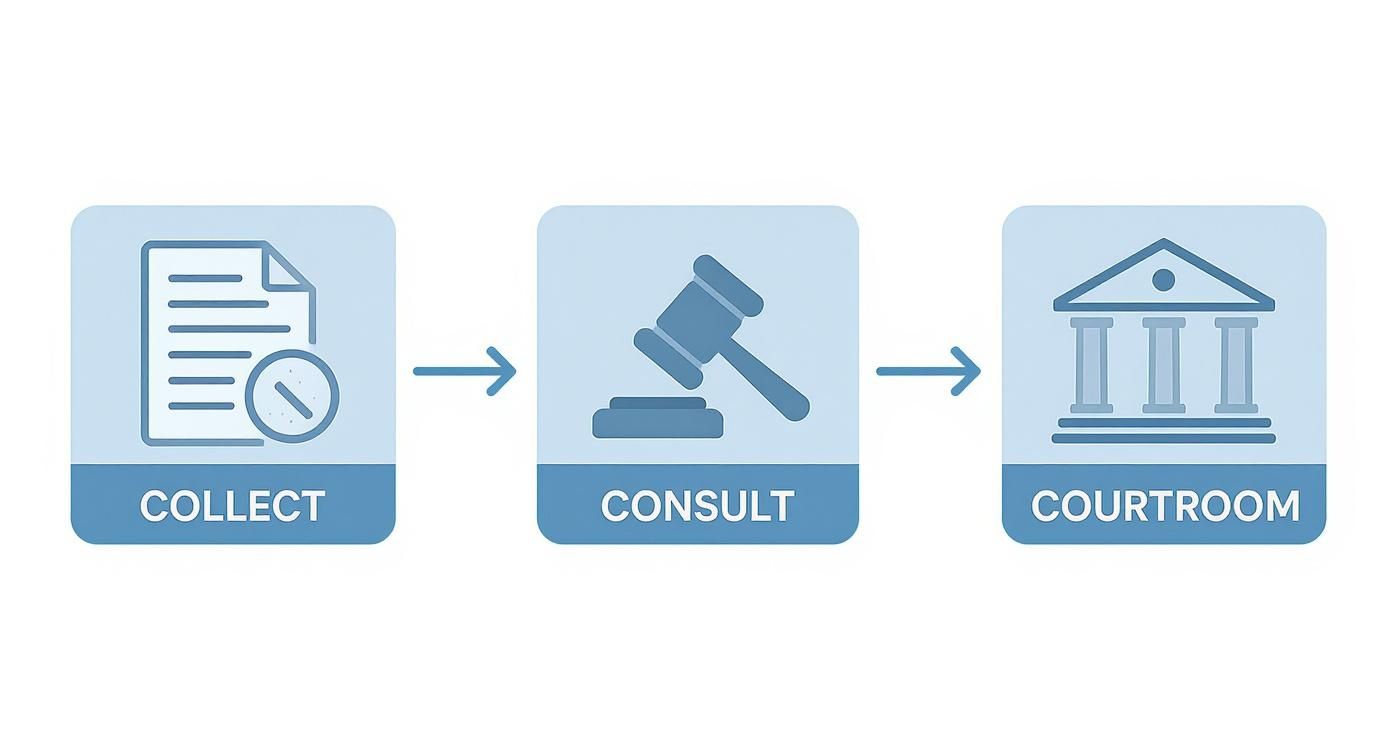
As you can see, a successful outcome isn't the result of a single action. It's a series of connected steps, starting with diligent evidence collection and culminating in a confident, well-prepared courtroom presentation.
To help you stay focused, here's a quick summary of the key areas we'll be covering. Think of this as your high-level checklist for hearing preparation.
Key Preparation Areas for Your Kingwood Custody Hearing
| Preparation Area | Why It Is Critical in Texas Courts |
|---|---|
| Document & Evidence Gathering | Tangible proof of your parental involvement, financial stability, and your child's needs. |
| Working With Your Attorney | Strategic partnership to build a strong legal argument and navigate court procedures effectively. |
| Understanding Courtroom Etiquette | Demonstrating respect for the court and judge, which reflects on your character and judgment. |
| Witness Preparation | Ensuring testimony from others is clear, credible, and supportive of your case. |
Each of these components is a building block in presenting a complete picture to the court.
A successful custody hearing is rarely about winning a fight; it’s about proving you are the parent who can provide stability, support, and a nurturing environment for your child's future.
We’re going to walk you through all the essential steps, from what documents to start collecting today to how to work most effectively with your Kingwood attorney. By the end, you'll feel more in control and ready to present the strongest possible case for your family.
If you’re feeling overwhelmed, just remember that expert support is right here in your community. The Law Office of Bryan Fagan offers a free consultation at our Kingwood office to talk about your specific situation and give you the guidance you need to move forward.
Gathering Your Evidence and Documentation

When you walk into a Kingwood courtroom, what you say is important, but what you can prove is what truly builds a compelling case. A strong custody case rests on a foundation of solid, well-organized evidence.
This part of your preparation is about much more than just gathering papers. You're strategically piecing together the story of your life as a parent—a story that shows your stability, your involvement, and your deep commitment to your child's well-being. Think of it this way: instead of just telling the judge you're a great parent, your evidence will show them.
Financial Stability and Your Ability to Provide
First things first, a Texas court needs to see that you can give your child a stable financial life. This isn't about being rich; it's about being responsible and consistently able to meet your child's needs.
Start by collecting these key financial documents:
- Recent Pay Stubs: The last three to six months will show your current, steady income.
- Tax Returns: Pull your last two years of tax returns to give the court a bigger picture of your financial history.
- Bank Statements: These can highlight responsible spending and demonstrate how you prioritize expenses for your child.
Having these documents neatly organized helps your Kingwood family law attorney present your financial situation clearly and prepare for any child support calculations. More importantly, it signals to the court that you are a reliable provider who can offer a secure home.
Demonstrating Your Active Involvement
This is where you really get to paint a picture of your role in your child's world. Your goal is to document your hands-on, consistent participation in every facet of their life. For parents in Northeast Houston, this often means showing up for the little things that matter most.
Start putting together a file with items like these:
- School Records: Report cards, attendance records, and any emails or notes from teachers prove you're engaged in their education.
- Medical and Dental Records: Keeping track of appointments and follow-ups shows you're on top of their health.
- Extracurricular Schedules: A calendar showing soccer practice in Humble or music lessons in Porter—especially with proof of payment or photos of you there—speaks volumes about your dedication.
These pieces of evidence are powerful because they create a timeline of your consistent care. They prove that your involvement isn't just a recent thing for the court's benefit, but a long-standing pattern of love and support.
Your evidence should tell a story of consistent, loving involvement. A single photograph is nice, but a collection of records showing your participation over months or years is compelling proof of your commitment.
Documenting Communication and Co-Parenting
How you communicate with the other parent is a huge deal for a Texas court. A judge wants to see that you can put your child’s needs first and co-parent effectively, even when it's tough. Make it a habit to save every text message, email, and communication through co-parenting apps (like OurFamilyWizard).
When you organize these communications, highlight the ones that show you being:
- Respectful and Business-Like: Avoid emotional, accusatory language. Stick to the facts.
- Child-Focused: Keep the conversation centered on schedules, school, health, and logistics.
- Proactive and Cooperative: Show examples where you reached out to solve a problem for your child’s benefit.
If you’re seeking to be the primary parent, showing you can foster a healthy relationship between your child and the other parent is critical under Texas law. For those in more difficult situations, we have a detailed guide explaining more about how to get sole custody in Texas, which often involves documenting why the other parent is unable to co-parent effectively.
Proving a Safe and Stable Home
Finally, you need to show the court that your home is a safe, nurturing place for your child. This has nothing to do with the size of your house and everything to do with providing a clean, organized, and child-friendly space.
- Photographs and Videos: Take clear pictures of your child’s bedroom, the kitchen, and the main living areas. A quick video tour can also be very effective.
- Character Letters: Ask people who have seen you parent firsthand—teachers, neighbors in Kingwood, or long-time family friends—to write letters about your skills and the home you provide. These letters are most powerful when they include specific, real-world examples.
Get all of this organized. A physical binder with labeled tabs works great, as does a secure digital folder. When you bring this to our Kingwood office, we can hit the ground running and start building your case strategy right away.
It's completely normal to feel overwhelmed by this process. The good news is that you don't have to figure it all out alone. Schedule a free consultation with The Law Office of Bryan Fagan, and we can walk you through identifying and organizing the evidence that will make the biggest impact in your specific case.
Getting the Most Out of Your Kingwood Attorney

The relationship you build with your attorney is probably the most critical partnership you'll have during this entire process. Think of it as a team effort. You bring the deep, personal knowledge of your family's history, and our team brings the legal expertise to put it all together.
Our job is to help you take that collection of documents, memories, and personal experiences and shape it into a clear, compelling story for the judge. For this to work, the foundation must be built on two things: open communication and total trust.
Why Holding Back Can Hurt Your Case
If there's one golden rule when working with your lawyer, it's this: be 100% honest about everything. And yes, that includes the things you’re worried might make you look bad. We can't defend you against things we don't know are coming, and surprises in a courtroom are rarely the good kind.
Tell us about your past mistakes. Let us know what you think the other parent will try to use against you. Point out the potential weak spots in your own case. This kind of transparency isn't a weakness; it's a strategic advantage. It allows us to get ahead of the problem, frame the narrative, and prepare solid counterarguments.
A winning legal strategy isn’t about pretending you have a "perfect" case. It's about knowing exactly where the challenges are and tackling them head-on. Your honesty is the tool that lets us do that effectively.
Remember, everything you tell us is protected by attorney-client privilege. Our Kingwood office is a safe space for you to share the whole story, judgment-free.
Making Your Strategy Sessions Count
Your strategy sessions with us are where the real work happens—it's where we lay out the game plan. To get the absolute most out of this time, a little prep work on your end goes a long way. Before our meeting, jot down any new questions, list recent developments, or note any concerns that have been on your mind.
During these meetings, we'll typically cover:
- Evidence Deep-Dive: We'll sift through everything you've gathered to pinpoint what will have the most impact.
- Building Your Narrative: We’ll work with you to connect the dots, focusing on the story of your consistent, positive actions as a parent.
- The Legal Landscape: We'll explain the specific Texas laws that apply and give you a realistic idea of how a judge in a Northeast Houston court might view your case.
Your active involvement is key. When you respond promptly to requests and keep your files in order, you not only help us build a stronger case but can also help keep your legal costs down. It all starts with choosing the right legal partner, and our guide on how to choose a divorce attorney can give you some valuable things to look for.
Getting Your Witnesses Ready for the Stand
Witnesses can be incredibly powerful. Hearing a teacher, a neighbor from Porter, or a family member validate your parenting skills in their own words can be a game-changer. But an unprepared witness can stumble, get confused on the stand, and end up doing more harm than good.
A crucial part of our job is to make sure that doesn't happen. We’ll meet with your witnesses beforehand to walk them through what to expect. We'll review the key points of their testimony and practice how to answer questions clearly and directly without getting flustered.
The whole point is to make them feel comfortable and confident. That way, they can simply speak from their own firsthand experiences, providing the kind of specific, real-world examples that truly resonate with a judge.
At The Law Office of Bryan Fagan, we're not just your legal counsel; we are your dedicated partners through every step. If you're ready to build a smart, proactive strategy for your family's future, call our Kingwood office to schedule your free consultation today.
Navigating the Day of Your Hearing

The day of your hearing is the culmination of all your hard work. By this point, you and your attorney should have a solid strategy in place. Now, the goal is to execute that plan with confidence and composure.
Walking into the family courthouse, whether it’s in Harris or Montgomery County, can feel incredibly intimidating. But knowing exactly what to expect can cut through a lot of that anxiety and help you focus. This isn’t about legal theatrics from a TV show; it's about presenting yourself calmly and respectfully to the judge who is making life-altering decisions for your family.
Courtroom Etiquette: Making the Right Impression
First impressions in a courtroom are a big deal. The way you carry yourself speaks volumes about your respect for the process, the court, and the judge. It’s a powerful, non-verbal way to show that you take this matter seriously.
Keep these simple guidelines in mind for courtroom conduct:
- Dress the Part: Think business casual or what you’d wear to an important job interview. Slacks and a collared shirt are a good choice for men; adding a tie or jacket is even better. For women, a conservative dress, skirt, or slacks with a blouse is perfect. Steer clear of jeans, t-shirts, shorts, or anything that looks too casual.
- Be Early: This is critical. Plan to arrive at the courthouse at least 30-45 minutes before your scheduled hearing. This buffer gives you time for parking, getting through security, and finding the right courtroom without feeling frazzled.
- Address the Judge Properly: Always, always address the judge as "Your Honor." You should stand when the judge enters or leaves the room, and also when you are speaking directly to them. It’s a small act, but it shows a great deal of respect.
- Keep Your Cool: Custody hearings are emotional by nature. It's vital, however, to remain calm and collected. Avoid sighing, rolling your eyes, or having a visible reaction to what the other party or their attorney says. Let your lawyer handle the legal responses—your job is to stay composed.
These small details paint a picture for the judge. A calm, respectful demeanor helps reinforce the image of you as a stable and mature parent.
What to Expect: The Sequence of Events
Custody hearings follow a specific, predictable order. Understanding this flow helps you anticipate what’s coming next and feel more in control.
Here’s a typical rundown of how things will unfold:
- Opening Statements: Your attorney and the opposing counsel will each give the judge a brief overview of their case.
- Petitioner's Case: The parent who initially filed the motion will present their evidence and call their witnesses first.
- Respondent's Case: The other parent then gets their turn to present their side of the story and their witnesses.
- Cross-Examination: After a witness testifies, the other side’s attorney has the opportunity to ask them questions. This is a standard and expected part of the process.
- Closing Arguments: Finally, both attorneys will summarize their cases and argue why the judge should rule in their client’s favor.
A quick reality check: The vast majority of custody cases—around 90%—settle before ever reaching a trial. But when a case does go to court, that initial hearing is incredibly important, as appeals are difficult and rarely successful. Your best tool for a favorable outcome is deep preparation. You can learn more about these important family law trends and statistics to understand the landscape.
Taking the Stand: How to Answer Questions
If you’re called to testify, this is your chance to speak directly to the court. Your attorney will have already prepped you for this moment, but it’s completely natural to feel nervous. The key is to be honest, direct, and as concise as possible.
When you're answering questions from either your lawyer or the opposing counsel, remember this:
- Listen to the Entire Question: Don't jump the gun. Pause and make sure you fully understand what's being asked before you speak.
- Answer Only What Is Asked: Resist the urge to volunteer extra information. Often, a simple "yes" or "no" is the best answer. If you do need to explain, keep it brief and stick to the facts.
- Always Be Truthful: Never, ever guess or make up an answer. If you don't know something, it is perfectly fine—and much better—to simply say, "I don't know" or "I don't recall."
- Keep the Focus on Your Child: Whenever you can, frame your answers around what is best for your child, not your personal feelings about the other parent.
Your testimony is a crucial piece of your case. By staying calm and following these tips, you can present your side clearly and effectively, helping the judge see your commitment to your child's well-being.
Feeling prepared for your day in court can make all the difference. If you live in Kingwood, Humble, or anywhere in Northeast Houston, The Law Office of Bryan Fagan is here to provide the local, experienced support you need. Schedule a free consultation with us to ensure you walk into your hearing feeling confident and ready.
After the Hearing: Understanding and Following Your Custody Order
When the judge’s gavel comes down, it feels like an ending. But for you and your family, it’s really the start of a new chapter. The hearing is over, but the work of building a stable future for your child is just beginning. For parents here in Kingwood, Humble, and across Northeast Houston, this next phase is all about taking the court's decision and making it work in the real world.
The most critical piece of paper you'll receive is the final court order. Think of it as the legally binding blueprint for your co-parenting life from this day forward. Your very first move should be to get a signed copy and read every single word—ideally with your attorney—to make sure you understand the fine print.
Dissecting Your Texas Custody Order
A Texas custody order, which is officially called a "Suit Affecting the Parent-Child Relationship" (SAPCR) order, is intentionally detailed. The whole point is to head off future arguments before they can even start. While every family’s situation is unique, most orders share a few key components that will define your new normal.
Here’s what you should expect to find:
- Conservatorship: This section lays out your legal rights and responsibilities. It will clarify if you are "Joint Managing Conservators," which is the most common outcome in Texas, or if one parent is the "Sole Managing Conservator."
- Possession and Access: This is just the legal term for the visitation schedule. It will break down the regular weekly plan—like the first, third, and fifth weekends—and spell out exactly how holidays, birthdays, and summer vacations will be handled.
- Child Support and Medical Support: No ambiguity here. The order will state precisely who pays child support, the exact amount, and the due date. It also dictates which parent is responsible for carrying the child's health insurance.
- Geographic Restriction: Many orders in the Kingwood area include a geographic restriction. This means the child's main home must stay within a specific area, often limited to Harris County and its adjacent counties.
This order is your rulebook. Knowing it inside and out is the absolute best way to stay in compliance and protect your rights.
After a custody hearing, the final order isn't just a piece of paper—it's the foundation for your child's future stability. Understanding its terms is your first and most important responsibility as a co-parent.
What Happens When Life Changes
Here’s a simple truth: life is unpredictable. A plan that works perfectly for your family today might be completely impractical two years from now. A great job offer in another city, a shift in your child's needs, or a major change in finances can make the current order impossible to follow.
When that happens, Texas law allows you to go back to court and ask for a modification.
To get an order changed, you have to prove that there has been a material and substantial change in circumstances since the judge signed the last one. It's a high legal bar to clear, but it exists to ensure the order continues to serve your child’s best interests above all else. This is exactly why getting a clear, forward-thinking order from the start is so crucial. The legal system can move slowly; some complex international cases have taken an average of 333 days to resolve. While most of our local Kingwood cases are settled much faster, it really drives home the importance of getting the order right and knowing the proper steps for making changes down the road. You can see more about these international child abduction case statistics to get a sense of how long these things can take.
Enforcing the Order When Necessary
So, what do you do if the other parent just isn't following the rules? It’s incredibly frustrating and, more importantly, it's disruptive for your child. If the other parent is constantly late for exchanges, refusing to let you see your child, or not paying child support, you can take legal action to enforce the court order.
An enforcement action is you asking the court to step in and force the other parent to comply. The consequences can be serious, ranging from make-up visitation time and fines to, in some cases of repeated violations, even jail time. It’s a significant step, but it’s the mechanism that gives the order its teeth and protects your child’s stability.
The period after a custody hearing is about finding a new rhythm for your family. Here at The Law Office of Bryan Fagan, we can help you navigate this new legal landscape. If you have questions about your order, need to discuss a modification, or require help with an enforcement, contact our Kingwood office for a free consultation.
Common Questions We Hear About Texas Custody Hearings
When you're facing a custody hearing, your mind is probably swimming with questions. As attorneys who work with families right here in Kingwood, Humble, and the surrounding Northeast Houston area every day, we've heard them all. Let's walk through some of the most common concerns we address, with practical answers based on our experience in local courts.
Our goal here is to cut through the legal jargon and give you a clear picture of what to expect, so you can walk into that courtroom with confidence.
Will the Judge Force My Child to Testify?
This is easily one of the biggest fears parents have, and it’s completely understandable. The good news is, it's very unlikely. Texas courts go to great lengths to shield children from the conflict of a courtroom battle.
However, there are specific situations where a judge may want to hear from an older child. If a child is 12 or older, they have the right to file a document with the court stating their preference on where they want to live. The judge is then required to speak with them about it.
This doesn't happen in the open courtroom with everyone watching. It’s a private conversation in the judge's chambers. Most importantly, the child's preference is not the final say. It’s just one piece of the puzzle. The judge will carefully consider the child’s maturity and be on the lookout for any signs of one parent trying to influence them.
How Long Will This Hearing Actually Take?
This really depends on the complexity of your case. A custody hearing can be surprisingly quick or it can feel like a marathon. If you and the other parent have reached an agreement on most things, you might be in and out in less than an hour.
But if you’re heading into a contested temporary orders hearing in Harris or Montgomery County, you should prepare for a much longer process. These can easily take up several hours, sometimes even an entire day, as both sides present evidence, question witnesses, and make their arguments.
What's the Real Difference Between "Sole" and "Joint" Custody in Texas?
The terms people use in everyday conversation don't always line up with the law, and this is a big one. In Texas, the legal term for custody is conservatorship.
- Joint Managing Conservatorship (JMC): This is what the court awards in the vast majority of cases. It means both parents share the rights and duties of raising their child. Even in a JMC, one parent is typically named the "primary" parent—the one who decides where the child lives and who receives child support.
- Sole Managing Conservatorship (SMC): This is rare. A judge will only order this in serious situations involving things like family violence, child neglect, or significant substance abuse. The Sole Managing Conservator gets the exclusive right to make almost all decisions for the child.
Getting a handle on these terms is crucial for setting realistic expectations. To get a better sense of how these arrangements play out day-to-day, you can learn more about shared custody in Texas in our guide.
In Texas, the starting point for every judge is the presumption that a Joint Managing Conservatorship is in the child's best interest. If you want a different outcome, you have to bring powerful evidence to court showing why that arrangement would actually be damaging to your child.
Can We Change the Custody Order Later On?
Absolutely. Life changes, and an order that works for your family today might not make sense in a few years. Texas law allows for a modification, but it isn't automatic.
You can't go back to court just because you've changed your mind. You first have to prove that there has been a "material and substantial change in circumstances" since the judge signed the last order.
What does that mean? It could be a major life event like one parent relocating for a job, a big shift in income, or new concerns about the child's environment or safety. Once you've shown that, the court will then decide if changing the order is truly in your child's best interest.
Walking into a custody hearing prepared is half the battle. At The Law Office of Bryan Fagan – Kingwood TX Lawyers, we believe our neighbors deserve clear guidance and strong, dedicated representation. If you have more questions or need to talk about the specifics of your situation, reach out to our Kingwood office. We're here to help you with a free, no-obligation consultation.