
Life doesn’t stand still, and neither do your finances. When circumstances change for your family in Kingwood, an old child support order can quickly become unfair or unmanageable. To change a child support order in Texas, you have to show a court there's been a material and substantial change in circumstances since the last order was signed. Simply put, something significant has to have happened—a job loss, a major promotion, or new, expensive needs for your child. The only way to make a change legally binding is by filing a formal "Petition to Modify" with the court.
Do You Have Grounds to Modify Your Child Support Order?
What made sense for your family three years ago might be completely unworkable today. A layoff from a job in Humble, a major promotion in Kingwood, or a child’s unexpected medical diagnosis can throw your financial reality into a tailspin. When that happens, the existing child support order can quickly feel unfair or impossible to manage.
Texas law understands that life happens. But you can't just decide to change your support payments on your own. You need a legally recognized reason, and that reason is called a "material and substantial change in circumstances."
This is the legal standard a judge will use to evaluate your request. It might sound like complex jargon, but it just means something significant and ongoing has shifted for you, the other parent, or your child. We’re not talking about a small dip in overtime one week; it has to be a real, impactful event.
What Counts as a Material and Substantial Change?
For parents across Northeast Houston, this is often the trickiest part. A "material and substantial change" isn't about a specific dollar amount; it's about the impact of that change.
Here are some real-world situations we see in our Kingwood practice that often meet this standard:
- Major Income Shifts: One parent is involuntarily laid off, takes a significant pay cut, or becomes disabled and can no longer work. On the flip side, a big promotion or a new, much higher-paying job for the person paying support also counts.
- The Child's Needs Evolve: The child is diagnosed with a medical condition requiring costly treatments, needs special tutoring or therapy, or daycare costs have shot up.
- Custody Arrangements Change: The child now lives primarily with the parent who was originally paying support. This is a game-changer. Custody and support are deeply connected, and it's vital to understand how possession orders affect your case. You can explore this more in our guide on father's rights in Texas.
- A Parent Has More Children: While having a new family doesn't automatically wipe out your duty to your existing children, a court can consider the financial strain as part of the bigger picture.
This decision tree can give you a quick visual on whether you might have a strong case for modification.
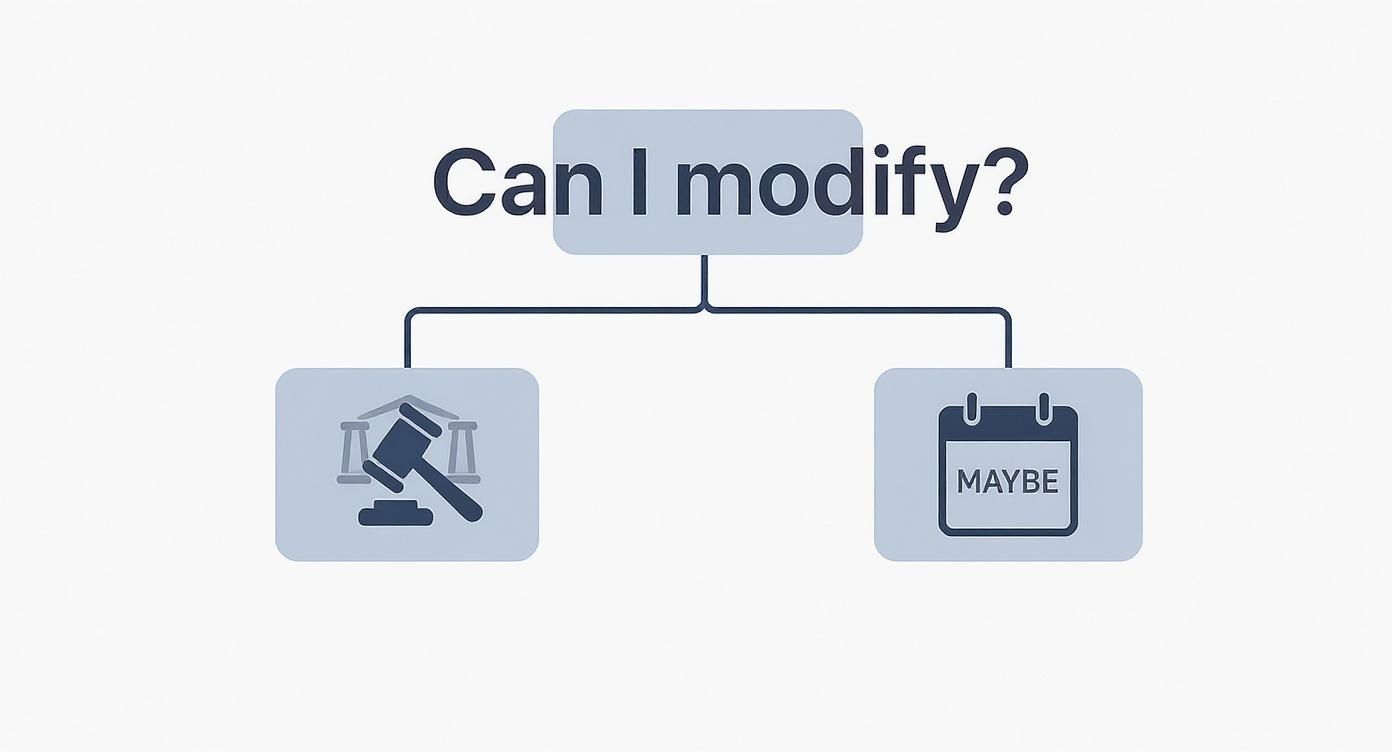
As you can see, a major life event is the clearest path, but the simple passage of time can also open the door for a review.
The Three-Year Review Rule
What if nothing dramatic has happened, but incomes have just slowly drifted apart over the years? Texas law provides another option for this exact scenario.
You can ask for a review if at least three years have passed since your last order was finalized, and if the new support amount, calculated under current guidelines, would be different by either 20% or $100 per month.
This isn't an automatic adjustment. It’s a ticket to get back in front of the judge without needing to prove a life-altering event. The court will simply recalculate support based on everyone's current income.
This rule is a huge help for Kingwood families whose financial situations have changed gradually. It creates a predictable opportunity to make sure the support order is still fair and based on reality.
Below is a quick-reference table to help you see how common life changes stack up against the legal standard in Texas.
Qualifying for a Child Support Modification in Texas
| Common Life Change | Does It Typically Qualify? | What This Means for Your Case |
|---|---|---|
| Losing Your Job (Involuntarily) | Yes | This is a classic "material and substantial change." You'll need to show you're actively looking for new work. |
| Getting a Big Raise or Promotion | Yes | A significant income increase for the paying parent often justifies an upward modification for the child's benefit. |
| Child's Medical Diagnosis | Yes | New, uninsured medical expenses or therapy costs are a direct change in the child's needs. Documentation is key. |
| Possession Schedule Flips | Yes, absolutely. | If the child now lives with the paying parent most of the time, the support order will almost certainly need to be modified. |
| Voluntarily Quitting Your Job | No | A judge won't lower your support if you are intentionally unemployed or underemployed. The court can base support on your earning potential. |
| It's Been Over 3 Years | Maybe | If it's been 3+ years AND the new amount would differ by 20% or $100, you can request a review without another reason. |
This table provides a starting point, but every family's situation has its own unique details.
Feeling overwhelmed trying to figure out if your situation qualifies? That's completely normal. You don’t have to navigate this alone. The legal team here in Kingwood at The Law Office of Bryan Fagan is ready to help you evaluate your options. Call our Kingwood office to schedule a free, no-pressure consultation to talk about your case and get clear, straightforward advice.
The Process of Filing for a Modification
So, you're pretty sure your situation qualifies for a change. The big question now is, "What do I actually do?" For families in Kingwood and across the Houston area, understanding the practical steps of how to modify child support in Texas can take a lot of the anxiety out of the process. You have a couple of ways to approach this, and choosing the right one is your first move.

The Two Main Paths: An Informal Agreement vs. a Formal Filing
Before preparing for a court battle, it’s always worth seeing if you and the other parent can simply talk it out. Reaching an agreement on your own can save everyone a ton of time, stress, and legal fees. If you can agree on a new child support amount, you can put it in writing, sign an Agreed Order, and submit it to a judge for approval.
But be careful. A simple handshake deal or a verbal promise is not legally enforceable. This is a huge mistake we see all the time in our Kingwood practice. If you don't get that agreement signed by a judge and filed with the court, the old child support order is still the one that counts.
When an agreement just isn't in the cards, you have to take formal action with the court. That means filing a specific legal document to kick things off.
Starting the Legal Process: The Petition to Modify
To officially ask a Texas court to change your child support, you must file a Petition to Modify the Parent-Child Relationship. This is the formal document that lays out who you are, who the other parent is, details about your children, and, most importantly, the material and substantial change that makes a modification necessary.
Where you file this is crucial. The petition almost always has to be filed in the same court that issued your last custody or support order. For our clients here in the Kingwood area, that usually means filing in one of two places:
- Harris County, at the main civil courthouse in downtown Houston.
- Montgomery County, at the courthouse up in Conroe.
Once filed, your case is officially open. You'll pay a filing fee (which varies by county) unless you qualify for a waiver based on financial hardship. This is the first real, tangible step toward getting your court order to match your current life circumstances.
Key Takeaway: The date your new support amount can take effect often goes back to the day the other parent was officially notified of the lawsuit—not the day your income changed. This is exactly why it’s so important to file your petition as soon as you can.
The Critical Step of Serving the Other Parent
After you file the petition, you can't just text the other parent to give them a heads-up. Texas law requires formal service of process. This means a constable, sheriff's deputy, or a certified private process server has to personally deliver a copy of the lawsuit to the other parent.
This isn't just a technicality; it’s a constitutional right. It ensures the other person has proper legal notice and a fair chance to respond to the case.
Trying to skip this step or doing it incorrectly is one of the fastest ways to get your case delayed or even thrown out. Proper service is non-negotiable and shows the court that you're following the rules and giving everyone a fair shot.
The paperwork and legal rules can feel like a lot to handle, but they are there to protect your rights and ensure a fair result for your kids. If you’re a parent in Kingwood, Humble, or Porter and you're not sure where to even start, you don't have to go it alone. The Law Office of Bryan Fagan is right here in your community. Contact our Kingwood office for a free consultation, and let us help you take that first step with confidence.
Building Your Case: Gathering the Right Evidence
When you walk into a courtroom asking a judge to change a child support order, your word alone isn't enough. You need proof. A successful modification is built on a solid foundation of evidence that clearly shows why the current order is no longer appropriate.
Think of it this way: you’re painting a picture for the judge of what has changed since the last order was signed. The documents you bring are the colors and brushes you use to make that picture clear and compelling. For our clients in Porter and Northeast Houston, this is often the most critical part of the entire process.
Showing the Financial Shift
The most frequent reason for a modification is a change in someone's income. Whether you got a big promotion or were unexpectedly laid off, you have to prove it. Simply telling the judge you lost your job or started a new one won't cut it.
You'll need to start collecting the paper trail:
- Recent Pay Stubs: Grab your last three to six months of pay stubs. This gives the court an immediate, real-time snapshot of your gross and net earnings.
- Tax Returns: Your last two years of tax returns, complete with all W-2s and 1099s, are non-negotiable.
- Proof of Job Loss: If you were laid off or terminated, find that official letter. You’ll also want to show proof of any severance pay and documentation that you've applied for or are receiving unemployment benefits.
- New Job Offer Letter: Landed a new position? The official offer letter that spells out your new salary or hourly wage is a key piece of your puzzle.
Having these documents organized and ready makes it easy for a judge in Harris or Montgomery County to see precisely what changed and by how much.
Documenting the Child's Evolving Needs
Sometimes, the need for a change isn't about your income, but about what your child needs. Kids grow, and their expenses often grow right along with them. It's up to you to show the court exactly how those costs have changed.
Focus on documenting these key areas:
- Health Insurance Costs: You need to show what you're actually paying each month for the child's health, dental, and vision insurance. If that premium has jumped, get statements from your employer or the insurance company that show the old cost and the new one side-by-side.
- Out-of-Pocket Medical Expenses: Keep every single receipt. Co-pays, prescriptions, therapy bills, braces—it all adds up. Creating a simple spreadsheet to track these costs can be incredibly powerful in court.
- Childcare and Schooling: Gather up all the invoices and statements from daycare, after-school care, or private school tuition. If your child requires special tutoring or has other educational needs, get letters or reports from the school or specialists involved.
A well-organized binder full of receipts, bank statements, and invoices does more than just prove your numbers. It tells the judge you're a diligent, responsible parent who is on top of the real costs of raising your child. That kind of credibility can make all the difference.
It’s also helpful to understand the bigger picture in Texas. The state collected an astounding $4.2 billion in child support in a recent year, more than any other state. At the same time, parents across Texas owed a collective $19 billion in back payments, which accrues interest at a 6% rate. These Texas child support statistics underscore why the courts demand such thorough financial proof—they take the enforcement and accuracy of these orders very seriously.
We get it. Pulling all this paperwork together can feel overwhelming, especially when you're already navigating a significant life event. But this is the single best investment of time you can make in your case. If you're a parent in the Kingwood area and aren't sure where to start, you don't have to figure it out on your own. Give us a call at The Law Office of Bryan Fagan. We offer a free consultation at our Kingwood office to help you identify the evidence that will matter most and build a strategy to present it effectively.
How Texas Calculates New Child Support Amounts
When you ask a judge to modify your child support, their decision isn't based on guesswork or what feels fair. They follow a specific formula laid out in the Texas Child Support Guidelines. Getting a handle on how this math works is the best way for Kingwood families to set realistic expectations for what might happen.
The whole calculation hinges on one key figure: the paying parent's net monthly resources.

This isn't just a person's take-home pay. "Resources" is a broad term covering nearly every dollar coming in—salary, wages, overtime, commissions, self-employment income, rental income, and even retirement benefits. From that total gross amount, the court subtracts mandatory deductions like federal income tax, Social Security, Medicare, and what you pay for the child's health insurance. What’s left over is the "net monthly resources" used in the formula.
Applying the Guideline Percentages
Once the court lands on that net resources number, it applies a simple percentage based on how many children are involved. This system is designed to create a consistent, predictable starting point for families across Texas, whether you're in Kingwood or anywhere else.
The guidelines provide a clear framework. Below is a quick breakdown of the standard percentages a court will use.
Standard Texas Child Support Guideline Percentages
| Number of Children | Percentage of Net Resources |
|---|---|
| 1 Child | 20% |
| 2 Children | 25% |
| 3 Children | 30% |
| 4 Children | 35% |
| 5 or More Children | 40% |
As you can see, the percentages are straightforward. For instance, if a parent in Humble has net monthly resources of $5,000 and two children, the guideline child support amount would be $1,250 per month (25% of $5,000). This formula gives everyone a clear baseline for what to expect.
The Income Cap and Its Impact on High Earners
Texas law also sets an income cap to keep support obligations reasonable for higher-earning parents. Right now, the guidelines are only applied to the first $9,200 of a parent’s net monthly resources. Anything earned above that amount isn't automatically included in the standard calculation.
However, a major change is on the horizon. Starting September 1, 2025, Texas will raise this income cap significantly, from $9,200 to $11,700 per month. This will directly impact high-income parents in Northeast Houston by increasing the maximum base for calculating child support. You can find additional information about the Texas child support cap increase to see how this might affect you.
A Judge's Discretion: It's important to remember that while the guidelines are the starting point, a judge can order support above the capped amount. This typically happens when the child has proven needs that justify a higher payment, such as for special medical care or unique educational expenses.
When Can a Judge Deviate from the Guidelines?
The guidelines aren't set in stone. A judge has the authority to order an amount that's different—either higher or lower—if they believe the standard formula would be "unjust or inappropriate" for a specific family's situation. They'll look at a whole host of factors to make that call.
Some common reasons a judge might deviate include:
- Special Needs: The child has extraordinary medical, educational, or psychological needs that come with significant extra costs.
- Custody and Travel: One parent has to spend a great deal of money just to travel and see their child. The specific details of your possession order matter here, which is why understanding the rules of shared custody in Texas is so crucial.
- Other Financial Resources: A parent might have access to significant assets or other financial resources that aren't reflected in their typical monthly income.
Knowing how a judge calculates a new support amount is the first step in preparing your case effectively. If you're in the Kingwood area and need help figuring out the likely outcome of your modification, The Law Office of Bryan Fagan is here to help. Schedule a free consultation with our local team to go over your financial circumstances and get clear, practical advice.
Common Mistakes and When to Call a Kingwood Attorney
Trying to change a child support order can be tricky, and a few common missteps can unfortunately cause big problems for your case. We see families in Kingwood and Humble run into the same preventable issues all the time. Knowing what these pitfalls are is the best way to steer clear of them.

The Danger of "Handshake Deals"
The single most frequent—and costly—mistake is relying on an informal agreement. You and the other parent might agree over the phone or even by text to change the support amount. It seems simple and avoids conflict, but it’s a trap.
These agreements are not legally binding.
The original court order is the only thing that matters until a judge signs a new one. This means that even if you've been paying a lower, agreed-upon amount for months, the court sees you as falling behind on the official amount. The other parent can later take you to court for the full difference (called "arrearages"), and your handshake deal will offer you zero protection.
Pitfalls to Sidestep in Your Modification Case
Beyond verbal agreements, a few other procedural errors can completely derail your modification efforts.
- Failing to Properly Serve the Other Parent: You can't just mail the lawsuit or hand it to your ex. Texas law requires formal service of process, usually by a constable or a private process server. Get this wrong, and your case stops dead in its tracks.
- Waiting Too Long to File: This is a big one. A judge can typically only make the new support amount effective retroactive to the date the other parent was formally served with your lawsuit. Every month you delay after losing your job is another month you're stuck with the old, higher payment.
- Showing Up to Court Unprepared: Walking into a hearing without your financial documents organized and your evidence ready is a recipe for disaster. A judge in Harris or Montgomery County needs to see proof, not just hear your story.
Remember, the court's primary focus is always the best interest of the child. A disorganized case makes it hard for a judge to understand how your requested change serves that core principle.
Knowing When You Need an Attorney's Help
While some simple modifications can be handled on your own, many situations are just too complex to risk. If your case involves any of the following, getting guidance from an experienced Kingwood family law attorney is crucial.
- Self-Employed or Unpredictable Income: Calculating the "net resources" for a business owner or someone paid on commission is notoriously difficult and often becomes a major point of contention.
- Suspected Hidden Income: If you believe the other parent is hiding money or deliberately working less to lower their child support obligation, an attorney has legal tools, like discovery, to find the truth.
- A High-Conflict Co-Parent: When communication is hostile, an attorney acts as a vital buffer. They handle the negotiations and court appearances, shielding you from unnecessary conflict.
- Complex Custody Changes: Is your request to change child support tied to a major shift in the possession schedule? When custody is also on the table, the legal stakes get much higher.
Choosing the right legal partner is a critical decision. For more on this, you can read our guide on how to choose a divorce attorney, as many of the same principles apply here.
Protecting your finances and ensuring your child's needs are met is too important to leave to chance. If you're a parent in Kingwood, Porter, or anywhere in Northeast Houston facing a complex modification, don’t wait. Contact The Law Office of Bryan Fagan for a free, confidential consultation at our Kingwood office to discuss your rights and build a clear path forward.
Common Questions About Modifying Texas Child Support
When life throws you a curveball, your child support order often needs to change, too. For families here in Kingwood and throughout Northeast Houston, this process can feel overwhelming. Let's walk through some of the most common questions our local clients ask to give you some clarity and peace of mind.
How Long Does It Take to Modify Child Support in Texas?
Honestly, the timeline can be all over the map. If you and the other parent see eye-to-eye on the new amount and are willing to sign off on the paperwork, it can be surprisingly quick. Once an Agreed Order is drafted and submitted, you might have a judge’s signature within a few weeks.
But that's the best-case scenario. If you can't agree and the modification is contested, you're looking at a much longer road. The process could stretch out for several months, easily, once you factor in court hearings or mediation. The court dockets in Harris and Montgomery County can get backed up, and any complex issues will add time. This is precisely why it's crucial to file the moment your situation changes. The new support amount typically only goes back to the date the other parent was served with the lawsuit, not the day you lost your job.
I Lost My Job. Can I Just Stop Paying Child Support?
No. Absolutely not. This is a mistake we see people make that can have disastrous consequences. You are legally required to follow the current court order until a judge officially signs a new one.
The very first thing you should do after a job loss or a major pay cut is file a Petition to Modify. A job loss is a classic example of a "material and substantial change," but the court can't help you until you formally ask it to. If you stop paying, you open yourself up to an enforcement action. That could mean contempt of court charges, wage garnishment, losing your driver's license, and even jail time. Filing immediately is your only real legal protection.
Key Takeaway: A court order is a powerful thing; it doesn't just vanish because your job did. You are legally on the hook for every payment until a new order is in place. It's your responsibility to get the ball rolling.
What if My Ex and I Already Agreed on a New Amount?
That's great news! Reaching an agreement on your own can save everyone a ton of time, stress, and money. However—and this is a big one—a handshake deal or a text message exchange is not legally enforceable.
To make your agreement official, it has to be put into a formal document called an Agreed Order. You both have to sign it, and then it must be submitted to the court for a judge to sign. Without that judge's signature, the old child support amount is the only one that legally exists. A local Kingwood attorney can make sure your agreement is drafted properly to avoid any loopholes and get it filed correctly, turning your understanding into a solid, protective court order.
Does Child Support Change Automatically if Custody Changes?
It does not. This is another common misconception. Even if there's a huge shift in the possession schedule—for instance, the child moves in with the parent who was previously paying support—the support order doesn't just update itself.
While a change in who has the child most of the time is a very strong reason to modify child support, they are two separate legal issues. You have to file a formal Petition to Modify to get the support obligation changed or even stopped to match the new living situation. The court won't do this for you. You have to take that first step to ensure the support order reflects your family's new reality here in Kingwood.
Figuring out the details of how to modify child support in Texas can be tricky, but you don't have to go it alone. The dedicated family law attorneys at The Law Office of Bryan Fagan – Kingwood TX Lawyers are part of your community and ready to offer the straightforward advice you need. We know the challenges families in Kingwood, Humble, and Northeast Houston are up against. Schedule a free, no-obligation consultation with us today to go over your case and see how we can help protect your family's future. Visit us at https://kingwoodattorneys.com.