Skip to content
It's a question we hear a lot from our neighbors in Kingwood and Northeast Houston: "Can I actually write my own will without a lawyer?" The short answer is yes, you absolutely can. But—and this is a big but—it demands meticulous attention to Texas law. For our clients in Kingwood, getting it right is crucial to making sure your final wishes are honored and your family is protected.
Your Guide to Creating a Texas Will on Your Own
Making a will is one of the most powerful things you can do for your family, yet it's something many people put off. With the rise of online will-making tools, the idea of doing it yourself has become more popular than ever. It's a surprising fact, but a recent survey showed that only 33% of Americans have a will or living trust. This means the vast majority of people haven't put these essential documents in place. You can find more details on this trend in these estate planning statistics on NerdWallet.com.
For our community members in Humble and Porter, creating a will on your own can feel both empowering and budget-friendly. Think of this guide as your practical roadmap, breaking down the essentials of how to get it done right here in Texas.
Why Consider a DIY Will?
People who decide to draft their own will usually have a few key reasons in mind. Seeing if these resonate with you can help you decide if it's the right approach for your family.
- You have a straightforward estate. If your assets are simple—maybe a house in Kingwood, a few bank accounts, and some personal items—and your family situation is uncomplicated, a DIY will can be a very practical option.
- You're looking to save money. Let's be honest, avoiding legal fees is a big motivator. For anyone on a tight budget, handling the will yourself feels much more attainable than booking time with an attorney.
- You value privacy and control. Some people simply prefer to manage their personal and financial affairs themselves. Crafting your own will gives you direct control over every single word in the document.
Creating your own will puts the power directly in your hands. However, that power comes with the responsibility of getting every detail right according to Texas law. A small mistake can create significant problems for your loved ones down the road.
Before you even think about writing, it’s vital to know that Texas recognizes two main types of wills. The most common is a formal, typed will, which comes with very strict rules for signing and witnessing. The other is a "holographic" will, which is one written entirely in your own handwriting. Each has a unique set of legal hoops to jump through, and we'll walk through both.
Here at The Law Office of Bryan Fagan, our goal is to give you the information you need to make a smart decision. While a DIY will is certainly possible, it's not a one-size-fits-all solution for every family in Kingwood. If you have questions or your gut tells you your situation might be a little complex, we're here to help. You can schedule a free, no-obligation consultation at our Kingwood office to talk about your estate planning needs.
Getting the Legal Details Right for a Valid Texas Will
If you're in the Kingwood or Porter area and thinking about creating your own will, the first thing you need to understand is that Texas law has very specific rules. This isn't just a list of your wishes; it's a formal legal document. If you don't follow the rules to the letter, a court could throw the whole thing out, leaving your family in a real bind.
The most fundamental requirement is what the law calls testamentary capacity. It sounds complicated, but it's pretty straightforward. When you sit down to sign your will, you must:
- Know you're making a will that will pass on your property when you die.
- Have a general idea of what you own—your assets and property.
- Be able to identify your closest relatives, like your spouse, kids, or parents.
In short, you need to be of sound mind and fully understand what you're doing. This is the bedrock of any valid Texas will.
Your Two Main Options for a DIY Will in Texas
When it comes to actually creating the will yourself, Texas law gives you two distinct paths. Each one has its own set of rules for signing and making it official, so picking the right one for your situation is a critical first step.
The decision flowchart below gives you a quick visual breakdown of these two paths.
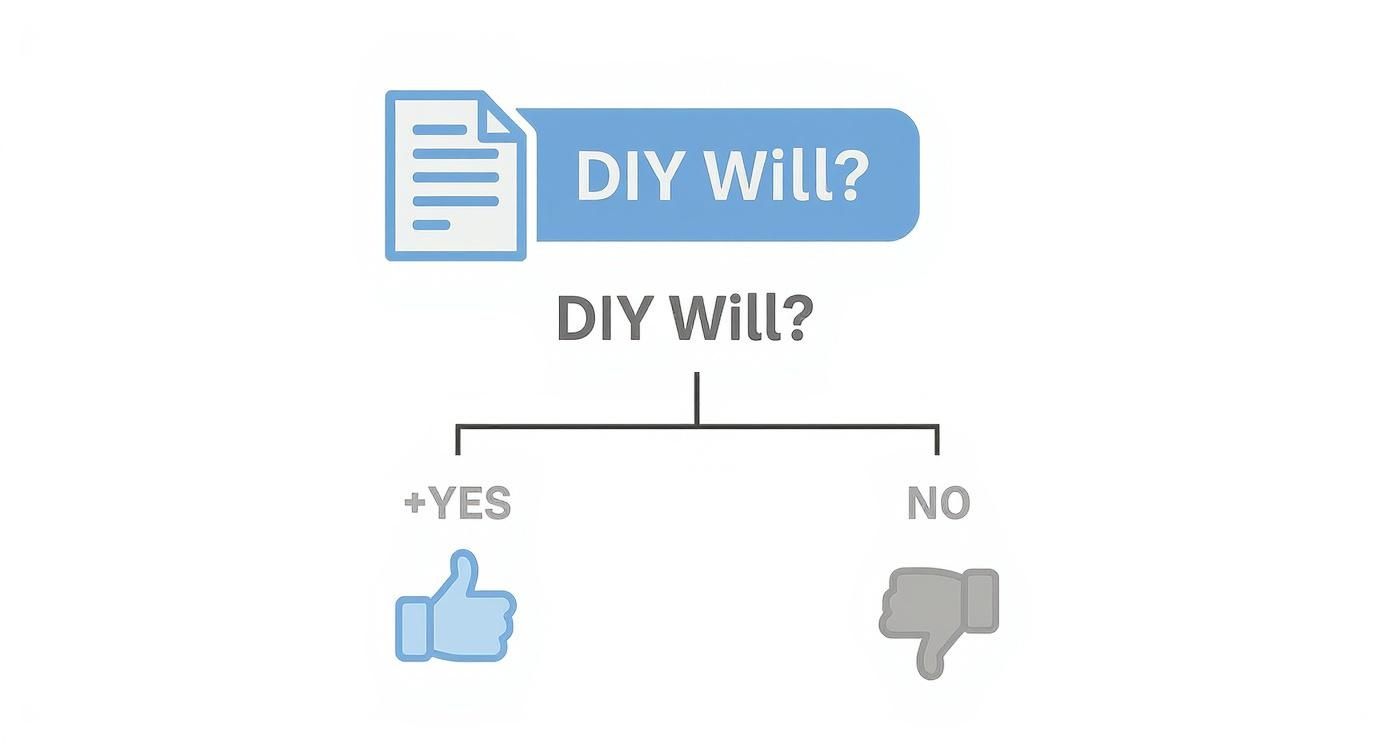
As you can see, your choice boils down to a formal typed will, which needs witnesses, or a holographic will, which has its own strict handwriting requirement.
Typed Will vs. Holographic Will in Texas
Choosing between a typed or a handwritten will is one of the first major decisions you'll make. Both are legally recognized in Texas, but their requirements are completely different. This table breaks down what you need to know for each.
| Requirement | Typed Will | Holographic Will |
|---|---|---|
| Format | Must be in writing (typed or handwritten by another). | Must be wholly in your own handwriting. |
| Signature | You must sign it, or have someone sign it for you in your presence and under your direction. | You must sign it. |
| Witnesses | Two credible witnesses, at least 14 years old, who sign in your presence. They cannot be beneficiaries. | No witnesses required. |
| Common Use | The most common and legally secure method for most people. | Often used in emergency situations or by those who prefer simplicity, but can be easier to challenge in court. |
While a holographic will might seem simpler because you don't need to round up witnesses, that's also its biggest weakness. Without witnesses, it can be much harder to prove its validity in court if someone decides to challenge it.
Key Takeaway: In our experience helping Kingwood families, the single biggest mistake people make with DIY wills is messing up the execution. For a typed will, if you fail to have two qualified witnesses sign it in your presence, the document is likely invalid, no matter how perfectly it captures your wishes.
Why the Witnessing Rules Are So Strict
The strict rules around witnessing a typed will are there for a good reason: to prevent fraud and undue influence. They serve as proof that you signed the document willingly and with a clear mind. For anyone in Humble or the surrounding areas creating a standard, typed will, this step is absolutely non-negotiable.
The need for this formality is one of the key things that separates a will from other estate planning tools. While both wills and trusts have their place, the execution process for a will is rigid and must be followed precisely. You can learn more about the primary differences between a will and a trust in our detailed guide.
Ensuring your will is legally airtight is how you protect your legacy and your family. If these rules feel a bit intimidating or you're just not sure which path is right for you, that's a good sign it's time to get some professional guidance. A free consultation at our Kingwood office can give you the clarity you need to move forward with confidence.
How to Draft Your Will with Confidence

Alright, you've got the legal rules down. Now it's time to put pen to paper (or fingers to keyboard) and actually draft your will. This is where your wishes really take shape, and it’s not nearly as intimidating as it sounds. Let's walk through the key pieces you’ll need to include, especially for our neighbors right here in Kingwood and Northeast Houston.
Choosing Your Executor
This is arguably one of the biggest decisions you'll make in this entire process. Your executor is the person (or institution) you trust to see your will through. They’re the ones who will gather your assets, pay off any debts, and make sure your property gets to the right people.
Think long and hard about this. You need someone who is organized, completely trustworthy, and can handle administrative legwork during what will likely be a tough time for everyone. A lot of folks in the Humble area pick a responsible family member or a close friend. Some even opt for a professional, like a bank or trust company.
What makes a good executor?
- Trustworthy and Honest: This one’s a no-brainer. They will have access to your entire estate.
- Organized and Diligent: Probate involves a surprising amount of paperwork, deadlines, and phone calls.
- A Texas Resident (Preferably): It's not a legal must, but having an executor in or near Kingwood can make the court process a whole lot easier.
- Willing to Serve: Don't just spring this on someone. Always ask them first if they're willing to take on the responsibility before you name them.
And a pro tip: always name a backup. If your first choice can't serve for whatever reason, having an alternate executor in place ensures your plans don't grind to a halt.
Identifying Beneficiaries and Assets
The whole point of a will is to spell out who gets what. To make that happen, you have to be incredibly clear. First, make a list of your beneficiaries—the people or organizations you want to inherit from you. Use their full, legal names to avoid any mix-ups down the road.
Next, you'll need to take inventory of your significant assets. You don't have to list every single book or piece of furniture, but you absolutely need to cover the big stuff. For a typical family here in Porter, that list might look something like this:
- Real Estate: Your house, a vacation cabin, or any rental properties.
- Financial Accounts: Checking and savings, retirement funds like 401(k)s and IRAs, and investment portfolios.
- Vehicles: Any cars, trucks, boats, or RVs you own.
- Valuable Personal Property: This includes things like jewelry, art collections, antiques, or other items of significant value.
A Word of Caution: Some assets don't pass through a will at all. Things like life insurance policies and most retirement accounts go directly to the beneficiaries you named on those specific accounts. We call these "non-probate assets," and your will won't control them unless you've specifically named your estate as the beneficiary.
Using Clear Language for Bequests
When you give something away in your will, it's called a bequest. The language here needs to be airtight. We have seen firsthand how vague instructions can lead to family disputes that require litigation.
Here are a few examples of clear, direct language:
- For a specific item: "I give my collection of antique clocks to my nephew, David Chen."
- For a sum of money: "I give the sum of $25,000 to my sister, Maria Rodriguez."
- For a percentage of the estate: "I give 50% of my estate to my son, John Williams, and 50% of my estate to my daughter, Susan Williams."
Being specific and direct leaves absolutely no room for someone to misinterpret your wishes.
Including Critical Overlooked Provisions
A really solid will does more than just hand out assets. There are a few other clauses you should include to protect your family, and this is especially true if you live in the Kingwood area and have young children.
One of the most important is naming a guardian for minor children. If something were to happen to you and the other parent, this clause tells the court exactly who you want to step in and raise your kids. Without it, the court is left to make that decision for you.
Another crucial piece is a residuary clause. Think of this as a safety net. It specifies who gets any property you forgot to mention or anything you acquire after you write the will. A simple line like, "I give the remainder of my estate to my spouse, Jane Doe," ensures nothing falls through the cracks. This kind of foresight is just as important as planning for your own care; for instance, you can learn more about how a power of attorney works to protect your financial and medical interests while you're still living.
Common Mistakes to Avoid with a DIY Will

Going the DIY route for your will can feel like a savvy, money-saving move. And for some, it can be. But this path is littered with potential missteps that can cause serious, lasting headaches for your family right here in Northeast Houston. Honestly, knowing what to watch out for is half the battle.
From what we've seen over the years, the most damaging errors often seem insignificant at first. Under the microscope of Texas law, however, they can completely unravel your final wishes. We’ve seen well-meaning DIY wills turn into sources of confusion and bitter disputes—all of which could have been easily sidestepped. Our goal is to help you dodge these common pitfalls so your intentions are left crystal clear and legally binding.
Using Vague or Ambiguous Language
One of the biggest traps you can fall into when writing your own will is using unclear wording. You know exactly what you mean when you write "give my car to my son," but what happens if you have two sons and two cars? Which son gets the sedan and which gets the truck? Ambiguity is a breeding ground for family conflict.
Your will needs to be painfully specific. Instead of vague terms like "my personal effects," you should either list specific items or, better yet, name a trusted person to handle dividing them fairly. The more precise you are, the less room there is for arguments down the line.
We recall a case from a Kingwood family where the will left the "house" to one child and the "investments" to another. The trouble started when the home was sold and the cash was reinvested. This created a huge legal mess that ended up pitting the siblings against each other in court.
Failing to Execute the Will Correctly
This is, without a doubt, the easiest way to invalidate your will. Texas law is incredibly strict about how a typed will must be signed and witnessed. If you mess this part up, the will is worthless. It’s that simple.
You absolutely must sign the will in the presence of two credible witnesses, who then must sign it in your presence. Critically, these witnesses can't be people who stand to inherit anything in your will. It sounds straightforward, but even tiny deviations from this process can void the entire document.
Forgetting to Update Your Will
A will isn't a "set it and forget it" document. Life happens—people are born, people pass away, relationships change—and your will needs to reflect those changes. We always tell our clients in Kingwood to pull out their will for a review every 3-5 years, or immediately after any major life event.
What kind of events warrant an immediate update?
- Marriage or Divorce: A divorce in Texas can automatically nullify provisions for an ex-spouse, but it’s always smarter to create a completely new will to match your new reality.
- Birth of a Child: You’ll need to officially include your new child and, just as importantly, name a guardian for them.
- Death of a Beneficiary or Executor: If someone named in your will passes away, you need to adjust your plans accordingly.
- Significant Change in Assets: Buying a new home in Humble or selling off a major investment could easily require an update to your will.
Overlooking Certain Assets or Debts
It’s surprisingly common for people to forget about certain types of property, especially digital assets or items they’ve acquired recently. This is where a residuary clause becomes your safety net. It’s a catch-all provision that directs where any property not specifically mentioned in the will should go.
Just as important is thinking about your debts. Before any of your beneficiaries receive a dime, your executor must use your estate's assets to pay off your outstanding debts. Forgetting to plan for this can shrink the inheritance your loved ones were expecting and seriously complicate the probate process. A good estate plan often includes ways to simplify this, and you can learn more from our guide on how to avoid probate in Texas.
Navigating these potential mistakes is where getting professional guidance really shows its value. At The Law Office of Bryan Fagan, we're committed to helping our Kingwood neighbors create solid, legally sound plans that will hold up when they’re needed most. If you have any doubts about your DIY document or just want an expert to look it over, schedule a free consultation with our team. We're here to give you that peace of mind.
Knowing When to Call a Kingwood Estate Lawyer
https://www.youtube.com/embed/rgGXsGQSCjs
Creating a will on your own is absolutely possible for many Texans, especially if you have a straightforward estate. For a lot of our neighbors here in Kingwood and Northeast Houston, a DIY approach can work just fine. But it's not the right path for everyone.
Certain life circumstances add layers of complexity that a generic template or an online form just can't handle. Knowing when to spot these complexities is the most important step in protecting your family's future. It's about understanding when the risk of making a mistake outweighs the money you might save upfront. A seemingly small error today can snowball into massive legal battles and family heartbreak down the road.
This is where sitting down with an experienced local Kingwood attorney becomes crucial. Think of it like this: you know when to use a first-aid kit and when you need to see a specialist. Your will is no different.
Is Your Situation More Complex Than You Think?
If any of the following scenarios sound familiar, it’s a strong signal that you should get professional legal advice. These situations almost always touch on specific Texas laws that require careful navigation to make sure your wishes are legally airtight.
You Own a Business: If you're a business owner in Humble or Porter, your will has to do more than just pass on personal items. It needs to address succession plans, buy-sell agreements, and how business assets are managed. A simple will just isn't built for that.
You Have a Blended Family: Life is messy, and families are beautifully complex. Second marriages, stepchildren, and kids from previous relationships demand carefully crafted language to prevent disputes and ensure everyone is treated as you intend. A DIY will can easily create confusion about who gets what.
You Want to Disinherit a Close Relative: Texas has very specific rules about disinheritance. If you plan to leave a spouse or child out of your will, it has to be done with precise legal language to have any chance of surviving a court challenge.
You Have a Large or Potentially Taxable Estate: Once your assets reach a certain level, professional estate planning becomes a tool to minimize potential estate taxes and protect the value of what you pass on.
You Own Property Outside of Texas: A house in Colorado or a condo in Florida is subject to that state's probate laws. A Kingwood attorney can help create a plan that coordinates everything, saving your family from a costly and complicated legal mess across multiple states.
Here's the key: an attorney doesn't just fill out a form for you; they provide strategy. We help our Kingwood clients see around corners and plan for legal challenges they might not even know exist, making their plan as solid and conflict-proof as possible.
What If Your Beneficiaries Have Special Circumstances?
Sometimes, the complexity isn't about your assets—it's about the people you love. If you need to provide for someone who requires special consideration, professional guidance is non-negotiable.
One of the most common situations we see is providing for a beneficiary with special needs. If you leave a direct inheritance to someone receiving government benefits like Medicaid or SSI, that lump sum could immediately disqualify them from that vital assistance. An attorney can help you establish a special needs trust, which allows you to provide for your loved one without jeopardizing their eligibility.
Likewise, you might be worried about a beneficiary's ability to handle a large inheritance. Maybe they're young, struggle with addiction, or just aren't good with money. A lawyer can help you structure a trust that distributes funds over time or only under specific conditions you set.
For our Kingwood community, the peace of mind that comes from a professionally drafted, legally sound will is immeasurable. At The Law Office of Bryan Fagan, we understand the unique challenges families in our area face. If your life includes any of these complexities, we invite you to schedule a free, no-obligation consultation at our Kingwood office. Let's work together to build a plan that truly protects what matters most.
Answering Your Top Questions About Texas Wills
When you start thinking about creating a will, a lot of questions pop up. It's completely normal. Here in our Kingwood office, we hear the same questions time and again from folks in the community. Getting these answers straight can give you the peace of mind to take the next step.
Let's walk through some of the most common ones we encounter.
What Happens If I Die Without a Will in Texas?
This is a big one. If you pass away without a will in Texas, you don't get a say in who gets your property. Instead, the state decides for you based on a set of rigid laws called intestate succession. The court follows a strict legal formula to hand out your assets to your closest relatives.
For example, a married person with kids might assume their spouse gets everything. That's not always the case under Texas intestate laws—the kids might inherit part of your community property, which can create a real mess. If you're single with no kids, your assets could end up with your parents or siblings. The bottom line is this: you lose all control. This can cause real headaches and heartache for the people you leave behind in Humble or Porter.
Does My Will Have to Be Notarized?
There's a lot of confusion around this. Technically, no. A standard, typed will in Texas does not need to be notarized to be considered legally valid. What really matters is that you sign it in front of two credible witnesses, and they sign it in your presence, too. That's the core requirement.
So where does the notary come in? A notary is used for something called a self-proving affidavit. This is a separate statement that you and your witnesses sign, and the notary's seal just verifies that everyone signed it correctly. It doesn't make the will more valid, but it makes proving its validity in court a whole lot easier down the road.
Think of it this way: skipping the self-proving affidavit is technically fine, but getting one is a smart move. It can save your family a ton of time, money, and stress during the probate process here in Harris or Montgomery County.
How Often Should I Look at My Will Again?
Your will isn't a "set it and forget it" kind of document. Life changes, and your will needs to keep up. We always tell our clients to pull it out and review it every 3 to 5 years. You should also review it immediately after any major life event.
What counts as a "major life event"?
- Getting married or divorced
- The birth or adoption of a child or grandchild
- A major change in your finances (like an inheritance or selling a business)
- The death of someone you named in the will, like your executor or a beneficiary
- Moving to another state, since laws can differ
Keeping your will updated ensures it actually reflects what you want. It's interesting to note that even with all the DIY options out there, a 2023 study found that 51% of people still hired a lawyer for a straightforward will-only plan. You can read more about how people make wills on NCOA.org. It just goes to show that many people still see the value in getting professional guidance.
At the Law Office of Bryan Fagan – Kingwood TX Lawyers, we're dedicated to helping local families build a secure future. Whether you just have a few questions or you're ready to create a comprehensive estate plan, our team is here for you. We invite you to schedule a free, no-pressure consultation at our Kingwood office to talk about what you need. Find out more at https://kingwoodattorneys.com.