Skip to content
If you're a parent in Kingwood, Humble, or Porter facing a separation, figuring out child support is likely one of your biggest concerns. It can feel confusing and stressful, but the good news is that Texas law provides a clear, structured process to ensure your child is financially supported. You are not alone in this, and our team at The Law Office of Bryan Fagan is right here in Kingwood to help you navigate it.
The process starts by calculating the non-custodial parent's net monthly resources and then applying a set percentage based on the number of children who need support. Let's walk through how it works for families in our community.
Understanding Child Support in Kingwood, Texas
When a family separates in our Northeast Houston communities, the immediate concern is always the children. How will they be provided for? Thankfully, the Texas child support system is built for predictability, not punishment. Its sole purpose is to create a stable financial foundation for your child's future, ensuring their needs are met.
The core idea is simple: children deserve to receive financial support from both parents, just as they did before the separation. To make this happen, Texas law provides a clear, mathematical starting point. This structure helps minimize conflict and prevents long, drawn-out arguments over money, allowing your family to move forward with clarity.
Key Takeaway: The Texas child support system is designed to provide consistent financial support for a child's needs. The law provides a structured framework to remove guesswork and reduce potential conflict between parents in Kingwood and the surrounding areas.
The Guideline Formula Explained
For parents wondering how to calculate child support in Kingwood, the journey begins with the Texas Family Code. This is the official rulebook that judges, attorneys, and families across the state, including here in Montgomery and Harris Counties, must follow.
At The Law Office of Bryan Fagan, our Kingwood attorneys navigate these rules daily for local families. The calculation itself is laid out in Chapter 154 of the Family Code. The standard approach involves multiplying the non-custodial parent's net monthly resources by a specific percentage:
- 20% for one child
- 25% for two children
- 30% for three children, and so on.
This formula ensures a child's financial needs are met in a predictable way after a divorce or separation. If you're interested in the broader principles behind these kinds of family support laws, there's some insightful reading available from the UN about global efforts. You can find more on that at UN.org.
The Roles of Custodial and Non-Custodial Parents
To truly understand how the calculation works, you need to know who the court considers to be in each role. The court uses two specific terms:
- Custodial Parent: This is the parent the child lives with most of the time. They manage the day-to-day costs of raising the child—from groceries and housing in your Kingwood home to school supplies and clothing.
- Non-Custodial Parent: This is the parent who typically has a visitation schedule and is ordered by the court to pay child support.
The system works on the assumption that the custodial parent is already contributing financially through direct, daily care. Because of this, the formula focuses on calculating the non-custodial parent's monetary contribution to the child's well-being.
It's also crucial to remember that for unmarried parents in Texas, a child support order can't be put in place until legal parentage is confirmed. You can learn more about this essential first step in our guide on how to establish paternity in Texas.
Calculating Your Net Monthly Resources
Everything in a Texas child support case starts with one key figure: the non-custodial parent's net monthly resources. This isn't just your take-home pay; it's a specific number calculated according to state law. Getting this number right is the foundation for the entire process, and we walk our Kingwood-area clients through this step-by-step to make sure nothing is missed.
The first part of the equation is to add up all sources of gross income.
What Counts as Gross Income
Think of "gross income" as nearly every dollar that comes your way. For many folks in Kingwood with a steady salary, this is pretty straightforward. But for others, like local small business owners in Humble or professionals in the oil and gas industry with fluctuating bonuses, it can get complicated fast.
A judge will look at a wide range of income sources, including:
- Your salary, wages, overtime, and commissions
- Tips and bonuses
- Income from self-employment
- Net rental income from properties
- Severance pay
- Retirement benefits, pensions, and Social Security (but not SSI)
- Disability and workers' compensation benefits
- Interest, dividends, and royalties
Basically, if it's money being earned or received, you should expect it to be counted. Honesty and transparency are critical, as judges have the authority to verify everything you report.
This flowchart gives you a good visual of how the calculation flows, from adding up your resources to applying the state guidelines.
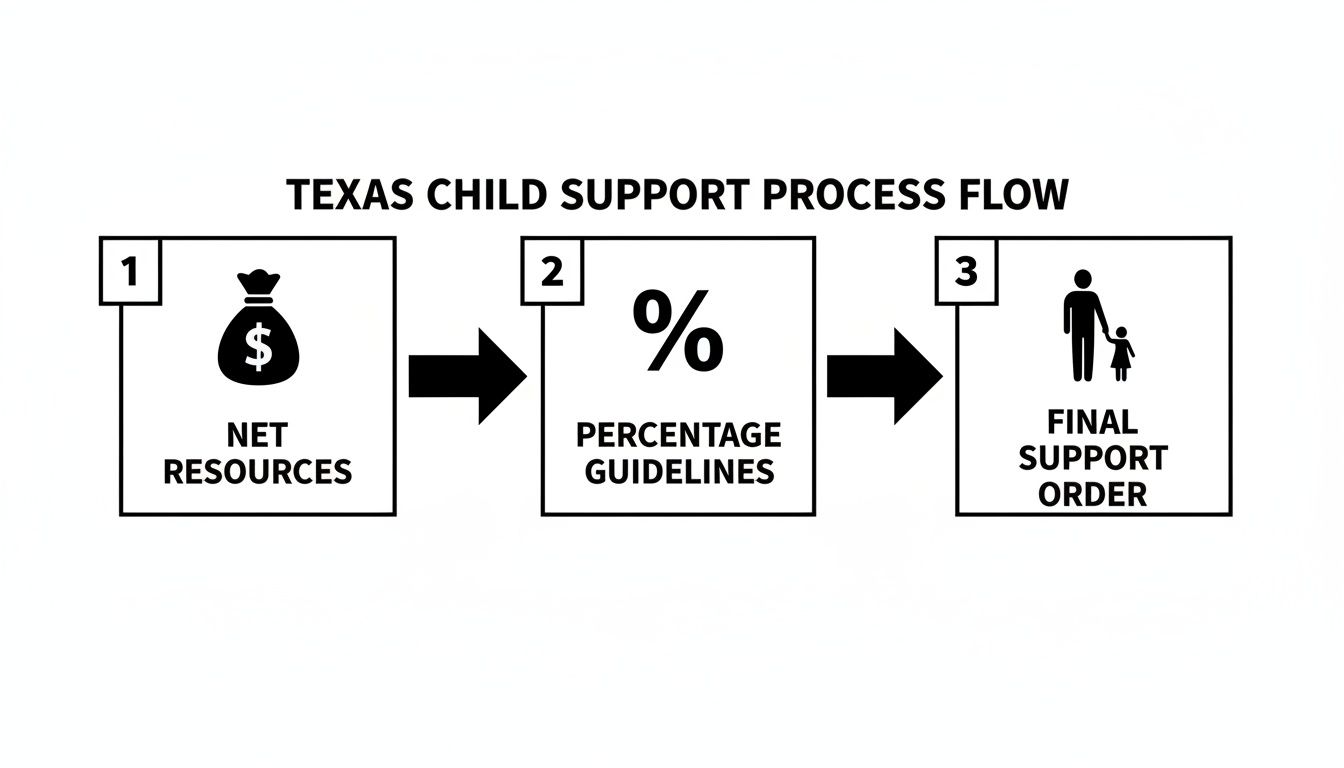
As you can see, a precise net resources calculation is the essential starting block before any percentages are even considered.
Allowable Deductions from Your Gross Income
After you have your total gross monthly income, the Texas Family Code allows for a handful of specific deductions. This is where many people get tripped up—they assume "net" means their take-home pay. It doesn't. The list of what you can subtract is actually very short and specific.
To get to your net resources, you’ll need to subtract a few key items from your gross income. The table below breaks down exactly what the court permits.
Allowable Deductions from Gross Income in Texas
| Deduction Type | Description & Local Kingwood Example |
|---|---|
| Federal Income Taxes | The amount withheld for a single person claiming one standard deduction. Even if you're married and file jointly, the court uses this single-filer standard for the calculation. |
| Social Security (FICA) Taxes | Standard FICA taxes (Social Security and Medicare) are deducted. This is a fixed percentage of your income up to the annual limit. |
| Union Dues | If you are a member of a union and pay dues as a condition of your employment, those mandatory dues are deductible. |
| Child's Health Insurance | The amount you actually pay out of pocket for the child's health and dental insurance premiums can be deducted. For example, if your employer covers half the cost, you only deduct your half. |
That’s it. Notice what's missing? Things like your mortgage payment, car note, or credit card bills are not deductible when calculating net resources for child support.
For a Kingwood family, a simple miscalculation of net resources can result in a child support order that's off by hundreds of dollars a month, an error that can compound for years. That's why at The Law Office of Bryan Fagan, we meticulously account for every income source and every legitimate deduction for our local clients.
What Happens If Income Isn't Clear?
A Kingwood court needs solid numbers to make a fair decision. A judge will look closely at recent pay stubs, W-2s, and at least two years of tax returns.
But what if a parent is out of work or seems to be earning far less than they could? If a judge believes a parent is voluntarily unemployed or underemployed, they have the power to "impute" income. This means the court assigns an income based on that person's skills, work history, and earning potential in the local Kingwood-Humble job market. This could be based on a full-time, minimum-wage job or a much higher salary, depending on the circumstances.
A landmark 2023 Texas Supreme Court case, In re E.A.K., which involved a Kingwood-area executive, is a perfect example. The court upheld a ruling that imputed $60,000 in annual income to a voluntarily unemployed parent. This led to a child support obligation of $1,200 per month, showing just how seriously the courts take a parent's duty to provide. If you're interested in the broader global context of child welfare, the Christian Alliance for Orphans offers extensive information and resources at CAFO.org.
Applying the Guideline Percentages to Find the Right Number

Once you’ve figured out the non-custodial parent's net monthly resources, you're ready for the next step. This is where we get into the heart of how to calculate child support in Kingwood. Thankfully, the Texas Family Code gives us a clear formula based on percentages. This framework is designed to bring predictability to families across the state, from downtown Houston to our own neighborhoods in Kingwood.
The idea is simple: the percentage of income paid in child support directly corresponds to the number of children the parent is responsible for supporting in this specific case.
The Guideline Percentages at a Glance
For most families here in the Kingwood, Humble, and Porter areas, the calculation is straightforward. The more children before the court, the higher the percentage of net resources that goes toward their support.
To make this easy, here’s a quick-reference table that shows the exact percentages a Texas court will use, along with a practical example.
Texas Child Support Guideline Percentages
| Number of Children | Percentage of Net Resources | Example Calculation (Based on $5,000 Net Resources) |
|---|---|---|
| 1 Child | 20% | $5,000 x 0.20 = $1,000/month |
| 2 Children | 25% | $5,000 x 0.25 = $1,250/month |
| 3 Children | 30% | $5,000 x 0.30 = $1,500/month |
| 4 Children | 35% | $5,000 x 0.35 = $1,750/month |
| 5+ Children | 40% | $5,000 x 0.40 = $2,000/month |
These percentages are the standard as long as the paying parent doesn't have other children from a different relationship that they are also legally obligated to support. If they do, the court adjusts the percentages to ensure all the parent’s children receive fair support.
A Real-World Kingwood Scenario
Let's see how this plays out in a common situation we see right here in our community. Picture a parent who lives in Kingwood and has $6,000 in net monthly resources. This parent has two children who live primarily with the other parent in a nearby Humble neighborhood.
Based on the guidelines, we’d apply 25% for two children. The calculation looks like this:
$6,000 x 0.25 = $1,500 per month
In this case, a Montgomery or Harris County judge would likely order $1,500 per month in child support. This is the presumptive amount unless specific circumstances justify a different figure.
An Expert's Take: For most Kingwood families, this standard calculation gives a reliable baseline. But remember, it’s a starting point. An experienced local attorney can spot factors—like a child's special needs or an unusual possession schedule—that might convince a judge to adjust the final amount up or down to better serve the child's best interest.
What About the Income Cap?
You might be wondering what happens with very high earners. Does the percentage just keep applying no matter how high the income? Not exactly. Texas law sets a "cap" on the income used for the guideline calculation to prevent excessive support awards.
As of September 1, 2023, that cap is set at $9,200 in net monthly resources.
So, if a parent earns $15,000 a month in net resources, the guideline formula only applies to the first $9,200 of it. With two children, the guideline support would be $2,300 ($9,200 x 0.25).
This isn't always the end of the story, though. A judge can order child support above this guideline amount if the custodial parent can prove the children have needs that require additional funds. To see how these numbers and rules work in practice, check out our comprehensive guide on how much child support you might expect in Texas.
Working through these guidelines can get complicated, especially when high incomes or other factors are involved. Our team at The Law Office of Bryan Fagan is committed to serving the Kingwood community by helping you understand your rights and ensuring the law is applied fairly to your family’s unique situation.
When the Standard Calculation Doesn't Tell the Whole Story
The official Texas child support guidelines provide a solid baseline, but real life for families in Kingwood and across Northeast Houston is rarely that simple. The law recognizes this, giving judges the power to adjust child support up or down from the standard percentage when the facts of the case justify it.
This is where knowing how to calculate child support in Kingwood goes beyond simple math. It’s about understanding the complete picture of your family's financial life and your child's actual needs. A judge in Montgomery or Harris County will look at everything, and having an attorney who knows what they look for can make all the difference.
Health Insurance and Medical Expenses
One of the most frequent adjustments we see involves who pays for health and dental insurance. Typically, the parent paying child support is also ordered to provide the child's health coverage. The good news is, you get credit for that. The actual amount you pay out-of-pocket for the child's portion of the premium is usually deducted right from your monthly support payment.
So, if the guideline calculation says you owe $1,250 a month, but you spend $150 a month to keep your child on your health plan, the final order will likely be for $1,100.
Of course, some children have needs that go far beyond a standard check-up. For kids with chronic conditions or special needs, the costs can add up fast. These often include:
- Physical, occupational, or speech therapy
- Ongoing prescription medications
- Specialized medical equipment
- Counseling or psychiatric care
When a child has proven needs that result in significant out-of-pocket costs, a judge can order child support above the standard guideline amount. The goal is always to make sure the child’s essential needs are covered.
The Impact of Your Possession Schedule
More and more Kingwood parents are using possession schedules that give both parents more time, like an Expanded Standard Possession Order or even a 50/50 split. A huge misconception we often clear up for our clients is that a 50/50 schedule automatically means no one pays child support. In Texas, that is not the case.
However, having nearly equal time with your child is a powerful reason for a judge to deviate from the guidelines. A common approach is an "offset" calculation. The court will determine what Parent A would pay Parent B, then figure out what Parent B would pay Parent A. The parent with the higher obligation simply pays the difference.
This approach acknowledges that both parents are shouldering more of the daily costs directly, while still ensuring the child's standard of living is consistent between both homes.
In our Kingwood practice, we constantly remind clients that the court's main job is to protect the child's best interest. Even with a 50/50 schedule, a judge will ensure the child is financially supported. This usually means the higher-earning parent will still pay support, even if it's a reduced amount.
Other Key Factors to Consider
Every family's situation is unique, and several other factors can convince a court that the standard calculation isn't fair or appropriate. These are the details that online calculators miss entirely.
An experienced lawyer will dig into your life to see if any of these apply:
- Travel Costs for Visitation: If one parent is in Kingwood and the other lives in Austin or even out of state, the cost to exercise visitation can be significant. A judge can lower the child support amount to help a parent afford the flights and long drives needed to maintain a strong relationship with their child.
- Responsibility for Other Children: The court recognizes that a parent's resources are finite. If the paying parent has a legal duty to support other biological or adopted children, the standard percentage is automatically reduced. This ensures resources are distributed more equitably among all of that parent's children.
- Special Educational Needs: Just like with medical needs, a child's education can require extra funds. If a child needs private school tuition to manage a learning disability or requires extensive tutoring to keep up, a judge can increase child support to cover those specific, documented costs.
These are the kinds of real-life details that require more than a formula. Each one needs to be proven with solid documentation and a strong legal argument to protect both your child's future and your own financial well-being.
Handling High Net Worth and Self-Employment Income

The standard Texas child support guidelines work well for many families. But what happens when you’re dealing with a high-income earner or a parent who owns their own business? For many families right here in Kingwood, Porter, and Humble, this is where the simple math ends and the real legal work begins.
These situations are almost never straightforward. Whether you’re trying to justify support above the state's cap or prove what a self-employed person truly earns, the details matter immensely. The financial future for both you and your child hangs in the balance.
For Parents with High Net Resources
As we’ve covered, Texas law has a presumptive cap on the income used for child support calculations—currently $9,200 in net monthly resources. But plenty of professionals and executives in the greater Houston area earn far more than that. So, what then?
The law allows judges to order child support above the guideline amount. The catch? The parent requesting the higher amount has the burden of proving the child has proven needs that justify it.
A question we hear all the time in our Kingwood office is, "What exactly is a 'proven need' when there's a lot of money involved?" It really comes down to the standard of living the child was accustomed to before the parents separated. It’s not just about survival; it’s about consistency.
For a high-net-worth family, proven needs could easily include:
- Private School Tuition: If your child has always attended a private or Montessori school in the Kingwood area, a judge will almost certainly see that tuition as a necessary expense.
- Extracurricular Activities: Think competitive sports leagues, advanced music or art lessons, or specialized tutors that were a regular part of your child's life.
- Travel and Enrichment: The costs for family vacations, summer camps, or other enrichment opportunities that have been a consistent part of the child's upbringing.
To get a judge to award support above the cap, you need to bring your receipts—literally. You’ll need to present concrete proof like invoices, bank statements, and a detailed budget showing where the money is needed. Speculation won't cut it.
Navigating the Challenges of Self-Employment
Calculating child support for a self-employed parent is, without a doubt, one of the trickiest parts of family law. Whether they're a contractor, a local business owner in Porter, or a freelancer, the core problem is the same: figuring out their true income without a simple W-2.
Frankly, courts are often skeptical of the financials presented by self-employed parents because there is so much opportunity to minimize reported income. A judge will dig deep into tax returns, profit and loss statements, and bank records to get to the truth.
One of the biggest battlegrounds is business expenses. While legitimate costs of doing business are deductible, we often see attempts to pass off personal living expenses as business write-offs. Some classic examples include:
- Claiming a personal vehicle 100% as a business expense.
- Writing off family meals, vacations, or entertainment costs.
- Putting family members on the payroll who don't actually work for the business.
An experienced Kingwood family law attorney knows exactly where to look in business financials to ensure the income being reported is fair and accurate. Without that expertise, a parent can easily end up paying—or receiving—an amount that has no connection to reality. It's a massive financial risk to try and handle a self-employment case on your own.
If you’re facing a complex child support situation involving a high income or a family business, don't leave the outcome to chance. The attorneys at The Law Office of Bryan Fagan understand the unique financial complexities our Kingwood community faces. Schedule a free consultation at our local office today to get the clarity and expert guidance you deserve.
When You Should Call a Kingwood Child Support Attorney
While it's tempting to plug numbers into an online calculator and call it a day, those tools can only provide a ballpark figure. They simply can't grasp the unique, often complex details of a family's financial life.
Knowing how to calculate child support in Kingwood is one thing, but successfully arguing your case before a judge is another entirely. There are certain moments when a rough estimate just won’t cut it, and bringing in an experienced local attorney becomes the smartest move you can make for your family's future.
This isn't just about having someone in your corner; it's about securing a fair and stable outcome for your child and for yourself. At The Law Office of Bryan Fagan, we see ourselves as your local guides through this process, helping you make sound decisions from right here in our Kingwood office.
Red Flags That Signal You Need an Attorney
Some situations are too complex for a DIY approach. If any of the following scenarios sound familiar, it's a clear sign you need a professional advocate to protect your interests.
- You suspect income is being hidden. This is a common and frustrating problem. If the other parent is self-employed, gets paid in cash, or you have a strong feeling they aren't being honest about their earnings, an attorney has access to legal tools you don't. We can use the discovery process to subpoena bank statements, tax returns, and business records to get to the truth.
- Your child has special needs. The standard child support guidelines rarely cover the significant costs of raising a child with special needs. These expenses can include everything from specialized medical care and therapies to private tuition at a school like Kingwood Montessori. An attorney can help you meticulously document these costs and build a compelling case for support that goes above the standard guidelines.
- Income is complex or irregular. Calculating net resources gets tricky when income comes from a business, commissions, seasonal work, or large annual bonuses. Our Kingwood attorneys know how to ensure that income is calculated fairly, whether that means averaging it over several years or making sure it's imputed correctly by the court.
Protecting Your Financial Future
Even in what seems like a straightforward case, a lawyer's job is to make sure the final order is drafted with precision. A poorly worded or vague court order can create years of conflict and confusion, often requiring you to go back to court to fix it.
Think of legal counsel not as an expense, but as an investment in your child's well-being and your own financial peace of mind. A fair and accurate child support order provides the predictability your family needs to move forward successfully.
Our team regularly helps families in Kingwood, Humble, and across Northeast Houston navigate these exact issues. For example, we make sure credits for health insurance premiums are applied correctly or argue for a deviation from the guidelines when parents have a near-equal possession schedule. We are in the Harris and Montgomery County family courts all the time, so we know what judges are looking for.
You can learn more about how we build these cases by reading about our dedicated child support legal services in Kingwood.
Trying to handle the legal system alone can feel overwhelming, but you don't have to go through it by yourself. The Law Office of Bryan Fagan is here to provide our Kingwood neighbors with clear, practical advice. We invite you to schedule a free consultation at our Kingwood office to talk through your specific situation and get the clarity you need.
Common Questions We Hear About Kingwood Child Support
When you're dealing with a family law issue, your head is probably swimming with questions. That's completely normal. Here in our Kingwood office, we hear from families across the Humble and Porter areas every day, and we've found that many people have the same concerns. Let's walk through some of the most common child support questions we answer.
Can we just agree on a child support amount ourselves?
Yes, you can, and many parents do. Texas law allows parents to create their own child support agreement. But there’s a crucial catch: a judge has to sign off on it.
A judge in Montgomery or Harris County won’t just rubber-stamp any agreement you put in front of them. Their primary duty is to protect the best interest of the child. If your agreed-upon amount is much lower than the state guidelines recommend, the judge will want to know exactly why. You must be prepared to explain how the child’s needs will still be fully met. They need to be absolutely certain the child isn't getting the short end of the stick.
What happens if the parent who pays loses their job?
A job loss is a major life event, and the court recognizes that. Under Texas law, this is considered a “material and substantial change” in financial circumstances, which is the legal green light you need to ask for a change (a "modification") to your child support order.
The most important thing you can do is act immediately. Your legal duty to pay the full, court-ordered amount doesn’t stop until a judge signs a new order. Every day you wait, the unpaid support piles up as arrears. Filing a formal modification request with the court right away is the only way to protect yourself financially.
Does a 50/50 schedule mean no one pays child support?
This is probably the biggest myth we have to bust for our Kingwood clients. In Texas, a 50/50 possession schedule does not automatically mean child support is zero. While it’s a powerful factor, it’s not a magic eraser for the financial obligation.
What often happens instead is an "offset" calculation. The court will calculate what Parent A would owe Parent B based on their income, and then do the same for what Parent B would owe Parent A. The higher-earning parent then pays the difference to the other.
This approach recognizes that both parents are contributing directly to the child's daily life, but it also ensures the child has a consistent standard of living between both homes. It levels the playing field to protect the child's best interests.
Is child support taxable income?
Here’s a simple answer: no. In Texas, child support is not considered taxable income for the parent who receives it. You do not need to report those payments to the IRS.
On the flip side, the parent who pays child support cannot deduct those payments on their tax returns. It’s a straightforward rule, but knowing it is essential for both parents as they plan their new financial futures.
Trying to figure out the complexities of child support can feel overwhelming, but you don’t have to do it alone. The team at The Law Office of Bryan Fagan – Kingwood TX Lawyers is here to give our Kingwood neighbors the clear, supportive legal advice they need. We are a local firm focused on helping our community. Schedule a free consultation at our Kingwood office today to find the clarity and support you deserve. Learn more about our services.