When it comes to estate planning in Texas, most families I meet share a common goal: getting their assets to their loved ones as efficiently and privately as possible. The secret to achieving this often lies in understanding how to avoid probate in Texas. As a local firm serving the Kingwood community, we help families use the right tools—like living trusts, smart beneficiary designations, and strategic property ownership—to bypass this cumbersome court process, saving them a world of time, money, and stress.
What Is Texas Probate and Why Should You Avoid It?

If you live in Kingwood or anywhere in the Northeast Houston area, you’ve probably heard the word "probate" thrown around, usually with a sigh. So, what is it? Simply put, probate is the court-supervised legal process for validating a deceased person's will, settling their debts, and officially passing their remaining assets on to their heirs. It’s the State of Texas's default system for handling an estate.
While that sounds straightforward, the reality is often a heavy burden on a grieving family. For the local clients we work with from Humble to Porter, the biggest headaches are the cost, the slow pace, and the complete lack of privacy. It’s a formal court proceeding, and every step unfolds on the public record.
The Time and Expense Involved
One of the most compelling reasons our clients want to sidestep probate is the time it consumes. Texas courts are busy, and that caseload translates directly into delays for families waiting to settle an estate. According to the latest data from the Texas Office of Court Administration, a typical probate case can drag on for 9 to 18 months. If the estate is complex or someone contests the will, it can take even longer.
Imagine your family’s inheritance being tied up in legal limbo for over a year. It’s more than just frustrating; for many in our Kingwood community, it can be a real financial strain.
This drawn-out process also comes with a hefty price tag. Attorney fees, court filing costs, and other administrative expenses pile up, slowly chipping away at the value of the assets you worked so hard to build. Every dollar spent on probate is one less dollar going to your beneficiaries.
For many Kingwood families, the goal is simple: preserve as much of their hard-earned legacy as possible for the next generation. Avoiding probate is a direct way to protect that legacy from unnecessary costs and delays.
A Lack of Privacy
Another major drawback is that probate is a public affair. Every document filed with the court—the will, a detailed inventory of every asset you owned, and the names of your beneficiaries—becomes part of the public record. Anyone can walk into the Harris County courthouse and pull that file. They can see what you owned, who you owed, and who got what.
In a close-knit community like Kingwood, that kind of exposure can feel like a deep invasion of privacy. Most of us prefer to keep our financial matters to ourselves. A well-crafted estate plan ensures the transfer of your assets happens discreetly, just between your trustee and your beneficiaries.
Probate vs. Non-Probate Asset Transfer at a Glance
Here's a quick comparison of what happens to your assets with and without probate avoidance planning in Texas.
| Characteristic | Through the Probate Process | With Probate Avoidance Tools (e.g., Trust) |
|---|---|---|
| Timeline | Typically 9-18 months, or longer | Assets can be distributed in weeks |
| Cost | Court fees, attorney fees, executor fees | Minimal administrative costs |
| Privacy | Public record—all details are accessible | Private—details are kept within the family |
| Control | Court supervised and controlled | Controlled by your designated successor |
Seeing the differences side-by-side makes it clear why so many people in Northeast Houston are taking steps to keep their estates out of the courtroom.
The good news is that it’s entirely possible with some thoughtful, proactive planning. Our team at The Law Office of Bryan Fagan is right here in Kingwood, ready to help you create a plan that provides security and peace of mind. We're part of your community, and we're here to help. Schedule a free consultation with us today to start the conversation about your options.
Using a Living Trust to Keep Your Estate Private

For many families we work with here in Kingwood and the surrounding Humble area, a revocable living trust is the single most effective tool for keeping their affairs out of court and completely private.
The best way to think about it is creating a private company to hold your assets. Instead of owning your property in your personal name, you transfer it into a legal entity—the trust—that you continue to control for the rest of your life.
This strategy offers a level of privacy that a traditional will simply can't provide. Because the trust is a private agreement, it’s never filed with the court, which gives our clients tremendous peace of mind.
How a Living Trust Works in Texas
When you set up a living trust, you'll find there are three main roles involved. The good news is, you start out by holding all of them.
- The Grantor (or Settlor): That’s you. You're the one creating the trust and placing your assets into it.
- The Trustee: This is also you. You manage all the assets in the trust just like you always have. You can still buy, sell, or refinance your property without any extra hassle.
- The Beneficiary: You guessed it—this is you, too. During your lifetime, you get the full benefit of everything held within the trust.
The real magic happens when you name a successor trustee. This is the person or institution you've chosen to take the reins if you become incapacitated or after you pass away. This seamless transition is precisely what keeps your estate out of the probate court.
Since the trust technically owns your assets, there’s nothing left in your individual name for a court to administer. Your successor trustee simply steps in, follows the private instructions you left in the trust document, and distributes everything directly to your heirs.
The Crucial Step: Funding Your Trust
I can't tell you how many times I've seen this mistake made in Northeast Houston. Someone goes through the trouble of creating a trust document but never actually funds it. An unfunded trust is like an empty box—it's completely useless for avoiding probate.
Funding simply means retitling your major assets from your name into the name of your trust.
For example: A deed for a home in Kingwood would be changed from "John and Jane Doe" to "John and Jane Doe, Trustees of the Doe Family Revocable Living Trust."
You'll do the same for bank accounts, non-retirement investment accounts, and other significant property. It’s a meticulous process, but it’s the linchpin that makes the whole strategy work. As a local Kingwood firm, we walk our clients through this step-by-step to ensure nothing gets overlooked.
Advantages of Using a Trust
While skipping probate is the main draw, living trusts offer several other powerful benefits for Texas families.
- Total Privacy: Unlike a will, which becomes public record, a trust agreement stays private. No one can look up the details of your assets or who inherited them.
- Incapacity Planning: If an illness or injury leaves you unable to manage your finances, your successor trustee can step in immediately. This avoids a costly and public guardianship proceeding.
- Greater Control: Trusts let you set specific conditions for inheritances. You could, for instance, have a grandchild receive their share in stages at ages 25, 30, and 35, instead of all at once.
- Efficiency: Without the delays of the court system, your successor trustee can often settle your affairs and get assets to your loved ones in a matter of weeks, not months or years.
It's also important to know that not all trusts are the same. A revocable trust is fantastic for flexibility and probate avoidance, but an irrevocable trust serves very different goals, usually centered on asset protection or tax planning. You can explore the critical differences in our guide on the revocable trust vs. an irrevocable trust.
Choosing the right structure is key, and what works for a family in Porter might not be the best fit for someone in Kingwood. A living trust is an incredible tool, but it's just one piece of a well-crafted estate plan. To figure out if a trust is the right solution for your family, reach out to our Kingwood office for a free consultation.
Using Beneficiary Designations and Joint Ownership to Your Advantage
While a living trust is an excellent tool, you don't always need a complex legal document to keep your assets out of court. In fact, most folks in Kingwood and Humble already have some of the most effective probate-avoidance tools at their fingertips, often without even realizing it. These strategies are built right into the financial accounts you use every day.
These simple but powerful methods—joint ownership and beneficiary designations—allow specific assets to pass directly to your loved ones, completely bypassing the probate process. Think of them as express lanes for your assets, guaranteeing a swift and private transfer when it matters most.
Joint Ownership with Right of Survivorship
A common strategy, especially for married couples in Northeast Houston, is holding property as Joint Tenants with Right of Survivorship (JTWROS). When an asset, like a house or a bank account, is titled this way, both owners have an equal, undivided interest. When one owner passes away, their share automatically and instantly transfers to the surviving owner.
It's a seamless transition that requires no court intervention. The property never becomes part of the deceased's probate estate because the ownership transfer happens by operation of law. It's a straightforward, effective way to ensure a spouse or partner has immediate access to critical assets.
But be careful—JTWROS isn't a silver bullet. Adding a non-spouse, like an adult child, to your deed or account can open a can of worms. It can create unintended gift tax consequences, expose the asset to your child's creditors, and even limit your own control over your property. This is a move that absolutely warrants a conversation with a local Kingwood attorney first.
The Power of Beneficiary Designations
For many of your most valuable assets, the key to avoiding probate is sitting right there on a simple form: the beneficiary designation. Too many people fill these out once when they open an account and then forget about them for decades. That can be a costly mistake.
These designations are essentially a direct contract between you and the financial institution. You're instructing them to pay the funds directly to the person you name upon your death. Your will has no say over these assets, and they stay far away from the probate court.
A properly completed beneficiary form on a significant account can be just as powerful as a trust for that specific asset, ensuring your loved ones receive the funds quickly and without court involvement.
Based on what we see in Texas, beneficiary-driven accounts—life insurance, retirement funds, and payable-on-death accounts—often make up a huge chunk of an estate, typically between 25-35%. For some, these accounts can represent assets ranging from $50,000 to over $200,000, all of which can skip probate with proper planning. You can explore more national data and probate statistics in the United States.
Common Accounts That Use Beneficiary Designations
Take a few minutes to pull out the statements for your accounts. Chances are, several of them can be set up to bypass probate with a simple form update.
- Life Insurance Policies: This is the most classic example—the death benefit is paid directly to your named beneficiary.
- Retirement Accounts: This includes your 401(k), IRA, 403(b), and any other qualified retirement plans.
- Bank Accounts (Payable-on-Death): You can add a Payable-on-Death (POD) designation to checking, savings, and money market accounts. The money is 100% yours during your lifetime, but your beneficiary can claim it after your passing with just a death certificate.
- Brokerage Accounts (Transfer-on-Death): Stocks, bonds, and mutual funds can have a Transfer-on-Death (TOD) registration, which works just like a POD but for your investment portfolio.
Keeping these designations up-to-date is one of the single most important pieces of estate planning maintenance you can do. Life events like marriage, divorce, or the death of a beneficiary should trigger an immediate review to ensure your assets are protected and go to the right people.
An old, forgotten beneficiary form can create an absolute nightmare, accidentally sending your life savings to an ex-spouse or forcing the account into probate because your chosen beneficiary passed away before you. At The Law Office of Bryan Fagan, we can help you audit these crucial documents. Contact our Kingwood office for a free consultation to make sure your plan is secure.
Protecting Your Home with a Transfer on Death Deed
For most families in Kingwood and Humble, their home is more than just an asset; it's the backdrop for decades of memories. The thought of that home getting tied up in a public, expensive, and drawn-out probate process is a real worry. Luckily, Texas law offers a straightforward tool to prevent exactly that: the Transfer on Death Deed, or TODD.
Think of it like a beneficiary designation, but for your house. You prepare and file a simple legal document now that names who you want to inherit the property when you die. While you're living, absolutely nothing changes. It's still your house, and you have complete control. You can sell it, get a home equity loan, or change your mind and revoke the TODD altogether.
How a TODD Works in the Real World
The power of a Transfer on Death Deed is in its simplicity. When you pass away, your home's ownership automatically shifts to the person you named, completely bypassing the probate court. Your beneficiary just needs to file your death certificate and a simple affidavit with the county clerk to make it official.
For our clients here in Northeast Houston, this is a huge relief. Preparing and recording a TODD is a clear, one-time action that can save your family from a massive headache down the road.
A properly executed Transfer on Death Deed allows your home to pass directly to your loved ones, much like a life insurance policy pays out to its beneficiary. It’s one of the most direct ways to ensure your largest asset stays out of the probate court.
This direct-transfer approach makes the TODD a go-to option for single homeowners, widows and widowers, or anyone whose main concern is simply getting their real estate into the right hands without any fuss.
Creating and Recording Your TODD
While the process is designed to be simple, you have to get the details right for it to be legally binding. Here’s what it takes to set one up for a property in Harris or Montgomery County:
- Draft the Deed: The document needs the full legal description of your property (the one on your original deed, not just the street address) and must clearly name your beneficiary.
- Sign and Notarize: This isn't optional. You must sign the TODD in front of a notary public.
- Record with the County Clerk: The signed and notarized deed has to be filed in the real property records of the county where the home is located—for example, with the Harris County Clerk for a home in Kingwood. This step must be completed before your death.
Potential Downsides to Consider
A TODD is a fantastic tool, but it's not a silver bullet for every estate plan. It’s important to know its limits. For instance, if you name your three kids as beneficiaries, they’ll all inherit the house as co-owners. That can work out fine, but it can also lead to serious disagreements about whether to sell it, rent it out, or have one sibling buy out the others.
Also, a TODD does nothing to shield the property from creditors. And if there's a mortgage, your beneficiary inherits the house and the debt. That’s a crucial detail that people often overlook.
A TODD is a powerful instrument for a specific job, but it can’t offer the detailed control or robust asset protection you’d get from a living trust. Figuring out which tool truly fits your family’s needs means taking a hard look at your goals. Our team at The Law Office of Bryan Fagan is right here in Kingwood to help you do just that. Schedule a free consultation with us to talk through the best way to protect your home and your family's future.
Understanding When Probate Is Unavoidable
While planning to avoid probate is one of the smartest things a Kingwood family can do, it's just as important to be realistic. Sometimes, despite our best efforts, the court process simply becomes necessary. In a few specific situations, intentionally using a streamlined probate process can even be the best tool for the job.
A great estate plan isn't just about sidestepping the court system entirely. It’s about minimizing its involvement and preparing your family for any possibility. Knowing these exceptions is the key to building a truly resilient plan for your loved ones right here in Northeast Houston.
When an Asset Is Left Behind
One of the most common reasons an otherwise solid estate plan ends up in probate is a simple oversight. We've seen it happen many times: a family creates a comprehensive living trust but forgets to "fund" it completely. Maybe a new bank account was opened years later and never retitled in the trust's name, or a small piece of inherited mineral rights was overlooked.
If an asset is still titled solely in the deceased's name and has no beneficiary attached, probate is often the only way to legally transfer it to the heirs. This scenario really hammers home the importance of reviewing your plan regularly to make sure everything you own is correctly accounted for and titled.
Dealing With Disputes Among Heirs
Unfortunately, disagreements can pop up even in the closest families. When a serious dispute arises over the validity of a will, or if one heir suspects another of undue influence, the structured environment of the probate court becomes essential.
A judge provides a neutral forum to hear evidence, interpret Texas law, and make a legally binding decision. While it's the opposite of the private, efficient process we usually aim for, court supervision is the only way to resolve conflicts that can't be settled otherwise. It ensures a fair and final outcome.
This decision tree shows a simplified path for one common probate avoidance tool, the Transfer on Death Deed (TODD), which is great for real estate.
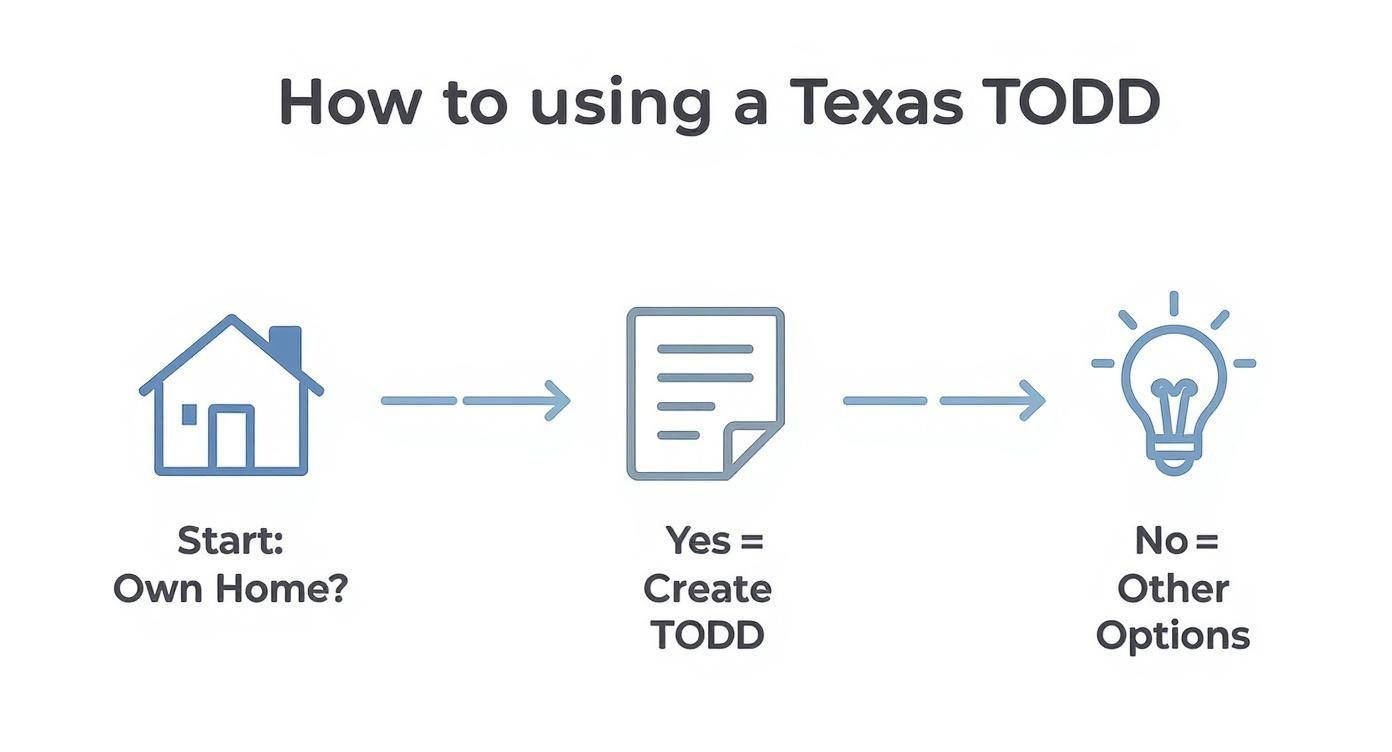
As you can see, specific tools are designed for specific assets. A complete plan requires a strategy for every part of your estate.
The Benefits of a Formal Creditor Process
This might sound counterintuitive, but sometimes, probate can be used strategically. If someone passed away with significant debts or potential liabilities—maybe from a business they owned in Humble or a recent car accident—probate provides a clear and final way to deal with creditors.
The formal probate process includes a specific procedure for notifying creditors and sets a strict deadline for them to file claims against the estate. Once that window closes, any unfiled claims are legally barred. Forever.
This provides an incredible form of closure. It allows the executor to settle all known debts and then confidently distribute the remaining assets to beneficiaries, knowing an old creditor can't emerge years later to cause trouble.
While a will is central to directing your wishes, it's the probate court that validates it. Understanding the difference between a will and a trust is crucial here, as a trust is the primary vehicle for keeping assets out of this court process.
Ultimately, the goal is always a smooth transfer of your legacy. For most families in our Kingwood community, this means avoiding probate entirely. But for some, a simplified or targeted probate proceeding is the most effective way to protect the estate and its beneficiaries. A local attorney with experience in these matters can help you navigate the nuances.
Connect With a Local Kingwood Estate Planning Lawyer
https://www.youtube.com/embed/p57ssSlj-pM
Navigating Texas estate law to protect your family can feel like trying to solve a puzzle in the dark. We've walked through some of the most effective strategies for how to avoid probate in Texas—from the flexibility of a living trust to the simplicity of a Transfer on Death Deed.
But knowing which tools to use, and how to combine them, is where things get tricky. The right mix depends entirely on your specific assets, your family dynamics, and what you want to achieve.
As a law firm with deep roots right here in the Kingwood community, we’ve seen firsthand what works for local families. Trying to DIY your estate plan can unfortunately backfire, leading to the exact court process you were trying to skip. A single overlooked bank account or an improperly worded deed can derail the whole thing.
The best estate plan isn't a template you find online. It's a custom-built strategy crafted by someone who understands the nuances of Texas law and, just as importantly, understands you. That's where true peace of mind comes from.
If you're in Kingwood, Porter, or anywhere in Northeast Houston, let's talk. I invite you to schedule a free, no-obligation consultation with our experienced estate planning team. We'll sit down, listen to your story, and map out a clear path to protect what you’ve worked so hard to build. We are your neighbors, and we're here to help.
Common Questions We Hear About Avoiding Probate in Texas
Even after putting a solid plan in place, it’s natural to have a few lingering questions. We see it all the time with our clients here in Kingwood. Getting clear on these details is what provides real peace of mind, so let’s walk through some of the most common concerns we hear from families across Northeast Houston.
Is a Will Enough to Keep My Estate Out of Court?
This is, by far, the most frequent question people ask, and the short answer is no. Think of a will as a set of instructions written for the probate court. In fact, a will guarantees probate—it’s the very document that gets the whole process started. The court's job is to make sure your will is valid and then supervise your executor as they carry out your wishes.
A will is an absolutely essential piece of a complete estate plan, but it won't keep your family out of the courthouse on its own. For that, you need other tools like trusts, beneficiary designations, or transfer-on-death deeds that move assets directly to your loved ones.
What if I Die Without Any Will at All?
Dying without a will—what the law calls dying "intestate"—also lands your estate squarely in probate court. The big difference? Instead of your wishes guiding the process, a judge will divide up your property based on a rigid, one-size-fits-all formula created by Texas law.
This almost always leads to results people wouldn't have chosen. Your property might get split in ways you never intended, leaving loved ones in a difficult position.
When you die without a will, you’re handing over all control to the state. A judge, not you, will decide who gets your assets, who raises your minor children, and who administers your estate. It's a scenario most families in Humble and Porter want to avoid at all costs.
Do I Still Need a Power of Attorney if I Have a Trust?
Yes, absolutely. A power of attorney and probate-avoidance tools handle completely different life events. Your will or trust only kicks in after you pass away.
A power of attorney, on the other hand, is a crucial document for managing your financial and medical affairs if you become incapacitated while you're still alive. Without it, your family could be forced into a costly and stressful guardianship proceeding just to get the authority to pay your mortgage or talk to your doctors. Our team can explain in detail what a power of attorney is and why it’s such a vital safety net.
These are just a handful of the questions we help Kingwood families work through every day. Every family’s situation is different, and the first step to building a secure future is getting clear, personalized answers.
At The Law Office of Bryan Fagan – Kingwood TX Lawyers, we believe every family deserves clarity and confidence in their estate plan. Don't leave your family's future to chance. Schedule a free, no-obligation consultation at our Kingwood office today by visiting us at https://kingwoodattorneys.com. We are local, experienced, and focused on helping our Kingwood neighbors protect their legacies.