Skip to content
It's a gut-wrenching moment for any Kingwood resident: you open the envelope, and the family court order inside feels completely wrong. If you're going to challenge that decision in Texas, your first step is filing a Notice of Appeal, and the clock is already ticking. You typically have just 30 days from the final judgment to act.
Crucially, an appeal isn't a do-over of your trial. You can't appeal simply because you are unhappy with the outcome; you have to prove the trial court made a significant legal mistake. This is a tough, technical process with unforgiving deadlines, but understanding your options right away is the key to protecting your family's future.
What to Do Right After an Unfavorable Ruling

When a judge in Harris or Montgomery County makes a call on your child's future, your property, or spousal support that seems to ignore the facts or the law, it's easy to feel defeated. For families we work with here in Kingwood, Humble, and across Northeast Houston, the first step toward taking back control is knowing what you can do immediately.
Let's be clear: an appeal is not a new trial. You don't get to bring in new evidence or rehash old arguments. What happens is a panel of appellate judges scrutinizes the trial record—everything that was said and filed—to see if the first judge made a "reversible error." This could mean they misapplied a section of the Texas Family Code or made a ruling that had absolutely no evidence to back it up.
Your Immediate Post-Judgment Options
Before you launch into a full-blown appeal, there's another path you need to consider: filing a Motion for New Trial. Think of it as asking the same judge who made the decision to take a second look and correct a mistake. The work that goes into this is just as serious as preparing for the initial trial itself, a process we detail in our guide on how to prepare for a custody hearing.
This can be a brilliant strategic move for our local clients. It gives the trial judge a chance to fix an error without the time and expense of going to a higher court. And here’s a critical bonus: filing a timely Motion for New Trial can extend your deadline to file a formal appeal from 30 days to a much more manageable 90 days, giving your legal team vital time to build the strongest possible case.
An appeal is about pointing out a legal or procedural mistake the judge made during the trial. It is entirely different from a modification, which is when you ask to change an order because your family's circumstances have significantly changed since the original ruling.
To help you see the fork in the road more clearly, here’s a simple breakdown of your two immediate choices after a bad ruling.
Immediate Options After a Texas Family Court Decision
The moments after receiving a judgment are critical. Here's a quick comparison of the two primary paths you can take immediately following an unfavorable family court decision in the Kingwood area.
| Action | Purpose | Typical Deadline in Texas | Best For |
|---|---|---|---|
| Motion for New Trial | Ask the original trial judge to reconsider and correct an error, potentially avoiding a full appeal. | 30 days after the final judgment is signed. | Situations where a clear error of fact or law can be quickly presented to the original judge. |
| Notice of Appeal | Formally begin the process of having a higher court review the trial judge’s decision for legal errors. | 30 days after the judgment (or 90 days if a timely Motion for New Trial was filed). | Cases where the trial judge is unlikely to reverse their decision or when the error is complex. |
Choosing the right path isn't a guessing game; it demands a careful, strategic analysis of what happened in your trial. Here at The Law Office of Bryan Fagan – Kingwood TX Lawyers, we sit down with Kingwood residents every day to weigh these choices. Let us help you understand your options and the best way forward. Schedule a free consultation at our Kingwood office today.
Understanding the Grounds for a Successful Appeal
So, you’ve just come from court in downtown Houston or Conroe, and the judge’s ruling feels completely wrong. It's a common feeling, and the first instinct for many folks here in the Kingwood area is to think, "I'll just appeal it." But it's crucial to understand that an appeal isn't a do-over. It's not a second chance to tell your story or present new evidence.
You can't appeal a family court decision simply because you're unhappy with it. The entire process hinges on one thing: proving the trial court judge made a significant legal mistake. The appellate court isn't there to re-weigh the evidence; they're there to review the trial record and see if the judge made an error in applying the law.
The Difference Between Disagreement and a True Legal Error
At the heart of any successful appeal is what lawyers call a "reversible error." This isn't a minor slip-up; it's a mistake so critical that it probably led to the wrong outcome. Let's look at what this actually means in a Texas family law case for a Kingwood family.
One of the clearest grounds for an appeal is a legal error. This is when the judge simply gets the law wrong—they misinterpret or misapply a specific part of the Texas Family Code.
- Practical Example: Imagine you owned a small business in Humble long before you ever got married. During your divorce, the judge classifies it as community property and orders you to split its value with your ex-spouse. That's a textbook misapplication of Texas separate property law and a very strong reason to appeal.
Another major ground is what's known as an abuse of discretion. Family court judges have a lot of latitude, or "discretion," especially when making decisions about what's in the best interest of a child. But that power isn't unlimited.
An abuse of discretion happens when a judge's ruling is so arbitrary or unreasonable that it has no basis in the facts or the law. It’s not just a decision you find unfair; it’s a decision that a neutral observer would find illogical.
For instance, if a judge in your Northeast Houston case drastically limits a parent’s time with their child without any evidence of danger, drug use, or neglect ever being presented in court, that could be an abuse of discretion. The ruling appears to be based on personal opinion rather than the facts on the record.
When an Appeal Isn't the Right Path
It’s just as important to recognize what doesn’t make for a strong appeal. Knowing this can save you an incredible amount of time, money, and heartache. We have these practical, honest conversations with clients in our Kingwood office all the time.
Generally, these situations are not solid grounds for an appeal:
- You don't like the possession schedule. A judge who orders a standard possession order, even when you pushed for a custom 50/50 schedule, is almost certainly acting within their discretion.
- The judge believed your ex's testimony over yours. The appellate court wasn't in the room. They give enormous weight to the trial judge's ability to assess who was more credible.
- You forgot to introduce a key piece of evidence. An appeal is strictly limited to what's in the trial record. You can't add new exhibits or call new witnesses later.
Finally, you can appeal if a key factual finding is not supported by sufficient evidence. If a judge bases their child support calculation on a finding that you are intentionally unemployed, but the trial record contains your pay stubs and employment contract proving you have a full-time job, that finding is factually unsupported. Proving a lack of sufficient evidence for a crucial part of the judge's ruling can be a powerful basis for an appeal.
Figuring out if your case contains a genuine, reversible error requires a fine-toothed comb and an expert eye on every page of the trial transcript and court filings. The team at The Law Office of Bryan Fagan is trained to do exactly that. Schedule a free consultation with us to get a straightforward analysis of whether you have legitimate grounds to challenge the court's decision.
Navigating Critical Deadlines and Initial Filings
When you're reeling from a family court decision that feels wrong, the last thing you want to hear is that a clock has already started ticking. But in the world of Texas appeals, that's exactly what happens. The system is built on a series of strict, unbending deadlines. For families here in Kingwood and across the Humble area, this is the first and most critical hurdle.
Miss just one of these deadlines, and your chance to appeal could be gone for good—no matter how strong your case is. This initial phase isn't about arguing your case; it's about following a precise procedural map where every step must be taken at the right time.
The Clock Starts Ticking Immediately
The moment a judge in Harris or Montgomery County signs that final order, the countdown begins. Generally, you have just 30 days to file a document called a Notice of Appeal. This is the official paper that tells the court and the other side that you plan to fight the ruling.
But there's a key strategic move that can buy you precious time. By filing a Motion for New Trial (or a similar post-judgment motion), you can push the deadline for your Notice of Appeal out to 90 days from the date the order was signed. That extra time is invaluable for gathering court records and preparing for the tough road ahead.
A Notice of Appeal is a straightforward, formal heads-up. It doesn't lay out your arguments—it simply gets the ball rolling and puts everyone on notice that an appeal is coming.
"Perfecting" the Appeal: More Than Just a Notice
Filing the Notice of Appeal is just the first step. You also have to "perfect" your appeal, which is a legal term for handling the administrative side of things. It's a series of small but non-negotiable tasks that, if missed, can get your case thrown out before a judge ever sees it.
This usually involves a couple of key things:
- Paying the Filing Fee: The court of appeals charges a fee to open a new case, and it must be paid on time.
- Filing an Affidavit of Indigence: If you can't afford the fees, you can submit a sworn statement about your financial situation. If the court approves it, your fees might be waived.
These are purely procedural steps, but the courts are unforgiving if they're overlooked. This is a common pitfall for people in Northeast Houston trying to handle an appeal on their own. They file the notice but don't realize these other small but essential requirements exist.
The infographic below shows the three fundamental grounds—legal error, abuse of discretion, and no evidence—that must exist for an appeal to even have a chance.
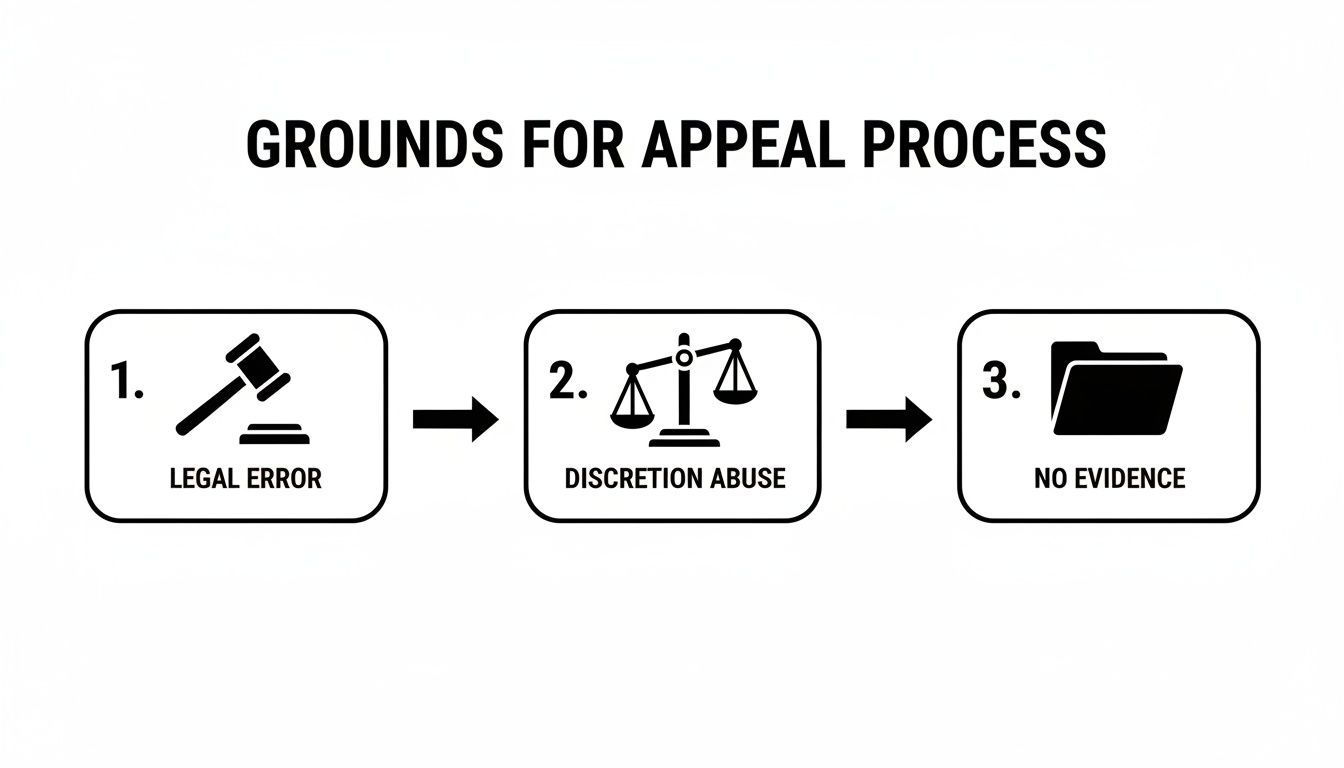
This just goes to show why you need a solid legal reason for appealing before you even start worrying about these tight deadlines.
The Importance of Getting the Procedure Right
Successful appeals demand two things: strict adherence to the procedural calendar and a strong legal reason for the challenge. While Texas deadlines are clear, it's worth noting that procedures can vary. Some states, for example, give you only 21 days just to ask the trial judge for permission to appeal. Ultimately, success always comes down to proving the trial judge made a serious legal mistake. You can learn more about how different procedural factors affect case outcomes by reading these insights on family court statistics.
Once your Notice of Appeal is filed and the fees are handled, you also have to make sure the other party is properly served with a copy. This formal step ensures everyone knows the trial court's order is being challenged.
This entire initial filing stage is a minefield of deadlines and rules. For people in Kingwood, Porter, and the surrounding areas, trying to manage this while dealing with the emotional weight of a bad court ruling is an enormous burden. One mistake can cost you everything.
At The Law Office of Bryan Fagan – Kingwood TX Lawyers, we handle these crucial first steps with the precision they require, making sure your right to appeal is protected from day one. Don't let a technicality sink your case. Schedule a free consultation with us at our Kingwood office, and let's make sure you get started on the right foot.
Building Your Case with the Appellate Record and Brief

Once you've navigated the initial flurry of deadlines for filing your notice, the real work of the appeal begins. This is where we move past the procedural hurdles and start building the actual argument that will be presented to the higher court. Your entire case now hinges on two crucial elements: the appellate record and the appellate brief.
For most folks in Kingwood and Northeast Houston, these terms are probably unfamiliar. Here’s a simple way to think about it: the appellate record is the official, complete story of what happened in the trial court. The appellate brief is where your lawyer uses that story to persuade the appellate judges that the trial judge got it wrong.
Assembling the Official Story of Your Case
One of the biggest misconceptions about appeals is that you get a "do-over" with new evidence. That's not how it works. The appellate court is restricted to reviewing only what was presented to the trial court judge in your original case, whether it was in Houston, Conroe, or another Harris or Montgomery County court.
This collection of documents, exhibits, and spoken testimony is what makes up the appellate record. It’s broken down into two main parts:
- The Clerk’s Record: This is a bound volume of every single document filed in your case—from the initial petition and motions to discovery requests, temporary orders, and, of course, the final judgment you’re appealing.
- The Reporter’s Record: This is the official, word-for-word transcript of everything said during your hearings and trial. The court reporter who was present during the proceedings is the one who prepares this.
Getting these records isn't automatic. You must file a formal written request with the district clerk for the clerk's record and a separate one with the official court reporter for the transcript. There are costs involved for both, but this step is absolutely mandatory. Without a complete record, you have nothing to show the appellate court.
Crafting Your Legal Argument in the Appellate Brief
After the full record has been compiled and delivered, the focus shifts to drafting the single most important document of your appeal: the appellate brief. This is no simple letter or summary. It’s a highly structured, persuasive legal argument that must pinpoint exactly how, where, and why the trial court made a reversible error.
A well-written brief is both a narrative and a rigorous legal analysis. It must guide the appellate judges through the facts of your case, point them to specific pages in the record to back up every claim, and then connect those facts to established case law to prove the judge’s mistake warrants overturning the decision.
The unbreakable rule of writing an appellate brief is this: if it's not in the record, it never happened. Every single assertion you make must be directly supported by a citation to a specific page and line in the clerk's or reporter's record.
A strong brief will always contain several key sections:
- Statement of the Case: A quick summary of the case and its journey through the court system.
- Issues Presented: The precise legal questions you are asking the court of appeals to resolve.
- Statement of Facts: A factual narrative where every sentence is tied directly to a source in the record.
- Argument: This is the core of the brief. Here, your attorney explains why the trial court's decision was legally incorrect, weaving together facts from the record and arguments based on statutes and prior court rulings.
- Prayer for Relief: A simple, direct statement asking the appellate court for a specific outcome, like reversing the decision and ordering a new trial.
The time and money that go into preparing the record and the brief are substantial, which is why appeals aren't undertaken lightly. For instance, the cost of the reporter's record alone can be significant, acting as a filter against appeals that don't have a solid legal basis. The evidence contained in that record often comes from the discovery process, which is why thorough work at the trial level is so critical.
Here at The Law Office of Bryan Fagan – Kingwood TX Lawyers, we want our clients in Kingwood and Northeast Houston to understand that appellate work is a specialized craft. It’s completely different from arguing in a trial court. It demands an attorney who can meticulously review a "cold" record, spot the subtle legal errors, and then build an airtight written case to convince a panel of seasoned judges. If you feel a significant error was made in your family law case, give us a call for a free consultation. We can help you determine if an appeal is the right path for you.
What Happens After You've Filed Everything? The Appellate Court's Decision
After the incredible amount of work that goes into preparing the record and writing a persuasive appellate brief, your case is finally in the hands of the appellate judges. For our clients here in Kingwood and Northeast Houston, this is often the hardest part—the waiting.
Once all the briefs are submitted, the clock starts. You might picture lawyers making dramatic speeches in a packed courtroom, but the reality of a Texas family law appeal is usually far more subdued.
Don't Count on an Oral Argument
One of the first things people ask is, "Do I get another day in court?" While oral argument is possible, it's definitely not guaranteed. In fact, most family law appeals in our area are decided "on the briefs."
This means the panel of appellate judges will make their final decision based solely on the written arguments and the official record you and your attorney so carefully put together. The court typically only sets a case for oral argument if it involves a new, unusual, or particularly complicated legal question that the judges want to discuss and clarify through live questioning.
The Three Potential Outcomes of Your Appeal
After the judges have reviewed all the materials, they will issue a formal written opinion explaining their decision. Your appeal can only end in one of three ways, and it’s crucial to understand what each one means for your family.
Here are the possibilities:
- Affirm: The appellate court finds that the trial court made the right call. If your judgment is affirmed, you've lost the appeal, and the original court order stands exactly as it was.
- Reverse: The appellate court agrees that a serious legal error was made and completely overturns the trial court's decision. This is a win.
- Remand: This is a bit of a hybrid. The appellate court identifies an error but sends the case back down to the original trial court with specific instructions on how to correct it.
It's important to know that a "reverse and remand" is much more common than an outright reversal. Let's say a judge in your Humble courthouse incorrectly characterized a piece of property as separate when it should have been community property.
The appellate court won't just redraw the property division themselves. Instead, they "remand" the case back to that same trial judge with instructions to re-evaluate that specific asset using the correct legal standard. This usually results in a new, limited hearing just on that single issue.
A Realistic Look at Your Chances
Taking on an appeal is a major commitment, so it's vital to be realistic about the odds. The entire legal system is built to uphold the finality of a trial court’s judgment, especially in family law, where stability for children and families is a primary concern.
Nationally, statistics on civil appeals show that only around 20-30% of decisions get overturned. While you can absolutely appeal a family court ruling, the procedural rules are unforgiving. You often have a very narrow window to file a notice of appeal, sometimes as little as 21 days after the judge signs the final order. You can find more data on the procedural side of these cases by looking at these family court statistics.
This isn't meant to discourage you from fighting an unjust outcome. It just underscores a critical point: a successful appeal must be built on a strong, identifiable legal error—not just on being unhappy with the result.
The road through an appeal is long, and the outcome is never a sure thing. But for families in our Kingwood community who have been wronged by a clear mistake of law, it's often the only way to get a fair result. If you feel your case was decided incorrectly, don't wait. Schedule a free consultation with our team at the Law Office of Bryan Fagan, and let us give you an honest, experienced assessment of your options.
Why You Absolutely Need an Experienced Appellate Attorney
Navigating a family law trial in Harris or Montgomery County is a battle. But taking that fight to an appellate court? That’s a whole different war, with a completely different set of rules. This isn't the time for a DIY approach. The appellate system is incredibly complex and unforgiving of even the smallest mistakes.
Think of it this way: a trial lawyer is a master storyteller, skilled at presenting evidence and questioning witnesses to persuade a judge or jury. An appellate attorney, on the other hand, is a legal scholar and a detective. Their job is to dive deep into the trial record—every single word of testimony, every exhibit, every motion—to pinpoint the precise legal errors that an appeals court will actually care about. Their weapons are exhaustive legal research and highly technical, persuasive writing.
A Completely Different Skill Set for a Different Court
The value of a seasoned appellate lawyer is hard to overstate. Trying to handle an appeal on your own is a recipe for disaster. The skills that win a trial are simply not the same ones that win an appeal. For an appeal, it's all about mastering the written argument and understanding the unique procedural maze of the appellate courts.
An appellate specialist brings a critical fresh perspective. They weren't in the emotional trenches of your original trial, so they can look at the case with complete objectivity, focusing strictly on the cold, hard facts in the record and how the law was applied (or misapplied).
Choosing the right legal partner is paramount. The skills that make a great trial lawyer are not the same ones that win an appeal. It's about finding someone with a deep understanding of appellate procedure and the ability to craft a compelling legal argument on paper.
Understanding how to choose the right divorce attorney from the very beginning can make a huge difference. But if you've received a ruling you believe is wrong and an appeal is on the table, you need a specialist.
For families in Kingwood, Humble, and the surrounding Northeast Houston area, you don't have to go it alone. The Law Office of Bryan Fagan – Kingwood TX Lawyers offers the dedicated, experienced appellate guidance you need to fight for the right outcome.
Don't let a procedural error sink your one chance to fix a bad court order. Contact our Kingwood office today to schedule a free, no-obligation consultation. We'll give you an honest, straightforward assessment of your case and your best path forward.
Answering Your Top Questions About Texas Family Court Appeals
If you’re considering an appeal, you're likely feeling overwhelmed by the technical rules and legal jargon. It's a complex process, and it's completely normal to have questions. Here in our Kingwood office, we hear the same concerns from families across the Northeast Houston area, so let's clear up a few of the most common ones with simple explanations.
Is an Appeal the Same Thing as a Modification?
This is a frequent point of confusion, but they are entirely different legal actions under Texas law.
An appeal is all about looking backward. You're essentially telling a higher court that the trial judge made a significant legal mistake in the original decision. You aren't arguing about new facts; you're arguing that the law was applied incorrectly based on the facts presented at the time.
A modification, on the other hand, looks forward. It's a request to change an existing order because life has changed. For example, if a Kingwood parent has lost their job and can no longer afford the current child support amount, they would file for a modification, not an appeal.
Can I Bring in New Evidence for My Appeal?
This is a hard and fast rule, and it’s a crucial one: No, you cannot introduce new evidence on appeal. The appellate court isn’t there to re-try your case. Its job is to review what already happened in the trial court.
The only things the higher court will look at are the official documents from your case file and the court reporter's transcript—a word-for-word record of everything that was said. This is why it’s so important to get everything on the record during the initial trial.
How Long is This Appeal Process Going to Take?
You'll need to be patient. A family law appeal isn't a quick fix. From the moment you file the Notice of Appeal to getting a final decision from the appellate court, you're realistically looking at a year, and sometimes even longer. The exact timeline depends on how complex the legal issues are, how busy the court is, and whether either side requests extensions.
A hard truth about appeals is that the odds are not stacked in your favor. Courts are generally hesitant to overturn a trial judge's decision. That’s why you absolutely must have a strong, identifiable legal error to stand on before investing the time and money.
To put it in perspective, while there are over a million divorces a year in the U.S., the success rate for highly contested family law appeals often sits around 15-20%. These complex cases can take over a year to resolve at the trial level, and an appeal easily tacks on another 6 to 12 months. You can learn more from these family law statistics.
Do I Still Have to Follow the Judge's Original Order During the Appeal?
Yes, absolutely. The judge’s order for child support, possession schedules, or anything else remains legally binding while the appeal is pending.
The only way to pause the order is if your attorney successfully petitions the court for a "stay" of enforcement, which is not always granted. Unless and until a stay is in place, you must continue to follow every part of the original order.
The appellate process is a legal minefield where a single misstep can doom your case. Don't gamble with your family's future by trying to navigate it alone. At The Law Office of Bryan Fagan – Kingwood TX Lawyers, we have the specialized experience to build the strongest possible case for your appeal. We are a local firm focused on helping our Kingwood neighbors. Schedule a free, confidential consultation at our Kingwood office today by visiting us at https://kingwoodattorneys.com.