Skip to content
When you realize your co-parent is deliberately turning your child against you, it’s a uniquely painful and frustrating experience. For parents in Kingwood, Humble, and the surrounding Northeast Houston area, the big question isn't just if it's happening, but how you can actually prove parental alienation in a Texas family court. It's a tough road, but it's one you must walk to protect your child and your rights as a parent.
What Texas Courts Consider Parental Alienation
In Texas, and specifically in the family courts of Harris and Montgomery Counties, you won’t find a law that uses the exact term "parental alienation." Instead, judges look for a clear pattern of behavior that goes against the best interest of the child. This is the guiding principle for every custody ruling in Texas.
Parental alienation isn't about a child being mad at you after a disagreement or going through a phase of preferring the other parent. It's a calculated, systematic campaign of psychological manipulation designed to sever your parent-child bond.
Distinguishing Alienation from Normal Conflict
Every co-parenting relationship has its share of friction, especially for families navigating life after a divorce in Northeast Houston. Kids get upset. They might say they don't want to come over. Texas judges have seen it all, and they know the difference between typical family drama and genuine alienation.
What gets a court's attention is a persistent, deliberate effort to sabotage your relationship with your child. It's a pattern of poisoning the well, and we see the heartbreaking results in our Kingwood office all too often.
Some of the most common red flags include:
- Constantly bad-mouthing you to your child.
- Blaming you for the divorce or money troubles, forcing the child to take sides.
- Routinely interfering with your court-ordered visitation or phone calls.
- Sharing inappropriate details about the custody case with the child.
- Making your child feel guilty for having a good time with you.
This isn't a rare problem. National surveys show that around 22.2 million adults in the U.S. feel they've been the target of these alienating behaviors. It's estimated that this affects as many as 3.9 million children to a moderate or severe degree.
The most important thing for Kingwood parents to understand is that courts need more than hurt feelings or a few isolated incidents. They need to see a clear, documented pattern of harmful behavior that directly threatens the child’s well-being and your parent-child bond.
The Impact on Custody and Your Rights
When a judge is presented with credible, compelling evidence of this manipulation, they have a duty to protect the child. This is where your documentation becomes absolutely crucial. A finding of parental alienation can dramatically shift the outcome of a custody case right here in Texas.
Depending on how severe the situation is, a judge might order reunification therapy, change the possession schedule to give you more time, or, in the most serious cases, completely change who has primary custody. In fact, proving parental alienation can be a powerful argument when you're looking into how to get sole custody in Texas.
Building a case is about showing the court, piece by piece, that the other parent's actions are a direct threat to your child's mental and emotional health. Here at The Law Office of Bryan Fagan in Kingwood, we help local parents do exactly that, providing trusted representation right in your community.
How to Build a Rock-Solid Case for Parental Alienation
When you’re trying to prove parental alienation, shifting from a gut feeling to hard evidence is everything. A Texas family court, whether you’re in Houston or Humble, runs on facts. Your personal conviction that your child is being turned against you, no matter how certain you are, simply won’t be enough.
You need to build a case with clear, organized, and undeniable proof that tells a consistent story. This isn't about collecting a few angry text messages. It's about systematically documenting a pattern of behavior that is actively harming your child. It takes patience and a thick skin, but it’s the most powerful way to protect your relationship.
The core of your strategy comes down to three things: showing the behavior, establishing a pattern, and proving the impact.
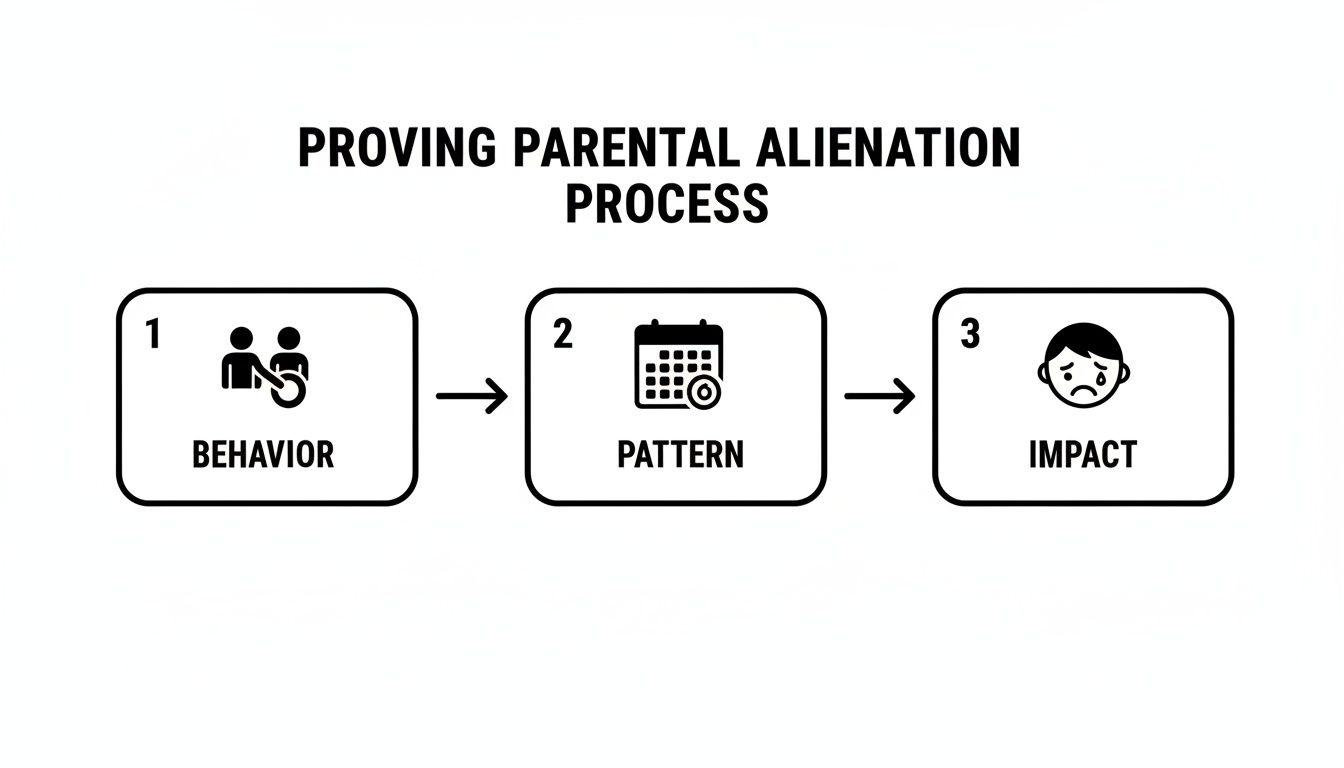
As you can see, a judge might dismiss a single incident. But a documented pattern of those same actions starts to reveal intent and makes the harm impossible to ignore.
Step 1: Start a Communication Log Yesterday
Your first and most important tool is a detailed log of every single interaction. Think of it less like a diary of your feelings and more like a fact-based record for the court. Grab a spreadsheet or a dedicated journal and start tracking everything related to your child.
For every single entry, you need to note:
- Date and Time: Be exact. This is how you build a timeline.
- Method: Was it a text, an email, a phone call, or face-to-face?
- The Gist: Stick to the facts. For example: "7:15 PM: Received text from co-parent. Stated child was suddenly 'too sick' for my scheduled weekend."
- Your Reply: Show that you were reasonable. For example: "7:20 PM: Responded asking if child needed a doctor. Offered to pick them up in the morning if they felt better. Got no reply."
Over time, this log paints a powerful picture of interference that a judge can’t easily dismiss.
Step 2: Save Every Digital Crumb
So much of this evidence is going to be digital. You have to preserve it correctly. Just leaving texts on your phone is a huge mistake—phones get lost, broken, or upgraded.
Take screenshots of every relevant text, social media comment, or email. And we mean every single one. Make sure the date and time are clearly visible. Create a folder for these on your computer and immediately back it up to a cloud service like Google Drive or Dropbox. This digital paper trail is your best friend when the other parent tries to deny what they said.
A crucial tip for Kingwood parents: Courts need to see specific, measurable behaviors. Vague complaints like "they're turning my child against me" get you nowhere. You need to show the judge precisely what was said and when.
A text message that reads, "Don't bother calling tonight, [Child's Name] doesn't want to talk to you," is a smoking gun. It’s a perfect piece of evidence showing direct interference. This is exactly the kind of documentation you need. Later on, the legal process of discovery can be used to formally request these records. You can learn more about what discovery in a divorce entails in our detailed guide.
Step 3: Keep a Private Journal of Your Child’s Behavior
Watching your child’s behavior change is the most heartbreaking part of this process, but it's also crucial evidence. The key here is to be discreet and sensitive. You never want your child to feel like they’re a pawn in a legal fight.
In a private journal, jot down:
- Parroted Phrases: If your child starts repeating negative things about you that sound like they came straight from an adult’s mouth, write them down word-for-word. Think: "Mommy says you don't send enough money for us to have fun."
- Sudden Anxiety: Note any new or escalating anxiety your child shows before coming to your house or after returning to the other parent.
- Unexplained Hostility: Document those moments when your child is suddenly cold, angry, or withdrawn for no apparent reason, especially if it’s a complete departure from their normal, loving self.
Research has identified dozens of alienating tactics. One study found 30 different behaviors, and a shocking 25% of targeted parents reported experiencing at least 20 of them. These actions range from badmouthing and limiting contact to completely distorting a child's memories. This is why documenting every little behavioral shift is so vital.
Step 4: Get Backup From Third Parties
Sometimes, the most powerful proof comes from people with no skin in the game. Neutral, third-party observers who see your child regularly can provide objective accounts that back up everything you’re claiming.
Think about the people in your child's life right here in the Northeast Houston area:
- Teachers or counselors in Humble ISD
- Coaches for their sports teams in Kingwood or Porter
- Family friends, neighbors, or relatives who have witnessed troubling comments or behaviors
Politely ask if they'd be willing to provide a written statement or even testify about what they've seen. A note from a teacher mentioning your child is suddenly withdrawn and sad every Monday morning provides powerful, objective support for your case.
Building this mountain of evidence is exhausting, we know. But it’s the absolute foundation of your legal strategy. At The Law Office of Bryan Fagan in Kingwood, we understand how draining this fight is. We’re here to help you get organized, build a strong case, and protect what matters most.
Bringing in the Experts for Your Kingwood Custody Case
While the detailed records you keep are the bedrock of your case, sometimes a judge needs more to see the full picture. Proving parental alienation can be an uphill battle, and that's where the objective, professional opinion of a neutral third party can change everything.
In a Texas family court, an expert witness can cut through the emotional noise, analyze the complex dynamics, and give the judge an unbiased assessment of what's truly happening with your child. All that hard work you put into your evidence log gives these professionals the history and context they need to understand the pattern of behavior.
For many of our clients in Kingwood and Northeast Houston, hiring an expert feels like a massive, overwhelming step. But we've seen firsthand how it can be the single most crucial move you make to protect your relationship with your child. A seasoned Kingwood family law attorney is your guide here, helping you determine which expert is right for your specific situation and petitioning the court to get one appointed.

What is a Child Custody Evaluator?
Think of a Child Custody Evaluator as a neutral investigator for the court. Under Texas law, this is a mental health professional, appointed by the judge, whose entire job is to dig deep into your family's situation and recommend what they believe is in your child's best interest.
And when we say "dig deep," we mean it. The evaluator will interview you, your co-parent, your child, and often other key people like teachers, doctors, or new partners. They will pour over the evidence you've meticulously collected—those communication logs, text messages, calendars, and third-party reports.
Their real skill lies in identifying the subtle, often manipulative, patterns of behavior that define parental alienation. These are things a judge, with a packed docket, simply might not have the time or training to spot. The evaluator’s final, comprehensive report is submitted directly to the court, and it carries immense weight. It’s an expert opinion that can validate your concerns with professional authority.
Therapists vs. Court-Appointed Experts
It’s incredibly easy to get the various professional roles confused, but the distinctions are critical in a legal setting.
- Your Child's Therapist: This person is focused on your child's ongoing mental health. Their sessions are confidential, and their primary duty is to their patient—your child—not to your court case. They generally cannot be compelled to testify or provide records in Texas.
- Reunification Therapist: This is a specialist brought in after a court often finds that alienation has occurred. Their specific mission is to repair the damaged parent-child bond. Their work is structured, therapeutic, and focused on rebuilding trust and healthy communication.
While your child's regular therapist is off-limits as a witness, a reunification therapist's progress reports can become powerful evidence, showing both the impact of the alienation and the potential for healing.
A huge mistake we see Kingwood parents make is thinking they can just ask their child's regular therapist to write a letter for the court. In Texas, this is a non-starter. Courts rely on unbiased experts appointed specifically for the legal case, not professionals who already have a confidential therapeutic relationship with the child.
The Role of an Amicus Attorney or Guardian ad Litem
In particularly difficult and high-conflict cases in Texas, a judge might appoint an Amicus Attorney or Guardian ad Litem (GAL). This is an attorney whose only client is your child. Their job is to represent the child's best interests to the court.
Essentially, they act as the court's eyes and ears. An Amicus Attorney will conduct their own thorough investigation, much like a custody evaluator. They talk to everyone, review all the documents, and observe you and your co-parent interacting with your child.
They then provide a formal report and recommendation to the judge on custody, possession, and access. For a parent in Humble or Porter fighting an uphill alienation battle, a good Amicus Attorney can be a game-changer. They are trained to see past the drama and get to the truth of what the child is experiencing. Their independent voice can be the very thing that gives the judge the confidence to take decisive action.
To help clarify these roles, here’s a quick breakdown of the key professionals you might encounter.
Key Professionals in a Parental Alienation Case
| Professional | Role in Your Case | What They Provide to the Court |
|---|---|---|
| Child Custody Evaluator | A neutral mental health expert who conducts a deep-dive investigation into the family's dynamics and well-being. | A comprehensive written report with findings and a specific recommendation on custody and possession for the child's best interest. |
| Reunification Therapist | A specialized therapist tasked with repairing the damaged parent-child relationship after alienation is identified. | Progress reports and professional opinions on the therapy's effectiveness and the child's emotional state. |
| Amicus Attorney / GAL | A court-appointed attorney who acts as the "eyes and ears of the court," representing only the child's best interests. | An independent legal recommendation on what custody arrangement would best serve the child, based on their own investigation. |
These professionals all have unique and powerful roles to play. They are strategic assets that can provide the clarity and authority needed to protect your child.
Bringing these experts into your case is a formal legal process. Having an experienced Kingwood family law attorney from The Law Office of Bryan Fagan on your side is essential to ensure the right professionals are appointed and that their findings are presented effectively in court. Schedule a free consultation with us today to figure out the best path forward for your family.
How to Present Your Evidence in Court
You’ve done the hard work. You’ve saved every text, logged every missed visit, and documented every single concerning comment. For a parent in Kingwood, this mountain of evidence is your voice in a Texas family court. But having all the pieces is one thing; putting them together to tell a clear, compelling story is another entirely.
How you present this evidence in front of a judge can literally make or break your case. This isn't the time for emotional outbursts or fumbling through disorganized stacks of paper. The goal is to present a calm, logical, and fact-based narrative that shows a clear pattern of alienation. You need to prove you are the stable, reasonable parent focused solely on your child's well-being.
Crafting a Persuasive Courtroom Narrative
A judge in Harris or Montgomery County is tasked with one thing: determining the best interest of your child. Your job, alongside your attorney, is to make the truth as easy as possible for them to see. This means organizing your evidence into a coherent timeline that lays out the other parent’s systematic campaign.
Our Kingwood legal team recommends organizing everything chronologically. Start with a simple summary sheet listing key events. Then, create a binder with tabbed sections for each type of proof:
- Communications: Texts and emails, printed and organized by date.
- Visitation Log: A clean record showing every scheduled visit and the specific reason for any cancellations.
- Witness Statements: Written declarations from teachers, coaches, or family members who have seen things firsthand.
- Child's Behavior Journal: Your private notes on specific comments your child has made or shifts in their behavior.
This structured approach transforms a messy box of records into a powerful story of interference. When you can point to a text from May where your ex interfered with a holiday, followed by a journal entry in June where your child repeated a hurtful phrase, and then a note from a teacher in July about your child’s sudden anxiety, a judge starts to see the undeniable pattern.
Your testimony should be calm, concise, and centered on the facts and the impact on your child. A judge is far more persuaded by a parent who says, "After these calls were blocked, my son began having nightmares," than by one who simply says, "My ex is a monster."
Delivering Your Testimony with Confidence
Standing before a judge is intimidating for anyone. The key is to remain composed and credible because, in a way, your demeanor is also a form of evidence. An emotional, angry outburst can unintentionally sabotage your carefully prepared case, making you seem like part of the conflict.
Here are a few practical, step-by-step tips we give our Kingwood clients before they testify:
- Stick to the Facts: Answer only the question you are asked. Don't volunteer extra information or get sidetracked by your own hurt and anger. Let the evidence do the talking.
- Use Your Logs: Refer to your notes. It's perfectly fine to say, "Your Honor, according to my log from that date…" This shows you are prepared, organized, and reliable.
- Focus on the Child: Frame everything in terms of your child's best interest. Instead of "She sabotaged my weekend," try something like, "My daughter missed out on her planned weekend with me because she was told I was too busy to see her, which wasn't true."
- Stay Respectful: Never, ever bad-mouth the other parent in court. Let the evidence speak for itself. Your respectful conduct reinforces your position as the stable, thoughtful parent.
Thorough preparation is the best medicine for courtroom nerves. Before your day in court, it’s critical to understand exactly what to expect. That’s why we created a guide on how to prepare for a custody hearing in Texas, which offers practical steps to help you feel ready.
Avoiding Common Courtroom Mistakes
So many parents with strong cases have weakened them by making avoidable errors. One of the most damaging mistakes is trying to involve your child in the legal proceedings. A Texas judge will almost never allow a child to testify against a parent, as it puts them in an impossibly traumatic position. Pushing for it can backfire badly, making you look like you don't understand your child's emotional needs.
Another pitfall is relying on a single, dramatic piece of evidence. While a "smoking gun" text is definitely helpful, judges are looking for a consistent pattern over time. Your case is a movie, not a snapshot. It's the relentless, day-in-day-out interference that truly proves parental alienation.
Presenting a strong case is a skill. At The Law Office of Bryan Fagan in Kingwood, we don't just help you gather evidence—we help you build a compelling narrative and present it with the confidence and clarity that a Texas court demands.
Why This Fight Matters for Your Child's Future
The journey to prove parental alienation is emotionally and financially draining. For any parent in Kingwood, Humble, or the surrounding communities, we know there will be days you feel overwhelmed and question if the fight is even worth it. In those moments, it's critical to remember what’s truly at stake—this isn’t just about winning a legal battle; it's about protecting your child’s entire future.

This legal struggle is a profound act of parental protection. You are standing up for your child's fundamental right to have a healthy, loving relationship with both parents, free from manipulation and emotional harm.
Understanding the Long-Term Damage
Parental alienation isn't a temporary problem that will just fade away. The psychological damage it causes can cast a long shadow over a child’s life, creating deep-seated issues that follow them straight into adulthood. The constant emotional manipulation they endure often leads to significant mental health challenges down the road.
The consequences are severe and well-documented. Research shows that children experiencing parental alienation have higher rates of crime, school dropout, substance abuse, depression, and anxiety—scars that often last a lifetime. What's especially troubling is the generational echo; these toxic childhood experiences frequently lead to a repetition of similar unhealthy patterns in their own adult relationships.
This isn't about blaming your child for their hostility or withdrawal. It's about recognizing their behavior is a symptom of a much deeper problem.
By taking legal action, you are not escalating a conflict; you are intervening to stop a destructive cycle. You are fighting for the person your child was meant to become—someone who can form healthy, trusting relationships throughout their life.
Reframing Your Fight as an Act of Protection
Seeing this legal process as an act of protection, rather than just a conflict, can give you the strength to keep going. Every text message you save, every note you make, and every court appearance is a step toward securing a healthier future for your child. It is a fight to preserve their emotional well-being and their ability to love freely.
For parents here in the Kingwood and Porter areas, this is about so much more than your visitation schedule. It's about ensuring your child doesn't grow up believing that half of who they are is "bad" or unlovable.
This fight is for them. It's for:
- Their right to an untainted, loving memory of their childhood.
- Their ability to build secure and healthy attachments in the future.
- Their mental health, self-esteem, and overall well-being for decades to come.
Taking decisive legal action is the most powerful statement you can make that you will not stand by while your child's emotional health is compromised. You are their advocate and their defender, especially when they can't see it themselves.
The road ahead is challenging, but you don’t have to walk it alone. The Law Office of Bryan Fagan is here to support Kingwood families through these incredibly difficult times. We understand what you're fighting for. Schedule a free, confidential consultation at our Kingwood office to discuss how we can help you protect your child's future.
Got Questions About Proving Parental Alienation? You're Not Alone.
Navigating a parental alienation case can feel like walking through a minefield. For parents here in Kingwood and Northeast Houston, it’s completely normal to feel overwhelmed and unsure of where to turn. Let's tackle some of the most pressing questions we hear from local parents just like you.
Will My Child Have to Testify in Court?
This is a huge source of anxiety, and for good reason. The short answer is: almost certainly not. Judges in Harris and Montgomery counties go to great lengths to avoid putting a child on the witness stand. The emotional toll is just too high.
Instead of subjecting your child to that kind of pressure, the court has other ways to hear their perspective. A judge will almost always rely on neutral, specially trained professionals to get the real story. This is usually done through:
- A Guardian Ad Litem (GAL) or Amicus Attorney: This is an attorney appointed by the court whose only job is to represent your child’s best interests.
- A Child Custody Evaluator: This is a mental health professional who conducts a deep-dive investigation into the family dynamics and makes a recommendation to the court.
These professionals can interview your child in a safe, low-stress environment and then report their findings. This keeps your child out of the courtroom crossfire while ensuring their voice is still heard.
How Much Evidence Is Enough?
It's tempting to think you need a mountain of evidence, but that's a common misconception. When it comes to proving parental alienation, quality and consistency are far more important than sheer quantity.
One dramatic, nasty text message might feel like a smoking gun, but a judge is much more likely to be convinced by a clear, documented pattern of behavior over several months. Think of it this way: your goal isn't to dump a disorganized box of papers on the judge's bench. It's to tell a clear, chronological story. A well-organized log showing ten separate instances of canceled visits or blocked calls tells a much more powerful story than one single, angry email.
Is It Really Alienation, or Does My Child Genuinely Not Want to See Me?
This is the toughest question of all, and it requires some painful, honest self-reflection. There’s a legal difference between parental alienation and what’s called justified estrangement.
Justified estrangement happens when a parent’s own actions—maybe past struggles with addiction, anger, or neglect—have legitimately harmed the relationship. In that situation, a child's reluctance to see you is a direct result of that history, not manipulation by the other parent.
Parental alienation is different. It’s when a child’s rejection of you is completely unfounded and is clearly being fueled by the other parent's negative campaign. A tell-tale sign is when your child’s reasons for being angry seem flimsy, irrational, or sound like they’re just repeating adult phrases they’ve overheard. If you once had a great bond that suddenly deteriorated for no logical reason, alienation is a very real possibility.
Can I Legally Record Conversations in Texas?
We get this question all the time from our Kingwood clients. Texas is a "one-party consent" state, which is good news for you. It means you can legally record any phone call or in-person conversation that you are a part of without telling the other person. This can be a useful tool for documenting conversations with your co-parent.
A word of extreme caution: Recording your child without the other parent’s knowledge is a legal and ethical minefield. This can backfire on you in a spectacular way. A judge could easily see this as you manipulating your child and putting them in the middle of the conflict—the very behavior you’re accusing the other parent of.
Before you even think about hitting the record button on your phone, you absolutely must speak with an experienced Kingwood family law attorney. The risks are huge, and there are often safer, more effective ways to get the proof you need.
Fighting to protect your relationship with your child is one of the most important battles you'll ever face, but you don't have to do it by yourself. The dedicated team at The Law Office of Bryan Fagan – Kingwood TX Lawyers is here to offer the clear guidance and strong legal support you need. We know exactly what's at stake for your family, and we're ready to stand with you. Schedule a free, confidential consultation with us today by visiting our Kingwood family law website.