
When you're facing a divorce, a tidal wave of questions about your financial future is completely normal. The word "alimony" gets thrown around a lot, but for families here in Kingwood, it's important to know that Texas law works differently. We call it spousal maintenance, and the law treats it as a temporary safety net, not a lifelong entitlement. It’s designed to help a spouse get back on their feet financially after the divorce is final.
At The Law Office of Bryan Fagan, we understand the stress that comes with financial uncertainty. Our Kingwood office is dedicated to providing clear, empathetic guidance to our neighbors in Northeast Houston, helping you understand your rights and options.
What Texas Law Says About Alimony
For families here in Kingwood and across Northeast Houston, getting a grip on Texas's unique approach to post-divorce support is the first step toward feeling in control. Forget what you see in the movies; Texas law is intentionally strict about ordering one person to pay another after a divorce. The whole system is built to encourage financial independence, and fast.
You might be surprised to learn that Texas historically banned permanent, court-ordered alimony altogether. This was tied to our community property laws, which aim for a fair division of the marital estate right from the start. While the law now allows for limited spousal maintenance, it's never a given.
Dispelling Common Myths
It's easy to get the wrong idea based on how other states handle this. Let's clear up a few common myths for our neighbors in Humble and Porter:
-
Myth: Alimony is automatic in every divorce.
-
Reality: Far from it. Court-ordered spousal maintenance is actually quite rare in Texas. The spouse asking for it has to prove they meet very specific legal requirements. A judge can't order it simply because one person makes more money.
-
Myth: Spousal maintenance lasts forever.
-
Reality: By law, court-ordered support is temporary. The duration is capped based on how long you were married, typically topping out at five, seven, or ten years.
-
Myth: Maintenance is meant to equalize lifestyles.
-
Reality: This is a big one. The legal standard in Texas is only to provide for a spouse's "minimum reasonable needs." It is not designed to maintain the lifestyle you had during the marriage.
The heart of Texas spousal maintenance is simple: it's a short-term financial bridge. It gives a spouse the breathing room to get the skills or find the job they need to stand on their own two feet.
To help our Kingwood clients see the big picture quickly, here's a simple breakdown of the core rules.
Texas Spousal Maintenance at a Glance
This table offers a quick summary of court-ordered spousal maintenance rules for our Kingwood clients.
| Concept | Key Detail in Texas Law |
|---|---|
| Legal Term | Spousal Maintenance (not "alimony") |
| Primary Goal | To meet the receiving spouse's "minimum reasonable needs" |
| Eligibility | Requires meeting strict criteria, often involving a long-term marriage (10+ years) and a lack of earning ability. |
| Duration | Temporary and strictly limited by law, usually capped at 5, 7, or 10 years based on marriage length. |
| Payment Amount | Capped at $5,000 per month or 20% of the paying spouse's average monthly gross income, whichever is less. |
| Not Guaranteed | It is the exception, not the rule. The requesting spouse has the burden of proof. |
This is just a starting point, of course, as every family's situation has its own unique details that a judge will consider.
Working through the details of a divorce demands a clear-eyed view of your rights and the realities of Texas law. The rules around spousal maintenance are a crucial part of the overall divorce process in Texas. If you're in the Kingwood area and have questions about what your financial future might look like, our team is here to give you the straightforward, practical advice you need.
How Do You Qualify for Spousal Maintenance in Texas?
Let's get one thing straight: getting a judge to order spousal maintenance in Texas isn't a given. It’s a common misconception, probably fueled by movies and TV shows, that a judge can just grant support because one spouse made more money. That's not how it works here in Harris County.
The law sets a high bar. To even be considered, you have to prove two crucial things. First, you must show the court that after the divorce, you won't have enough property (including your separate property) to cover your "minimum reasonable needs." Second, you have to meet at least one of several specific conditions laid out in the Texas Family Code.
Think of it as a two-part test. You have to pass both parts, not just one.
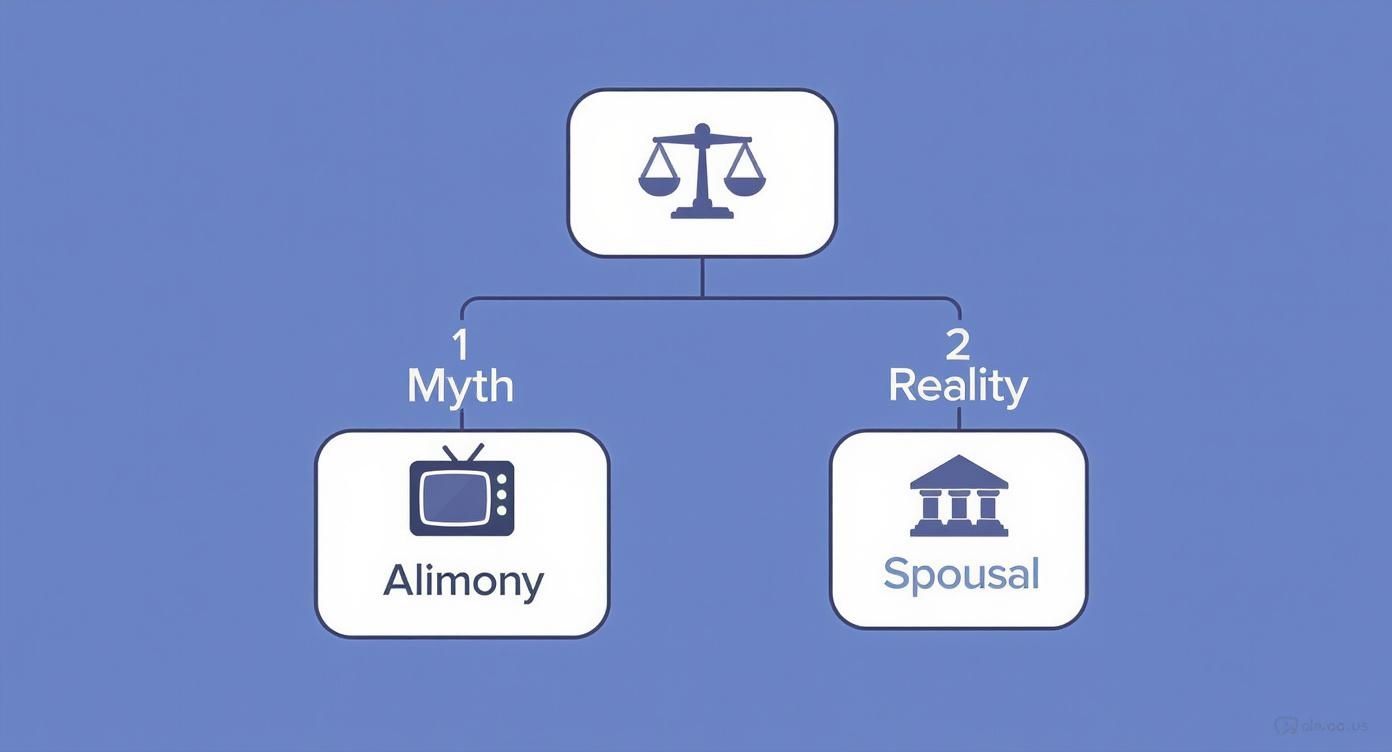
This visual really drives home the difference. Texas law moves away from the dramatic, lifelong alimony payments you might see on TV and instead focuses on a structured, needs-based system with some very strict rules.
The 10-Year Marriage Rule
The most common way people qualify for spousal maintenance is through what everyone calls the 10-year marriage rule. For many families going through a divorce in Northeast Houston, this is the starting point.
Here is a step-by-step guide to meeting this standard:
- Prove the Marriage Duration: You must first prove your marriage has lasted for 10 years or longer.
- Demonstrate Diligent Effort: Next, you must show that you've made a real, diligent effort to either earn enough income or develop the skills needed to provide for your own minimum reasonable needs.
That second part is key. A Kingwood court wants to see that you're actively trying to become self-sufficient. You can’t just sit back and wait for a check. You’ll need to show that you’ve been job hunting, taking classes, or getting training to get back on your feet.
Imagine a stay-at-home parent in Porter who's been out of the workforce for 15 years. They might qualify if they can show they've been applying for jobs or enrolled in a certification program but still can't make ends meet. The combination of their long-term marriage and their proactive efforts is what builds a strong case.
The Family Violence Exception
The law also recognizes that some situations are far more serious and don't fit neatly into the 10-year box. Texas provides a critical exception for victims of family violence, which completely removes the 10-year marriage requirement.
You could be eligible for spousal maintenance, no matter how long you were married, if your spouse was convicted of (or received deferred adjudication for) a criminal act of family violence.
This act of violence must have been committed against you or your child. It also must have happened within the two years before you filed for divorce or while the divorce was ongoing.
This is an essential protection. For someone in a shorter marriage who has endured domestic abuse, this exception offers a vital path to the financial stability they need to leave a dangerous situation and rebuild their life.
Other Qualifying Circumstances
While the 10-year rule and the family violence exception are the most frequent paths, the Texas Family Code does outline a couple of other specific scenarios.
- Disability of the Requesting Spouse: If you have an incapacitating physical or mental disability that keeps you from earning enough to cover your basic needs, you may be eligible.
- Caring for a Disabled Child: You may also qualify if you are the primary custodian of a child from the marriage (of any age) who has a physical or mental disability requiring such substantial care and supervision that it prevents you from holding a job.
Trying to figure out these eligibility rules can be overwhelming, especially when you're already navigating the emotional turmoil of a divorce. If you're in the Kingwood or Humble area and wondering if you qualify for alimony in Texas, our local attorneys are here to help. Schedule a free, confidential consultation at our Kingwood office, and we'll walk you through your options to help you protect your financial future.
Calculating Spousal Maintenance Payments and Duration
So, a Harris County judge has agreed you're eligible for spousal maintenance. That's a huge step, but it immediately leads to the two most pressing questions: how much will I get, and for how long? For our clients in Kingwood and the surrounding communities, getting clear answers here is the key to building a stable financial footing after a divorce.
Texas law doesn't leave these things to chance. There's a specific framework in place that puts hard limits on both the dollar amount and the timeline for these payments. This isn't about punishing one spouse or creating a life-long dependency; it’s about providing essential, temporary support while one person gets back on their feet.

The Legal Caps on Payment Amounts
First things first, Texas puts a firm ceiling on how much spousal maintenance can be ordered. This provides a measure of predictability for everyone involved—you know the absolute maximum that can be awarded, regardless of how wide the income gap is.
The monthly payment is legally capped at the lesser of two numbers:
- $5,000 per month, OR
- 20% of the paying spouse's average monthly gross income.
Let's see how that plays out for a family in Northeast Houston. Say a spouse brings in an average gross income of $15,000 a month. Twenty percent of that is $3,000. Since $3,000 is less than the $5,000 cap, the most a judge could possibly award is $3,000 per month.
Now, what if that same spouse earned $30,000 a month? Twenty percent comes out to $6,000. In this case, the $5,000 statutory cap kicks in, making that the maximum possible award.
Factors a Judge Considers
That cap is just the ceiling—it's not the automatic award amount. A judge has the discretion to award less, and they'll look at a whole host of factors to decide what's fair and just for your specific situation. It’s a holistic review, not just a math problem.
Some of the key things a judge will weigh include:
- What financial resources each spouse has left after the property is divided.
- The education and job skills of both spouses.
- How much time the requesting spouse needs to get the training or education to find a decent job.
- The age, work history, and physical and emotional health of the spouse asking for support.
- Any marital misconduct by either spouse, like adultery or cruelty.
- The contributions one spouse made to the other’s education or career.
A judge’s decision is never based on just one thing. They weigh all these elements together to craft an order that reflects the reality of your family's life, aiming for an outcome that's equitable for both people.
Strict Time Limits on Duration
Just like the payment amount, the duration of spousal maintenance is also tightly controlled by law. The single biggest factor here is how long you were married. This reinforces the core principle that alimony in Texas is meant to be a temporary bridge, not a permanent arrangement.
The Texas Family Code sets these maximum time limits:
- Five Years: For marriages lasting at least 10 years but less than 20 years. This also applies if eligibility was based on family violence, even in shorter marriages.
- Seven Years: For marriages lasting at least 20 years but less than 30 years.
- Ten Years: For marriages lasting 30 years or more.
Remember, these are the absolute maximums. A judge can—and often will—order maintenance for a shorter period if they believe it’s appropriate. The only real exception to these time limits is in rare situations where a spouse has a serious, incapacitating disability or is caring for a disabled child of the marriage, making it impossible to become self-supporting.
Facing a divorce in Humble or the Kingwood area is stressful enough without financial guesswork. Understanding how spousal maintenance is actually calculated can bring some much-needed clarity. If you have questions about what to expect, our Kingwood attorneys can give you a straightforward assessment based on your unique circumstances. Schedule a free consultation with us today.
The Court Process for Requesting Maintenance
https://www.youtube.com/embed/SB7Vmm5iPno
Going to court to ask for spousal maintenance can feel overwhelming, but knowing the steps involved can make a world of difference. For our clients here in Kingwood, we provide a step-by-step process that follows a clear path from the initial divorce filing all the way to a final hearing. Let’s break it down so you know what to expect.
- File the Initial Petition: A request for spousal maintenance isn’t a separate lawsuit—it’s a key part of your divorce case. It all starts when you officially ask for support in your Original Petition for Divorce. This is the first legal document you file, and it’s what puts all the issues, including financial support, on the table.
- Notify Your Spouse and the Court: Filing this petition is a critical first move. It formally notifies your spouse and the court that you're seeking financial help.
- Gather Evidence: From that point forward, both sides will start gathering the evidence needed to build their arguments.
Building a Strong Case for Support
If you’re the spouse asking for maintenance, the burden of proof falls squarely on you. Working with your attorney, you'll need to build a solid case that proves two things to a judge: first, that you meet the strict eligibility requirements under Texas law, and second, the exact amount of your financial need.
This requires careful preparation and detailed documentation. We guide our Kingwood clients through collecting all the necessary financial paperwork, including things like:
- Bank and investment account statements
- Recent pay stubs and tax returns
- A complete record of your monthly bills and household expenses
- Proof of your efforts to find a job or get training for a new career
The heart of your request is proving your "minimum reasonable needs." This isn't about maintaining the lifestyle you had during the marriage. It’s about demonstrating the specific financial gap you have each month after considering all your own income and property.
Putting together a detailed, realistic budget is absolutely essential. This budget becomes a crucial piece of evidence that shows a Harris County judge precisely why you need support to cover your basic living expenses.
How to Defend Against a Maintenance Claim
If you’re on the other side of the table and might be asked to pay, you have every right to present your own case. The goal is to make sure any potential support order is fair, just, and follows the strict limits set by Texas law.
Defending against a claim often means questioning the other party’s evidence. For instance, your Kingwood attorney might argue that:
- The requesting spouse has enough property or income to provide for their own needs.
- The requesting spouse hasn't made a real, good-faith effort to find work and become self-sufficient.
- The budget they presented includes wants, not just needs, and goes beyond the "minimum reasonable" standard.
The point isn't to leave a former spouse destitute. It's about ensuring that any award for alimony in Texas is grounded in facts and complies with the state's legal requirements. This entire court process is a fundamental part of learning how to file for divorce in Texas.
Whether you're seeking support or responding to a request, having a knowledgeable Kingwood family law attorney by your side is vital. We are a local firm that is client-focused, and we’ll be there to advocate for your financial future and make sure your side of the story is heard loud and clear.
How to Modify or End Alimony Payments
A divorce decree that includes spousal maintenance isn't necessarily the final word. Life in Kingwood is always changing—jobs are lost, promotions happen, and new relationships begin. Texas law understands this, and it provides clear ways to change or even stop court-ordered spousal maintenance when life throws you a curveball.
For our clients in Humble and Northeast Houston, understanding these rules offers some much-needed peace of mind for the long haul. Whether you’re the one writing the check or the one receiving it, you need to know how your rights and obligations can evolve years after the divorce is finalized. It’s all part of building a secure financial future for yourself.

Requesting a Modification to Payments
The legal standard for changing a spousal maintenance order is a "material and substantial change" in either person's circumstances. We're not talking about a minor financial blip. This has to be a major, and often permanent, shift that makes the original court order unfair or simply impossible to follow anymore.
To get the ball rolling, you have to file a formal motion with the same court that handled your divorce. From there, the court will set a hearing to look at the new evidence and hear both sides.
So, what counts as a "material and substantial change"? Common examples include:
- Job Loss or a Big Pay Cut: The paying spouse gets laid off or takes a significant, involuntary hit to their income.
- Serious Illness or Disability: Either person develops a health condition that drastically affects their ability to work and support themselves.
- The Recipient’s Income Goes Up: The person receiving support lands a great new job or finds another source of income that allows them to meet their own needs.
Events That Automatically End Alimony
While modifying an order requires going back to court, some life events automatically end the spousal maintenance obligation right then and there. Under Texas law, the duty to pay just stops—no court hearing needed.
These "terminating events" are pretty straightforward:
- The Death of Either Party: The obligation to pay or the right to receive support ends with death. It doesn't get passed on to an estate.
- Remarriage of the Recipient: As soon as the person receiving maintenance legally remarries, the payments stop.
- Cohabitation: If the receiving spouse moves in and starts living with a romantic partner in a marriage-like relationship, the paying spouse's obligation is over.
It's crucial to understand these rules. For instance, if you are the paying spouse in Porter and find out your ex-spouse has remarried, your legal duty to send that monthly check is officially done.
This part of the law really highlights the state's emphasis on self-sufficiency after divorce. In fact, family law cases, including those involving alimony in Texas, have been on a downward trend. The Texas Judiciary's latest annual report shows that new family law filings dropped by 6 percent in 2023, hitting their lowest point since 1994. This lines up with Texas's strict legal framework, which purposefully limits how much spousal maintenance is paid and for how long, all to encourage financial independence. Learn more about recent Texas family law trends.
Dealing with a modification or termination of spousal maintenance means you need to be crystal clear on your legal rights. If your circumstances have changed in a big way, you don't have to feel stuck with an outdated court order. The attorneys at The Law Office of Bryan Fagan are right here in Kingwood, ready to provide a free consultation to review your situation and walk you through your options.
Common Questions About Alimony in Texas
When you're facing a divorce, your mind is probably swimming with questions. Here in Kingwood, we find that the topic of spousal support, or alimony in Texas, is one of the biggest sources of concern for our clients. To give you some clarity, we’ve put together straightforward answers to the most common questions we hear in our office every day.
Can I Get Alimony If We Were Married for Less Than 10 Years?
This is usually the first question people ask, and the answer is typically no—but there's one major exception. As a general rule, a Texas court won't order spousal maintenance unless the marriage lasted for at least 10 years. The law views a decade as a significant period where one spouse might have reasonably stepped back from their career to support the family, making them eligible for support.
However, that 10-year rule gets thrown out the window in cases involving family violence. If your spouse has a conviction or received deferred adjudication for an act of family violence against you or your child, the time requirement doesn't apply. This act must have happened within two years of filing for divorce or during the divorce proceedings. For most couples in the Humble area, though, that 10-year mark is the first hurdle to clear for court-ordered support.
Is "Contractual Alimony" the Same as "Spousal Maintenance"?
No, they're completely different, and knowing how to use each one is crucial for your divorce strategy. Think of them as two separate tools in the toolbox, each with its own set of rules and advantages.
- Court-Ordered Spousal Maintenance: This is the official, legally mandated support we've been talking about. It’s bound by the strict rules of the Texas Family Code. A judge can only order it if you meet the tough eligibility requirements, and the amount and duration are capped by law. The good news? It's enforceable through things like wage garnishment.
- Contractual Alimony: This is a private agreement you and your spouse negotiate, usually during mediation or settlement talks. The beauty of it is its flexibility. You can agree to payments for longer than a judge could order or for higher amounts. It’s all up to you.
For our clients in Northeast Houston, deciding which path to take is a major strategic choice. Contractual alimony can be a fantastic bargaining chip, but remember, it’s enforced like a private contract, not a direct court order.
A well-crafted contractual alimony agreement can provide security and predictability that a court battle just can't guarantee. It lets you and your spouse design a financial future that actually works for your unique situation, free from the rigid boxes of the law.
How Will Alimony Affect My Taxes?
This is a big one. The tax rules for spousal support changed dramatically a few years ago, and anyone in Kingwood getting a divorce needs to know about it. For any divorce finalized after December 31, 2018, the new rules are simple but have a huge financial impact.
Here's the bottom line under current federal law:
- The person paying alimony cannot deduct the payments on their taxes.
- The person receiving alimony does not have to claim the payments as taxable income.
This is a complete reversal of the old system. Now, the after-tax value of the support is what really counts. When you're negotiating a settlement, you have to factor this in to understand what the money is actually worth to each person's bottom line. We always urge our clients to chat with a financial advisor to fully understand what this means for them.
How Do I Actually Prove My "Minimum Reasonable Needs"?
This is the heart of any spousal maintenance case. The court needs you to prove that you can’t cover your "minimum reasonable needs" with your own income and the property you'll get in the divorce. This isn’t about maintaining a lavish lifestyle; it's about showing the judge you have a real financial shortfall for your essential living expenses.
To do this, your Kingwood attorney will help you build a detailed monthly budget, which becomes a key piece of evidence. It needs to clearly and honestly list out all your necessary costs, including:
- Housing (your mortgage or rent)
- Utilities (lights, water, gas)
- Groceries and household supplies
- Transportation (car payment, fuel, insurance)
- Health insurance premiums and out-of-pocket medical expenses
When you back this budget up with bank statements, bills, and receipts, you paint a clear, factual picture for the court. It turns a vague request for help into a specific, documented need—which is exactly what a judge needs to see to award alimony in Texas. Putting this case together correctly is complex, underscoring why having the right legal team is so important. In fact, the process of finding the right lawyer is so critical that we've put together a guide on how to choose a divorce attorney to help you make the best decision for your case.
Navigating the complexities of spousal maintenance requires clear guidance and strong advocacy. If you are a resident of Kingwood, Humble, or Northeast Houston and have questions about your financial future during or after a divorce, the team at The Law Office of Bryan Fagan – Kingwood TX Lawyers is here to help. We are a local, experienced, and client-focused firm providing trusted representation right here in our community. We offer a free, no-obligation consultation to discuss your specific situation and provide the practical, supportive advice you deserve. Contact our Kingwood office today to schedule your appointment and take the first step toward protecting your future.